Pay in installments of $6.14 with
 ,
,
 and
and

Shipping Estimate
USA
- USA
- CAN
- USA
- CAN
Ships within 48 hours · Estimated delivery Sep 8 - Sep 13
 Promo Codes Available:
For Your Every Summer RSVP, with Code: SUMMER15
Description
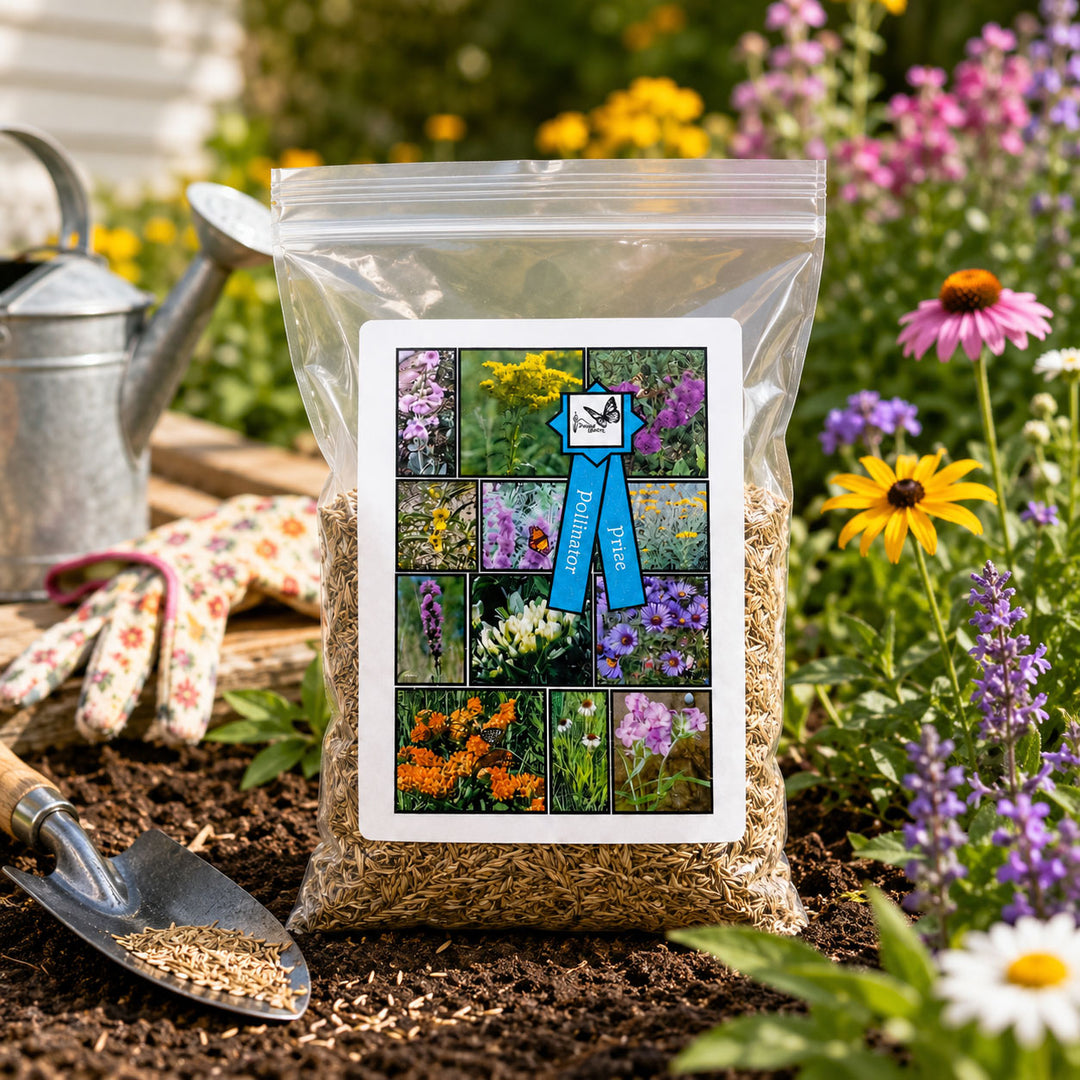
purchase flower seeds Pollinator Prize Native Nebraska Flower Seed Mix | 2.03 ozAll seeds are packaged with born on dates based on the year of purchase. Product images are for reference only and may not reflect the exact packaging, label details, or born on date of the item received. The Pollinator Prize Seed Mix is one of our most diverse native wildflower blends, featuring more than 65 species selected for their exceptional value to pollinating insects. Developed using species recognized by both the Natural Resources
All seeds are packaged with born-on dates based on the year of purchase. Product images are for reference only and may not reflect the exact packaging, label details, or born-on date of the item received.
The Pollinator Prize Seed Mix is one of our most diverse native wildflower blends, featuring more than 65 species selected for their exceptional value to pollinating insects. Developed using species recognized by both the Natural Resources Conservation Service (NRCS) and the Xerces Society, this mix contains plants rated as having high or very high pollinator value.
With blooms spanning from early spring through late fall, this mix provides a continuous source of nectar and pollen throughout the growing season. The blend includes a wide variety of native wildflowers, including several uncommon species, creating a vibrant and ecologically rich habitat for bees, butterflies, moths, and other beneficial pollinators.
Some species will germinate and bloom during the first growing season, while others may require additional time to establish. Patience is essential when creating a native pollinator planting, with optimum establishment typically occurring within two to three years.
This mix contains approximately 160 seeds per square foot, providing twice the recommended broadcast seeding rate for quicker and denser establishment. Minimum seeding rates are 40 seeds per square foot when drilling and 80 seeds per square foot when broadcasting.
Key Features:
- Contains 65+ native species of high or very high pollinator value
- Based on NRCS and Xerces Society pollinator plant recommendations
- Bloom period from early spring through late fall
- Includes a greater number of uncommon native species
- Supports a wide diversity of pollinators and beneficial insects
- Optimum establishment typically occurs within 2–3 years
Coverage: Up to 500 Square Feet
Seeding Density: Approximately 160 Seeds per Square Foot
Disclaimer: While every effort is made to include the species listed, substitutions of comparable native species may be necessary due to seed availability.
| Common Name | Scientific Name | % by Weight |
|---|---|---|
| sideoats grama | Bouteloua curtipendula | 24.92 |
| showy partridge-pea | Chamaecrista fasciculata | 9.97 |
| blue grama | Bouteloua gracilis | 6.23 |
| Virginia wild-rye | Elymus virginicus | 6.23 |
| easter white prairie-clover | Dalea candida | 4.98 |
| Canada milk-vetch | Astragalus canadensis | 3.74 |
| purple prairie-clover | Dalea purpurea | 3.74 |
| tall dropseed | Sporobolus compositus | 2.49 |
| Slimflower scurfpea | Pediomelum tenuifolium | 2.49 |
| gray-prairie-coneflower | Ratibida pinnata | 2.49 |
| pale purple coneflower | Echinacea pallida | 1.99 |
| hoary vervain | Verbena stricta | 1.50 |
| plains coreopsis | Coreopsis tinctoria | 1.25 |
| wild licorice | Glycyrrhiza lepidota | 1.25 |
| wild prairie rose | Rosa arkansana | 1.25 |
| narrow-leaf coneflower | Echinacea angustifolia | 1.06 |
| purple poppymallow | Callirhoe involucrata | 1.00 |
| New Jersey tea | Ceanothus americanus | 1.00 |
| redroot New Jersey tea | Ceanothus herbaceus | 1.00 |
| sawtooth sunflower | Helianthus grosseserratus | 1.00 |
| sensitive brier | Mimosa nuttallii | 1.00 |
| cobaea penstemon | Penstemon cobaea | 1.00 |
| pitcher sage | Salvia azurea | 1.00 |
| rosinweed | Silphium integrifolium | 1.00 |
| western ironweed | Vernonia baldwinii | 1.00 |
| tall boneset | Eupatorium altissimum | 0.87 |
| Lemon beebalm | Monarda citriodora | 0.78 |
| Sullivant's milkweed | Asclepias sullivantii | 0.75 |
| butterfly milkweed | Asclepias tuberosa | 0.75 |
| Canada tick-clover | Desmodium canadense | 0.75 |
| rough gayfeather | Liatris aspera | 0.75 |
| wild-bergamot | Monarda fistulosa | 0.75 |
| long-beak sedge | Carex sprengelii | 0.62 |
| purple lovegrass | Eragrostis spectabilis | 0.62 |
| Junegrass | Koeleria macrantha | 0.62 |
| spider milkweed | Asclepias viridis | 0.62 |
| thick-spike gayfeather | Liatris pycnostachya | 0.62 |
| false boneset | Brickellia eupatorioides | 0.50 |
| Illinois tick-clover | Desmodium illinoense | 0.50 |
| dotted gayfeather | Liatris punctata | 0.50 |
| shell-leaf penstemon | Penstemon grandiflorus | 0.50 |
| tube penstemon | Penstemon tubaeflorus | 0.50 |
| prairie phlox | Phlox pilosa | 0.50 |
| American germander | Teucrium canadense | 0.50 |
| western spiderwort | Tradescantia bracteata | 0.37 |
| Missouri goldenrod | Solidago missouriensis | 0.31 |
| candle anemone | Anemone cylindrica | 0.25 |
| Joe Pye weed | Eutrochium purpureum | 0.25 |
| Virginia mountain mint | Pycnanthemum virginianum | 0.25 |
| New England aster | Symphyotrichum novae-angliae | 0.25 |
| grey goldenrod | Solidago nemoralis | 0.20 |
| showy-wand goldenrod | Solidago speciosa | 0.20 |
| bushy seedbox | Ludwigia alternifolia | 0.15 |
| meadow anemone | Anemone canadensis | 0.12 |
| ground-plum | Astragalus crassicarpus | 0.12 |
| tall cinquefoil | Drymocallis arguta | 0.12 |
| Curly cup gumweed | Grindelia squarrosa | 0.12 |
| everlasting | Pseudognaphalium obtusifolium | 0.12 |
| heath aster | Symphyotrichum ericoides | 0.12 |
| silky aster | Symphyotrichum sericeum | 0.12 |
| plains wild indigo | Baptisia leucophaea | 0.10 |
| Culver's root | Veronicastrum virginicum | 0.10 |
| golden alexander | Zizia aurea | 0.10 |
| plains evening primrose | Oenothera serrulatus | 0.06 |
Prairie Legacy dedicated to preserving and restoring native plant communities through exceptional botanical and environmental consulting services. Owner Kay Kottas has provided botanical education for more than 20 years, leaving a lasting legacy through university teaching, research projects, and professional collaboration with public and private agencies. Through Prairie Legacy Inc., Kay shares her deep expertise in native plants with clients and communities alike. Based in Western, Nebraska.
Shipping Notes
- Free Standard Shipping on $100+ Orders to the USA.
- Except Preorder products are shipped in 48 hours.
- Delivery to the USA:
- Standard Shipping : 3-10 business days
- If time is of the essence, please consider selecting expedited delivery for faster service.
Exchange/Return Notes
- We offer a 30-day return/exchange service after receiving.
- Final sale items are not eligible for returns or exchanges.
- To process your return/exchange, please contact us at [email protected]
- Please click here for more details>>> Return & Exchange Policy