Pay in installments of $5.59 with
 ,
,
 and
and

Shipping Estimate
USA
- USA
- CAN
- USA
- CAN
Ships within 48 hours · Estimated delivery Sep 10 - Sep 15
 Promo Codes Available:
For Your Every Summer RSVP, with Code: SUMMER15
Description
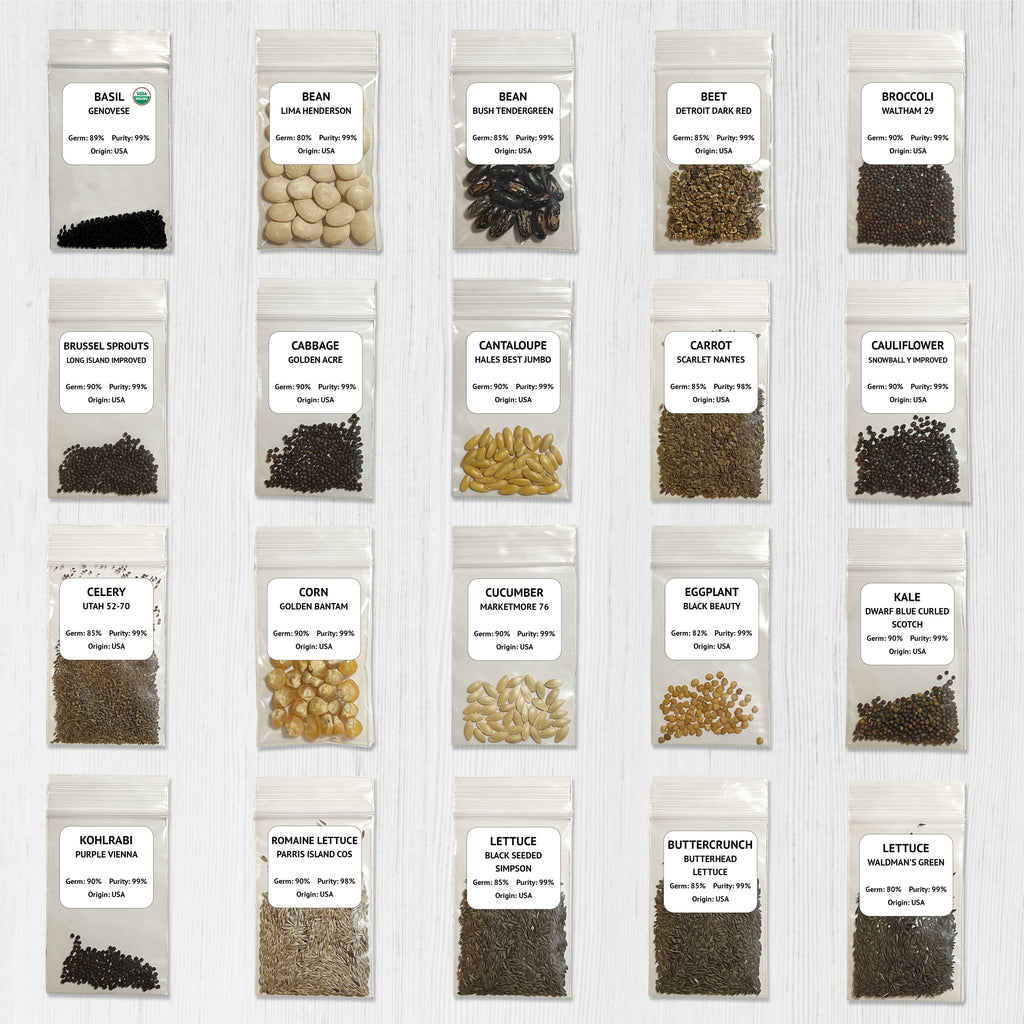
seed garden kit Heirloom Vegetable Seeds Survival Garden KitThis could be one of the best seed collection, best value for your garden! 39 Heirloom Varieties, High Germination rates. 100% USA Sourced, Non GMO, Heirloom Seeds for Planting Vegetables, Fruits & Herb. Top Quality You Can TrustOver 18,000 seeds, including 39 varieties: Basil (Genovese) 400 seedsBean (Lima Henderson) 25 seedsBean (Bush Tendergreen) 20 seedsBeet (Detroit Dark Red) 150Broccoli (Waltham 29) 500 seedsBrussels Sprouts (Long Island
This could be one of the best seed collection, best value for your garden! 39 Heirloom Varieties, High Germination rates.100% USA Sourced, Non-GMO, Heirloom Seeds for Planting Vegetables, Fruits & Herb. Top Quality You Can Trust
Over 18,000 seeds, including 39 varieties:
Basil (Genovese) - 400 seeds
Bean (Lima Henderson) - 25 seeds
Bean (Bush Tendergreen) - 20 seeds
Beet (Detroit Dark Red) - 150
Broccoli (Waltham 29) - 500 seeds
Brussels Sprouts (Long Island Improved) - 300 seeds
Cabbage (Golden Acre) - 300 seeds
Cantaloupe (Hales Best Jumbo) - 45 seeds
Carrot (Scarlet Nantes) - 1200 seeds
Cauliflower (Snowball Y Improved) - 320 seeds
Celery (Utah 52-70) - 3164 seeds
Corn (Golden Bantam) - 30 seeds
Cucumber (Marketmore 76) - 40 seeds
Eggplant (Black Beauty) - 100 seeds
Kale (Dwarf Blue Curled Scotch) - 300 seeds
Kohlrabi (Purple Vienna) - 200 seeds
Lettuce (Parris Island Cos Romaine) - 2200 seeds
Lettuce (Black Seeded Simpson Leaf) - 2000 seeds
Lettuce (Buttercrunch Butterhead) - 2000 seeds
Lettuce (Waldmann's Green Leaf) - 1400 seeds
Okra (Clemson Spineless) - 56 seeds
Onion (Evergreen Long White Bunching) - 200 seeds
Parsnip (All American) - 300 seeds
Pea (Sugar Daddy Snap) - 25 seeds
Parsley (Giant of Italy) - 500 seeds
Bell Pepper (Sweet California Wonder) - 100 seeds
Pumpkin (Sugar Pie) - 18 seeds
Radish (Cherry Belle) - 200 seeds
Radish (French Breakfast) - 200 seeds
Spinach (Bloomsdale) - 200 seeds
Sunflower (Mammoth) - 25 seeds
Swiss Chard (Fordhook Giant) - 100 seeds
Tarragon (Russian) - 500 seeds
Tomato (Roma VF) - 100 seeds
Tomato (Large Red Cherry) - 100 seeds
Turnip (Purple Top White Globe) - 600 seeds
Watermelon (Sugar Baby) - 45 seeds
Winter Squash (Waltham Butternut) - 32 seeds
Zucchini (Black Beauty) - 25 seeds
OUTSTANDING MEANINGFUL GIFT - for couples, vegetarians, vegans, gardeners, house survivalists, and people looking for a new hobby or trying something new. It can be used for various occasions - housewarming, babyshower, birthday, anniversary gift, and more.
EASY TO GROW & HIGH YIELD - Each packet in our seeds variety pack has its own label with a QR code for online growing instructions.
Shipping Notes
- Free Standard Shipping on $100+ Orders to the USA.
- Except Preorder products are shipped in 48 hours.
- Delivery to the USA:
- Standard Shipping : 3-10 business days
- If time is of the essence, please consider selecting expedited delivery for faster service.
Exchange/Return Notes
- We offer a 30-day return/exchange service after receiving.
- Final sale items are not eligible for returns or exchanges.
- To process your return/exchange, please contact us at [email protected]
- Please click here for more details>>> Return & Exchange Policy
4.8 ★★★★★
Based on 5 reviews
Sort
Product Reviews
★★★★★ 4
Grumpy Sunshine, Small Town Romance
Format: Kindle
ARC Review 3.75 ⭐️, rounded up to 4 ⭐️’s.
I really enjoyed the book and think the author did a good job of drawing her readers into this couple’s world. The characters were complex, but well developed. Even the side characters were amazing. The setting of the story was well thought out and came to life on the pages. There were definitely some plot twists that I didn’t see coming, and some that were anticipated, but with the way they were timed I was still shocked when it happened. And while this wasn’t the spiciest book I’ve ever read, the spice was definitely there. When it hit, it hit hard!
Overall, I really enjoyed Evie and Maddox’s story. There were some things that seemed repetitive and that could’ve flowed better for me, and there were errors that a good editor should have caught. I definitely look forward to more books from this author though and am thankful for the opportunity to ARC read this book.
This is a book you definitely want to check the trigger warnings before starting. It is packed with trauma and subjects that could be difficult for some readers.
Tropes in this book include:
Grumpy/Sunshine
Small Town Romance
Curvy Single Mom FMC
Broody Hermit MMC
He Falls First
Touch Her & ☠️
Previous DV and offscreen SA
PTSD rep
WAS THIS REVIEW HELPFUL?YesReportShare
Reviewed in the United States on March 31, 2025
★★★★★ 5
Instantly Needed More...
Format: Kindle
Tuesday James... lord have MERCY!! I cannot believe this was your first book, to think that you are just getting started terrifies me and leaves me on the edge of my seat! The absolute chokehold that this book has had on me... cannot be put into words.
I waited for this book to be released. I saw teaser reels on IG and saved it on my TBR and patiently waited. The moment it became available I DEVOURED it! I read it in one day, and it is definitely in my top favorites of all time and I read a lot. I love a romance book that has a deeper, twisty, trauma filled plot. I like a book about people some would call damaged, (with jagged edges 😉) that have tons of baggage and are an ever evolving work in progress.
Maddox and Evie had me from the jump. I have a soft spot for victims of domestic violence and all other forms of abuse as I grew up in a similar environment and when I say that this book captured and represented victims of DV beautifully, I mean it with my whole chest. I saw so many similarities in Evie that I could relate to and how she didn't want to be saved she wanted someone to stand beside her... and boy oh boy was that Maddox Wilder! Maddox is haunted by his own ghosts and after meeting Evie they bond over their pasts and push each other to be better. Evie is the definition of a single mom doing the very best that she can, and I loved every second of sweetness Tuesday shared of her adorable twin boys. I found myself thinking several times, I want to be in Evie and Louisiana's friend circle.
This book is angsty, full of funny banter, suspenseful, filled with little boy cuteness/silliness and full of all the steamy good parts. Definitely read the trigger warnings, as it explores darker themes and may not be for everyone. For me this one was a 12 out of 10 and Tuesday James will be an automatic read for me. Do not even get me started on my anticipation for Mr. Mercy Wilder because do not have words. I also CANNOT WAIT for Louisiana's book, I fell in love with her instantly.
Do yourself a favor and read this book, it had all the things. And Tuesday, please do us all favor and keep writing books like this one that embed in my brain and I cannot stop thinking about!!
Tropes:
🖤 MMC with a Dirty Mouth
💖 Grumpy Neighbor
🖤 Possessive
💖 Single Mom (On the Run)
🖤 Trauma Bonding
💖 Curvy FMC
🖤 Found Family
💖 He Falls First (less)
@ashleyheartsbooks
WAS THIS REVIEW HELPFUL?YesReportShare
Reviewed in the United States on April 10, 2025
★★★★★ 4
Evie and Maddox
Format: Kindle
Please check trigger warnings before diving in.
This book was an emotional rollercoaster in the best way. Tuesday James did an incredible job crafting a story that flowed effortlessly while packing a serious emotional punch. The found family dynamic hit me right in the feels, and the backstories? Heart-wrenching. Evie and Maddox have been through so much—it’s impossible not to root for them. Their healing journey isn’t easy, but the way they lean on each other makes every struggle worth it.
The side characters were fantastic, bringing warmth, friendship, and that cozy found-family vibe. And Evie’s twin boys? Absolutely adored them. Their bond with Maddox was heart-melting. Speaking of Maddox—his growth was chef’s kiss. He starts off as a broken man, using anger as a shield, but Evie cracks through that armor, bringing light back into his life. Not gonna lie, he irked me around the halfway mark, but once his backstory unfolds, you get it. Was he right? No. But he’s trying, learning, and making up for past mistakes, and I love that. Also, that man and his filthy mouth? Devoured this book the same way he devoured Evie.
And Evie? Absolute powerhouse. She’s been through hell but never let her storm touch her babies. Watching her be the best mom while fighting for her own happiness was everything.
I’m beyond excited for the next book because if this one is anything to go by, it’s going to be so good.
What to Expect:
❤️ Grumpy x Sunshine
🖤Hurt/Comfort
❤️ "Pretty girl"
🖤 Height Difference
❤️ Plus-Size FMC
🖤Single Mom on the Run
❤️ FMC with Physical Scars
🖤Trauma
❤️ Banter
🖤MMC in Glasses
❤️ Who did this to you?
🖤Dark Small-Town Romance
❤️ Found Family
Thank you to Tuesday James, the author, and the Author Agency team for the ARC opportunity!
WAS THIS REVIEW HELPFUL?YesReportShare
Reviewed in the United States on March 31, 2025
★★★★★ 5
Obsessed. Destroyed. Healed. Tuesday James’ debut is everything.
Format: Kindle
4.5
These Jagged Edges by Tuesday James is the debut that grabs your heart, gives it a squeeze, and then stitches it back together, one broken piece at a time.
Meet Evie: fierce, no-nonsense, and a single mom who’s escaped her traumatic past but still carries the weight of it. Enter Maddox Wilder: broody, broken, emotionally unavailable—everything Evie should avoid. She’s everything he thinks he can’t have. But of course, they can’t stay away.
This book? Pure emotional chaos—and I am HERE for it. Evie’s journey as a mother, survivor, and woman finding her way back to love? Breathtaking. And Maddox? Oh, honey. He’s the broody, big-hearted hero that makes you scream, "Let me love you!" The chemistry? Electric. The tension? Off. The. Charts. The spice? Don’t even get me started.
The side characters? OBSESSED. Mercy is the flirty golden retriever we all need, Vic will steal your heart, and the twins? Pure joy. This book isn’t just a romance; it’s a found family story that will make you laugh, cry, and want to hug every single character.
Tuesday, please don’t make me wait too long for Lou or Mercy's stories. I’m begging you.
The writing? Lyrical, gut-punching, and beautifully raw. Every single moment will hit you. If you love grumpy-sunshine, second chances, and emotional healing that’s messy, imperfect, and oh-so-satisfying, this is a must-read.
Read it. Cry. Hug your loved ones. Then DM me so we can scream about Maddox Wilder together.
WAS THIS REVIEW HELPFUL?YesReportShare
Reviewed in the United States on June 30, 2025
★★★★★ 3
Awesome story but…
Format: Kindle
The first half of the book needs a lot of editing. Normally I wouldn’t mind but there were a lot of mistakes.
If you take that out of the equation, it’s a solid 4. But this as it is for me is a 3.5
The story is somewhat unique and it brought emotions in the second part.
WAS THIS REVIEW HELPFUL?YesReportShare
Reviewed in the United States on April 5, 2025