SKU: 13218559675
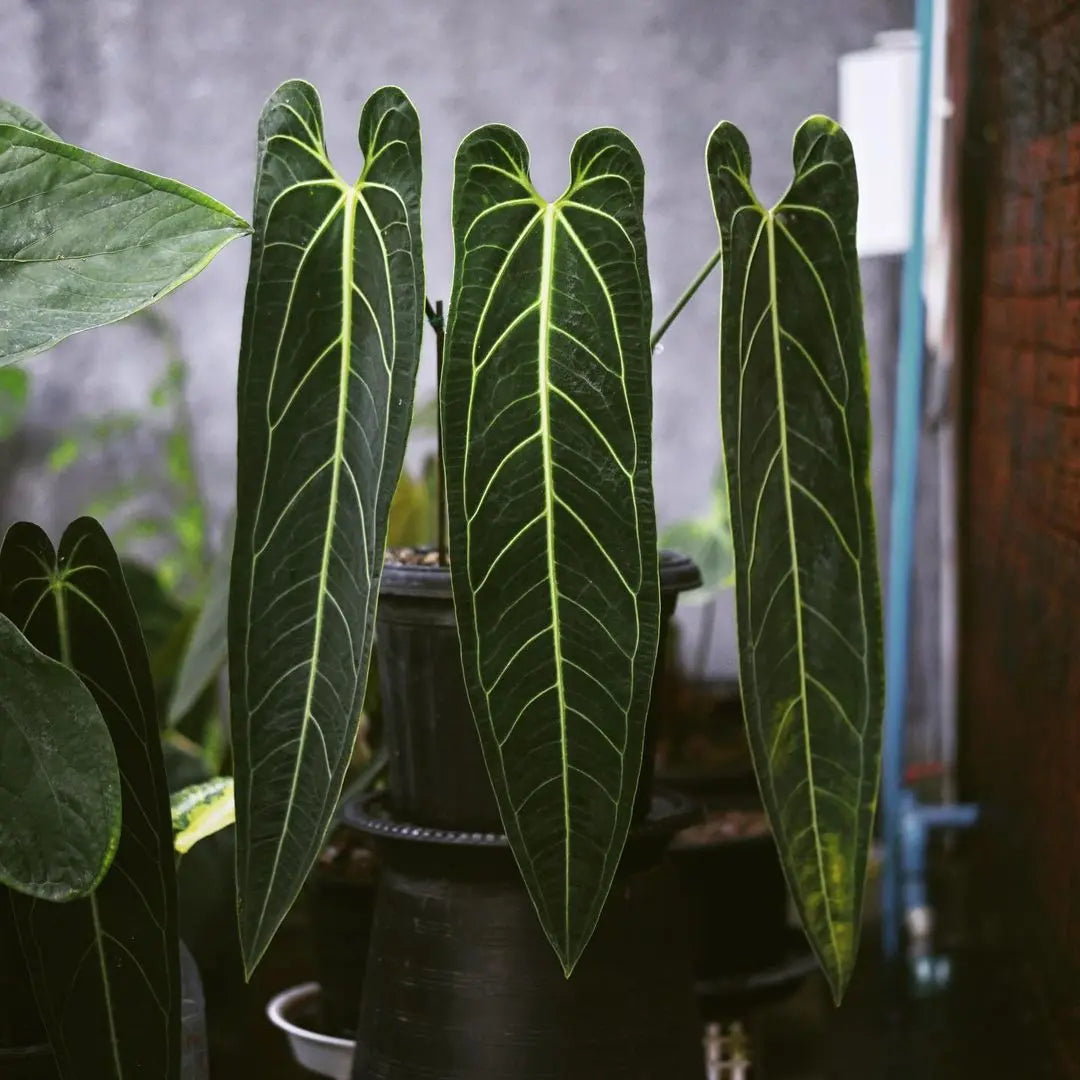
anthurium warocqueanum dark form vs green

anthurium warocqueanum dark form vs green Anthurium Queen Warocqueanum 'Dark Narrow' – Soiled

Sale price$18.59 Regular price$20.65
Save 10%

Pay in installments of $5.16 with ShopPay, AfterPay and Klarna

Shipping Estimate
USA
  • USA
  • CAN

Ships within 48 hours · Estimated delivery Oct 10 - Oct 15

Promo Codes Available:

For Your Every Summer RSVP, with Code: SUMMER15

Description

anthurium warocqueanum dark form vs green Anthurium Queen Warocqueanum 'Dark Narrow' – SoiledIf the Anthurium veitchii is the King, then Anthurium warocqueanum is unquestionably the Queen and the 'Dark Narrow' form is the Queen at her most regal. Native to the rainforests of Colombia and named to honour Belgian industrialist and plant collector M. Warocqu, this epiphytic aroid produces pendant, velvety leaves that hang downward in long, narrow arcs reaching 90120 cm at maturity deep near black green in colour, each one traced with a fine

If the Anthurium veitchii is the King, then Anthurium warocqueanum is unquestionably the Queen — and the 'Dark Narrow' form is the Queen at her most regal. Native to the rainforests of Colombia and named to honour Belgian industrialist and plant collector M. Warocqué, this epiphytic aroid produces pendant, velvety leaves that hang downward in long, narrow arcs — reaching 90–120 cm at maturity — deep near-black-green in colour, each one traced with a fine network of silver-white veins that gleam against the dark surface like threads of light through silk. The 'Dark Narrow' designation refers to the collector-selected ecotype with the deepest, most saturated leaf colour, narrower and more elongated leaf form, and fewer but more dramatically defined veins compared to the broader, greener standard form. A member of the Cardiolonchium section — the velvet-leaved royalty of the Anthurium genus — it is one of the most coveted aroids in the world.

💡 The Leaf Count Rule — How to Know If Your Queen Is Happy Unlike most plants where the health metric is new growth, the Queen Anthurium is measured differently: a thriving plant retains all its existing leaves and adds new ones on top. A stressed plant drops one older leaf for every new one it produces — staying permanently at the same leaf count no matter how long you wait. A healthy, well-established specimen can hold 6–8 leaves simultaneously. If your plant is cycling leaves rather than accumulating them, review light, humidity, temperature, and watering simultaneously — all four factors together determine her happiness.
⚠️ Do Not Let Water Sit on the Velvety Leaves The thick, velvety surface of the leaves is beautiful but vulnerable. Water sitting on the leaf surface — from misting, overhead watering, or condensation — creates ideal conditions for bacterial leaf spot: brown circles with a yellow halo, which spread rapidly and are permanent. Never mist the leaves directly. Use a humidifier to maintain humidity, ensure strong air circulation around the foliage at all times, and water at the base only.
☀️

Light

▾

Bright indirect light — 6–8 hours daily, but never direct sun. An east-facing window or 1–2 m from a filtered south-facing window is ideal. The 'Dark Narrow' form's deep colouration is most vivid in bright indirect light — in lower light leaves trend greener and growth slows significantly. A quality grow light at 12–14 hours is an excellent solution and produces some of the most impressive leaf development. No morning or late evening direct sun on the velvety surface — even gentle direct sun scorches the leaves.

💧

Watering

▾

Keep the substrate barely moist — allow the top 3–4 cm to approach dryness, then water thoroughly. In chunky mix this means checking every 5–7 days. The roots need excellent airflow and will rot rapidly in saturated substrate. Use filtered or rainwater at room temperature. Never let the pot sit in standing water. Reduce slightly in winter but never allow to fully dry. This is a heavier drinker than most aroids — do not underwater.

💦

Humidity

▾

70–85% — the single most critical factor for sustained health and long leaf development. A humidifier running nearby is strongly recommended. Crucially, pair high humidity with good air circulation — stagnant humid air is as damaging as dry air. A gentle fan on low, directed away from the plant but circulating the room, provides the airflow the leaves need. Never mist directly onto the velvety surface.

🌱

Growing Media

▾

Chunky, extremely well-aerated epiphytic mix — 40% orchid bark, 30% perlite, 20% sphagnum moss, 10% coco coir. Or 100% sphagnum moss kept barely moist. pH 5.5–6.5. Shallow wide pot or hanging basket. The entire stem can be packed in damp sphagnum to encourage aerial root development along its length. Repot every 2 years in spring — do not disturb roots unnecessarily. Can also be grown on an epiphytic mount.

🌾

Feeding

▾

A heavy feeder compared to most aroids — balanced liquid fertilizer at half strength every 3–4 weeks in spring and summer. An extended-release fertilizer applied at half label strength every 3 months is an excellent low-maintenance alternative. Apply only to moist substrate. Flush thoroughly every 2–3 months to prevent salt build-up. Stop feeding in winter.

🌿 Supporting Long Mature Leaves As leaves reach 60–120 cm they become heavy and may droop or kink at the petiole — which can damage the leaf permanently. Gently stake mature leaves with a soft tie to a bamboo cane or hang the plant where leaves can drape freely without obstruction. The pendant form is natural; what to prevent is the leaf bending or folding against itself under its own weight.
⚠️ Common Issues & Quick Fixes

Dropping One Leaf for Every New One — No Progress

▾

The Queen's distress signal. Review all four factors simultaneously: light (too low?), humidity (below 70%?), temperature (below 20°C at night?), and watering (inconsistent?). Usually one is the culprit — improve all four and the cycle breaks within 1–2 leaf cycles. Do not repot during this phase; root disturbance compounds stress.

Brown Circles with Yellow Halo on Leaves

▾

Bacterial leaf spot — caused by water sitting on the velvety leaf surface. Remove affected leaves with clean scissors. Improve air circulation immediately, stop all misting, and ensure humidity comes from a humidifier rather than direct water. Existing spots are permanent; new growth will be clean in improved conditions.

Brown Crispy Leaf Tips or Edges

▾

Low humidity, proximity to an AC vent or fan, or underwatering. Boost humidity to 70%+, move away from drying air sources, and check that the substrate is not drying out fully between waterings. Trim existing brown tips neatly — they will not recover.

Leaves Getting Greener, Less Dark

▾

The 'Dark Narrow' colouration deepens in bright indirect light and diminishes in low light. Move to a brighter position or add a grow light. The deep near-black-green is most vivid at the right light level — too little and the leaves trend olive-green; too much direct sun and they bleach.

Root Rot — Yellow Leaves, Soft Stem Base

▾

Overwatering or substrate staying saturated too long. Unpot immediately, trim all black and mushy roots with clean scissors, allow to air-dry for a few hours, then repot in fresh chunky mix. Water much less going forward — the roots need to breathe between waterings.

📋 Quick Plant Profile

Botanical Name Anthurium warocqueanum T.Moore 'Dark Narrow'
Named After M. Warocqué — Belgian industrialist and plant collector
Common Name Queen Anthurium — paired with A. veitchii, the King Anthurium
Section Cardiolonchium — the velvet-leaved group; includes A. crystallinum and A. magnificum
Family Araceae
Origin Colombia; epiphytic in tropical rainforest
'Dark Narrow' Form Near-black-green colouration; narrow elongated leaves; fewer but more defined silver veins vs. standard form
Mature Leaf Length 90–120 cm; pendant, hanging downward; cardboard-thick and velvety
Health Metric Leaf count accumulates on a happy plant; cycling (losing one per new one) = distress signal
Light Bright indirect; 6–8 hours; grow light excellent; no direct sun
Watering Top 3–4 cm approaching dry; filtered water; heavier drinker than most aroids; no standing water
Humidity 70–85%; humidifier essential; strong air circulation alongside; never mist leaves directly
Temperature 20°C–30°C; cold-sensitive; nighttime minimum 18°C critical
Soil Chunky epiphytic mix or 100% sphagnum moss; pH 5.5–6.5; shallow wide pot or hanging basket
Feeding Heavy feeder — every 3–4 weeks in growing season; extended-release alternative every 3 months
Do Not Mist Water on velvety leaves causes bacterial leaf spot — use humidifier only
Ideal For Serious Collectors, Hanging Displays, Grow Tents, Bright Humid Rooms
Care Level Advanced — humidity, air circulation, and consistent warmth are the three pillars
Shipping Notes
  • Free Standard Shipping on $100+ Orders to the USA.
  • Except Preorder products are shipped in 48 hours.
  • Delivery to the USA:
  1. Standard Shipping : 3-10 business days
  • If time is of the essence, please consider selecting expedited delivery for faster service.
Exchange/Return Notes
  • We offer a 30-day return/exchange service after receiving.
  • Final sale items are not eligible for returns or exchanges.
  • To process your return/exchange, please contact us at [email protected]
  • Please click here for more details>>> Return & Exchange Policy
SKU: 13218559675

Discover Niche Categories That Outsell anthurium warocqueanum dark form vs green

Top-Converting Item to Boost Your Average Order

4.8 ★★★★★
Based on 11 reviews
Sort
Highest Rating
Newest First
Oldest First
Product Reviews
R
Verified Purchase
Richard Clark
Draper, US
★★★★★ 5
Wright is right
The fact Wright attacks popular concepts of progress is enough to merit five stars. Until 1955, when I was 25, I naively believed progress was inevitable, natural, and simply a part of human nature and society. I attended the Earl Lectures that year. Swiss Theologian Emil Brunner presented three addresses on "Faith, Hope, and Love" at Berkeley, California. Westminster Press published his series in a book given the same title. I shall quote a few remarks. Brunner traced the burgioning faith in progress to the nineteenth century, when "Darwin's theory of evolution seemed so to support and enlarge this optimistic evaluation of progress as to see it in a cosmic perspective." But the doctrine of progress is not the same as evolution. "Although this idea of progress had a success for which the word 'triumph' is hardly an exaggeration, there were warning voices raised against it, voices of men of weight and importance who were not willng to accept the new doctrine," he said. "It was a new doctrine because it was not known to antiquity, it was not known in the time of the Reformation, it was unknown in all Asiatic culture. It was a new thing! The idea of progress became an axiomatic conviction which needed no proof and could not be disproved." At one point, Brunner said, "Since Hiroshima the world does not believe in progress anymore." The end of WWII was still fresh in our memories, and I suppose that's why he said it. We know, today, that it didn't take long for much of the world to revive and renew its faith in progress. And now it's stronger--and more dangerous--than ever. I'm not opposed to every aspect of progress. Progress, when it moves in wholesome and healthy directions, is a blessing. I'm glad my dentist is able to fill--and save--my teeth without pain. And when it came time for my doctor to pull my cataracts and replace them with implanted lenses, I marveled at the miracle. It was a quick and painless operation, and now I have wonderful vision. It's that dogmatic idea of progress based on greed and cold indifference to global warming that concerns me. It's that ongoing waste of limited resources, whether they be animal, vegetable or mineral, that concerns me. We are pulling the carpet from beneath our feet, and the king is pulling hardest of all. And who is the king? Ignorance! Ignorance is king!
WAS THIS REVIEW HELPFUL?YesReportShare
Reviewed in the United States on September 21, 2008
K
Verified Purchase
Kevin S. Grail
Boise, US
★★★★★ 5
My favorite book, in any genre
Ronald Wright is an amazing scholar and writer. His style is fun and easy to read while delivering impeccable historical research. I have listed to this book several times over the years and I appreciate it more each time. I recommend the audio version more than the print version because of the compelling way Mr. Wright delivers this 4-Part lecture series to his audience (now in book form). Note to Amazon: Please make this book available on Audible, CDs are cumbersome.
WAS THIS REVIEW HELPFUL?YesReportShare
Reviewed in the United States on July 3, 2018
J
Verified Purchase
J. Edgar
Grantham, US
★★★★★ 4
How many trees do we have left?
In this book, the author takes a look at the downfall of civilizations. Yes, that's plural. There are several models of how civilization is progressing. One is that we're getting better and better as time goes by. Another, less popular one states that we are actually in decline, going down from some sort of golden age. You'll find many of these proponents in the old age homes and such. For them, the only disagreement is when we are declining from. Wright takes a look at the cyclical nature of the rise and fall of civilizations, taking examples from several once- prospering civilizations. This book stands as a call to action that something must be done to grow smartly and be careful on how we allocate the scant resources we have left. While he doesn't hit an anything new, this book's strength is its concise nature. The several examples are familiar and in that have more impact. The strongest example is one he visits several times to show an analogy of current times: Easter Island. This isolated speck in the Pacific was once a thriving mini-civilization with culture and art. And a lot of trees. These trees helped the islanders fish and raise their ceremonial head sculptures. However, these trees also were a poorly cultivated resource. Someone not too long ago cut down the last tree, and the island is now a wasteland and anthropological curiosity. We are doing the same thing. How many trees do we have left to cut?
WAS THIS REVIEW HELPFUL?YesReportShare
Reviewed in the United States on October 14, 2009
W
Verified Purchase
W Lorraine Watkins
West Palm Beach, US
★★★★★ 3
Good on Review Short on Direct Experience
It is an extensive review of the literature on rise and fall of civilizations with observations on our's. Extremely well footnoted and referenced it however suffers from the author appearing to have little direct primary experience in the study of his topic. Nonetheless there is good information here and substantiation of the notion that cultures come and go, frequently going as a result of the lack of capacity necessary to change group behavior in response to certain challenges. He presents compelling evidence that those overwhelming challenges often revolve around irrational and compulsive exploitation of natural resources. Sadly I share the author's pessimism in regard to our global culture being likely to respond adequately to the ongoing destruction of our livable earthly environment. I fear the planet is headed for a massive kill off in the disturbingly near future.
WAS THIS REVIEW HELPFUL?YesReportShare
Reviewed in the United States on April 13, 2013
P
Verified Purchase
phamv
Omaha, US
★★★★★ 5
I hate to be the kind of person preaching on Doom's ...
This is an impressive quick read. I hate to be the kind of person preaching on Doom's Day, but I do find the definition of progress to be a multi-faceted, direct correlation to humanity, or as this book challenges, inversely related. As Le Corbusier once stated in Towards a New Architecture, "[Progress is] the study of minute points pushed to its limits." I think that we forget that limits do exist. On a sustainability level, we seem to forget that growth is bound to a carrying capacity which is only a constant. We exceed limits in population, in wealth, in energy consumption, and we are doing so blindly because we believe we are progressing. This is the first that I heard the term "progress traps" (which I think Wright may have coined himself), and I believe we seem to fall under the impression that distilling or expanding our limitations is an ultimate form of progress, when in fact, its lack in sustainability will only push us back. If you have the time, it's a pretty quick and enlightening read. If you are still on the fence with the concepts discussed in the book, I recommend finding it at a local library before committing to buy. For me, I recommend it. Also, if you are interested, there is a documentary based on this book called "Surviving Progress" (2011). I prefer the book so much more, but the documentary wasn't that bad.
WAS THIS REVIEW HELPFUL?YesReportShare
Reviewed in the United States on August 29, 2015

recommand products