SKU: 14016995391
aloe vera plant price in india

aloe vera plant price in india Aloe Vera

Sale price$18.47 Regular price$20.52
Save 10%

Pay in installments of $5.13 with ShopPay, AfterPay and Klarna

Shipping Estimate
USA
  • USA
  • CAN

Ships within 48 hours · Estimated delivery Sep 10 - Sep 15

Promo Codes Available:

For Your Every Summer RSVP, with Code: SUMMER15

Description

aloe vera plant price in india Aloe VeraIntroducing the fabulous Aloe Vera plant also known as Aloe barbadensis 'miller,' it is also known as a medicinal aloe and burn plant. The Aloe vera plant is by far the most popular out of over 400 varieties of the Aloe genus. This incredible tropical succulent is not your average houseplant. It's a superstar known for its leaves, which hold a magical aloe vera gel for soothing sunburn and as a popular drink to help your stomach. This large Aloe vera

Introducing the fabulous Aloe Vera plant- also known as Aloe barbadensis 'miller,' it is also known as a medicinal aloe and burn plant. The Aloe vera plant is by far the most popular out of over 400 varieties of the Aloe genus.

This incredible tropical succulent is not your average houseplant. It's a superstar known for its leaves, which hold a magical aloe vera gel for soothing sunburn and as a popular drink to help your stomach.

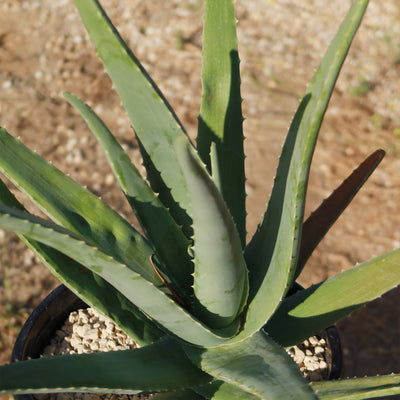
This large Aloe vera plant boasts fleshy lance-shaped grey-green leaves with small white teeth along the edges growing out from a starfish-like basal rosette. 

The edible aloe vera flowers burst into bloom in vibrant shades of yellow at the tips of their stalks when given favorable conditions. Only mature plants will yield flowers, so you'll have to wait at least four years to see an aloe vera bloom. However, in some growing conditions (especially hybrid plants), the flowers can sometimes appear with orange or reddish hues. 

This fast-growing succulent can grow into a large aloe vera plant up to 3 feet tall and 2 feet wide and even produce adorable pups that you can repot or share as delightful gifts with fellow plant enthusiasts.

How to Get Aloe Vera Gel from the plant to use on your skin

  1. Choose and Cut a Leaf: Select a large, healthy leaf from the bottom of the plant. Use a sharp knife to cut the entire leaf off at the base.
  2. Prepare the Leaf: Let the leaf sit upright in a container for 10–15 minutes to allow the yellow sap (aloin) to drain out. This sap can be irritating to the skin.
  3. Slice and Extract the Gel: For a small amount of gel, cut a section from the leaf rather than using the whole thing. Slice the leaf lengthwise to expose the gel. Use a spoon or knife to scoop out the clear gel.
  4. Apply or Store: Apply directly to your skin for soothing relief. Store extra gel in an airtight container in the fridge for a few days.

Aloe vera juice has many benefits for humans, this succulent rich in antibacterial, antioxidant, and anti-inflammatory properties, may enhance digestion, blood sugar levels, and oral health, although certain compounds, particularly aloin, may cause digestive discomfort and other side effects.

An aloe vera indoor plant is a great addition to any home, as it is easy to aloe vera care for and provides a variety of aloe vera benefits. 

According to the American Academy of Dermatology, Aloe vera has anti-inflammatory properties that can help in wound healing. It can also help to moisturize the skin and prevent peeling.

When and How to Water Your Aloe Vera 

As a desert dweller, watering the aloe vera succulent may be tricky, it may shrivel and die if given too little water, but it may also easily rot when given excessive water. So be careful not to overwater your aloe plantyou only want to give it enough to keep it from drying out completely, not drown it! 

A good rule of thumb is to water the Aloe plants deeply and then allow the soil to dry out completely before watering again. In the spring and summer, during the growing season, watering can be done once every 2-3 weeks.

During the winter months, when aloe vera is in a dormant period, it can be watered even less frequently. If you live in a rainy climate, consider planting aloe in gravel or stones. 

It is also important to note that aloe vera plants are sensitive to water quality. They prefer water that is low in minerals and salts, so it is best to use distilled or filtered water. Tap water can be used, but it should be left out for 24 hours before watering the plant to allow the chlorine to evaporate.

Light Requirements - Where to Place Your Aloe Vera Plant 

When growing indoors as a houseplant, place the aloe vera a few feet away from the south-facing window that receives plenty of sunlight, but it is important to avoid direct sunlight, as this can cause the leaves to burn. If the aloe plant is not receiving enough light, the leaves will start to droop and turn brown. In this case, it may be necessary to move the aloe vera plant to a brighter location. 

When planted outdoors, your Aloe plants need their daily dose of sunshine like a beach-loving teenager needs their favorite tunes!

They thrive on at least 6 to 8 hours of direct sunlight, soaking up those glorious rays with joy.

But wait, before you go dragging your aloe plant from its cozy shady spot into the blazing sun, be cautious. That sudden move can dry out your leafy buddy and leave it looking as yellow as a lemon.  

Now imagine you live in one of those cooler climates where clouds have permanent residency or if your home lacks these sunny windows altogether.

Fear not; you can use artificial lights – they're like little suns in bulb form! Hang them about one to two feet above your precious plant during daylight hours (that's roughly 16 hours per day) and watch it flourish happily amidst dim interiors.

Optimal Soil & Fertilizer Needs 

Aloe vera plants prefer well-draining soil that is a mixture of sand, perlite, and peat moss. It is critical to avoid soil that retains excessive moisture, as this can cause root rot. Instead, make or buy a well-draining potting mix, or ideally use our specialized succulent potting mix soil for aloe vera that contains 5 natural substrates and mycorrhizae to promote the development of a strong root system that helps your succulent to thrive.  

In terms of fertilizer, aloe succulents do not require a lot of nutrients. They can be fertilized once a year in the spring with a balanced fertilizer (NPK) of 5-10-5 in ratio. It is important not to over-fertilize the aloe plant, as this can lead to root burn. 

Hardiness Zones & More 

When grown indoors as a houseplant, aloe vera plants prefer a warm and dry environment. They thrive in temperatures between 60°F and 80°F. Aloe vera is a succulent, so it's adapted to arid conditions and doesn't do well in overly humid environments. Aim for a humidity level of around 30% to 40% for your indoor aloe vera plant.

In the United States, this is mostly an indoor plant, but if you live in southern Florida or Hawaii then you can cultivate it outdoors in USDA zones 9-11

Aloe vera can tolerate temperatures as low as 40°F for short periods, but prolonged exposure to freezing temperatures can damage or kill the plant. If you live in a colder climate, it's best to keep your aloe vera indoors or provide protection during winter months.

Aloe vera plants prefer dry air and do not require high levels of humidity. They can tolerate low humidity levels and do not need to be misted or placed in a humid environment. 

Wildlife - Aloe Vera Attracts the Following Friendly Pollinators

Aloe vera plants attract a variety of friendly pollinators, including bees, butterflies, and hummingbirds. These pollinators are essential for the reproduction of aloe vera plants, as they help transfer pollen between flowers, ultimately leading to the production of seeds. Additionally, these pollinators play a crucial role in maintaining biodiversity and ecosystem health.

Butterflies
Bees
Hummingbirds
Lady Bugs
Multi Pollinators
Other Birds

According to the ASPCA, the Aloe vera can be mildly toxic to pets and humans. It is rare but can occur if consumed in large quantities and can cause abdominal cramps, diarrhea, and electrolyte imbalances. It is important to consult a healthcare professional if you experience any adverse effects from consuming aloe vera.

How to Propagate Your Aloe Vera Plant

To propagate your aloe vera plant, you can separate the offsets or "pups" that grow at the base of the main plant. Gently remove these pups and plant them in their own pots with well-draining soil to encourage root growth. Water sparingly until they establish themselves, and place them in a sunny spot to promote healthy growth.

Aloe Vera: The Natural Sunburn Remedy


Aloe vera gel is known for its ability to moisturize the skin, it helps soothe burns and sunburns, as well as being known for its anti-inflammatory and antibacterial properties.

Aloe Vera is also rich in vitamins and minerals that are essential for healthy skin. It is best to use pure aloe gel extracted directly from an aloe vera plant.

To use aloe vera gel to soothe sunburns, cut off a piece of the large aloe vera leaf and open it to reveal the gel.

To maintain the aesthetic appeal of your aloe plant, it is advisable to cut off the entire leaf of the large aloe vera plant when cutting one. Just chop the leaf off as close to the main stem as you can. Cutting leaves from the base of the plant is always preferable. These leaves will be thicker since they are older. If you cut off the tip of a leaf, it will eventually turn brown at the tip because cut leaves keep their scars.

Key Takeaways

  1. Aloe vera is renowned for its medicinal properties, particularly its soothing gel, which is widely used for treating burns, wounds, and skin irritations. Its natural compounds, like aloin and acemannan, have anti-inflammatory and healing properties.
  2. When cut, aloe vera can seal its own wounds by producing protective latex, showcasing its remarkable survival mechanism in harsh environments.
  3. Aloe vera is not just a skincare savior; it also purifies indoor air by removing harmful pollutants like formaldehyde and benzene, making it a great addition to homes and offices.
  4. Native to arid regions, aloe vera thrives in minimal water conditions. It stores water in its thick, fleshy leaves, allowing it to endure prolonged droughts.
  5. The inner gel of aloe vera leaves is edible and used in drinks and food for its health benefits, such as aiding digestion, boosting immunity, and providing hydration. Always ensure proper preparation to remove any bitter or toxic compounds.
  6. The presence of yellow flower buds is a strong indicator of the edible variety.

The Bottom Line

Overall, Aloe vera is a popular plant known for its healing properties and versatility. It has gained popularity for its ability to help heal wounds, cuts, and burns, including sunburns. The gel inside the aloe vera leaves contains soothing and moisturizing properties that can provide relief and promote healing. In terms of care, aloe vera is relatively low-maintenance. It thrives in well-draining soil and requires moderate watering. It prefers bright, indirect sunlight but can tolerate some shade. 

A lot of people have a hard time finding large aloe vera plants, but here at Planet Desert, we regularly have large sizes in stock. Don't miss out on adding an Aloe vera plant for sale to your garden! Order now and enjoy its beauty for years to come. 

Shipping Notes
  • Free Standard Shipping on $100+ Orders to the USA.
  • Except Preorder products are shipped in 48 hours.
  • Delivery to the USA:
  1. Standard Shipping : 3-10 business days
  • If time is of the essence, please consider selecting expedited delivery for faster service.
Exchange/Return Notes
  • We offer a 30-day return/exchange service after receiving.
  • Final sale items are not eligible for returns or exchanges.
  • To process your return/exchange, please contact us at [email protected]
  • Please click here for more details>>> Return & Exchange Policy
SKU: 14016995391

Discover Niche Categories That Outsell aloe vera plant price in india

Top-Converting Item to Boost Your Average Order

4.9 ★★★★★
Based on 9 reviews
Sort
Highest Rating
Newest First
Oldest First
Product Reviews
E
Verified Purchase
Etienne RP
Belleville, US
★★★★★ 5
Hosting Diplomatic Conferences 101: The Case of Bretton Woods
Format: Paperback
Bretton Woods was the most important international gathering since the Paris Peace Conference of 1919. I read this book looking for clues on how to host international conferences: how to accommodate delegates, maintain protocol, overcome obstacles, build consensus, and reach a satisfying outcome. I was disappointed on that count. The Battle of Bretton Woods doesn’t focus on the Bretton Woods conference per se. It is a work of intellectual history built around the two characters of John Maynard Keynes and Harry Dexter White. It describes the way these two Treasury officials negotiated the main financial issues facing the United States and the United Kingdom during World War II and immediately after: the Lend-Lease Act of 1941 granting the British access to war finance and equipment; the blueprints for a postwar monetary order that began circulating in 1942 and ultimately culminated in the adoption of the Articles of Agreement of the International Monetary Fund and the International Bank for Reconstruction and Development at Bretton Woods; the signing of the $4.4 billion Anglo-American Financial Agreement in December 1945; and the inaugural meeting of the IMF board of governors in Savannah, Georgia, on March 8, 1946. It mixes these elements of diplomatic history with personal aspects of the lives of the two main characters: Keynes’s inflated ego and lack of diplomatic acumen that resulted in missed opportunities for Great Britain; and White’s dual personality as the braintrust of the US Treasury and as a mole operating clandestinely for the Soviets. To be sure, there are some useful indications on the Bretton Woods conference itself. It took place in the Mount Washington Hotel in New Hampshire, a luxury resort with striking views of the White Mountains. The organization itself was a mess: “everything is in a state of glorious confusion,” commented British economist Lionel Robbins, who added: “with all their virtues as technicians—and these are very great—the Americans are not good organizers of international conferences.” The conference took place in war time, and army bus and personnel brought the delegates in and out. Delegates were thrown out of the hotel on July 23 for fear they would reopen the discussion and have a closer look at the hastily agreed texts. The location itself owed a lot to domestic politics. US Treasury Secretary Henry Morgenthau wanted to court a local politician for future support of the agreement in the Senate, remembering the disastrous defeat of Wilson’s League of Nations in Congress after World War I. The press was also in attendance, and Bretton Woods became one of the first international conferences to be covered live by the media. Most of the delegates came from Ministries of Finance or central banks, and true diplomats—the ones hailing from Ministries of Foreign Affairs—were a rare occurrence. The US Treasury Department had willingly kept the State Department out of the loop, and considered the only senior diplomat present, Undersecretary of State Dean Acheson, as “one of them”. The conference was only the tip of the iceberg: everything was set in advance, during the two years when plans were circulated and drafts were discussed. The invitations were sent to forty-four nations, but the United States ran the show from start to finish, and even British delegates were relegated to a secondary role. Keynes, who had termed the Reconstruction Bank scheme imagined by White “the work of a lunatic,…some sort of bad joke,” was named chairman of the commission that drafted the Bank’s Articles of Agreement, while White himself dealt with the much more significant IMF. As for other nations, their input was limited to discussing the national quotas that would measure their relative power and influence at the boards of the two institutions or, in the case of the Cubans, to “providing the cigars”. White’s goal was to “channel the energy, aims, ambitions, and vanities of the mass of delegates into meaningless debate.” As an American organizer wily remarked, “there should be just one general rule: that anybody can talk as long as he pleases, provided he doesn’t say anything.” To make things even safer, the session secretaries were all Americans, appointed by White, and it was they who wrote the official minutes of the committees. Some important remarks made during sessions disappeared from the draft minutes, while crucial provisions were introduced surreptitiously in the final text versions. As an example, White’s technicians strategically replaced “gold” with “gold and dollars” in the paper describing the foundations of the postwar monetary order, a crucial modification that Keynes discovered only after his departure from Bretton Woods. The result was, in Keynes’s words, “the most monstrous monkey-house assembled for years.” The distinguished Cambridge don liked that expression, and indeed often referred to non-Anglo-saxons as monkeys, with a special mention to the French which he utterly despised. But the monkey-king in this diplomatic jungle was certainly Keynes himself. Long before Paul Krugman and Thomas Piketty, Keynes was the first-ever international celebrity economist. He was surrounded by an aura of awe and admiration, and the printed media craved for his every declarations. In Benn Steil’s rendering, he had “an effortless facility with words that might have made him a master diplomat, had he actually been more concerned with convincing opponents than with cornering them logically and humiliating them.” “The man is a menace for international relations,” remarked fellow British economist James Meade, who nonetheless revered him. He would make aggressive jokes on lawyers in front of American lawyers, show his contempt for other delegates by displaying his immense intellectual superiority, and try to steal the show by pretending the outcomes of negotiations were all due to his influence while in fact they ran counter to his prescriptions. His last speech in Savannah, where he metaphorically summoned spirits and fairies to bestow the newborn institutions with their gifts, was taken as a personal attack by the American delegate: “I do mind being called a fairy,” he muttered to his aide. If a statesman is to be judged by his capacity to serve the national interest, Keynes failed miserably in his attempt at statesmanship. This is not to say that he didn’t have Britain’s interest in mind. His visionary monetary schemes notwithstanding, he had ultimately come to the United States with the mission of conserving what he could of bankrupt Britain’s historic imperial prerogatives. As Schumpeter wrote, “Keynes’s advice was in the first instance always English advice, born of English problems.” Keynes was thoroughly British, and it was the British problems of his day that drove his theorizing: problems of deflation and depression, paying for war and surviving the perilous transition to peace. He had spent his career thinking about monetary issues as a way to preserve his country’s clout in the world. In particular, the shift of financial power from London to New York was a matter of constant concern for him. But he lacked the basic insight that the Americans did not share British national interests, and that they could even be rival powers on the international scene. Throughout the war, Keynes continuously overestimated American sympathies with Britain and underestimated the importance of public and congressional resistance to US aid or involvement. He thought of Bretton Woods as a battle of ideas, counting on his immense intellectual superiority to carry the day, whereas it was first and foremost a battle of power and influence, with the United States as the clear winner. Indeed, British and American interests were not identical, however much both peoples were dedicated to destroying Nazism. Henry White had a clear goal in Bretton Woods: to entrench the dollar as the world’s currency, and to make it “as good as gold”. He used the leverage provided by the Lend-Lease agreement and Britain’s quasi-bankrupt situation in order to put a permanent end to the pound sterling’s international role. This required dismantling the structural supports of the British empire. In particular, Americans sought to put an end to “imperial preference”, by which Britain secured privileged trade access to the markets of its colonies and dominions. There was no room in the new order for the remnants of British imperial glory: the postwar world needed to be grounded in nondiscriminatory multilateral trade and full monetary convertibility. The Americans never deviated from their hard-line geopolitical terms. Many held no particular sympathy for the British, who had “shamefully walked away from their Great War debt obligations,” and who were trying to extend their Empire’s lease of life by credit. At Bretton Woods, we see American power in full swing, and in particular the role of the US Treasury as the economic arm of American foreign policy. Contrary to the myth, Bretton Woods did not provide the economic foundation for postwar prosperity and monetary stability. And it was not the cooperative, disinterested, forward-looking endeavor that people often have in mind when they stress the need for a new Bretton Woods. The Bretton Woods system didn’t work the way it was supposed to. It was effective for only a brief period, and then not for the reason its authors had envisaged. It was not until 1961, fifteen years after the IMF was inaugurated, that the first nine European countries formally adopted the required provisions that their currencies be convertible into dollars. Even then, Bretton Woods was an ineffective and crisis-prone monetary system. It began experiencing potentially fatal difficulties as early as the late 1950s, and was only kept alive by a series of political fixes that made little long-term, macroeconomic sense. It could never have survived the globalization of finance and the removal of capital controls that began to take place in the 1970s. Indeed, it can be argued that the system was doomed the moment that it came into existence, and that the Bretton Woods agreements contained fatal flaws that could only lead to the abandon of gold convertibility. Not only was Bretton Woods a crisis-prone, unstable system: it was also a bad deal for Great Britain and, one could argue, for the United States and for the world as well. What Britain actually needed in 1944-45 was short-term financing at reasonable cost with few geopolitical strings attached, and possibly a lower exchange rate. There was evident hubris in the attempt to design a global monetary system, to be managed by an international body, at a time when the outcome of the war was not yet clear. Keynes and White’s ambition was to create “a New Deal for a new world,” but they lacked the political legitimacy and also the effective means to achieve such a grand plan. Another course of action was possible for the United Kingdom, one suggested by a British Treasury official after the facts: postpone the “Grand Design” negotiations, avoid irreversible decisions, try to buy time until you see how the new postwar world develops, and borrow your way out of the crisis by getting a commercial loan from Wall Street. Who at Bretton Woods would have thought that the British empire would unravel, the United States and the Soviet Union turn into arch-enemies, and the world divide into hostile camps just two years after the conference? There was no necessity to conclude Bretton Woods in a haste. Waiting for the San Francisco conference to address the issue of money and finance jointly with the creation of the United Nations would have made the postwar institutional framework more coherent. The world would have avoided the dichotomy between the Bretton Woods institutions in Washington and the United Nations in New York, in which both seem to live on completely different planes. So are there practical lessons from Bretton Woods for statesmen and diplomats hosting international meetings, such as the Paris Conference on Climate Change that will take place in end-November and December 2015? First, as the previous attempt to tackle climate change at Copenhagen taught us, the summit itself is not the place where comprehensive negotiations should take place. Most items on the agenda should be solved beforehand, in preparatory meetings among experts or in a pre-summit rehearsal such as the UN General Assembly in New York. Second, organizers should make sure they keep a bone for the leaders and national delegates to chew, one that is easy enough to grasp and with a clear payoff in terms of national interest, such as the quota issue at Bretton Woods. Managing expectations and egos will always be a tricky issue, but one that diplomats are best equipped to handle. How to deal with the media is also a key issue, particularly in our age of instant communication and world broadcasting. Lastly, a modicum of modesty should be in order: the world is not going to be saved by international conferences, however successful they turn out to be. For Britain in 1944 and for the planet as a whole in 2015, buying time is always a sensible option.
WAS THIS REVIEW HELPFUL?YesReportShare
Reviewed in the United States on September 10, 2015
A
Verified Purchase
active reader
Lake Worth, US
★★★★★ 3
History worth reading
Format: Kindle
Presents the history of the Bretton Woods conference, creation of the World Bank and the IMF and global and US politics surrounding the events. Discussion of Harry Dexter White, key US representative at Bretton Woods focuses on claims he was a Soviet spy beginning in the late 1930s and continuing through the conference and into the late 1940s; spends more time than necessary on this even though it is not clear how this affected the outcome of the conference. Most of the discussion of Keynes is on his reputation rather than his economics. Not the definitive history of Bretton Woods.
WAS THIS REVIEW HELPFUL?YesReportShare
Reviewed in the United States on July 10, 2013
J
Verified Purchase
John Hemphill
Alexandria, US
★★★★★ 4
Foes at the Top Table
Format: Kindle
Those of us who studied economics in the 60s grew up on Keynes. This book provides a fascinating picture of the great man in action. And an equally fascinating picture of the Lend Lease negotiations and then the US hard line at Bretton Woods. Behind this hard line was Harry Woods, of Lithuanian emigre stock, who clawed his way by hard work and intelligence to negotiating prominence in the US Treasury. And who was a Soviet agent of influence. Well written, lucid, and remarkably interesting.
WAS THIS REVIEW HELPFUL?YesReportShare
Reviewed in the United States on May 19, 2013
M
Verified Purchase
Manuel Hinds
Chelsea, US
★★★★★ 5
A distant mirror of our current problems
Format: Hardcover
The title of this excellent book accurately describes its contents:it is about a battle fought to define a new world order, that which was emerging from the ashes of World War II. The book also conveys the messy complexity of such a historical process--how individual characters interpreted the events around them, realized that they were giving shape to a radically new future, tried to take advantage of them to advance their own personal and national interests, and succeeded in accordance with their intelligence, the cunning of their argumentation, and, above all, the shifts in the real power that supported them. Masterly, Benn Steil makes the reader feel how Keynes and White gradually reached an unspoken and unrecognized agreement regarding the shape that the new world would have, and then fought to gain advantage in that new world--Keynes trying to keep the British Empire paramount in the world order, now based not on the Royal Navy but on Britain's alliance with the United States, the emerging superpower, and White asserting the unimpeded power of the United States. Focusing on one crucial aspect of the new order, money, Steil is able to reenact the human drama of the transfer of world power from Britain to the United States in all orders of life. It is an excellent history book. The book, however, goes beyond history as the narration and understanding of past events. When reading it, there is an eerie feeling that you are reading about current events. The process that led to Bretton Woods started thirty years before, with World War I and the end of the classical gold standard. When the war ended, a new monetary system was created, which was called the gold exchange standard. It resembled but emasculated the power of the old gold standard to keep monetary order in the world at large. This new system gave central banks the power to create money independently of the international consequences of doing it. With time, central banks abused this power, created a boom in the 1920s and then a depression in the 1930s. Bretton Woods was convened to reintroduce order in the monetary world. Like the gold standard of old, the new system created there was tied to gold in an effort to ensure stability. Yet, it also allowed central banks freedom to create money under certain circumstances. As it happened in the 1920s and 1930s, central banks abused their power, blew up the international system (in this case the Bretton Woods system) and then led the world into a series of booms and busts that has not ended as yet. A new monetary order will be needed to avoid worldwide inflation and protracted recessions. To understand the issues that will be crucial to give shape to this new monetary order it will be necessary to revisit the making of Bretton Woods in detail. There is no better way to understand these issues that Ben Steil's The Battle of Bretton Woods. Thus, in addition to being an excellent history book, it is also an excellent book about current events. Full disclosure: I wrote a previous book with Benn Steil: Money, Markets and Sovereignty (Yale University Press, 2009).
WAS THIS REVIEW HELPFUL?YesReportShare
Reviewed in the United States on May 28, 2013
D
Verified Purchase
djwatkins487
Belleville, US
★★★★★ 5
The Battle of Bretton Woods
Format: Hardcover
From the growing reliance upon international finance and the devastating repercussions of two World Wars, Steil weaves together an important narrative that tells the story of America's rise to the world stage as a major power. Britain's reign of dominance comes to an abrupt end under the weight of the Second World War and the dependence of their territories. Reliance on foreign aid and mounting debt put Britain in a precarious situation for which the United States capitalized on to secure its place as the dominant world power. Through the ideas and experiences of two brilliant economists, Harry White and John Keynes, were guided through the creation and implementation of an economic solution to remedy, and further amalgamate the global financial framework. At Bretton Woods, White and Keynes promote slightly different plans that form the International Monetary Fund and World Bank; organizations designed to monitor, stabilize, and assist international finance. To Britain, and much of the world's chagrin, the organizations are formed in a manner that benefited the United States post-World War Two position as a creditor nation. Dollar dominance in the newly designed financial markets promotes short-term growth for the United States. However, financial mismanagement and over-extension soon lead the U.S. down a path of monetary hardship that ultimately results in our current situation as debtor nations (much like Britain was when the story began). The author ends the narrative by chronicling the effects of Bretton Woods on the United States, Britain, and international finance from the mid-twentieth century to the present. This book tells the remarkable story of America's rise to power through a financial lens. Steil is a wonderful writer who describes complex ideas of monetary policy, international economics, and currency manipulation in such a manner that is easy to understand and leaves the reader wanting more.
WAS THIS REVIEW HELPFUL?YesReportShare
Reviewed in the United States on August 16, 2013

recommand products