SKU: 147143110
ice plant succulent propagation

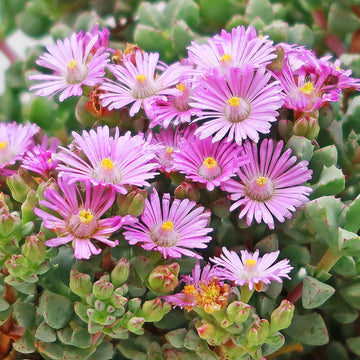
ice plant succulent propagation Pink Ice plant Succulent 'Oscularia deltoides'

Sale price$25.88 Regular price$28.76
Save 10%

Pay in installments of $7.19 with ShopPay, AfterPay and Klarna

Shipping Estimate
USA
  • USA
  • CAN

Ships within 48 hours · Estimated delivery Sep 1 - Sep 6

Promo Codes Available:

For Your Every Summer RSVP, with Code: SUMMER15

Description

ice plant succulent propagation Pink Ice plant Succulent 'Oscularia deltoides'Introducing the Pink ice plant, known as Oscularia deltoides, which is a trailing succulent with pink flowers. Native to South Africa, this low maintenance succulent makes great ground cover and spreads out, forming a colorful mat, and grows well on the rocky edge. Additionally, this pink ice plant can be grown in pots too. The name "ice plant" refers to tiny hairs on the plant's leaves and stems that reflect light in the same way that ice crystals

Introducing the Pink ice plant, known as Oscularia deltoides, which is a trailing succulent with pink flowers. Native to South Africa, this low-maintenance succulent makes great ground cover and spreads out, forming a colorful mat, and grows well on the rocky edge. Additionally, this pink ice plant can be grown in pots too.

The name "ice plant" refers to tiny hairs on the plant's leaves and stems that reflect light in the same way that ice crystals do. The foliage is fleshy and succulent-like, and it darkens as fall temperatures drop. Although ice plants are cold-sensitive, many varieties are evergreen in warm, dry climates.

Ice plants are used in sunny but sheltered desert gardens, rock gardens, slopes, ground cover, and as edging plants.

It is also known as Lampranthus Deltoides, Deltoid Leaved Dew Plant, Tooth-leaf Rock Vygie, Dassievygie, and Sandsteenvygie.

With its small, plump leaves that boast a mesmerizing blue-green hue, this ice plant is sure to turn heads and add drama to any space.

The three-sided leaves of the ice plant are fat and trailing.  The color becomes more intense as the pink ice plant ages and is exposed to more sunlight. It can grow up to 1 foot tall and 2 feet wide.

The ice plant flowers bloom during the late spring to summer, with bright pinkish-purple and dazzling magenta-pink flowers. They bloom from every nook and cranny until they completely surround and cover the whole plant. This stunning ground covered with pink flowers is closed up in the morning but open, often to cover the plant, in the afternoon. 

The true beauty of this trailing plant is that it can withstand high temperatures and extreme environmental conditions without showing signs of stress. It attracts butterflies.

Leaf cuttings and stem cuttings are the easiest way to propagate these ice plant ground cover. 

When and How to Water Your Ice Plant 

The ice plant is a succulent that prefers well-draining soil and requires watering only when the soil is dry to the touch. Overwatering can cause root rot and other issues that can damage these pink plants. They can be watered year-round and water regularly from spring to Autumn but reduce the watering frequency in winter; the growth period is early Spring to late Summer. 

When watering the pink ice plant, it is important to avoid standing water and to ensure that the soil is able to dry out between watering sessions. The pink ice plant is well-suited to dry climates and can tolerate periods of drought, but it does require a lot of water to thrive. 

Remember, watering should be done at the base of the succulent ice plant rather than from above to avoid getting water on the leaves, which can cause damage or rot. With proper watering and care, the pink ice plant can thrive and produce colorful blooms that are sure to brighten up any garden. 

Light Requirements - Where to Put Ice Plant

Like many other succulents, the ice plant is sun-loving and also requires direct, bright light to thrive.  When grown indoors, place it in the sunniest place in your house. It is ideal to grow this pink flower ground cover in a west- or south-facing window, when it can get 4-6 hours of bright sunlight. 

For outdoor cultivation, these oscularia deltoides require full sun to partial shade for at least 6-8 hours of strong light each day. Although light shade in the afternoon is often preferable - especially in hotter climates where the plant might become stressed by the intense heat of the afternoon sun. It's crucial to place your pink plants away from any areas with constant direct sunlight, as doing so could result in burned foliage. 

Remember, when planting the pink ice plant, it is important to choose a location that receives full sun throughout the day to maintain its colors. It is well-suited to hot and dry climates and can tolerate high temperatures and intense sunlight. 

This pink ice is able to tolerate some shade, but it may not produce as many blooms in areas with less sunlight or in too much shade. With proper light and care, the pink ice plant can thrive and produce beautiful blooms that are sure to add color and interest to any garden or landscape. 

Optimal Soil & Fertilizer Needs 

The ice plant favors very airy, sandy soil that drains well. Planting them in ordinary soil will result in compacted roots, stunted growth, and, most likely, root rot. Instead, make or buy a well-draining potting mix, or ideally, use our specialized potting mix that contains 5 natural substrates and mycorrhizae to promote the development of a strong root system that helps your succulent to thrive. 

When it comes to fertilizer, the pink ice plant does not require a lot of additional nutrients. In fact, too much fertilizer can cause the plant to produce excessive foliage at the expense of blooms. A slow-release natural fertilizer with an equal mix of NPK (5-10-5) can be applied once a year in the spring to help provide the plant with the nutrients it needs to thrive. Care should be taken to avoid over-fertilizing the succulent plant, as this can lead to issues with growth and blooming. 

With proper soil and fertilizer, the ice flower plant can thrive and produce beautiful blooms that are sure to add color and interest to any garden or landscape. 

Hardiness Zones & More 

When growing indoors, it should be kept between 65-75 degrees Fahrenheit to ensure optimal growth. The requirements are fairly flexible, as it can tolerate a wide range of temperatures. However, it is best to keep it in a warm environment with plenty of sunlight to encourage healthy growth.

For outdoor cultivation, this hardy ice plant is suitable outdoors in USDA zones 8-11, making oscularia deltoidesa a versatile plant that can be grown in a variety of climates. However, it is important to ensure that the succulent plants receive enough water to prevent issues with dehydration. 

The ice plant is able to tolerate mild frost, but it may struggle in areas with prolonged periods of frost or freezing temperatures. The best way to grow these pink ground covers is in containers, especially for those who live in regions with harsh winters.  

When it's cold outside, or there is a chance of snow or frost, you can then bring them inside. There are ways to keep your pink ice plant succulent safe from the cold if you are unable to bring it inside.To help them endure the harsh winter, you can use frost cloths or tiny greenhouses. 

Final Thoughts

Overall, the Pink Ice plant Succulent (Oscularia deltoides) is a beautiful and low-maintenance plant that adds a pop of color to any garden or indoor space. With its unique triangular-shaped leaves and ability to thrive in dry conditions, it is an excellent choice for beginner gardeners or those looking to add a touch of vibrancy to their collection. Remember to provide well-draining soil, ample sunlight, and occasional watering to keep this succulent happy and healthy.

Be sure to add Oscularia deltoides - Pink ice plant, to your collection today and elevate the beauty of your home or garden with this stunning-looking plant.

Shipping Notes
  • Free Standard Shipping on $100+ Orders to the USA.
  • Except Preorder products are shipped in 48 hours.
  • Delivery to the USA:
  1. Standard Shipping : 3-10 business days
  • If time is of the essence, please consider selecting expedited delivery for faster service.
Exchange/Return Notes
  • We offer a 30-day return/exchange service after receiving.
  • Final sale items are not eligible for returns or exchanges.
  • To process your return/exchange, please contact us at [email protected]
  • Please click here for more details>>> Return & Exchange Policy
SKU: 147143110

Discover Niche Categories That Outsell ice plant succulent propagation

Top-Converting Item to Boost Your Average Order

4.0 ★★★★★
Based on 15 reviews
Sort
Highest Rating
Newest First
Oldest First
Product Reviews
D
Darcy W.
Pawtucket, US
★★★★★ 5
A beautifully crafted invitation to journal
Format: Paperback
Lilias Trotter Legacy’s latest book Beholdings is not so much a text as it is a beautifully crafted invitation. Inspired by the journals and sketches of Lilias Trotter (1853-1928—English missionary to Algeria, artist, writer, and journaler par excellence), biographer Miriam Rockness invites the reader to try their own hand at journaling, using Trotter as a model and guide. Rockness herself is no stranger to journaling, and her Preface to Beholdings enumerates the many benefits that await any reader who is willing to commit to the discipline for a period of time. In the short term, Rockness describes how journaling encourages one to focus, to pay attention, to take the time to behold the beauty in the world before one’s very eyes. Each page following the Preface includes a quote designed to stir the imagination, and an image from Trotter’s journals to illustrate what it means to behold an acorn, a flower petal, a sunrise in the Algerian desert. It is not just to see what is before one’s eyes, but to hold it in the mind’s eye and cherish it. As Simone Weil said, “Attention, taken to its highest degree, is the same thing as prayer. It presupposes faith and love.” It is this kind of attention that Rockness encourages the journaler to cultivate, and it is the kind of attention that Lilias Trotter so artfully illustrates. There is ample space on each page for the journaler, thus inspired, to record his or her observations, musings, sketches, or doodles. In the longer term, Rockness suggests that journaling helps cultivate a sense of proportion and perspective. She describes looking back with her husband over her journals from years before, reliving the moments that might otherwise have been forgotten, and allowing those glimpses in the rear view mirror to inform present day experience. Sometimes one finds that images seen in the rear view mirror really are smaller than they appeared at the time! In addition to being an incitement to journaling, Beholdings is a beautifully produced creation in its own right. Great thought has gone into the selection of the typeface, the texture and feel of the paper, the quality of the images reproduced. This makes Beholdings not only a delight to own, but also an exquisite gift to offer. My advice: buy one for yourself, and another for someone you love.
WAS THIS REVIEW HELPFUL?YesReportShare
Reviewed in the United States on January 16, 2022
W
Verified Purchase
WellBCare
Louisville, US
★★★★★ 2
Be clear that it's a blank journal you create, with brief quotes and thumbnail art
Format: Paperback
If one is looking for a personal journal of empty lined pages ~ and a brief Lilias Trotter quote with a thumbnail-size photo of her art on each page then this is for you. I understood it was a book of her journalling with more viewable-size sketches.
WAS THIS REVIEW HELPFUL?YesReportShare
Reviewed in the United States on May 13, 2022
E
Verified Purchase
Eric Balkan
Cuba, US
★★★★★ 5
When and where economics went wrong
Format: Paperback
This is one of those books that can provide an epiphany to the reader -- but not very many American readers have even heard of it, unfortunately. That could be due to it's being a book primarily about English economic history, with assumptions that the reader is familiar to some extent with things like the Poor Laws and Tory socialism. But I wasn't, and was still able to glean some great insights from the work. That could be because Polanyi is not afraid of repetition. :-) A key insight, and the one that could be summed up as the theme of the book, is Polanyi's realization that prior to about 1830, the market and the economy were considered part of society. That is, economic activity was something that people did along with everything else they did, like engage in social/familial relationships, religious rituals, etc. But with the 1830s came a paradigm shift: the advent of rational capitalism. Now, the market was considered an entity by itself, outside of society. This market entity was viewed as governed by universal laws. Like laws of physics, these market laws were independent of culture, independent of social group, independent of time period, and, in fact, independent of human behavior. While any observer of human nature would say that people often make decisions for emotional reasons -- and modern neurological research shows that virtually every decision we make is a combination of the rational and the emotional -- these market laws assumed only rational behavior on the part of economic actors. Though Polanyi doesn't mention it, it's now easy to see how Alfred Marshall could get carried away with creating a mathematical foundation for microeconomics and how Leon Walras could, reportedly, say that if something couldn't be studied mathematically, it wasn't worth studying. There's no current way to model emotions with math, and so the Ricardian prototype of an emotion-less economics continues into the modern economics of today. These universal market laws frees the market from any social constraints. A number of modern neo-classical economists assert that this makes economics purely amoral, i.e., without regard for any ethics. Therefore any attempts by the public, by politicians, or by workers to add ethics to the market is an interference with pure market workings, which, according to their interpretation of Adam Smith's "invisible hand", will produce optimal results if just left alone. But Smith never said that, and in fact rational capitalism, in elevating greed and selfishness to the status of goals -- see the Ayn Rand work "The Virtue Of Selfishness" -- is, IMO, not amoral at all, but rather is a morality of its own. Anyway, back to Polanyi's insights. Another key one is the concept of a "double movement" in 19th century England. Each move to create a purer market created an ad-hoc counter move. E.g., Ricardian free trade was faced with opposition from workers losing their jobs and local firms losing business Americans can easily think of another example: where the employment of children (eventually) led to laws restricting that employment, simply because human beings have too much of a sympathetic nature to sit still for children losing limbs in the dangerous factories and mines of the time. Polanyi notes that capitalists often blame these anti-capitalist laws on planned activity by socialist anti-market groups, but he says they're actually the result of the recognition by the general public that they don't want to live under a pure market system. Yet another good insight is Polanyi's recognition that market laws treat labor, land, and money as commodities. We can see that today, where neo-classical economists assert that the law of supply and demand should apply to workers as it applies to anything else in the economy. That is, if there's a surplus of workers in one area and a shortage in another, supply and demand dictates the flow of workers from the one area to the other. But a laid-off textile worker in South Carolina is not going to move to China for a job. That's my own example, but Polanyi offers his own from modern English history. The book isn't perfect. Polanyi does have a tendency to generalize, a common failing among authors, IMO. E.g., in discussing the rise of fascism in the 1930s, he's on very shaky ground when he starts talking about the US or about Russian policy intentions during that period. I gave The Great Transformation 5 stars because, even with its faults, the reader will be thinking about Polanyi's insights for some time to come. I am.
WAS THIS REVIEW HELPFUL?YesReportShare
Reviewed in the United States on May 18, 2009
K
Verified Purchase
Kindle Customer
Grantham, US
★★★★★ 5
Not light reading but worth it
Format: Kindle
Much of this book was heavy reading for me, mainly due my not being familiar with the background development and history of various economic theory and associated laws over 500 or so years of British history. I did stick it out and am glad I did. There are many insights as to how we have arrived at today and the book is still relevant even though it was written in 1942. I found the last few chapters and the comments in Sources to offer the most explanations to fit modern times especially with regard to the rise of fascism. Thick but worth it.
WAS THIS REVIEW HELPFUL?YesReportShare
Reviewed in the United States on May 6, 2025
B
Verified Purchase
Blake West
Massapequa, US
★★★★★ 4
Interesting anthropology and critique, but dense and obtuse writing
Format: Kindle
The good part is that at the end of the day, I learned a lot here, and Polanyi raised a lot of very interesting and under-discussed historical points to create his argument. It felt very similar to David Graeber (or I guess Graeber is similar to Polanyi) in that way. The bad part is that, whereas Graeber writes with exceptional clarity and vividness, Polanyi is obtuse and dense. And I've read other books from this era, I don't think it's the time. I think it's Polanyi's writing. Beyond that, his work serves more as analysis than prescription. It's a bit unclear exactly what he's advocating for. Which maybe is OK, though I prefer when non fiction writers offer solutions rather than just pointing out problems. All in all, if you can settle in with his writing, there are definite gems in there.
WAS THIS REVIEW HELPFUL?YesReportShare
Reviewed in the United States on June 5, 2026

recommand products