SKU: 14750714575
tiger lily vs asiatic lily

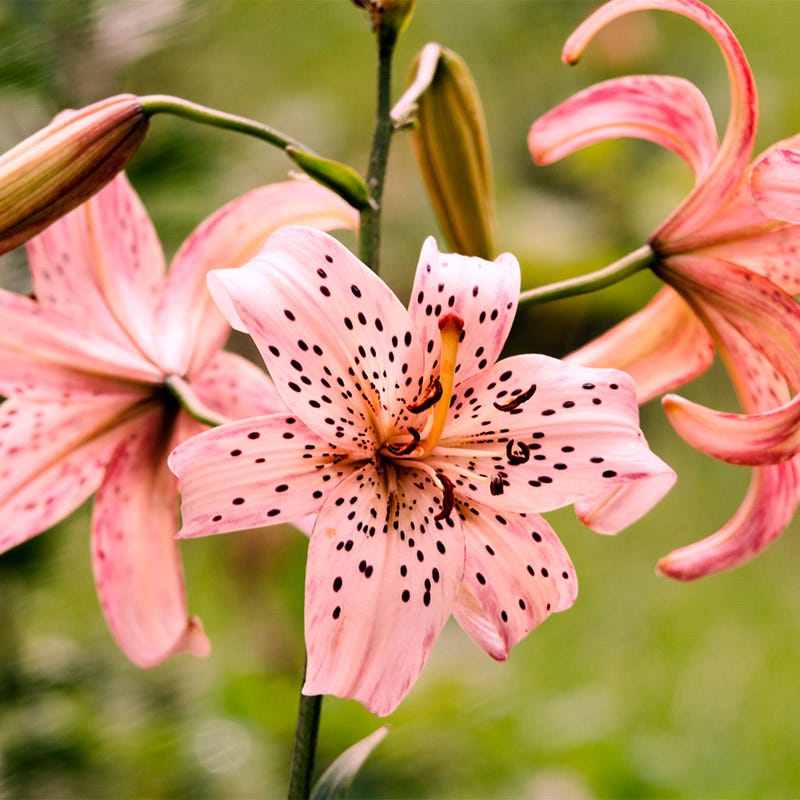
tiger lily vs asiatic lily Pink Tiger Lily Bulbs, Lilium

Sale price$24.10 Regular price$26.78
Save 10%

Pay in installments of $6.70 with ShopPay, AfterPay and Klarna

Shipping Estimate
USA
  • USA
  • CAN

Ships within 48 hours · Estimated delivery Jul 23 - Jul 28

Promo Codes Available:

For Your Every Summer RSVP, with Code: SUMMER15

Description

tiger lily vs asiatic lily Pink Tiger Lily Bulbs, LiliumIn more recent years, the hybridizers have managed to create new colors in the Tiger Lily group, maintaining the large flowers, the easy culture, the perennial qualities, and even the handsome black spots of the original Orange Tiger.' The true Tiger Lilies: Don't make a common mistake, and call just any old spotted orange lily a 'Tiger Lily.' Only one group is descended from the real thing. Like most Asian species lilies, this old reliable was a

In more recent years, the hybridizers have managed to create new colors in the Tiger Lily group, maintaining the large flowers, the easy culture, the perennial qualities, and even the handsome black spots of the original Orange Tiger.'

The true Tiger Lilies: Don't make a common mistake, and call just any old spotted orange lily a 'Tiger Lily.' Only one group is descended from the real thing. Like most Asian species lilies, this old reliable was a staple in the Oriental diet for centuries. The bulbs were--and are--cooked for foods and soups. But it's not the taste that made this lily bulb world famous. It's the beautiful flowers and the ease of growing them.

The true Tiger Lily is native to Korea, but today, gardeners the world over enjoy the beautiful big flowers on strong stems that return year after year. In fact, Tiger lilies are now so common in the US, many people think they're native.

As long as you have well-drained soil, they will grow for you, perfectly perennial even in some of America's coldest climates.

This is the lily with little black 'bulbils' (baby bulbs) that form up and down the stem in the leaf axils. These little bulbs drop to the ground naturally, and spring up the next year as baby tiger lily plants. Over the years, you'll have an expanding clump.

This is the perfect no-maintenance lily to add to your flower border or particularly, your wildflower meadow. A few towering lilies over a wild meadow in full bloom is a wonderful mid-summer sight.


Growing Lilies: True lilies (which don't include daylilies and others which are not in the genus Lilium) are easy to grow today, and more popular every season. Since they are upright and take practically no space at ground level, it's easy to plant lilies between other established perennials and shrubs. Most can also tolerate some shade, which adds versatility for the gardener. There are many lily groups, but to keep it simple, we will consider only a few of the main types that are important to gardeners. Each lily we ship includes complete instructions for planting. So don't hesitate. You can easily bring the spectacular beauty of lily flowers to any summer meadow or garden.

'Wild' Lilies or 'Species' Lilies These are the true wildflowers from the world over. They are the ones all the glamorous hybrids are descended from. We're fortunate to have some of these botanical treasures on our list of lilies this season.

Oriental Hybrid Lilies are the now famous, very fragrant ones with large, flattened flowers such as red Stargazer and white Casa Blanca. These are the ones now so popular in the floral trade, but are also very easy to grow. They bloom from mid-summer through early fall. Most have very large, outward-facing, fragrant flowers.

Asiatic Hybrid Lilies are today's largest group of garden lilies, quite easy to 'naturalize'. This growing group of lilies was begun by hybridizers in the US, and were first called 'Mid-Century Hybrids.' Compared to Orientals, the Asiatic Hybrid lilies bloom earlier (early to mid summer), the plants are shorter, the flowers a bit smaller, and most blooms are upward-facing and star-shaped. Some of the most famous Asiatic Hybrids are yellow 'Connecticut King,' and the famous red, 'Gran Paradiso.'

Tiger Lilies. This group is led by the famous old orange wild lily, which used to be called Lilium tigrinum. Botanists have changed that to Lilum lancifolium, but that doesn't stop most people (including us) from using the old name 'tigrinum.' From the original orange, the hybridizers have created new colors from white to pink. All have the large flowers, black spots, and tough perennial qualities of the original. (By the way, don't call any old spotted orange lily 'tiger lily'. This one is the real thing, and no lily common name is more mis-used.)

Trumpet Lilies Sometimes called 'Aurelian Hybrids' or other names, the large, tall trumpet lilies are all descended from The Regal Lily, a white wild species lily from China. All are incredibly fragrant, and wonderful for cutting. They grow tall, and often need staking, since a well-grown stalk can have over 15 huge flowers.

Shipping Notes
  • Free Standard Shipping on $100+ Orders to the USA.
  • Except Preorder products are shipped in 48 hours.
  • Delivery to the USA:
  1. Standard Shipping : 3-10 business days
  • If time is of the essence, please consider selecting expedited delivery for faster service.
Exchange/Return Notes
  • We offer a 30-day return/exchange service after receiving.
  • Final sale items are not eligible for returns or exchanges.
  • To process your return/exchange, please contact us at [email protected]
  • Please click here for more details>>> Return & Exchange Policy
SKU: 14750714575

Discover Niche Categories That Outsell tiger lily vs asiatic lily

Top-Converting Item to Boost Your Average Order

4.2 ★★★★★
Based on 15 reviews
Sort
Highest Rating
Newest First
Oldest First
Product Reviews
K
Verified Purchase
Kay Ennis
Louisville, US
★★★★★ 5
Historical education, great book!
Format: Paperback
This is a very good book. It gives a very insightful culturally appropriate view toward understanding a viewpoint from another persons perspective!
WAS THIS REVIEW HELPFUL?YesReportShare
Reviewed in the United States on June 15, 2025
D
Verified Purchase
Dr VickersBey JD
Lake Worth, US
★★★★★ 5
Post Traumatic Slave Syndrome
Format: Hardcover
Very well done book that does not make Black People feel angry nor White People guilty but from a gentle and skillful psychological point of view the book will "have you considered the impact of this or that upon both races as the result of Slavery in America?" A folk-like homespun way of tell these truths that masks the clinical questions that all trained psychologist asked..."and how would (does) that make you feel for all of us who ever sat on a couch?" The book made me consider the psychological impact of daily slave life with a WOW again and again as I never thought of the situations the book made me consider. The shared dehumanization of both whites and blacks due to the slave experience which goes a long way towards explaining to me why we as a country cannot truly discuss slavery's impact today. I found it self-healing and very necessary for all, both black and white, but especially for the victims of the African Holocaust my terminology not hers. I thought Dr. Leary PhD, did an excellent job and a high school or even a 6 grader could read the material without difficulty.
WAS THIS REVIEW HELPFUL?YesReportShare
Reviewed in the United States on November 18, 2010
H
Verified Purchase
Heather
Carnegie, US
★★★★★ 5
Healing & Understanding
Format: Paperback
We are living in a slave master's land (was the Indians..). Hundreds of years of slavery, mental torture and degradation and then "freed." No therapy. No understanding, not even patience. To listen to Dr DeGruy's youtube videos was so enlightening to me. Sorrow, but understanding and then JOY. I didn't understand the anger, towards myself or others. Now, I can see where so much pain has come from. I can show compassion and love towards myself and others. Whatever programming I had, has been deleted--destroyed. I look back with pride, hurt, and know that I, myself, can heal. What a blessing this woman has brought us! Thank you Dr. Joy DeGruy!
WAS THIS REVIEW HELPFUL?YesReportShare
Reviewed in the United States on November 3, 2024
A
Verified Purchase
Athena
Natrona Heights, US
★★★★★ 5
Aged wisdom and knowledge
Format: Paperback
Mental health and history goes hand and hand
WAS THIS REVIEW HELPFUL?YesReportShare
Reviewed in the United States on June 22, 2025
A
Verified Purchase
A.
Carnegie, US
★★★★★ 4
Why do black people . . .
Format: Hardcover
I purchased this book because I had many questions I wanted answered. Most of them were questions of "Why?". My biggest question was why we as black people have so many unhealthy habits in how we treat each other. As a young African American male who was raised by his mother in a predominantly white suburban area, I wanted to know why, when I encountered other black youth in more urban areas, they would tell me I "talk white." What is "talking white?" Basically, talking white means I was talking like I have an education. Why do so many members of the black community (those without an education) reject me for valuing education? Why is it that when one black person fidns a way out of the ghetto, it seems the whole neighborhood, church included, condems that person for leaving "his/her people" and wanting to live in the suburbs with the whites? Why don't we support one-another in this society that has always held us from achieving our full potential? I wanted to learn why we seem to have no clue of who we are, and so many of us, young and old, strive to "prove" we are "black enough." So talking a certain way makes us black? Or is it eating certain foods that makes us "black"? Listening to only certain kinds of music? We lack a firm sense of cultural identity. We take rebellious pride in being at the bottom, and equate success with "whiteness." We denounce the achievements of any black person and ostracize him from the community. We work to pressure our own to stay at the bottom. In this very interesting book, the author, Dr. Joy Degruy Leary, proposes a number of explanations for why the African American community has developed these and other unhealthy cultural habits. Leary examines this very real "crabs in the barrel" mentality, as well as many other self-destructive habits which plague the black community. Leary establishes a diagnoses, and calls it Post-Traumatic Slave Syndrome. Leary presents a very strong argument that the behaviors are all symptoms that have been passed down through the generations of African American people from the dawn of the trans-atlantic slave trade to today. Leary uses her own observations to support her theory of Post-Traumatic Slave Syndrome. This book is a very thoughtful read. The reason I give this work only four stars is because I truly feel that Leary's argument would have been much more affirmed and effective if she had included a visual timeline to help the reader to better understand the timeframes and chain of events in history discussed in the book. The argument also would have been more effective if the author spent more time on each point. At times it seems she's just getting started before summarizing all that was just said and moving on. Scholarly sources are cited and research is used, but the book does not explore any one study or statistic in great depth. It is a fast read.
WAS THIS REVIEW HELPFUL?YesReportShare
Reviewed in the United States on September 16, 2012

recommand products