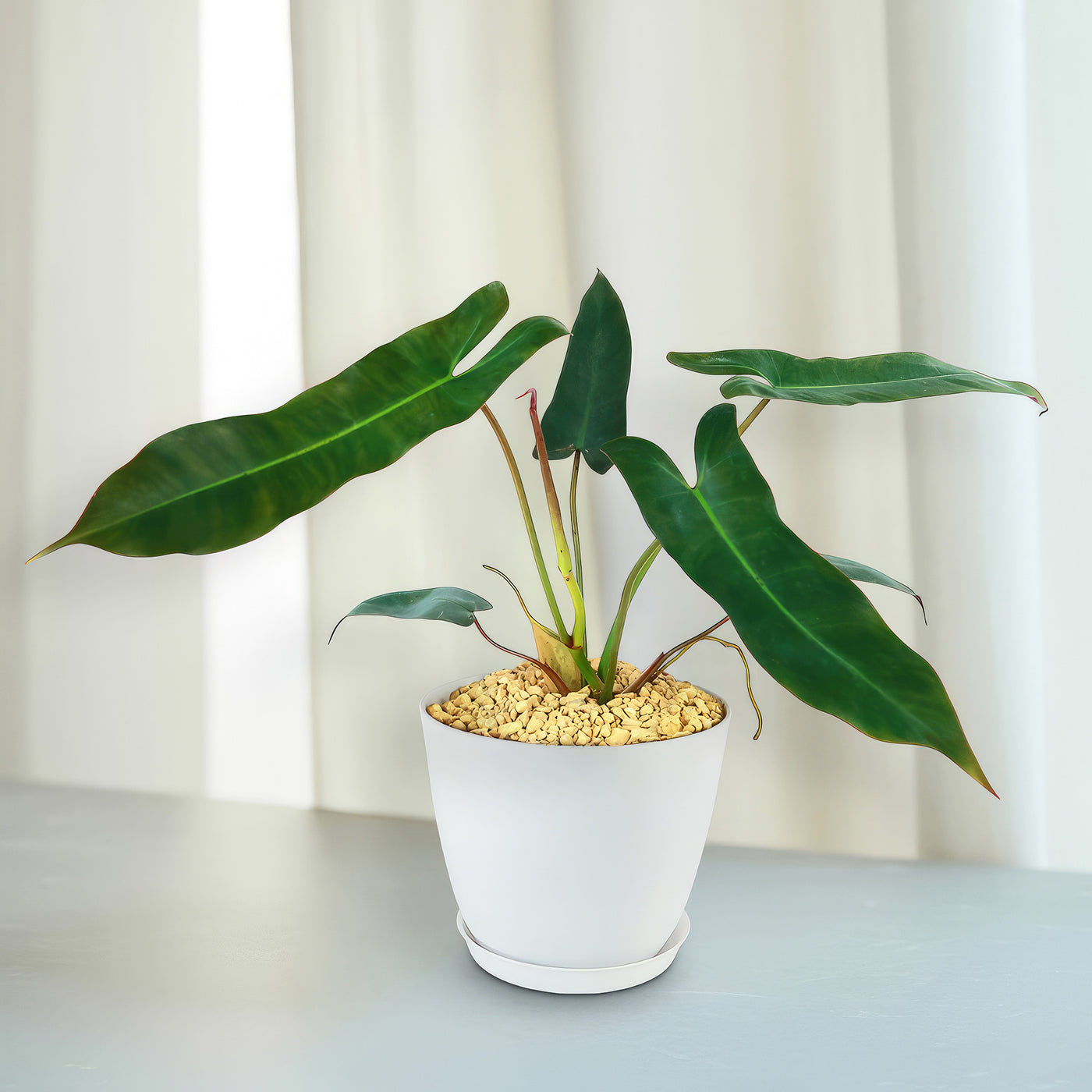
SKU: 15412923355
epiphytic philodendron

epiphytic philodendron Philodendron atabapoense 6" Pot / Self Watering / Without Pot

Sale price$20.41 Regular price$22.68
Save 10%

Pay in installments of $5.67 with ShopPay, AfterPay and Klarna

Shipping Estimate
USA
  • USA
  • CAN

Ships within 48 hours · Estimated delivery Jul 24 - Jul 29

Promo Codes Available:

For Your Every Summer RSVP, with Code: SUMMER15

Description

epiphytic philodendron Philodendron atabapoense 6" Pot / Self Watering / Without PotKey Highlights Philodendron atabapoense The Philodendron atabapoense is highly sought after as a houseplant due to its fast growing, climbing nature and adaptability to indoor conditions. While it thrives in humidity, this plant is surprisingly resilient and can tolerate short dry periods if necessary. Its long, narrow leaves feature deep green tops and striking maroon purple undersides, giving it an exotic appearance. It is a hemi epiphytic plant

Key Highlights - Philodendron atabapoense 

  1. The Philodendron atabapoense is highly sought after as a houseplant due to its fast-growing, climbing nature and adaptability to indoor conditions.
  2. While it thrives in humidity, this plant is surprisingly resilient and can tolerate short dry periods if necessary.
  3. Its long, narrow leaves feature deep green tops and striking maroon-purple undersides, giving it an exotic appearance.
  4. It is a hemi-epiphytic plant that climbs trees in its native habitat and benefits from a moss pole or trellis indoors to encourage larger, elongated leaves.

The Philodendron atabapoense is a striking rare climbing philodendron that has gained popularity among plant collectors due to its elongated, lance-shaped leaves with deep green tops and contrasting maroon undersides. Unlike more common philodendrons, it has a sleek, refined appearance that makes it stand out in any indoor or outdoor plant collection. 

Philodendron atabapoense grows great indoors while maintaining an impressive size, making it a favorite among houseplant enthusiasts. When given proper support, such as a moss pole or trellis, it will produce longer, more dramatic leaves, enhancing its visual impact. In the wild, it grows as an epiphyte, climbing trees and reaching for sunlight while absorbing moisture and nutrients from the humid air. 

Native to the tropical rainforests of Venezuela and Brazil, this plant has long, narrow arrow-shaped leaves with a deep green upper surface and a burgundy to maroon underside with an illustrious shine and sheen.

This color contrast gives it an exotic appearance that is highly appealing to plant collectors.

The plant is also known for its fast-growing nature, especially when provided with adequate support, humidity, and indirect light.

When grown indoors, this Philodendron typically grows up to 6 feet tall and 3 feet wide, depending on its support structure.

In its natural habitat, it can climb much higher, reaching over 10 feet. The leaves can grow significantly longer when provided with optimal conditions, adding to their appeal as a large, dramatic houseplant. 

The flowers of Philodendron atabapoense are small and greenish-white in color. Its blooms consist of a spathe and spadix, which are typical of the Araceae family. The spathe is usually green or maroon on the outside and pale inside, enclosing the spadix that contains tiny flowers. However, it rarely flowers indoors, as it requires specific environmental triggers, including high humidity and warm temperatures. 

One unique aspect of Philodendron atabapoense is its epiphytic and hemi-epiphytic nature, meaning it can grow both in soil and attached to trees. This versatility allows it to adapt well to different growing conditions. It also has a high tolerance for humidity fluctuations, making it easier to care for than some other tropical plants. Its leaves have a leathery texture, helping reduce moisture loss and allowing it to thrive in various indoor environments. 

When and How to Water Your Philodendron atabapoense 

Like other drought-tolerant plants, the Philodendron atabapoense is an excellent choice for plant enthusiasts who prefer low-maintenance greenery. This species can withstand occasional dry spells, thanks to its ability to store moisture in its roots. However, while it is resilient, it thrives best when provided with consistent moisture, allowing the soil to dry out slightly between waterings. Overwatering can lead to root rot, so a well-draining potting mix is essential to prevent standing water.

In the spring and summer, during the active growing seasons, it requires more frequent watering to support its vigorous growth. Water the plant thoroughly when the top 1-2 inches of soil becomes dry, ensuring even hydration. The frequency of watering largely depends on environmental factors such as humidity, light exposure, and pot size. If grown outdoors, the plant may require more frequent watering during hot, dry periods. 

In fall and winter, during the dormant season, your Philodendron enters a slower growth phase and requires less water. Watering should be reduced to prevent excessive moisture build-up in the soil. Ensure the soil is dry at least halfway before the next watering. Maintaining proper humidity levels indoors can help prevent dehydration, but misting is generally unnecessary unless the air is extremely dry. 

Light Requirements – Where to Place Your Philodendron 

When grown indoors as a houseplant, this plant thrives in bright, indirect light. It should be placed near a window with filtered sunlight, such as a north or east-facing window, where it can receive 6 to 8 hours of indirect light daily.

Too much direct sunlight can scorch its leaves, while insufficient light may lead to leggy growth and slower development.

Grow lights can supplement natural light if necessary, ensuring consistent growth throughout the year.

For outdoor cultivation, this Philodendron prefers dappled sunlight or partial shade, similar to its natural rainforest habitat.

It can tolerate morning sun but should be protected from harsh afternoon rays to prevent leaf damage.

If grown under a tree canopy or shaded patio, it will flourish with at least 5 to 6 hours of bright, indirect light daily. In tropical climates, it can be grown outdoors year-round with proper light exposure. 

Optimal Soil & Fertilizer Needs 

The Philodendron atabapoense favors very airy, sandy soil that drains well. Avoid using dense, compacted soils that trap excess water, leading to root rot. Instead, make or buy a well-draining potting mix, or ideally use our specialized potting mix that contains 5 natural substrates and mycorrhizae to promote the development of a strong root system that helps your Philodendron to thrive.

For optimal growth, fertilize Philodendron atabapoense once a year in their actively growing season which is typically spring using a ratio of about 5-10-5 (NPK). Organic options like fish emulsion or worm castings can also boost soil nutrition. Stop feeding in the dormant months when the plant’s growth slows. 

Hardiness Zones & More 

When grown indoors as a houseplant, it prefers temperatures between 65°F and 80°F and humidity levels above 50%. Keeping it in a warm, humid environment mimics its natural tropical habitat, promoting lush growth. Avoid placing it near cold drafts, air conditioners, or heating vents, as extreme temperature fluctuations can stress the plant.

In the United States, this is mostly an indoor plant, but if you live in southern Florida or Hawaii then you can cultivate it outdoors in USDA zones 9-11.

It prefers high humidity and bright, indirect light similar to its rainforest origin.

If growing outdoors in cooler climates, it should be brought inside when temperatures drop below 50°F to prevent cold damage. 

If you are concerned about humidity or notice browning edges on your plant leaves. This addition will dramatically improve the health of your philodendrons. 

Wildlife – Philodendron Flowers Attract the Following Friendly Pollinators 

The Philodendron atabapoense flowers are known to attract a variety of pollinators such as bees, butterflies, hummingbirds, and beetles in their natural habitat. While the plant is primarily grown for its stunning foliage, when it does flower, these pollinators help with its reproductive cycle.

Butterflies
Bees
Hummingbirds
Lady Bugs
Multi Pollinators
Other Birds

According to the ASPCA, Philodendron atabapoense is mildly toxic to humans, and pets such as cats and dogs. The plant contains calcium oxalate crystals, which can cause oral irritation, excessive drooling, and gastrointestinal discomfort if ingested in a large amount. It is safe to touch and handle, making it a popular choice for indoor houseplants.  

How to Propagate Philodendron atabapoense 

The Philodendron atabapoense can be easily propagated through stem cuttings. Select a healthy stem with at least one node and a few leaves, then cut just below the node using sterilized shears. The cutting can be rooted in water or moist sphagnum moss before transferring it to soil. Keep the propagation medium consistently moist and place it in bright, indirect light to encourage root development. 

The Bottom Line 

Overall, the Philodendron atabapoense is a remarkable climbing philodendron with elegant foliage, rapid growth, and stunning leaf contrast. Its adaptability to indoor and outdoor conditions, along with its unique maroon undersides, makes it a favorite among plant collectors. Whether grown on a moss pole or allowed to trail in a hanging basket, it adds a touch of tropical beauty to any space. With proper care, including bright indirect light, well-draining soil, and regular humidity, it will flourish and become a standout feature in any plant collection. Order your very own Philodendron atabapoense for sale today! 

Shipping Notes
  • Free Standard Shipping on $100+ Orders to the USA.
  • Except Preorder products are shipped in 48 hours.
  • Delivery to the USA:
  1. Standard Shipping : 3-10 business days
  • If time is of the essence, please consider selecting expedited delivery for faster service.
Exchange/Return Notes
  • We offer a 30-day return/exchange service after receiving.
  • Final sale items are not eligible for returns or exchanges.
  • To process your return/exchange, please contact us at [email protected]
  • Please click here for more details>>> Return & Exchange Policy
SKU: 15412923355

Discover Niche Categories That Outsell epiphytic philodendron

Top-Converting Item to Boost Your Average Order

4.4 ★★★★★
Based on 20 reviews
Sort
Highest Rating
Newest First
Oldest First
Product Reviews
M
Verified Purchase
Matt Cockerill
San Leandro, US
★★★★★ 5
Five Stars
Format: Hardcover
Strauss demolishes originalism in a concise and accessible volume.
WAS THIS REVIEW HELPFUL?YesReportShare
Reviewed in the United States on November 11, 2014
S
Verified Purchase
Stephen J. Jaros
Charlottesville, US
★★★★★ 3
Ultimately disappointing .. but still a good read
Format: Hardcover
This book does have a few commendable features. It is written in laymen's language, you don't have to be a constitutional law scholar like David A. Strauss to comprehend the arguments. And it's short. Won't take more than a couple of hours to read. But as a critique of the "originalist" constitutional doctrine, it is hit and miss. For example, Strauss argues that originalism has three major flaws (p.18): 1) the impossibility of determining what the understanding of the founding fathers was on a particular issue. 2) the impossibility of translating an original understanding so that it addresses today's problems. 3) no answer for Thomas Jefferson's question about why we, the living, should be governed by the "dead hand" of past generations, including the founders. Of these three, the first is the most telling, because it is indeed sometimes the case that we do not know what the founders would have thought about a particular issue, because that issue simply did not exist at the time of the enactment of the constitution or a particular amendment, or because that original meaning could be lost to history. The patent-ability of new life forms as a result of genetic engineering being a good example (but, other technological examples, like cases related to airplanes and cars, are NOT good examples, since while the founders were unaware of these technological advances, it's safe to assume they would recognize them as transportation vehicles, so their understanding of ships and horse carriages would apply to them). That's why i am what Strauss might call a "sometimes originalist" - my view is that IF there is no reasonable doubt about what the enactors of a constitutional provision would have thought about a case, then that should control the decision a court arrives at. But obviously, if the issue was unknown to the enactors, or if their views are forever lost to us due to the passage of time, then there is no "original understanding" of that particular issue, and some other method of constitutional interpretation must be relied on. The second and third objections are far less compelling to me. The second objection is IMO a non-issue. To ask "well, we know that in 1880 the enactors of the 14th amendment did not believe its equal protection clause outlawed employment discrimination against women, but would they believe that if they were living in the year 2000, with all the economic/cultural/technological changes that have developed over those 120 years?" is an irrelevant question. It's like asking if the 1969 Congress that enacted the Clean Air Act would still enact it if that Congress were to debate the issue in 2010: it's purely speculative and ungermane, since neither statutes nor constitutional provisions have expiration dates on them. Likewise, the 3rd objection is both shallow and disingenuous. Shallow because Jefferson clearly understood that the constitution, like laws enacted by the legislature, are subject to change by later generations, who can amend the constitution or pass new legislation to supersede what previous generations have accomplished. Disingenuous, because the invocation of Jefferson seems to be a tactical decision by Strauss, a way to tweak originalists by citing one of the very greatest of our founding fathers. Yet Jefferson can also be quoted to support an originalist view. For example, in 1801 he said: "The Constitution on which our union rests, shall be administered by me according to the safe and honest meaning contemplated by the plain understanding of the people of the United States, at the time of its adoption....These explanations are preserved in the publications of the time, and are too recent in the memories of most men to admit of question." (Writings of Thomas Jefferson, quoted from a letter dated 3/27/1801). The first part of this quote clearly indicates that Jefferson believed that constitutional provisions should be interpreted according to original understanding, not "modern, evolved" standards of meaning as David Strauss would contend. The second part speaks to the need i identified before, that of knowing within the bounds of reasonable doubt what the enactors understood a provision to mean. Beyond all this, though, is David Strauss's contention that a "living constitution", as defined by a common-law like accretion of judicial precedent in constitutional matters that leave the original meaning of the text behind, is necessary because otherwise our constitution would become an archaic relic unable to meet the demands of a changing society, and that the formal amendment process is too slow and cumbersome. Professor Strauss correctly notes that Jefferson believed that our institutions must evolve with the development of society; however, he crucially fails to note that to Jefferson, the primary mechanism of such innovation was to be the actions of the legislature. Constitutional provisions are expounded in broad, general language not to enable future judges to interpret them in light of changing societal conditions, but to permit elected bodies, like legislatures and congress, wide latitude to address the problems of today. Legislative bodies, which directly reflect the ebbs and flows of societal change and are accountable to the people, were Jefferson's preferred vehicle of constitutional innovation, not the decisions of insulated, life-tenured court judges. On this point, unlike on many others, Jefferson was in agreement with John Marshall. As Jean Edward Smith (1996) writes "When (in McCulloch v. Maryland) Marshall spoke of the Constitution as "intended for ages to come" and of the need to adapt it "to the various crises of human affairs", he was alluding to the responsibility of Congress, not the Court. And the limits on Congress were defined by the political process, not the judiciary" (p. 445). Thus, for example, while the enactors of the 14th amendment did not intend for it to ban employment discrimination against women, it also was not intended to prevent Congress or the state legislatures, at the time of the enactment or in the future, from enacting legislation that does protect women from employment discrimination should that type of legislation be deemed necessary or advisable. Jefferson was far more wary of "innovative" actions by judges, exemplified by his belief that "if federal judges have the final word over its meaning, the Constitution would be a mere thing of wax in the hands of the judiciary, which they may twist and shape into any form they please". Yet it is exactly this type of judicial activism that Strauss means when advocates a "living constitution". Strauss's fundamental error is revealed on page 103 when he says that "We cannot say that the text of the constitution does not matter ... no (textual) provision of the constitution can be overruled in the way a precedent can, or disregarded the way original understandings often are". What Strauss is saying here (well, he wouldn't put it this way, but this is my view of the matter) is that when a judge wants to be activist, to impose his/her personal policy preferences on a case, it's very important that the judge somehow, through clever verbal gymnastics, no matter how convoluted, "ground" that ruling in some actual constitutional-textual language. This is very important for achieving the political purpose of maintaining respect for the court in the eyes of the public. But to me, Strauss creates a false dichotomy: The text of the constitution is ONE AND THE SAME with its "original understanding". The 'text', the actual words of the constitution, does not exist independent of the original understanding of those words, the text is merely the communicative vessel used to convey that original understanding. That's the way language works. It's a method to convey meaning. Thus, to invoke the Due Process Clause of the 5th amendment to outlaw Federal segregation laws (as the Court did in 1955) when the enactors of the 5th amendment clearly (as Strauss admits) did not intend for it to mean that, is the SAME THING as ignoring the "text" of the constitution, since the text and original understanding are one and the same. Overall, i recommend this book. One will learn alot about constitutional history, and Professor Strauss is surely correct in that the "living constitution" view is in fact the dominant way in which the Court has gone about its business in practice, regardless of what legal theoreticians have thought. But, don't expect to be convinced by much Professor Strauss has to say about why this is a good thing.
WAS THIS REVIEW HELPFUL?YesReportShare
Reviewed in the United States on May 18, 2010
R
Ross L. Meyer
Lake Worth, US
★★★★★ 5
Originalist v Living Document , 5 - 4
Format: Hardcover
I found the author's arguments to be logical and compelling. Those who embrace the so-called originalist view of the Constitution, for example Supreme Court Justice Antonin Scalia, claim that they know - with great certainty - the absolute intent of the Constitution's authors. Further they claim that the Constitution provides specifics and principles which of course it does. It is simple to understand the specifics, but what about the principles? Principles, it seems to me, can and do have differing interpretations. One of the definitions of the word principle found in Merriam-Webster states, "a moral rule or belief that helps you know what is right and wrong and that influences your actions." As we all know, rules and beliefs frequently mean different things to different people. If it were not so, Supreme Court decisions would inevitably be decided 9 - 0. Many are familiar with the Supreme Court's case District of Columbia v. Heller in which Justice Scalia opined that the Second Amendment shouldn't stop the U.S. from barring certain weapons. While his opinion certainly seems reasonable to me, I cannot find that principle in the Constitution. Rather it seems to be a logical conclusion based on modern society, mores, and laws - perhaps, as Professor Strauss argues, Common Law. Whether one accepts the originalist view of the Constitution or, as I, believes a living interpretation of the great document is preferable, the one thing we can all agree on is that our nation is one of laws. To that end, it is incumbent on all citizens to accept and abide by the pronouncements of our judges, agree with them or not.
WAS THIS REVIEW HELPFUL?YesReportShare
Reviewed in the United States on November 18, 2014
B
Verified Purchase
Brenda B.
Lake Worth, US
★★★★★ 5
My Grandchildren LOVED this!
Format: Hardcover
I read this out loud to my two grandchildren ages 4 and 6 at bedtime. They're so excited to be reading a chapter book and they LOVED it! The book's quirky sense of humor is great and it was fun to hear the kids giggle. We loved how the sloth appears in each story. They couldn't wait for the next night to read. Mr Angleberger- please write more!!!
WAS THIS REVIEW HELPFUL?YesReportShare
Reviewed in the United States on October 24, 2017
J
Verified Purchase
Jewels
Pawtucket, US
★★★★★ 5
Got my 8 year old to read!
Format: Hardcover
My eight year old hated reading and refused to pick up any book, until this arrived in the mail. He as usual refused at first to read it but I made him read a couple of pages, which he did and put it down but the next day he asked to read it and read the entire book in 30 mins. He said he loved it and it was really funny. Already have the 2nd book on its way.
WAS THIS REVIEW HELPFUL?YesReportShare
Reviewed in the United States on March 15, 2017

recommand products