Pay in installments of $5.46 with
 ,
,
 and
and

Shipping Estimate
USA
- USA
- CAN
- USA
- CAN
Ships within 48 hours · Estimated delivery Sep 3 - Sep 8
 Promo Codes Available:
For Your Every Summer RSVP, with Code: SUMMER15
Description
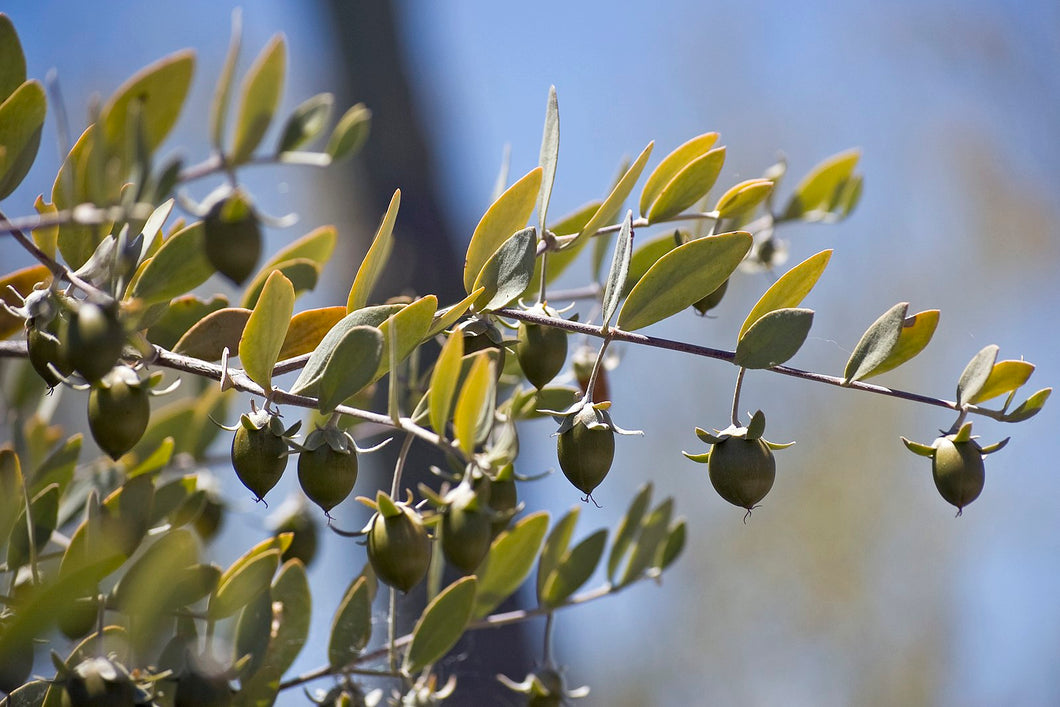
jojoba plant seeds for sale Jojoba – Experimental Farm Network Seed StoreSimmondsia chinensis Origin: Sonoran Desert (via India) Improvement status: Cultivated wild material Seeds per packet: ~10 BOTANICAL SAMPLE NOT GERMINATION TESTED Life cycle: Perennial Jojoba (Simmondsia chinensis), despite its scientific name indicating Chinese descent, is native to the US & Mexico. It is a shrubby perennial that thrives in its home desert, the Sonoran, straddling both sides of the US Mexico border. In fact, it's actually said to
Simmondsia chinensis
Origin: Sonoran Desert (via India)
Improvement status: Cultivated wild material
Seeds per packet: ~10
BOTANICAL SAMPLE - NOT GERMINATION TESTED
Life cycle: Perennial
Jojoba (Simmondsia chinensis), despite its scientific name indicating Chinese descent, is native to the US & Mexico. It is a shrubby perennial that thrives in its home desert, the Sonoran, straddling both sides of the US-Mexico border. In fact, it's actually said to thrive under drought conditions: the less summer rains it gets, the better it performs.
The name — pronounced "ho-ho-ba", since the colonial Spanish spelling is still used — comes directly from the indigenous Tohono O'odham name for the plant, which in English has also been called goat nut, deer nut, pignut, wild hazel, coffeeberry, quinine nut, and gray box bush. Indigenous people used it primarily for medicinal purposes, with an oily paste from the seeds being used on chapped lips, dry skin, and mild abrasions or burns. Seri people apparently used it for cleaning hair and as emergency food. In moderation, jojoba seed cakes are a fine food, though our bodies are incapable of digesting most of it. In larger amounts, it has a laxative effect. (Many animals also eat it, but apparently only Bailey's Pocket Mouse has evolved the ability to digest it!)
To the extent that you've heard of it it all, it's likely only as an ingredient in your shampoo or hand cream, where you usually see it called "jojoba oil." Technically, it's a liquid ester or wax that's squeezed from jojoba's nut-like fruit, but since it looks oily and feels oily, everyone calls it an oil. In the 1970s, as countries around the world wisely decided to ban commercial whaling, jojoba was touted as a chemically similar replacement for sperm-whale-head-oil (which was actually once an important product with many industrial uses). Scientists also realized that jojoba oil could replace petroleum!
You read that correctly: a drought-loving, desert-dwelling perennial plant that could replace petroleum. Indeed, the USDA still describes jojoba as a potential petroleum replacement. Of course, we'd probably need a few million more acres planted in jojoba for its oil to ever replace petroleum, but it could theoretically be done. In order for that to ever happen there would need to be lots and lots of investment in breeding, selection, and site evaluation. However, it's not as far-fetched as one might think. After all, the land where it thrives is used for little to no agriculture at present, and one day we will run out of oil. It does sort of make sense. So as a society, if we ever collectively realize that burning fossil fuels represents mass-suicide, jojoba will be there as one legitimate alternative. (Though in an ideal world we'll come to our senses sooner, abandon materialism and neoliberal capitalism, and chart a sustainable way forward that involves slowing down, focusing on our basic needs, and living in harmony with the only plant we've got.)
This seed comes to us from Sheffield's Seed Company in Locke, NY, who imported it from India. (Other than the US, it is mainly grown these days in India, Israel, Egypt, and Australia.)
GROWING NOTES: Based on our experience with the plant — Nate kept a few rooted cuttings alive in New Jersey for a few years, in pots and as winter houseplants — we only recommend trying to grow jojoba outdoors in the warmer and drier parts of California, Nevada, Arizona, New Mexico, Texas, Florida, Hawaii, Puerto Rico, Guam, Samoa, and the Virgin Islands. As a houseplant, however, feel free to give it a try anywhere! We suspect it could make a lovely bonsai. The seeds require no stratification, but soak in water for 24 hours prior to planting. Sow 1 inch deep and keep planting beds or pods free from weeds. Jojoba is dioecious, so you will need to have both pollen-producing and seed-producing plants in order to get a crop. The shrubby plants can reach almost 7 feet tall and they are much-branched. The evergreen leaves appear dull-grayish-green, somewhere between eucalyptus and olive.
Photo credit: Fruit photo is from Kenneth Bosma under the Creative Commons Attribution 2.0 Generic license. The rest are in the public domain.
Shipping Notes
- Free Standard Shipping on $100+ Orders to the USA.
- Except Preorder products are shipped in 48 hours.
- Delivery to the USA:
- Standard Shipping : 3-10 business days
- If time is of the essence, please consider selecting expedited delivery for faster service.
Exchange/Return Notes
- We offer a 30-day return/exchange service after receiving.
- Final sale items are not eligible for returns or exchanges.
- To process your return/exchange, please contact us at [email protected]
- Please click here for more details>>> Return & Exchange Policy