SKU: 18209334842
photos philodendron

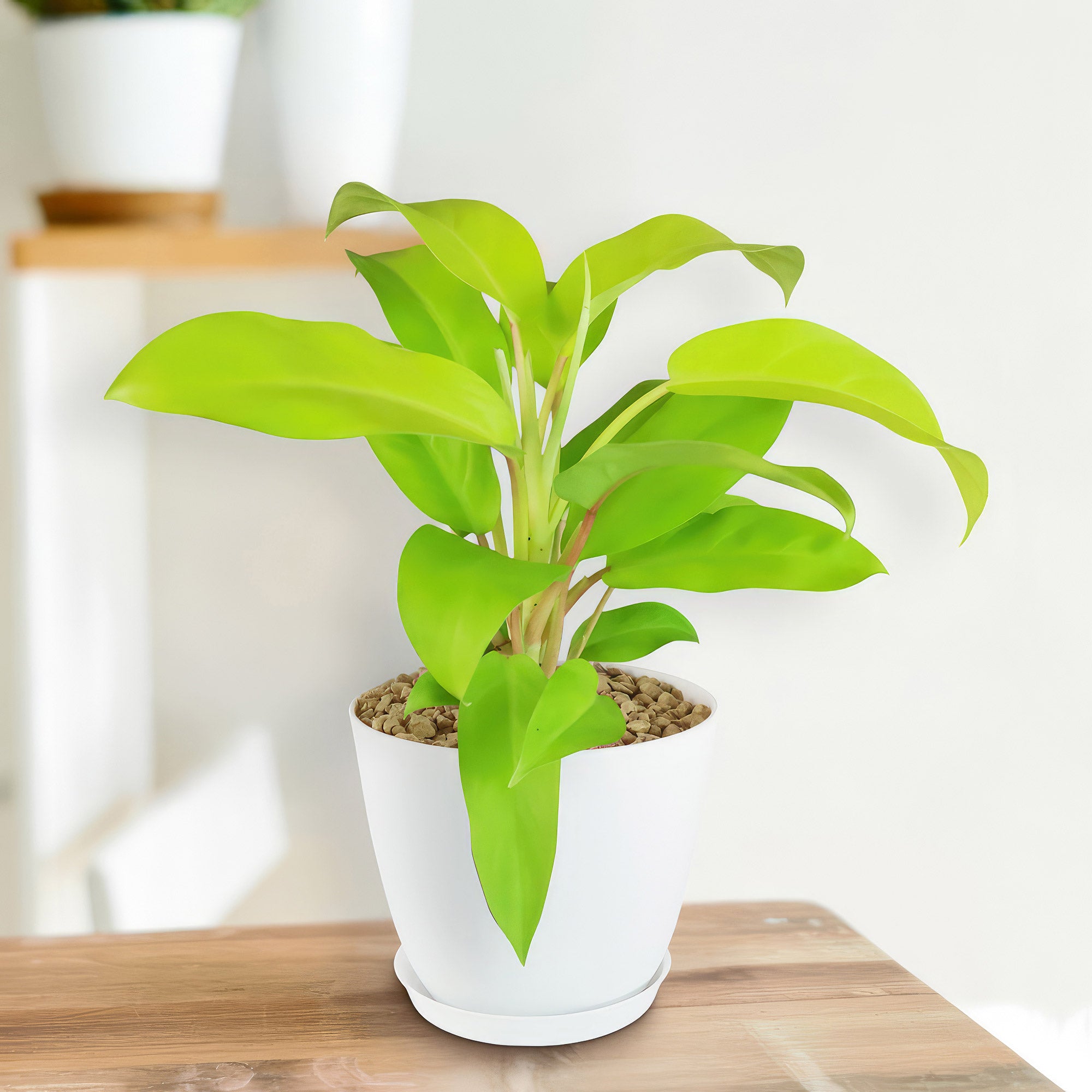
photos philodendron ‘Golden Goddess’ Philodendron 6" Pot / Teal / Without Pot

Sale price$20.66 Regular price$22.96
Save 10%

Pay in installments of $5.74 with ShopPay, AfterPay and Klarna

Shipping Estimate
USA
  • USA
  • CAN

Ships within 48 hours · Estimated delivery Jul 21 - Jul 26

Promo Codes Available:

For Your Every Summer RSVP, with Code: SUMMER15

Description

photos philodendron ‘Golden Goddess’ Philodendron 6" Pot / Teal / Without PotThe Golden Goddess Philodendron is a striking tropical houseplant known for its vibrant golden yellow foliage and easy to care nature. This fast growing climbing philodendron has gained immense popularity among houseplant enthusiasts due to its adaptability, bright color, and ability to thrive indoors with minimal maintenance. Unlike traditional green philodendrons, its chartreuse leaves add a lively pop of color to any indoor space, making it a

The ‘Golden Goddess’ Philodendron is a striking tropical houseplant known for its vibrant golden-yellow foliage and easy-to-care nature. This fast-growing climbing philodendron has gained immense popularity among houseplant enthusiasts due to its adaptability, bright color, and ability to thrive indoors with minimal maintenance. Unlike traditional green philodendrons, its chartreuse leaves add a lively pop of color to any indoor space, making it a favorite for plant collectors and interior decorators alike.

Native to the tropical rainforests of South America, the philodendrons are often found climbing trees, using aerial roots to anchor themselves.

The Philodendron ‘Golden Goddess’ has striking, bright golden-yellow leaves. 

One of its most unique features is its changing leaf color; new leaves start as bright yellow and slowly turn lime-green as they mature.

The amount of light also affects this color shift, with brighter light keeping the leaves golden and lower light making them greener.

This golden goddess plant has a climbing or trailing growth habit, making it an excellent choice for trellises, moss poles, or hanging baskets.

This fast-growing philodendron can quickly reach impressive heights when given the right support. 

When grown indoors as a houseplant, Philodendron ‘Golden Goddess’ typically grows up to 6 feet tall, depending on care and support. If allowed to climb, it can grow even taller, creating a lush vertical display. The leaves can reach up to 8 inches in length, developing a full and dense appearance over time. 

Philodendron ‘Golden Goddess’ is a climbing philodendron, and providing a moss pole, trellis, or other vertical support will help it develop larger leaves and a more upright growth habit. 

If placed next to a wall, it may lean toward it, but without a textured surface or additional support, it won't attach and climb effectively on its own. Aerial roots will try to grip onto a rough surface, but a moss pole or trellis will encourage stronger, healthier vertical growth.

The flowers of Philodendron ‘Golden Goddess’ are small, inconspicuous, consisting of a spathe and spadix. The spathe is a leaf-like part that wraps around the flower, while the spadix is a thick, upright spike where tiny flowers grow. These blooms are small and not very noticeable, and the plant rarely flowers indoors. If it does bloom, it usually happens in the warmer months, like late spring or summer.

When and How to Water Your Golden Goddess Philodendron 

It is a drought-tolerant tropical plant, making it an excellent choice for those who occasionally forget to water. This variety thrives in slightly dry conditions and does not tolerate overwatering. The best approach is to allow the top two inches of soil to dry out before watering again. Overwatering can lead to root rot, so it's crucial to ensure proper drainage in the pot or planting area.

In the spring and summer, during the active growing season, the Golden Goddess requires more frequent watering. Warmer temperatures and increased light exposure speed up soil evaporation, so checking moisture levels at least once a week is advisable. Deep watering is best, ensuring moisture reaches the roots. However, excess water should always drain out, preventing waterlogged conditions. Misting is not necessary but can be beneficial in dry indoor environments to maintain humidity. 

As fall and winter arrive, the plant enters a semi-dormant state, requiring significantly less water. Watering should be reduced to every 2 to 3 weeks, depending on indoor humidity levels. Since the plant is not actively growing during this time, it consumes less water. Always check the soil before watering to prevent overwatering, as the roots remain vulnerable to rot during dormancy. 

Light Requirements – Where to Place Your ‘Golden Goddess’ Plant

When grown indoors as a houseplant, your ‘Golden Goddess’ Philodendron thrives in bright, indirect light, making it an ideal houseplant for well-lit spaces.

It should be placed near an east- or west-facing window where it can receive gentle morning or late afternoon sunlight.

Avoid direct midday sun exposure, as its leaves can scorch. If natural light is insufficient, a grow light can supplement the plant’s needs, ensuring its vibrant golden foliage stays bright.

For outdoor cultivation, the plant does best in partial shade to filtered sunlight, as full sun exposure can cause leaf burn.

Ideally, it should receive around 4 to 6 hours of bright, indirect sunlight per day. A shaded patio, under a tree canopy, or on a covered porch are excellent locations for growing this philodendron outdoors. If grown in a particularly hot climate, ensure it is shielded from intense afternoon sun to prevent leaf damage. 

Optimal Soil & Fertilizer Needs 

The Philodendron plant thrives in well-drained, nutrient-rich soil.  Aroid potting mixes work exceptionally well for this variety, as they provide the right balance of drainage and nutrition. Avoid heavy, compact soils that retain too much moisture, as this can lead to root rot. Instead, make or buy a well-draining potting mix, or ideally, use our specialized potting mix, which contains 5 natural substrates and mycorrhizae to promote the development of a strong root system that helps your plant to thrive. 

To fertilize your Golden Goddess plant, use a liquid NPK fertilizer (5-10-5) once a year in the spring, during the growing season, to promote healthy foliage. Organic fertilizers like worm castings or compost can also be incorporated into the soil to enhance nutrient levels over time. 

During fall and winter, fertilization should be stopped entirely, as the plant's growth slows. Over-fertilizing during dormancy can lead to nutrient buildup and potential root damage. Instead, focus on maintaining proper watering habits and light conditions. 

This Philodendron works well with other climbing varieties such as Philodendron Brasil, Philodendron Mcdowell, making it a versatile and colorful addition to your home or office.

Hardiness Zones & More

For indoor growth as a houseplant, ‘Golden Goddess’ prefers temperatures between 65°F and 80°F with moderate to high humidity. It thrives in well-lit environments with indirect light. While it can tolerate lower humidity levels, maintaining at least 50% humidity ensures optimal growth. Placing it near a humidifier or pebble tray can help increase moisture levels in dry indoor climates. 

In the United States, this is mostly an indoor plant, but if you live in southern Florida or Hawaii, then you can cultivate it outdoors in USDA zones 9-11.

It should be planted in a shaded to partially shaded location, with humidity levels ideally above 50%.

If temperatures drop below 50°F, bringing the plant indoors is necessary to prevent cold stress.

In frost-prone areas, container planting allows easy relocation during winter months. 

Wildlife – Golden Goddess Flowers Attract the Following Friendly Pollinators

The small, inconspicuous flowers of the Golden Goddess plant attract a variety of pollinators, such as bees, butterflies, hummingbirds, beetles, and other pollinators in tropical and subtropical regions. 

Butterflies
Bees
Hummingbirds
Lady Bugs
Multi Pollinators
Other Birds

According to the ASPCA, Philodendron plants are mildly toxic to humans, cats, dogs, and other pets due to the presence of insoluble calcium oxalates. Ingestion can cause mouth irritation, excessive drooling, and gastrointestinal distress. However, it is safe to touch and handle, making it a popular choice for indoor houseplants.  

How to Propagate Your Philodendron Golden Goddess 

The Golden goddess philodendron propagation is best achieved through stem cuttings. Choose a healthy stem with at least two to three nodes and use clean, sharp shears to cut just below a node. Remove any lower leaves and place the cutting in water or moist soil. In water, roots should begin to form within two to three weeks. If propagating in soil, keep it consistently moist and in a warm, bright environment. Once roots are well-established, transplant the cutting into its permanent container. 

Key Takeaways

  1. The Philodendron Golden Goddess is a fast-growing climber, that has a vining growth habit and can be trained to climb using a moss pole or trellis.
  2. It can tolerate short periods of dryness but thrives with regular watering when the soil is dry.
  3. When small, it fits perfectly on desks or shelves, but as it matures, it can be grown in hanging baskets or as a climbing plant.
  4. It thrives in bright, indirect light and adapts well to typical home conditions.
  5. The new leaves start as bright yellow and gradually turn lime-green, depending on light exposure.

The Bottom Line 

Overall, the Philodendron ‘Golden Goddess’ is a must-have plant for anyone looking to add a vibrant, low-maintenance plant to their collection. Its striking yellow foliage, adaptability, and fast growth make it an excellent choice for homes, offices, and indoor gardens. Whether climbing up a trellis or trailing from a hanging pot, this plant adds a tropical touch and an instant burst of color to any space. With proper care—bright indirect light, occasional watering, and well-draining soil—it will thrive for years to come. This philodendron variety is perfect for plant lovers who want an easy-care, visually striking houseplant. 

Shipping Notes
  • Free Standard Shipping on $100+ Orders to the USA.
  • Except Preorder products are shipped in 48 hours.
  • Delivery to the USA:
  1. Standard Shipping : 3-10 business days
  • If time is of the essence, please consider selecting expedited delivery for faster service.
Exchange/Return Notes
  • We offer a 30-day return/exchange service after receiving.
  • Final sale items are not eligible for returns or exchanges.
  • To process your return/exchange, please contact us at [email protected]
  • Please click here for more details>>> Return & Exchange Policy
SKU: 18209334842

Discover Niche Categories That Outsell photos philodendron

Top-Converting Item to Boost Your Average Order

4.1 ★★★★★
Based on 24 reviews
Sort
Highest Rating
Newest First
Oldest First
Product Reviews
D
Verified Purchase
Daniel Myers
Louisville, US
★★★★★ 5
A Foundling's Felicity
This book or novel or whatever you may deem fit to call it has so many points in its favour that it's difficult to know where to begin. I think a rundown of a few of the myriad of characters that delight me personally might do for starters: Tom Jones - A young fellow with many "imperfections" if so they may be called, but a robust fellow with a "good heart." Prudence and what is commonly called virtue are not his strong suit - But may I remind the reader that virtue comes from the Latin word for "manliness"- Tom is certainly possessed of the word's etymological origins, if not of its modern usage (particularly in amorous matters)--And a good thing too, or we should have no story here to delight us! Squire Western- Another rambunctious character, who, for me, typifies all that is Eighteenth Century England. Every time he appeared in this book, whether it was to comment on wenching, wine, or riding to hounds a smirk would immediately cross my face followed invariably by chuckling by the end of the chapter. Henry Fielding - The author plays as much a part of the book as any of the characters with many prologues and prefaces and etc. For these, and for much of the rest of the book, I might add, the reader who has not had four years of Latin inculcated into him at an English boarding school would do well to buy the Oxford edition, which fully explains all the learned quotes - Also, as one who was thus inculcated but is inclined to laziness, the Oxford edition's notes prove extremely helpful also. Fielding also gives us a lively picture of the literary life of his time, which the Oxford footnotes do a deft job of explaining- In short, buy the Oxford edition. This review can not be comprehensive. There are simply too many characters to even make a go at encompassing them all. I'm merely describing some of the, to me, more delightful ones. The book as a whole is simply a joy to read, in its comic descriptions of all who will deign to admit that they are human, and of some priggish sorts who will not so deign. I can put it no better than Fielding Himself at the beginning of Book XV: "There are a set of religious, or rather moral writers, who teach that virtue is the certain road to happiness, and vice to misery, in this world. A very wholesome and comfortable doctrine, and to which we have but one objection, namely, that is not true." In short, this is a delightful ramble of a book which, while entertaining the reader not too attached to Sunday School, sheds light on how unvirtuous the virtuous can be, and how kind and good-natured the roguish can be as well as giving us as good a history lesson on the state of affairs in Eighteenth century England (with attention given to the Jacobite Rebellion etc.) as many a "proper" history does. Who, I ask myself, would not delight in this book? ---Well...for the priggish, there's always Jane Austen.
WAS THIS REVIEW HELPFUL?YesReportShare
Reviewed in the United States on January 24, 2007
A
Verified Purchase
Alexander Kobulnicky
Belleville, US
★★★★★ 4
The Sidekick in Early-Modern Literature.
Tom Jones is probably the most influential novel in English history, pioneering elements like complex characterization, social criticism and authorial interjection. But you already knew that. What you want to know is, is this a good book for us in the 21st century. And here, it's not so clear. The dialogue is pretty brisk, and some of the exchanges (the stereotypical Whig Mrs. Western arguing with her Jacobite brother is a particular treat) are actually funny. The latter part of the novel evolves into a farce, with a dozen characters engaged in scheming against one another, while Tom and Sophia helplessly go along. Farce works better in drama, where it has a faster pace, but it's always a welcome mode of comedy. You don't see enough farces. Some of the characters are evocative (why do I picture Blifil as looking like Ted Cruz?) but some are not: Dowling is just a lawyer, and Mrs. Miller is a good woman, like thousands who have come since, and that's all there is to it. It's not as if every character needs to, or can, be a fully realized person, but the parts of the novel spent with these human plot devices do feel mechanical. But Mr. Partridge, Tom's traveling companion, is in a different category altogether, and he just poisons the parts of the novel that he features in (chiefly the middle third). Eighteenth Century literature has a depressing reliance on goofy loose-lipped sidekicks: Mr. Partridge, Hugh Strap, Humphrey Clinker, Andrew Fairservice, Friday. Sometimes they're servants, but sometimes they're just stupid friends. Part of this must be practical: It's difficult to follow a wandering hero (and why are the heroes of these novels always wandering? But that's a different question altogether) without giving him a friend to talk to. Maybe early novelists had a hard time sketching characters who didn't have a way to discuss the ongoing action. But mostly, I think this is the bad influence of Don Quixote, which was becoming increasingly popular in England during this period. Sancho Panza is OK, and he's certainly the funniest element of that leaden tome. But Mr. Partridge *is* Sancho Panza, cowardice, superstition and all, and one Sancho Panza was more than enough. You know? There's a limited number of things that a silly, selfless, lazy pal can do, and it's hard to read about the same old doofus, yet again.
WAS THIS REVIEW HELPFUL?YesReportShare
Reviewed in the United States on April 28, 2016
D
Verified Purchase
Diana S. Long
Belleville, US
★★★★★ 5
Delightful and entertaining
Format: Kindle
314. The History of Tom Jones: a foundling by Henry Fielding (Novel-Audible/E Book-Fiction) 5* I read along with the Audible of the novel which I found a highly delightful and entertaining experience. The narrator, Bill Homewood, who performed the audio version of the work was excellent doing the various characters as well as the invisible narrator (author) of the story. The Synopsis is as follows: A foundling of mysterious parentage brought up by Mr. Allworthy on his country estate, Tom Jones is deeply in love with the seemingly unattainable Sophia Western, the beautiful daughter of the neighboring squire—though he sometimes succumbs to the charms of the local girls. When Tom is banished to make his own fortune and Sophia follows him to London to escape an arranged marriage, the adventure begins. A vivid Hogarthian panorama of eighteenth-century life, spiced with danger and intrigue, bawdy exuberance and good-natured authorial interjections, Tom Jones is one of the greatest and most ambitious comic novels in English literature. It is rather brilliant, and there is no lack of shenanigans as we follow Jones through his history and the reader never knows when and where the author will abruptly go off on a tangent, told in a most eloquent manner, end with a flourish and no doubt tossed his quill down and took a bow. I am either taken in by some farce or thoroughly enchanted by this author. As Fielding is rather the loquacious writer this read comes in Audible time at almost 38 hours or roughly 1,000 pages but worth every minute spent on it.
WAS THIS REVIEW HELPFUL?YesReportShare
Reviewed in the United States on December 19, 2017
H
Verified Purchase
Hawkeye
Whiting, US
★★★★★ 5
An epic nearly 300 years old
Tom Jones is the comical history of a young man who was adopted into a rich family and faces a brother who is against him all while they grow into maturity. It’s kind of like the first part of JoJo’s Bizarre Adventure except with Jonathan and Dio being reversed and with no vampires, but there is a moment where someone gets really scared while watching the ghost in hamlet so there’s at least some notion of the supernatural. Getting into it though, it’s an easy read despite it’s length encompassing 18 books, it’s honestly fascinating that it was able to be written so cleanly considering how many gaps there must of been between these books being written, it reads to us as a consistent narrative, but to imagine the wait and changing times that must have occurred during the duration to the story is really interesting to consider. The role and function of the narrator is probably the only real glimpse of this in narrative as he’s really just talking to us in the first chapter of every book, but the narrator being so clever and charming makes the only thing of interest be him and the relationship we form to him. It’s an incredible experience that I can recommend the entire story for alone. Getting to know the narrator is like talking to an old, reliable friend and it’s worth reading into nearly 300 years on.
WAS THIS REVIEW HELPFUL?YesReportShare
Reviewed in the United States on March 27, 2021
A
Verified Purchase
Astronomere
Waukegan, US
★★★★★ 3
Jone's Tome
This book seems more likely to be enjoyed by literary academics than by folks looking for a good story. While Henry Fielding is indeed a learned man of letters and does write in a fine and high style with many subordinate clauses, the actual substance thereof is no better than more earthy pedestrian fare. To put it plainly, I found most of the book a rather tedious slog. This is my personal subjective opinion only as I do believe Henry Fielding is well esteemed by serious literary scholars who undoubtedly see the matter quite differently. I am judging this book purely by my own personal enjoyment of the actual narrative and plot construction, and by my difficulty in teasing out the subordinate clauses which are so bound up with this age of writing. Imagine a very learned and erudite professor trying to tell you a common bawdy tale, but taking forever to do it while using the most stuffy language. I had thought that my deeper background in reading many Victorian era novels would qualify me to enjoy this one, but the language was a little too dense to make it an enjoyable read. I was however able to follow the story as well as the side epistles the author directly addresses the reader with (which I find to be an annoying device also much used in that era). I did read the whole thing and did take pleasure in some parts, but I must confess my bias towards this earlier era of novel writing. It takes very learned men of their age and has them writing long-winded tales of inferior construction when compared against later centuries. I know this is not their fault any more than you can blame a champion athlete of his time for having his record broken decades later when methods have universally improved.
WAS THIS REVIEW HELPFUL?YesReportShare
Reviewed in the United States on July 19, 2015

recommand products