SKU: 18810040912
chinese money plant pot

chinese money plant pot Pilea peperomioides – Foliage Factory

Sale price$19.44 Regular price$21.60
Save 10%

Pay in installments of $5.40 with ShopPay, AfterPay and Klarna

Shipping Estimate
USA
  • USA
  • CAN

Ships within 48 hours · Estimated delivery Sep 12 - Sep 17

Promo Codes Available:

For Your Every Summer RSVP, with Code: SUMMER15

Description

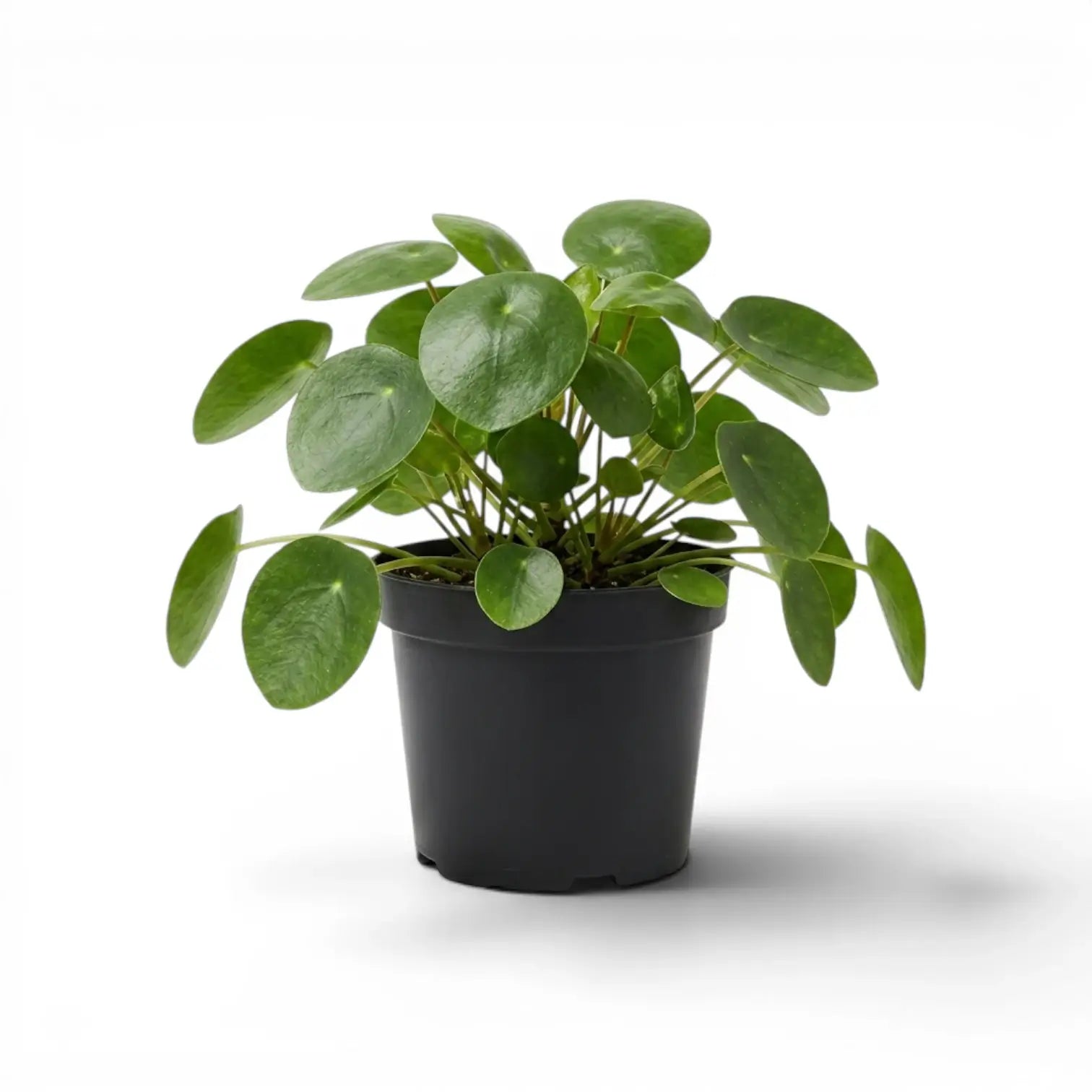
chinese money plant pot Pilea peperomioides – Foliage FactoryPilea peperomioides Pilea peperomioides is the classic round leaved Pilea, with coin shaped green leaves held on slim petioles around an upright central stem. It grows compactly at first, then often develops a visible stem and small offsets around the base. As the plant matures, the leaf canopy can rise above the pot and the basal pups become easier to separate. Bright indirect light keeps the growth more even, while occasional rotation helps the

Pilea peperomioides

Pilea peperomioides is the classic round-leaved Pilea, with coin-shaped green leaves held on slim petioles around an upright central stem. It grows compactly at first, then often develops a visible stem and small offsets around the base.

As the plant matures, the leaf canopy can rise above the pot and the basal pups become easier to separate. Bright indirect light keeps the growth more even, while occasional rotation helps the leaves develop around the stem rather than leaning strongly to one side.

Round coin leaves on Pilea peperomioides

  • Leaf shape: Round, peltate leaves attach near the centre, giving the plant its familiar coin-leaf form.
  • Leaf colour: Fresh green leaves sit on slender petioles and create an open canopy.
  • Growth habit: An upright central stem develops over time, often with basal pups around the parent plant.
  • Propagation: Offsets can be separated once they have enough root growth of their own.
  • Pot behaviour: A snug pot and airy substrate keep watering easier to control.
  • Mature growth: Older plants can form a taller visible stem below the leaf canopy.

Growth and origin of Pilea peperomioides

Pilea peperomioides is native to parts of south-western China, including Yunnan and Sichuan. Indoors, it behaves as a compact, upright perennial that grows in bright filtered light and a substrate that dries partly between waterings.

The rounded leaves turn toward the strongest light source, so rotating the pot keeps the plant from leaning strongly to one side. Older plants may develop a taller bare stem below the leaf canopy, especially after leaf drop or low-light growth.

Care guide for Pilea peperomioides

  • Light: Give bright indirect light. Too much direct sun can scorch leaves, while low light can stretch the stem and petioles.
  • Watering: Let the upper part of the substrate dry before watering again. Yellowing and leaf drop often follow repeated overwatering.
  • Humidity: Normal indoor humidity is usually enough, but very dry air can cause crisp leaf edges.
  • Temperature: Keep it warm and stable, away from cold draughts and cold windowsills.
  • Substrate: Use a free-draining houseplant mix with added aeration for the fine roots.
  • Repotting: Repot when the root ball fills the pot or watering becomes difficult to manage.
  • Feeding: Feed lightly during active growth. Skip fertiliser if the plant is stressed, recently repotted or growing slowly.
  • Propagation: Remove pups when they have several leaves and visible roots, then pot them into a small airy mix.

Common issues with Pilea peperomioides

  • Yellow leaves: Usually linked to wet substrate, poor drainage or watering before the pot has dried enough.
  • Leaning growth: Caused by one-sided light. Rotate the pot regularly for a more balanced canopy.
  • Crispy edges: Can come from drying too far, hot direct sun or very dry air.
  • Leaf drop: Often follows stress from overwatering, cold draughts or sudden changes in light.
  • Fungus gnats: More common when the substrate stays wet for too long.
  • Pests: Check stems and leaf undersides for spider mites and mealybugs.

Safety for Pilea peperomioides

Pilea peperomioides is commonly treated as a pet-safe houseplant. Chewing can still cause mild stomach upset, so keep it away from pets that regularly bite leaves.

Botanical background for Pilea peperomioides

Pilea peperomioides was described by Friedrich Ludwig Diels in 1912. The species belongs to Urticaceae, and the epithet peperomioides refers to its resemblance to Peperomia.

Shipping Notes
  • Free Standard Shipping on $100+ Orders to the USA.
  • Except Preorder products are shipped in 48 hours.
  • Delivery to the USA:
  1. Standard Shipping : 3-10 business days
  • If time is of the essence, please consider selecting expedited delivery for faster service.
Exchange/Return Notes
  • We offer a 30-day return/exchange service after receiving.
  • Final sale items are not eligible for returns or exchanges.
  • To process your return/exchange, please contact us at [email protected]
  • Please click here for more details>>> Return & Exchange Policy
SKU: 18810040912

Discover Niche Categories That Outsell chinese money plant pot

Top-Converting Item to Boost Your Average Order

4.4 ★★★★★
Based on 24 reviews
Sort
Highest Rating
Newest First
Oldest First
Product Reviews
J
Verified Purchase
JPC
Charlottesville, US
★★★★★ 5
Excellent resource for anyone hiking the PCT
Format: Paperback
I bought this for my brother who will be hiking the PCT for a second time this summer. He has read many books on the PCT and he said this book is an excellent resource for anyone thinking about or hiking, planning to return to, the PCT. Very easy to follow and everything you need to know as you plan your hike.
WAS THIS REVIEW HELPFUL?YesReportShare
Reviewed in the United States on March 17, 2020
N
Verified Purchase
Niz
Omaha, US
★★★★★ 5
Has me feeling prepared
Format: Paperback
Gearing up to hike the first section of the PCT. I got this book, my hiking buddy got a different book that covers the entire trail. While talking about our hiking plans he often says “my book didn’t mention that.” It’s clear this book is more detailed and up to date. I’m feeling very prepared and in the know about what to expect on the PCT.
WAS THIS REVIEW HELPFUL?YesReportShare
Reviewed in the United States on May 1, 2021
F
Verified Purchase
Fritz R. Ward
Omaha, US
★★★★★ 4
The Best of the Modern Guides to the PCT.
Format: Paperback
This book is not an update of the Wilderness Press classics on which the trail was discovered and hiked by a couple generations from the 1970s to around 2010. It does however owe those books a heavy and unacknowledged debt. This is most notable in lettering sections which the author of this guide, Shawnte Salabert, attributes to the PCTA but in fact come from scarified, Schaffer, et all who wrote the original guides to California, Oregon, and Washington. Even the definition of sweat constitutes the Southern California trail, comes from those guides. (It starts at the Mexican Border near Campo California and ends in Tuolumne Meadows, Yosemite.). But alas, those books are long out of print, in part because today’s hikers prefer light weight apps with minimal trail information as opposed to detailed descriptions of the physical geography and varied ecosystems of the trail. I’m not sure the lost knowledge has equaled the reduced weight but I’m a bit old school. And this book is as much a throwback to that kind of writing as it is a nod to recent demands of the hiking community. It does cover every mile of the route, suggest campsites along the way, and as much as possible provide an option for day and section hikes along the trail for just about anyone. The author provides good car descriptions to major trailheads for each section hike he recommends as well as available entry and exit options along the way. The writing is entertaining and the author has his own sense of humor that will become readily apparent as you read the text. Based on my experiences (and I’ve hiked 95% of the trail he describes at least once; sometimes multiple times) his mileage descriptions are accurate and you will easily be able to recognize the places he describes along the way. The book also features nice color photos and it’s availability in digital form will certainly please the gram counting hiker set. On the other hand, I miss seeing elevations along with miles at each major trail intersection, pass etc. Salabert does give total elevation gain and loss for each section of trail he describes but sometimes it’s nice to know just how much of a climb to expect. Ultimately, this book fulfills it’s purpose. You should want to hike the PCT after reading a few pages if you hadn’t already when you purchased the book. And if you are like many people with only a weekend or a few days to spare hiking the trail, this book will make planning short sections easier. It offers a lot. But it reminds me of an era when guidebooks offered even more.
WAS THIS REVIEW HELPFUL?YesReportShare
Reviewed in the United States on June 17, 2020
D
Verified Purchase
Darrow Kirkpatrick
Pawtucket, US
★★★★★ 5
Superb Guide in All Respects
Format: Paperback
An invaluable reference for anybody interested in section hiking the trail. I especially appreciate the coverage of water and campsites. It’s also a fun and beautiful read for any armchair adventurer. Salabert did an amazing job bringing together well-written text, data, maps, and beautiful photos to create a comprehensive guidebook. Deserves to do very well.
WAS THIS REVIEW HELPFUL?YesReportShare
Reviewed in the United States on February 6, 2018
P
Verified Purchase
Paul C Heidrick
New York, US
★★★★★ 5
Very good comprehensive collection of Section Hikes of the PCT
Format: Paperback
Great Maps. Accurate descriptions of everything (verified on previous hikes and hikes using the book).Well organized and beautifully laid out.
WAS THIS REVIEW HELPFUL?YesReportShare
Reviewed in the United States on August 28, 2021

recommand products