SKU: 19047745478
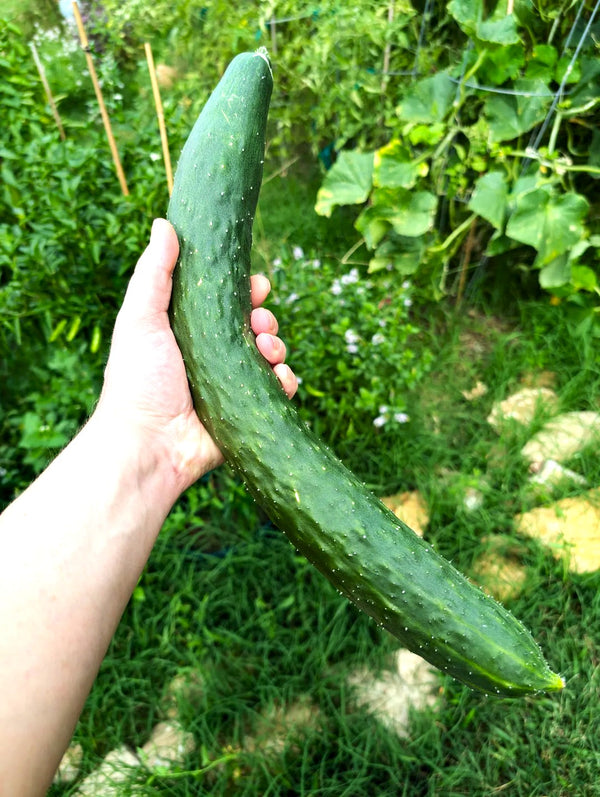
china jade cucumber plant

china jade cucumber plant China Jade Burpless Cucumber

Sale price$22.83 Regular price$25.37
Save 10%

Pay in installments of $6.34 with ShopPay, AfterPay and Klarna

Shipping Estimate
USA
  • USA
  • CAN

Ships within 48 hours · Estimated delivery Sep 10 - Sep 15

Promo Codes Available:

For Your Every Summer RSVP, with Code: SUMMER15

Description

china jade cucumber plant China Jade Burpless CucumberChina Jade Cucumber is a sleek, dark green "jade" colored Asian cucumber known for its crisp texture and mild, refreshing flavor. This popular Chinese variety boasts highly productive, disease tolerant plants that produce high quality, bitter free cucumbers that reach 10 12 inches in length, but can grow as long as 18 inches long! Perfect for fresh salads or pickling and plenty to share with friends and family, China Jade's easy to grow nature makes

China Jade Cucumber is a sleek, dark-green "jade"-colored Asian cucumber known for its crisp texture and mild, refreshing flavor. This popular Chinese variety boasts highly productive, disease-tolerant plants that produce high quality, bitter-free cucumbers that reach 10-12 inches in length, but can grow as long as 18 inches long! Perfect for fresh salads or pickling and plenty to share with friends and family, China Jade's easy-to-grow nature makes it ideal for gardeners of all skill levels. Grow your own China Jade Cucumber to experience the excitement of harvesting your own fresh, premium cucumber right from your backyard, ensuring the freshest and most flavorful cucumbers for your salads, pickles, and more.

Also Known As: China Jade Heirloom Cucumber, Jade Asian Cucumber, Chinese Burpless Cucumber, Japanese Burpless Cucumber, Chinese Jade Cucumber, Long Green Cucumber, China Green Cucumber, Oriental Cucumber, Heirloom Jade Cucumber

Plant Name: Cucumber, China Jade
Latin Name: Cucumis sativus
Days to Germinate: 3-10
Days to Harvest: 60
Plant Height: 6 - 8 Feet
Spread: 3 - 4 Feet
Growth Habit: Vining
USDA Zones: 3-11
Lifespan: Annual
Brand: TomorrowSeeds
Sunlight: Full Sun, Partial Shade
Pollination: Heirloom, Open-Pollinated
GMO: No
Fungicide-Treated Seeds*: No
Seeds Packed For**: 2026
*Fungicide-treated seeds protect the seedlings from diseases until they are up and growing. Do not eat treated seeds.
**Seeds are freshly packed for the growing season of the year listed. Seeds are still viable beyond pack date. Store in a cool and dry location such as the refrigerator or basement to best preserve germination rates.


Planting Instructions:

Soil Preparation:

Choose an area with heavy, well-draining soil that receives at least 6 hours of sunlight each day. Remove weeds, large rocks, and litter from the planting area. Leave small weeds and dead grass, they will enrich the soil when turned under. Spade or till the soil 8-12 inches deep. Loosening the soil will help the plant establish strong roots.

Plants grow best in soil with lots of organic matter. You may optionally add fertilizer or organic material such as compost, leaves, or rotted hay to mix into the soil at this point. For small gardens, scatter 2-3 tablespoons of fertilizer evenly and work into the top 2-3 inches of soil for each hill or 2 foot by 2 foot planting area. For larger gardens, scatter 2-3 pounds of a complete fertilizer for each 100 square feet of planting area. Work fertilizer or organic material into the soil and leave the surface smooth.

Form rows of soil beds 4-6 inches high and at least 4 feet apart. This formation of ridges will help with drainage.

Planting:

Cucumber grow best in warm weather (75F-85F).

Starting Indoors: For an earlier harvest, you may optionally start planting indoors in containers 2-3 weeks before the last expected frost date in Spring, keeping seedlings at least 70F. Harden off then transplant seedlings outdoors in a sunny location when the soil temperature is above 65F. To transplant seedlings, prepare a transplant hole outdoors in a sunny location. Remove the plants carefully from the pots or flats and set them in the holes, burying some of the stem in the ground. Pack the soil loosely around the plant and leave a slightly sunken area around each plant to hold water. Water the plants after transplanting. Optionally, Train plants to climb a 6-8 foot trellis or fence as they establish.

Directly Sowing: If directly sowing cucumbers outdoors, plant in mid-late spring when the soil warms to at least 70F. If Fall planting, sow in early summer, at least 12-14 weeks before the first expected frost date - or if growing indoors, keep at >70F using supplemental grow lights.

To plant, make holes 1 inch deep and spaced 2 feet apart down the rows of raised beds. Plant 2-3 seeds per hole. If choosing to thin to the strongest plant, determine the strongest and healthiest plant, then remove all other plants, narrowing to a single plant per hole. Cover seeds thinly with soil and water after planting. Optionally, train plants to climb a 6-8 foot trellis or fence as they establish, spacing plants 10 inches apart at the base of the trellis.

*Tip: You can plant fast maturing crops such as lettuce and radishes between cucumber hills to save space. These will be harvested before the cucumber vines get too large.


Planting Depth: 1 inch
Within-Row Spacing: 2 feet (sprawl) or 10 inches (trellis)
Between-Row Spacing: 4 feet


Care During the Season:

Watering: Water the plants deeply, soaking the soil to a depth of 6-8 inches, once a week. If there is no rainfall, water 2-3 times a week. Sandy soils may need to be watered more often than heavy clay soils. Mulching around plants can help retain moisture.

Weeding: Keeping plants weed-free improves production. If plowing or hoeing, do not dig deeper than 1 inch to prevent from cutting the feeder roots.

Fertilizing: Once plants start to bloom and set fruit, you may optionally apply a fertilizer that is higher in potassium and phosphorus and lower in nitrogen. Read and follow fertilizer instructions for best application. Water plants after fertilizing.

Insecticides: Insecticides may be used to protect plants. Bt-based insecticides and sulfur are organic options that can be used for prevention. Sulfur also has fungicidal properties and helps in controlling many diseases. Before using a pesticide, read the label and follow cautions, warnings and directions.

Diseases: If spots or mold appear, treat plants with an approved fungicide. Neem oil, sulfur, and other fungicides may be used. When using fungicides always follow label directions.

Harvesting:

Harvest cucumbers when reach the desired size and are green in color. Harvest Japanese Long cucumbers when reach the desired size and are deep green in color. These cucumbers are best picked when they are 12 inches long and mature. Cucumbers grown for pickling are best 3-4 inches long and up to 1 inch in diameter at maturity. Either type can be used for pickling if picked when small. It is best not to wait until cucumbers start yellowing because they will be over-mature and have a strong flavor. To harvest, use a pair of clean scissors or a knife to cut the cucumber from the vine, leaving about an inch of stem attached to avoid damaging the plant.

Shipping Notes
  • Free Standard Shipping on $100+ Orders to the USA.
  • Except Preorder products are shipped in 48 hours.
  • Delivery to the USA:
  1. Standard Shipping : 3-10 business days
  • If time is of the essence, please consider selecting expedited delivery for faster service.
Exchange/Return Notes
  • We offer a 30-day return/exchange service after receiving.
  • Final sale items are not eligible for returns or exchanges.
  • To process your return/exchange, please contact us at [email protected]
  • Please click here for more details>>> Return & Exchange Policy
SKU: 19047745478

Discover Niche Categories That Outsell china jade cucumber plant

Top-Converting Item to Boost Your Average Order

4.6 ★★★★★
Based on 16 reviews
Sort
Highest Rating
Newest First
Oldest First
Product Reviews
K
Verified Purchase
Karla Crum
Boise, US
★★★★★ 5
Professional and fun to read
Format: Paperback
The book is written by a professional who provides ideas and reasons about possibilities without being dogmatic.
WAS THIS REVIEW HELPFUL?YesReportShare
Reviewed in the United States on February 20, 2022
M
Verified Purchase
Mark McDonough
Alexandria, US
★★★★★ 4
Absolutely Not Nonsense
Format: Hardcover
At first glance, this book might be mistaken for "Chariots of the Gods" hokum -- it's about pyramids, it suggest prehistoric connections between widely scattered civilizations, and it has an entire chapter on planetary catastrophes. However, this is a very serious effort. Granted, it raises a lot more questions than it answers, and can be a little monotonous in spots. But as a former geology major, I didn't spot any pseudo-science (which is not surprising, given that the primary author has a Ph.D. in Geology from Yale) and I found much food for thought. Sure, if it turns out that the whole theory of cultural diffusion is wrong, (similarities in disparate civilizations are due to migration and interconnection rather than parallel developoment) this book will be little more than an amusing footnote in the history of science. But then, plate tectonics was once a crackpot theory. This is a serious book that deserves to be read.
WAS THIS REVIEW HELPFUL?YesReportShare
Reviewed in the United States on December 6, 2003
A
Verified Purchase
Art Lover
Carnegie, US
★★★★★ 5
Great Summer Read
Format: Paperback
As an academic who spends summers reading new - well grounded - theories, this was the best read of the summer. Intriguing! Well grounded in massive amounts of data - from myth to scientific dating techniques. LOVED it!
WAS THIS REVIEW HELPFUL?YesReportShare
Reviewed in the United States on June 6, 2014
A
Verified Purchase
A. Thomas
Charlottesville, US
★★★★★ 5
a very serious read about ongoing and proposed climate intervention
Format: Kindle
This book has a lot of serious information. If it’s honing to of any use to you , then it will require active reading, note taking etc. The complex social involvement of political and business interests that already exist with the spread of non- native species of plants and animals in North America, Australia, South America etc. Since the 19th century gives this reader a reason to pause in his quest to find the “right, simple, effective strategy” which would require an unimaginable level of cooperation between the EU, Asia,and North America. The likely scenario is that as get closer to deadlines by the year 2030 and beyond, partial programs will be launched by various combinations of government and public, and business interest’s. The result isn’t optimistic but it will be a reality.
WAS THIS REVIEW HELPFUL?YesReportShare
Reviewed in the United States on April 2, 2022
J
Verified Purchase
Jack Hicks
San Leandro, US
★★★★★ 4
interesting science
Format: Hardcover
Under A White Sky, The Nature of The Future, Elizabeth Kolbert, 2021 In 2015 Elizabeth Kolbert won the Pulitzer Prize for her book the Sixth Extinction. In my review of that book, I wrote: Kolbert is not a scientist but a reporter and writer for The New Yorker magazine and as such her book is structured as a series of bylines as she travels around the world reporting on scientists investigating extinctions in both the present and the past. As in that book she adopts the same format but this time investigating “how the very sorts of interventions that have imperiled our planet are increasingly seen as the only hope for its salvation”. Ice cores from the Antarctic and Greenland have shown that the last 10,000 years of earths history have been the most benign and stable climatological periods in the last 100,000 years. During this time, we have been able to develop agriculture, an amazing technological and a pervasive globe encompassing culture with a population now of almost 8 billion people. Without this unusually stable climate most of our current civilization would probably have not evolved or been possible. Up to this point we humans have taken this for granted thinking that this benign state will somehow last forever. In Kolbert’s last book she emphasized that due to our own rapacious destruction of earth’s ecosystems and our destabilization of climate stability, this situation is coming to an end and not responding is not an option. Facing an unimaginable crisis of our own making how should we respond? When we intervene, are we smart enough not to cause newer unanticipated problems greater than the original problem we sought to solve? Kolbert travels around the world seeking an answer to this question. She visits places and examples where we historically have tried to solve problems such as sewage in Chicago or taming floods on the Mississippi only to create larger problems such as invasive species or sinking cities such as New Orleans. The most interesting part of her book is when she addresses the people and places that are using current cutting-edge technology to save ecosystems and reverse global warming. One such example is on the Great Barrier Reef of Australia, one of the most diverse and prolific ecosystems on earth, which is under dire threat from oceanic warming and acidification. Faced with the real possibility of extinction of the reef in just decades, scientists are turning to genetic modification of Corals to make them more resistant to these fast-changing conditions. Since 2012 a new gene editing technology called CRISPR-Cas has become ubiquitous. In fact, so ubiquitous that you can buy your own “genetic engineering home lab kit” from a company in California called Odin for $1800. Kolbert buys her own kit and is able to engineer a colony of E. coli bacteria into a strain that is resistant to streptomycin antibiotic. She then inserts a jellyfish gene into yeast which then glows in the dark. Sound dangerous? Yes, what could possibly go wrong, but this is also the technology to develop new global warming resistant corals or destroy malaria carrying mosquitos, control rapacious rodents on Pacific Islands or control a plague of Cane Toads in Australia, not to mention breakthrough medical benefits. We have so altered natural systems with invasive species, with climatological chaos that the only solution is further intervention. She quotes a scientist at the Australian Animal Health Laboratory: “What people are not seeing is that this is already a genetically altered environment. Invasive species alter the environment by adding entire genomes that don’t belong. By contrast Genetic engineers, by contrast, alter just a few bits of DNA here and there”. “The classic thing people say with molecular biology is: Are you playing God? Well no. We are using our understanding of biological processes to see if we can benefit a system that is in trauma”. Do you feel guilty about all the carbon you are emitting into the atmosphere when you drive around in your SUV or eat a filet mignon? Now there is a way to assuage your guilt. There is a now a company called Climeworks that will do just that for the price of $1000 per ton of sequestered CO2. Being that each American emits about 20 tons per year following the American way of life and to totally assuage your guilt will cost you a cool $20,000 per year. Do you feel that guilty? Kolbert purchases one ton of sequestration and then visits the place where the deed is done which turns out to be at a geothermal power plant in Iceland. There they inject CO2 into the hot molten basalt at the bottom of their well to form limestone. This is a way the earth has been doing this process for millions of years without payment. In fact, it is the very process that transpired when the Himalayas were pushed up by the Indian subcontinent million of years ago, sequestered billions of tons of carbon into limestone and enabled the ice ages to begin 3 million years ago. Is this process a feasible solution to our current crisis? According to the latest UN climate report at this point, some form of sequestration is almost certainly required to avoid a catastrophic global temperature rise above 2 degrees regardless of what green technologies are introduced. Almost certainly the cost of that sequestration will have to be drastically reduced. Is there another way to approach the problem? Here Kolbert interviews scientists who are studying a process called solar geoengineering which involves shooting reflective compounds or crystals into the stratosphere to reflect sun light and reduce the earths albedo or heat absorption. This the same process that occurs when large volcanic explosions expel billions of tons of dust and S02 that block incoming sunlight and cool the planet. Last time a truly global volcanic eruption occurred was Tambora in Indonesia in 1815 and caused catastrophic cooling causing mass famine in various places around the world. Is this a feasible solution? Maybe, certainly not to the extent of Tambora and one side effect might be changing the sky from blue to white and hence the title of the book. Sunsets might be improved however. This a short book and quick read and one gets the sense that it was somewhat truncated because of the pandemic restricting travel. However, there is still a lot of interesting information about the future fate of our planet and what can be done to ameliorate the damage that we have inflicted. JACK
WAS THIS REVIEW HELPFUL?YesReportShare
Reviewed in the United States on March 1, 2021

recommand products