Pay in installments of $7.03 with
 ,
,
 and
and

Shipping Estimate
USA
- USA
- CAN
- USA
- CAN
Ships within 48 hours · Estimated delivery Sep 9 - Sep 14
 Promo Codes Available:
For Your Every Summer RSVP, with Code: SUMMER15
Description
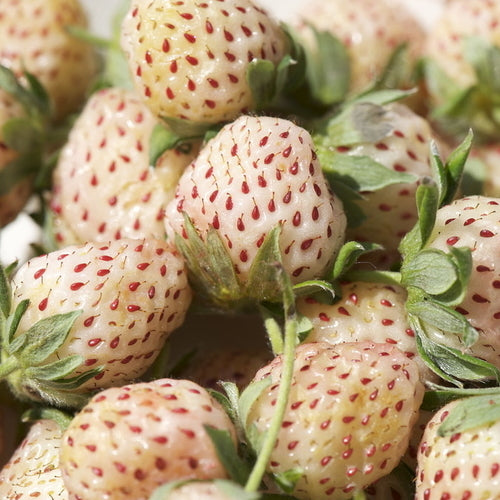
snow white strawberry seeds White Alpine - Strawberry SeedsThe French starting taking alpine strawberries from the wild to their gardens about 400 years ago, most likely around Grenoble in the lower Alps. White alpine strawberries are a natural mutation of the wild growing red alpine strawberry and are well adapted to colder climates and higher altitudes. White Alpine strawberries are one of a kind fruits, creamy white in colour, ornately speckled with beautiful contrasting red seeds. The delicate fruits are
The French starting taking alpine strawberries from the wild to their gardens about 400 years ago, most likely around Grenoble in the lower Alps. White alpine strawberries are a natural mutation of the wild growing red alpine strawberry and are well adapted to colder climates and higher altitudes.
White Alpine strawberries are one-of-a-kind fruits, creamy white in colour, ornately speckled with beautiful contrasting red seeds. The delicate fruits are dense and juicy with a memorable flavour. White alpine strawberries can quickly become your favourite in the garden. The tropical notes of pineapple and guava blended with the taste of classic red strawberry makes this variety a truly unique heirloom. White Alpine strawberries are often over-looked by animals and birds and will last for years, making this variety quite easy-to-grow. The plants will produce fruits all season long but are considerably less productive during the hotter months.
- Latin Name: Fragaria vesca
- Days to Maturity: 120
- Life Cycle: Perennial
- Canada Hardiness Zone: 5-9
- Start Indoors or Cold Frame: December to February or may not bear fruit the first year.
- Direct Sowing: After last spring frost
- Planting Depth: Need light to germinate, do not cover, mist lightly.
- Days to Germination: 7-42
- Optimal Soil Temperature During Germination: 20-25°C
- Seed Spacing: 2-3 seeds every 30 cm
- Thinning Seedlings: 60 cm apart
- Row Spacing: 90-120 cm
- Plant Height: 15-20 cm
- Average Seeds Needed Per 10 m Row: 100
- Average Yield Per 10 m Row: 10 lb.
Also known as Fraises des Bois or Woodland Strawberries, alpine strawberries are miniature ancestors of the regular strawberry. They are smaller than hybrid types but are at least twice the size of wild strawberries. You will probably never find Alpine strawberries at the supermarket because they are just too fragile. Unlike hybrid strawberries which tend to spread, alpine strawberries are easy to manage because they reproduce by seed rather than by runners. Alpine strawberry plants tend to produce very few runners, which you can keep the first year to fill space or cut to promote fruit production.
These compact plants are easy to grow and are a great fit for container gardening. The plants are very productive and everbearing, meaning they will fruit in the spring and will keep producing until the first fall frost. Alpine strawberries are cold-hardy perennials that will provide an abundance of fruits for many years but should be replaced every five years or so, as production declines with age. They have a much better chance of producing the first year if started indoors and transplanted after last spring frost. The seeds can also be sown later in the year but fruiting may only occur the following spring. The bees seem to especially love their little flowers!
GROWING INSTRUCTIONS
Because of their tiny size, strawberries may be a little tricky to start by seed. But don’t be discouraged. Once established, the plants will produce plenty of delicious berries for years to come.
To get a jump on the season, start seeds indoors early in the season from December to February. Strawberries may not produce until the following spring if they don’t get a head start.
Plant seeds in a flat or small pots, one seed/2 cm. Don’t cover seeds, they require light to germinate. Press them lightly and firmly into the soil. Mist seeds and keep them moist. Keep soil between 16-24°C for best germination. Seeds should be kept under grow lights for at least 12 hours/day.
After they’re established, feed seedlings with a mild liquid fertilizer every two weeks. Six weeks after germination, transplant seedlings into individual pots. Start gradually hardening plants off on nice spring days, but don’t transplant until after the last frost.
Dig a hole for each plant 60 cm apart. Work some compost or your fertilizer of choice into each hole before planting. Plant roots deeply, but don’t cover the crown of the plant. It should be right at the surface of the soil.
Water in well and lay mulch to shelter the shallow roots. Ensure that plants receive 3 cm of water/week. Strawberries prefer full sun and well-drained soil.
New plants that sprout up yearly should be encouraged to compete for space with older plants. This will ensure good berry quality and production. Cut berries by the stem to avoid harming the plant and enjoy these summertime gems by the handful.
After a few fall frosts, it is time to cut the plants down to 3 cm. Use a 10 cm layer of mulch to insulate crowns and roots throughout the winter. Welcome new growth by removing mulch in the spring after the danger of frost has passed.
QUICK FACTS
- The strawberry fruit was first mentioned over 2 000 years ago in ancient Roman literature in reference to its medicinal use. During the 14th century, the French began taking wild strawberry plants from the forest to their gardens for harvest. In England, the demand for strawberry farming had increased by the 16th century. During the early 1800s, breeding was conducted to improve the hardiness, disease resistance, size, and taste, giving rise to the modern strawberry.
- Strawberry seeds will remain viable for two years if stored in a cool, dark place, ideally between 4 and 10⁰C. After that, the germination rate may start to go down.
Shipping Notes
- Free Standard Shipping on $100+ Orders to the USA.
- Except Preorder products are shipped in 48 hours.
- Delivery to the USA:
- Standard Shipping : 3-10 business days
- If time is of the essence, please consider selecting expedited delivery for faster service.
Exchange/Return Notes
- We offer a 30-day return/exchange service after receiving.
- Final sale items are not eligible for returns or exchanges.
- To process your return/exchange, please contact us at [email protected]
- Please click here for more details>>> Return & Exchange Policy