SKU: 1962299547
allintitle:best fertilizer for hydroponic plants

allintitle:best fertilizer for hydroponic plants Microbe Life All-in-One, 1 qt

Sale price$25.79 Regular price$28.65
Save 10%

Pay in installments of $7.16 with ShopPay, AfterPay and Klarna

Shipping Estimate
USA
  • USA
  • CAN

Ships within 48 hours · Estimated delivery Sep 3 - Sep 8

Promo Codes Available:

For Your Every Summer RSVP, with Code: SUMMER15

Description

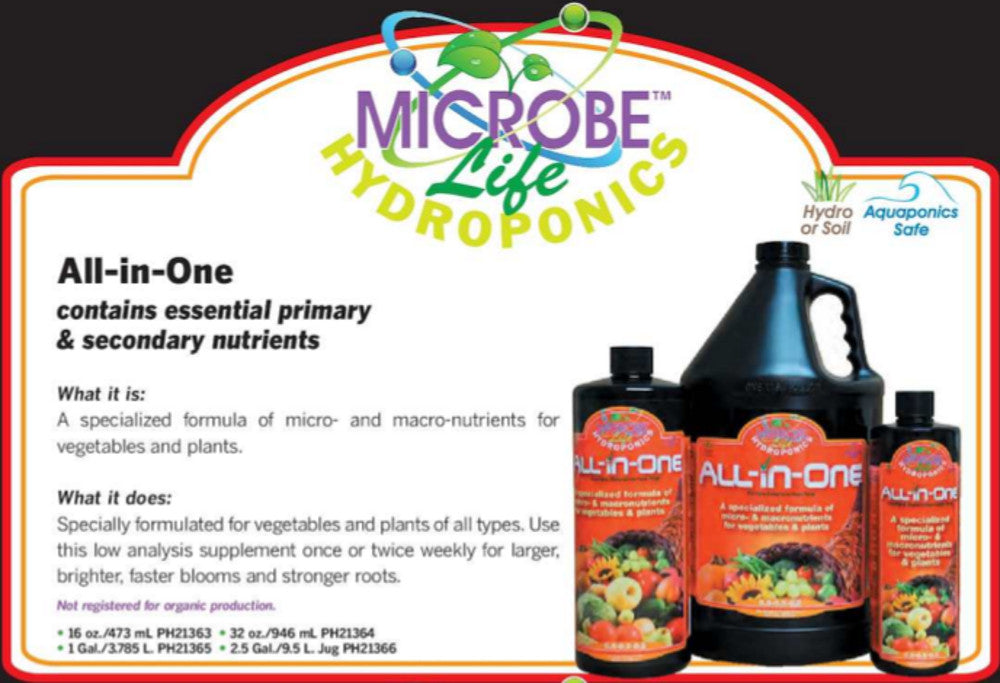
allintitle:best fertilizer for hydroponic plants Microbe Life All-in-One, 1 qtAll In One Fertilizer by Microbe Life Hydroponics Easy, Versatile Nutrition for Every Plant Finding the right fertilizer for all your plants can be a challenge, but All In One Fertilizer by Microbe Life Hydroponics makes it easy! Packed with essential vitamins and minerals, this all purpose fertilizer provides everything your garden needs to thrive. With a balanced mix of NPK plus sulfur, calcium, copper, magnesium, and iron, it helps prevent plant

All-In-One Fertilizer by Microbe Life Hydroponics – Easy, Versatile Nutrition for Every Plant

Finding the right fertilizer for all your plants can be a challenge, but All-In-One Fertilizer by Microbe Life Hydroponics makes it easy! Packed with essential vitamins and minerals, this all-purpose fertilizer provides everything your garden needs to thrive. With a balanced mix of NPK plus sulfur, calcium, copper, magnesium, and iron, it helps prevent plant disease and supports healthy, resilient growth.

This low-concentration, concentrated formula is perfect for any setup, whether you’re gardening indoors or outdoors. Compatible with hydroponics, irrigation systems, aeroponics, and more, it’s versatile and user-friendly. Plus, you can pair it with any other fertilizer program to give your plants an extra boost. With clear application instructions, All-In-One Fertilizer takes the guesswork out of feeding your plants—just mix, apply, and watch your garden flourish!

Key Benefits for DIY and Home Gardeners:

  • Simple, concentrated formula – just mix and apply!
  • Works with any feeding method – hydroponics, irrigation, aeroponics, and more
  • Easily combines with other fertilizers for maximum results
  • Available in three sizes with subscription options for convenience

Application Directions:

Shake thoroughly before use and store in a cool, dry place away from sunlight.

  • Mix 1-2 ounces (30-60 ml) of All-In-One Fertilizer per 10 gallons (38 L) of water.
  • For larger areas: Do not exceed 50 concentrated gallons per half-acre per year.

For an easy, all-in-one solution that keeps your plants healthy and vibrant, try All-In-One Fertilizer by Microbe Life Hydroponics—the perfect choice for home gardeners who want effective, hassle-free plant care.

Shipping Notes
  • Free Standard Shipping on $100+ Orders to the USA.
  • Except Preorder products are shipped in 48 hours.
  • Delivery to the USA:
  1. Standard Shipping : 3-10 business days
  • If time is of the essence, please consider selecting expedited delivery for faster service.
Exchange/Return Notes
  • We offer a 30-day return/exchange service after receiving.
  • Final sale items are not eligible for returns or exchanges.
  • To process your return/exchange, please contact us at [email protected]
  • Please click here for more details>>> Return & Exchange Policy
SKU: 1962299547

Discover Niche Categories That Outsell allintitle:best fertilizer for hydroponic plants

Top-Converting Item to Boost Your Average Order

4.2 ★★★★★
Based on 19 reviews
Sort
Highest Rating
Newest First
Oldest First
Product Reviews
J
Verified Purchase
James Secora
Belleville, US
★★★★★ 5
A readable set of reflections on Faith, Hope, and Charity
Format: Hardcover
Cardinal Raniero Cantalamessa offers a series of wonderful theological and spiritual insights into the three theological virtues of Faith, Hope, and Charity. Taking presentations on each of the virtues, the Cardinal edited each into smaller units, each three to four pages in length. This makes for easy reading (one could take a selection a day) for "lectio divina". His treatment of "Justification by Faith" puts what has been a "thorn of contention" into easily understood terms that can open itself to ecumenical dialog with other Christian denominations for whom this has been a point of misunderstanding of the Catholic position.
WAS THIS REVIEW HELPFUL?YesReportShare
Reviewed in the United States on October 18, 2024
E
Erik D. Curren
Port Orchard, US
★★★★★ 5
We can all be wise men bearing gifts to Jesus
Format: Hardcover
Faith, hope, and charity are not just virtues that we can develop to bring ourselves closer to God and our fellow person but they are also gifts that we can bring to God, writes this household preacher to two Popes. Cardinal Cantalamessa writes on serious topics with an accessible and joyful style that welcomes the reader to see him or herself as one of the Magi bringing precious and deeply meaningful gifts to Christ.
WAS THIS REVIEW HELPFUL?YesReportShare
Reviewed in the United States on November 14, 2024
R
Rocco
Alexandria, US
★★★★★ 5
Cardinal Cantalamessa is a Saint!
Format: Hardcover
This book has the wisdom of the fathers infused with the gentle Grace of the Holy Spirit, written for modern day Christian readers.
WAS THIS REVIEW HELPFUL?YesReportShare
Reviewed in the United States on December 20, 2024
J
jpmath
Natrona Heights, US
★★★★★ 4
Beautiful and profound, albeit flawed
Format: Hardcover
What I'd really like to rate this is 4 1/2 stars, because it isn't perfect, but it's better than a 4. I just can't bear to give it a 5, for reasons described below. The book has three main parts, each named for a theological virtue of the title. Altogether there are 40 chapters: 14 dedicated to faith, 10 to hope, and 16 to charity. A couple of "Bonus" chapters called "Excursus" take up some interesting theological questions that are related but don't quite fall under any one topic: did Jesus possess the theological virtues? and From God as Love to the Filioque. The book is deeply learned and cites theologians through the centuries, including a few I'd never heard of despite a lot of formal and informal theological study. Of course you meet the usual suspects such as Origen, pseudo-Dionysius, Augustine, Thomas Aquinas, Catherine of Siena, John of the Cross, Mother Teresa, and others; but: have YOU heard of St. Zeno of Verona before? If not, you're in for a treat! The text has more of an Augustinian flavor than a Scholastic one. (I should qualify that claim by admitting that I am at best an armchair theologian, so don't quote me on that.) But, for example: Chapter 39 discusses Beauty, uses the idea of God's eternal Beauty to explain the Trinity, and concludes with St. Augustine's "recipe" for becoming beautiful. Indeed, an in-depth discussion of the Trinity doesn't appear at all until Part 3 on Charity, rather than in the chapter on Faith! An important distinction that Fr. Cantalamessa draws is between "objective" aspects of a theological virtue and the "subjective" aspects of the same. The "objective" aspects refer to the object of the virtue, such as God Himself; the "subjective" aspects refer to how we experience them. He points out that, historically, the "objective" view tended to predominate in theological discussion, whereas the "subjective" view tends to dominate more recently, almost to the exclusion of the objective. It will probably not surprise the reader that Fr. Cantalamessa, former Preacher to the Papal Hosuehold, comes down squarely in the Catholic approach of "both/and", and he elaborates on this. A very appealing aspect of this book is the occasional use of parable and analogy to explain difficult subjects: a parable on trying to justify ourselves by our works (Ch. 7), analogies for "the hint that God exists" (ch. 5), the analogy of the seed (ch. 14), an analogy that hope needs difficulties and tribulations (ch. 22), the Trinity (ch. 29), God's love for us is erotic (ch. 34), and how we might hope that even Nietzsche can be saved (ch. 37). Many analogies, though not all, are drawn from ordinary family life: a mother's love for a child, a child's temper tantrum before collapsing in tears on a parent. These are powerful and effective. Unfortunately, I can't rate it 5 stars, because the text seems to consider its audience to be the average educated lay Catholic, but there are two serious weaknesses both for the theological newbie and even for the theological adolescent. One is the use of many unfamiliar terms, some of them merely transliterated from Greek, and no definition given anywhere -- often, not even a hint of what the word may mean. In some cases this can make it difficult to follow the discussion. For instance, the text dedicates two entire chapters to the question of justification, which makes sense given that it's an important topic in the realm of faith, and it's important to take it seriously. But the book never once provides a definition, which suggests the reader should be familiar with the term already. I guarantee you most people don't know what the word means. But even if you think that a definition of "justification" will indeed come tripping off the average reader's tongue, I challenge you to make a case for terms like ontological, parousia, and parenesis. I've been reading Catholic theology for 30 years and parenesis is a new one even to me. Sure, the reader might could look them up, and I'm glad to expand my vocabulary, but who's the audience here? If the text is meant only for seminarians, then never mind, but given how Word on Fire is marketing this I really don't think that is the case. The second major weakness is all the more disappointing, as it is so common to contemporary works of theology: when newer developments seem to contradict past dogma or even Scripture itself, pretend the dogma and Scripture doesn't exist. This happens at least twice: 1) Surely Fr. Cantalamessa is not unaware that Scripture both Old and New is replete with references to Christ "ransoming" us from God's wrath. Yet there he is in Chapter 31, not merely acting as if it doesn't exist, but contemptuously dismissive of the notion! Grant the Scholastics this much: at least they took Matthew 20.28, Romans 1.18, Romans 2.5-8, 1 Timothy 2.6, 1 Peter 1.18-19, and Revelation 19.15 seriously enough to wrestle with them. 2) Similarly, the Council of Florence made certain pronouncements on "those existing outside the Catholic Church" and "the souls of those who depart this life in actual mortal sin, or in original sin alone." Chapter 14 acts as if they do not exist. I do not for a moment mean to advocate for the "glass half-empty" interpretation of these pronouncements that predominated theological discourse for centuries, let alone for Feeneyism, but we ignore them at our peril, if only because ignoring them leaves a great big breach in the apologetic wall that will come under assault both from those who do reject the Second Vatican Council and from hostile Protestants more knowledgeable of Catholic theological history than the average Catholic and, one half-wonders, the average Catholic theologian. Those drawbacks, while severe enough in my eyes to warrant mention and deduct a star, do not for a moment take away from the beauty and profundity of the rest of this work. I am very glad to have had the chance to read it; it has challenged me both intellectually and spiritually, and I have given it to my (late teenage) children to read and discuss with me. It is absolutely worth reading, and you WILL get a lot out of it. Just be ready for the challenge.
WAS THIS REVIEW HELPFUL?YesReportShare
Reviewed in the United States on July 25, 2025
S
Verified Purchase
shelly turco
Fort Morgan, US
★★★★★ 5
OPEN YOUR EYES
Format: Paperback
Great book! Open your eyes sheep..... there is much more to this world that we know of. Authority figures have lied to us long enough..... do your own research. This book is a great example of what we were not taught in school! Well written.
WAS THIS REVIEW HELPFUL?YesReportShare
Reviewed in the United States on February 14, 2021

recommand products