Pay in installments of $7.04 with
 ,
,
 and
and

Shipping Estimate
USA
- USA
- CAN
- USA
- CAN
Ships within 48 hours · Estimated delivery Sep 9 - Sep 14
 Promo Codes Available:
For Your Every Summer RSVP, with Code: SUMMER15
Description
plant monkey puzzle seeds Monkey Puzzle Nuts (Araucaria) – Experimental Farm Network Seed StoreAraucaria araucana Origin: Chile (via Washington State) Improvement status: Landrace Seeds per packet: 7 seeds for $9. 45 ($1. 35 each) 15 seeds for $18. 75 ($1. 25 each) 30 seeds for $34. 50 ($1. 15 each) 50 seeds for $50 ($1 each) 100 seeds for $80 ($0. 80 each) 500 seeds for $250 ($0. 50 each) BOTANICAL SAMPLE NOT GERMINATION TESTED Life cycle: Perennial Monkey Puzzle is the common name given by some long dead Englishman to this extraordinary
Araucaria araucana
Origin: Chile (via Washington State)
Improvement status: Landrace
Seeds per packet:
7 seeds for $9.45 ($1.35 each)
15 seeds for $18.75 ($1.25 each)
30 seeds for $34.50 ($1.15 each)
50 seeds for $50 ($1 each)
100 seeds for $80 ($0.80 each)
500 seeds for $250 ($0.50 each)
BOTANICAL SAMPLE - NOT GERMINATION TESTED
Life cycle: Perennial
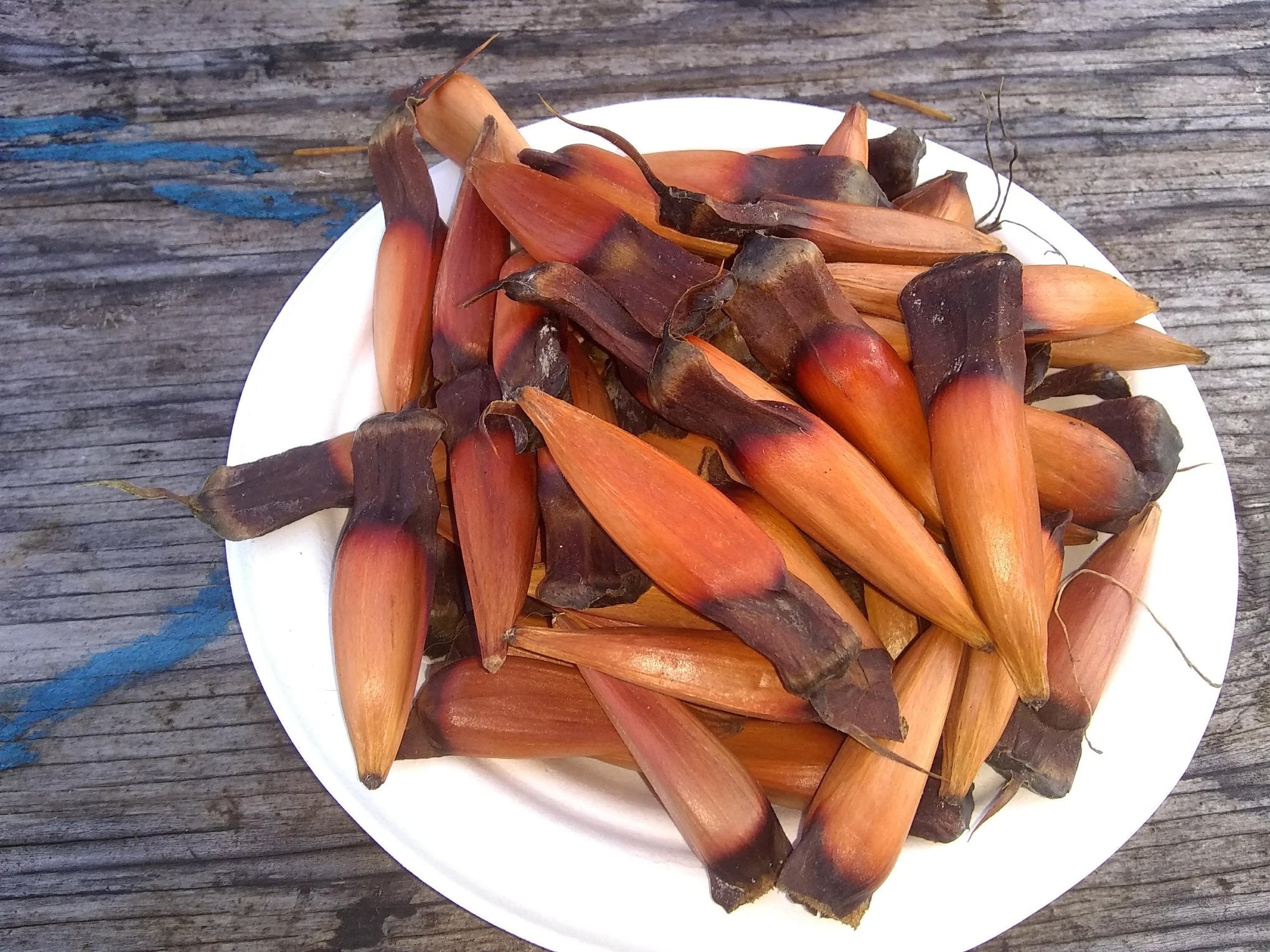
Monkey Puzzle is the common name given by some long-dead Englishman to this extraordinary Chilean pine relative (he's said to have remarked something along the lines of "that tree would puzzle even a monkey trying to climb it!"). It was and largely remains a curiosity in most places outside its native range, grown as an ornamental specimen tree in botanical gardens and front yards around the world (especially in the UK, where it thrives), but this means we non-Chileans have been overlooking the most important use of this tree: food!
Indigenous Chileans, particularly the Mapuche people, have been eating Monkey Puzzle seeds for thousands of years. Resembling pine nuts, but more like chestnuts in flavor and texture, they are three or four times the length of the average pine nut, and probably at least ten times larger by weight. Seed flesh is starchy and low in oil. They are born on 8-inch diameter cones with up to 300 seeds per cone. The cones remain on the tree but release nuts as they ripen, making them relatively easy to harvest right off the ground. What's more, individual trees can live and be productive for over a thousand years! The only downside to using this tree in agriculture (as with other conifers) is that it can take 20+ years to reach bearing age. Male trees, however, often begin flowering at an earlier age.
Our seed was harvested from plantings in the Seattle area by our great friend and collaborator Chris Homanics. Despite this tree's obvious merits, a number of fruitful Monkey Puzzles in Washington and Oregon have been cut down in recent years, and as such it has become increasingly difficult to locate trees from which to collect seed. Thankfully Chris is on the case, and we hope to make offering these a regular occurrence. The seeds are not likely to keep beyond this season, so we urge you to plant whatever you buy before this spring!
NOTE: These seeds have been treated with a weak hydrogen peroxide solution (2700 ppm) to prevent mold growth, which is Chris' standard practice at this point for both monkey puzzle seeds and chestnut seeds.
INSTRUCTIONS: These are fresh seeds harvested in late summer 2025. If you wish to start them indoors right away, you should have the best luck chilling them in your fridge for a week before starting them. If you wish to start them in the spring, and therefore plan to store them for an extended period in the fridge, place them in a moistened bag with or without media. The tag-end of the seed is prone to forest mold, so check on them every so often and rinse occasionally.
They should last many months. Best planted in a greenhouse or warm locale when temperatures reach into the 70’s – similar to tomatoes. Monkey Puzzle seems to do fine in a normal potting mix but could benefit from an acidic potting-soil mix. Choose deep pots like 2-gallon pots or tree pots or band pots that have root pruning holes, as they establish a deep taproot early. Plant by pushing the pointed tip into soil until the rounded “top” and “tag” is poking above the soil level. [Nate has also had good luck lining them up like sardines, reversing direction with each one, on the surface of a lightly moistened peat-based growing medium half-filling a gallon zip-lock bag — with the bag sealed, the young trees will thrive for up to a year until being repotted or planted out.] Once established in their nursery pot for 1-2 years, they can be carefully transplanted to the field. Despite their fearsome appearance, they should be protected from critters who may nevertheless rip them from the ground to munch on their swelling taproots. Trees can tolerate heavy clay soils but not standing water which can cause the roots to succumb to disease. Best planted in a full sun area, but will accept partial shade as well. Provide irrigation during dry spells for the first few years until establishment, but once established, Monkey Puzzles are very drought-resistant. (Cuttings can be rooted, but similar to other pines, this process is difficult and takes a long time to callus and establish roots. Superior trees have been successfully veneer-grafted onto seedling stock, though we have never seen this done in person.)
This species is well-adapted to USDA Zones 7–9 in sites with full sun and regular moisture. With extra care it is possible in zone 6 as there are some older established trees in colder areas (like the mountains at the New York/New Jersey border and Longwood Gardens in Pennsylvania). Monkey Puzzle is especially viable for maritime bioregions with low heat units during the growing season. It’s no surprise it grows well in the Pacific Northwest from Vancouver Island to Northern California. There are also quite a few mature trees in the British Isles and France. For reference, in its native environment, it is usually found on mineral-rich acidic volcanic ash soils with low nitrogen and it typically associates with endomycorrhizal fungi (unlike pine trees, which associate with ectomycorrhizal fungi). But, like pine, it may benefit from spreading duff from an established Monkey Puzzle tree if you happen to have one nearby. You are encouraged to plant at least several trees per locale within several hundred feet with good line-of-sight to produce nuts. Normal tree care is necessary, such as mowing, weeding, mulching, and adequate irrigation while establishing.
We strongly recommend you buy at least 5 or 10 seeds, as they may not all germinate successfully, they may sprout but then meet an untimely end, and you will want to have at least one mature pollen-producing tree and one nut-producing tree eventually.
Below is a monograph written by our source for these seeds about the history and potential of this amazing tree.
_____________________________
A TREE BRONTOSAURUS COULD NOT BROWSE
by Chris Homanics
Monkey Puzzle (Araucaria araucana) - Piñonero, Chilean Pine, Pehuén
What’s for dinner? Tonight I’m roasting Monkey Puzzle nuts, a relatively obscure relative of pines which originated in South America but has been planted here and there along the west coast as well as elsewhere in the US. Instead of an oily center like the related pine nuts, the flesh is starchy like a chestnut or potato, seasoned with a dash of pine nut oil. With a very pleasant mouth feel which is slightly chewy in all the right ways, its moist flesh melts away in your mouth. Quite appealing, they leave you longing for another. But, unlike the often diminutive size of the pine nut, these seeds are much larger measuring about 1.5in long and are about as narrow as a finger. The nuts which are an attractive shiny reddish light brown hue have a paper-like shell akin to a chestnut. Also like the chestnut, once roasted, the shell is easily shattered away revealing a delicious nutmeat which can be easily pulled out and removed. When raw they can be prepared by cutting away the shell for a crunchy and slightly sweet snack.
Traditionally, the Pehuén is a sacred tree to the Mapuche people who roast or boil these nuts or grind them into flour to make bread. An alcoholic drink called ‘mudai’ is also made from the nuts and is used in traditional ceremony. The botanical name Araucaria derives from a Spanish name for the Mapuche people, ‘Araucari, who inhabit a region of the Andean mountains of south-central Chilé to southwestern Argentina.
Growing eventually to 200 ft tall and beyond, the Monkey Puzzle stands tall with a rigidly straight stature and a steep narrow pyramidal form, giving it a commanding presence in the landscape. Its graceful cylindrical branches bifurcate and spread out in well-spaced upward arcs, bouncing and swaying in the gusts of wind. These branches are protected by whorls (verticils) of sharp, fibrous, scale-like triangular leaves. Thick flaky bark insulates it well from fire regimes. It's the hardiest species within the Araucaria genus, often found growing in higher altitude mountain valleys. These trees have an average lifespan easily spanning hundreds of years. The oldest known representative of the species was core-dated to 1,021 years old, with several more coming close to that.
Araucaria araucana is almost always dioecious, with seed-bearing and pollen-bearing cones born on separate trees. Though monoecious trees are rumored to exist, I have never observed them. Female seed-bearing cones are some of the largest amongst the Conifers rivaling the Coulter Pine (Pinus coulteri) with male cones being characteristically narrower. Female nut-bearing trees typically take 20 years to produce seed, with about 40 years for good production. Male trees however typically begin flowering much sooner (one tree in Olympia, Washington began flowering after only 8 years). The trees are wind-pollinated and should be planted within 200 feet of each other with a good line-of-sight. Males seem to be slightly more common so make sure to plant at least four to have good chances of having both sexes. This is a long-term tree crop for our future generations!
Cones tree-ripen in waning heat of late summer making it fit a niche crop for the market as an early-season chestnut-like starchy nut crop. As the cone dries, its scales loosen and the seeds shatter freely. As the tree branches shake in the wind, the small wings on the seeds help scatter the seed far from the mother tree. With the genera, an even more stark example of this trait can be seen with the New Caledonia species Araucaria montana which releases seeds that helicopter and flutter in the wind similar to maple.
While there are quite a few New Caledonia species, none appear to be worthwhile nut crops nor hardy in temperate regions. However, other species worth exploring are the Bunya-Bunya (Araucaria bidwillii) which is adapted to zone 9 or higher. But, most promising is the Paraná Pine (Araucaria angustifolia) which is classified in the same section of the Araucaria genera and though is from Brazil it is surprisingly hardy and worth planting more extensively. There is at least one surviving planting in Seattle of all places! I have seen several trees including established trees in Oregon and a number in Northern California. Further, Monkey Puzzle hybrids with A. angustifolia apparently exist and would be worth exploring as they may confer precocity or monoecious plants with both male and female cones.
This utilitarian species has a long history of use for food, medicine, and wood products. The dry-weight breakdown of the nutmeat is 64% Starch, 25% Dietary Fiber, 7% Sugars, 2% Oils, and 1% Protein. A majority of the starch is easily-digestible glucose-based polysaccharides, while 42% of starch is amylose, a resistant form of starch making it lower on the glycemic index than many starch-based foods. The related Paraná or Pinhão (Araucaria angustifolia) was found to have a nutritional analysis (mg/100g): Phosphorus 103mg, Magnesium 55mg, Calcium 13mg, Zinc .8mg, Copper .3mg, and Iron .7mg. The tree also has some traditional uses for the resin which include dressing wounds, treating bruises, and ulcers. The nuts, particularly the shells, are high in quercetin, a flavonoid which acts as a zinc ionophore and has antiviral activity against viruses including COVID-19 (SARS-CoV-2). This species has prebiotic and antimicrobial properties as well. The timber is softwood with straight grain, light brown in color, with occasional red/yellow hues, odorless. Easily to work and turnable. A specialty wood with possible usages in furniture, plywood, and turned objects, etc.
Long ago, ancestors of this tree towered above the earthbound dinosaurs, while flying reptiles and early avians flew amongst the branches, and comparatively small mammals scurried below. An early pine relative in the order of the Pinales, it’s impressive that this lineage is still with us today some 175 million years later after enduring a myriad of wild planetary climatic swings and major extinction events.
Earlier relatives of the Monkey Puzzle offered a softer, more palatable forage for long-necked dinosaurs. Imagine something akin to everyone’s favorite indoor conifer — the Norfolk Pine (Araucaria heterophylla) — the oft-used stand-in Christmas tree here in the US. During the Late Cretaceous-Tertiary boundary (~ 66 mya, or million-years-ago) it is speculated that in response to this predation, the Monkey Puzzle developed sharp, fibrous, scale-like triangular leaves, perhaps lending to its existential durability.
The Araucariaceae family lineage was a dominant forest canopy species in the tropical jungles and subtropical forests across not only the former supercontinent Gondwana — Antarctica (Araucaria fildesensis 56-38 mya), Australia, and South America (Araucaria mirabilis 160 mya) — but fossils of relatives have also been found in China, Japan/Russia (Araucaria nipponensis 100-66 mya), Arizona, Europe, and Madagascar (Araucaria sp. ~220 mya). This was once a globally ubiquitous plant family.
As we follow the Araucaria backwards in time, we come to a living fossil tree called the Wollemi Pine (Wollemi nobilis) which was found extant growing in a small valley in New South Wales, Australia circa 1994. Nearly identical fossils dating to the beginning of the Jurassic (~200 mya) have been found elsewhere on the continent. Wollemi appears to be close to the divergence point where one branch leads to Araucaria, Yellowwood/Plum Pine (Podocarpaceae), Umbrella Pine (Sciadopitys verticillata), Yews (Taxaceae), and Cypress (Cupressaceae), while the other branch evolved to become the Pines, Cedar, Fir, Spruce, etc (Pinaceae). Interestingly, part of a broader lineage called the Cordaites which gave rise to the Ginkgo — the progenitor of the true-flowering plants.
Speaking of these Cordaites, the Araucaria lineage first appears amongst petrified remains of an ancient Arizona fossilized forest dating to the Late Triassic (237-201 mya). There were discovered remains of one of the oldest ancient conifer fossils ever found. In 1905, John Muir described that the structure of the fossilized wood happened to bear some resemblance to the wood structure of Araucaria. Unfortunately, the massive volcanic hot ash flow which preserved these fossils happened with such force that it either burnt off or shredded all the leaves of this forest. Among the oak tree and other fossils, Woodworthia arizonica and Araucarioxylon arizonicum (probably actually multiple species) are found. Woodworthia was unusual in that it had a trunk which was covered in vegetative nodules along its trunk — perhaps as a sacrifice to foraging Dinosaurs or as a fire adaption?
The Araucaria genus seems to have had its apogee around the Late Cretaceous-Tertiary boundary (~66 mya), afterward significantly shrinking as ice sheets advanced over a rapidly cooling planet due to a precipitous drop in carbon dioxide levels. Several factors likely have led to extinctions and range restrictions in the Araucariaceae family. In the deeper past, as continental drift broke apart the supercontinent Gondwana, once ideal geographic bioregions drifted further from the equator and into colder temperate climes. In the Northern Hemisphere this was likely a large factor in the eventual extinction of species there. In the Southern Hemisphere, as the species compositions of jungle environments changed, Araucaria may have been crowded out by the proliferation of true-flowering hardwood trees that were able to better dominate as climax species. While in other environments where contemporary conifers tend to dominate, they were perhaps again out-competed by the arrival of better-adapted conifer species. Later, in the Quaternary period (2.58 mya to 11,000 ya), as large macro-mammals began to go extinct, many large-seeded species and masting species (i.e. nut-bearing) began disappearing. Range restrictions also occurred as rodent or rodent-like symbionts were removed along with their dispersal habits. In recent times, large-scale ecological changes and over-harvesting caused by humans have further restricted the range of Monkey Puzzle trees.
However, Araucaria persisted, albeit range-restricted in the Southern Hemisphere continents of Australia, South America, and the South Pacific. New Caledonia is the current biodiversity hotspot, an island archipelago in the middle of the Pacific which broke free from Australia and became isolated around 66 million years ago. Among the many unique and bizarre species that find these rocks home, a substantial number of both surviving and recently radiated species persist. These are good candidates for conservation in tropical climates.
Monkey Puzzle is now listed as endangered on the IUCN Red List and is steadily disappearing from the mountainous Andean slopes of South America. We have a responsibility to preserve this species by creating conservation plantings around the temperate world, utilizing both its nuts and lumber: preservation through human interaction and dissemination.
It’s my great hope that by offering these seeds here more and more people will come to appreciate the grace, beauty, and utility of this remarkable tree — and we will play a role in ensuring its survival for future generations.
Shipping Notes
- Free Standard Shipping on $100+ Orders to the USA.
- Except Preorder products are shipped in 48 hours.
- Delivery to the USA:
- Standard Shipping : 3-10 business days
- If time is of the essence, please consider selecting expedited delivery for faster service.
Exchange/Return Notes
- We offer a 30-day return/exchange service after receiving.
- Final sale items are not eligible for returns or exchanges.
- To process your return/exchange, please contact us at [email protected]
- Please click here for more details>>> Return & Exchange Policy