SKU: 20454759785
kinderwagen set maxi cosi

kinderwagen set maxi cosi ABC Design Salsa 5 Air - All in One Set Maxi Cosi – Princess

Sale price$21.44 Regular price$23.82
Save 10%

Pay in installments of $5.96 with ShopPay, AfterPay and Klarna

Shipping Estimate
USA
  • USA
  • CAN

Ships within 48 hours · Estimated delivery Sep 5 - Sep 10

Promo Codes Available:

For Your Every Summer RSVP, with Code: SUMMER15

Description

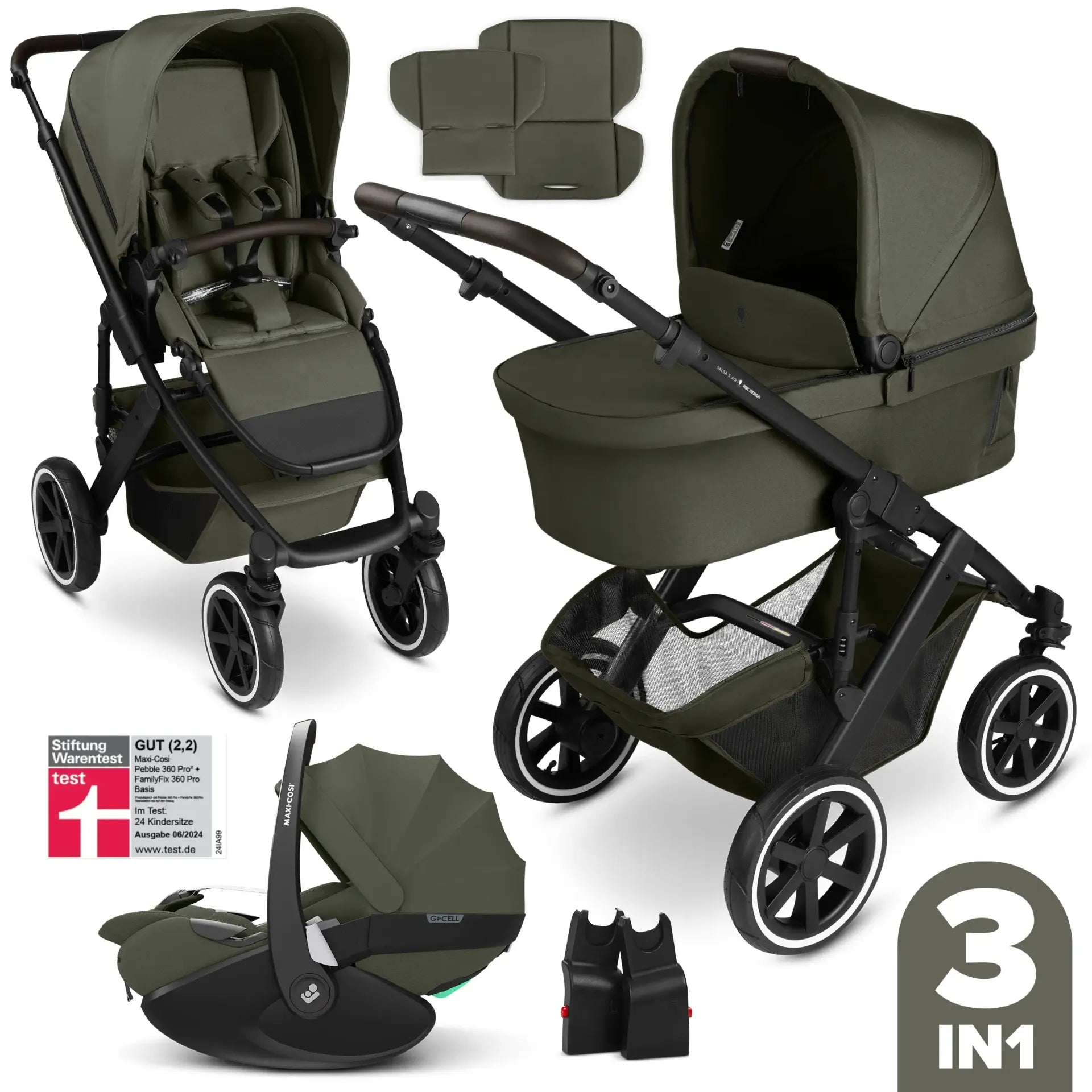
kinderwagen set maxi cosi ABC Design Salsa 5 Air - All in One Set Maxi Cosi – Princess3in1 Kinderwagen Set Salsa 5 Air inkl. Babyschale Maxi Cosi Pebble 360 Pro 2 Mit diesem praktischen Salsa 5 Air Set fhrt Dein Baby vom ersten Tag an sicher, bequem und entspannt: und das im Kinderwagen, auf der Fahrt im Auto und bei Nutzung Deines Salsa 5 Air als Travel System in Kombination mit der Maxi Cosi Babyschale. Dein Kind geniet in Kinderwagen und Babyschale maximalen Liege und Schlafkomfort bei gleichzeitig hchster Sicherheit. Dafr sorgen

3in1 Kinderwagen-Set Salsa 5 Air inkl. Babyschale Maxi Cosi Pebble 360 Pro 2 

Mit diesem praktischen Salsa 5 Air Set fährt Dein Baby vom ersten Tag an sicher, bequem und entspannt: und das im Kinderwagen, auf der Fahrt im Auto und bei Nutzung Deines Salsa 5 Air als Travel-System in Kombination mit der Maxi-Cosi Babyschale. Dein Kind genießt in Kinderwagen und Babyschale maximalen Liege- und Schlafkomfort bei gleichzeitig höchster Sicherheit. Dafür sorgen zwei starke Begleiter, die kombiniert als Set herausragende Komfort- und Sicherheitsfeatures vereinen: der ABC Design Salsa 5 Air Kombikinderwagen und die Babyschale Maxi-Cosi Pebble 360 Pro².

Nature als exklusives Set-Design

Natürlich passt die Maxi-Cosi Babyschale farblich optimal zum Look Deines Kinderwagens. Exklusiv für die aktuelle Kooperation und das 3in1 Kinderwagen-Set ist die Maxi-Cosi Pebble 360 Pro² im Design Nature erhältlich und ist so nicht nur in Sachen Sicherheit und Komfort eine wunderbare Ergänzung, sondern auch beim Look.

Der Salsa 5 Air mit Luftreifen im exklusiven Set für Alltag & Abenteuer

Mit dem Salsa 5 Air als vielseitigen Kombikinderwagen bist Du überall sorglos unterwegs. Egal, ob auf Gehwegen in der Stadt, beim Spaziergang im Grünen oder auf unbefestigten Wegen im Gelände, der Salsa 5 Air überzeugt dank seiner großen Luftreifen, hochwertigen Kugellager und integrierter Federung auf jedem Untergrund mit herausragender Laufruhe und höchstem Fahrkomfort.

Für Dein Neugeborenes ist die Babywanne mit unserer ergonomischen und atmungsaktiven CozyCloud® Matratze mit keilförmig gestaltetem Kopfende und erhöhtem weichen Schutzrand sowie zwei individuell nutzbaren Belüftungsfenstern der perfekte Ort für jedes Abenteuer. Wenn Du mit dem Auto unterwegs bist, faltest Du die Babywanne platzsparend zusammen und verstaust sie so leichter im Kofferraum.

Sobald Dein Schatz größer ist, wechselst Du unkompliziert auf den Sportwagenaufsatz, der in Sachen Komfort und Sitzklima dem hohen Komfort-Level der Babywanne in nichts nachsteht. Die gepolsterte Rückenlehne des Salsa 5 Air lässt sich 4-stufig verstellen und so ideal an die Bedürfnisse Deines Kindes anpassen. Je nach Bedarf wechselst Du von einer aufrechten Sitzposition, in eine Ruhe- oder komplett flache Liegeposition. Zusätzlichen Halt bietet die weiche und atmungsaktive Komfort-Sitzeinlage. Ein Belüftungsfenster aus feinem Mesh-Gewebe ist außerdem in die Rückenlehne integriert und sorgt durch die Luftzirkulation für ein angenehmes Sitzklima. Natürlich ist Dein Kind auch optimal gesichert. Das innovative HappyBelt® 5-Punkt-Gurtsystem ist dank praktischem Magnetverschluss und von vorne zugänglicher stufenloser Gurtverstellung einfach einzustellen. Die bequem gepolsterten Schultergurte stehen etwas von der Rückenlehne ab, so dass Du Dein Baby viel einfacher hineinsetzen kannst.

Der Salsa 5 Air überrascht darüber hinaus mit einem sehr kompakten Faltmaß und lässt sich auch mit Sportwagenaufsatz kinderleicht zusammenklappen – und das völlig unabhängig davon, ob der Sitz zu Dir oder nach vorne gerichtet ist.

Maxi-Cosi Babyschale Pebble 360 Pro² mit flacher Liegefunktion in Set enthalten:

Mit der im Travel-Set enthaltenen Babyschale Maxi-Cosi Pebble 360 Pro² bist Du auch für Autofahrten optimal ausgestattet und kommst mit Deiner Familie sicher und entspannt an Euer Ziel: egal, ob eine kurze Fahrt zum Supermarkt ansteht oder eine längere Fahrt in den Familienurlaub.

Von Geburt an liegt Dein Baby in der Maxi-Cosi Pebble 360 Pro² bequem und sicher. Die Babyschale verfügt über drei wählbare Liegepositionen. Mit der vollständig flachen Liegeposition genießt Dein Kind maximalen Schlafkomfort unterwegs. Auf jeder Fahrt, egal ob auf dem Gestell des Kinderwagens angebracht oder im Auto.

Die Babyschale kannst Du einfach mit dem 3-Punkt Fahrzeuggurt befestigen. Als Zubehör bietet Maxi-Cosi mit der Family Fix 360 Pro auch eine passende Isofix Basis an. In Verbindung mit dieser dreh- und ausziehbaren Basisstation lässt sich Dein Kind mühelos drehen und zu Dir sliden. Damit ist das Hineinsetzen und Herausnehmen Deines Kindes im Alltag besonders einfach.

Ein Maximum an Sicherheit und Komfort zeichnen die Pebble 360 Pro² aus, die Dein Baby vom ersten Lebenstag an bis zum Alter von ca. 18 Monaten (40 bis 87 cm) begleitet. Von der Stiftung Warentest erhielt die Maxi-Cosi Pebble 360 Pro² in Verbindung mit der FamilyFix 360 Pro Basis das Testurteil GUT (2,2) - Zeitschrift Test - Ausgabe 06/2024.

Ausgestattet mit ClimaFlow Belüftungselementen, atmungsaktivem Schaumstoff und bequemen Mesh-Stoffen für eine verbesserte Luftzirkulation, hat es Dein Kind bequem und entspannt in der Pebble 360 Pro². Die verstellbare Kopfstütze und die herausnehmbare Neugeboreneneinlage sorgen für eine ergonomische Haltung und damit optimale Atmung Deines Babys in der Babyschale.

Mit den ebenfalls im Set enthaltenen Adaptern kannst Du Deine Maxi-Cosi Pebble 360 Pro² schnell und unkompliziert auf dem Gestell Deines Salsa 5 Air befestigen. Dein ABC Design Kinderwagen wird so zum praktischen Travel-System, mit dem Du Einkäufe oder auch kurze Wege mit Deinem Baby zurücklegen kannst. Ist Dein Baby bspw. während der Fahrt im Auto eingeschlafen und Du erreichst Dein Ziel, wechselst Du einfach und ohne Dein Kind wecken zu müssen zwischen Auto und Deinem Salsa 5 Air Kinderwagen. Da die flache Liegeposition der Pebble 360 Pro² auch bei Befestigung der Schale auf dem Gestell des Kinderwagens genutzt werden kann, ist ein durchgehend hoher Liege- und Schlafkomfort für Dein Kind sichergestellt.

Natürlich passt die Maxi-Cosi Babyschale farblich optimal zum Look Deines Kombikinderwagens und ist so nicht nur in Hinblick auf Sicherheit und Komfort eine wunderbare Ergänzung, sondern auch beim Design.

Top-Features

Überall zu Hause dank Lufträder

Für Stadtflitzer & Naturfreunde: Die schwenkbaren Lufträder des All-Terrain Kinderwagens Salsa 5 Air sorgen für einzigartigen Fahrkomfort auf allen Untergründen. Entdecke die Welt mit Deinem Kind, ohne Kompromisse bei Komfort oder Mobilität.

Sanft & sicher: Federung der Extraklasse

Mit der erstklassigen Federung des Salsa 5 Air genießt Dein Kind auf jedem Gelände höchsten Komfort. Ob Waldwege, Parks oder Asphalt – die spezielle Federung gleicht alle Unebenheiten aus. Perfekt für Spaziergänge und erholsamen Schlaf unterwegs.

Babywanne mit extra Handling-Komfort

Der Faltmechanismus der Wanne ist von außen zugänglich. Über Schieber am Unterboden faltest Du sie platzsparend. Einfaches Handling auch beim Sonnenverdeck. Dank Memory-Funktion löst Du die Verdeckhalterungen nacheinander und verstellst es mühelos.

Zuverlässiger Sonnenschutz unterwegs

Ein extra großes UV-Schutz 50+ Sonnenverdeck, bei tiefstehender Sonne noch zusätzlich über ein Faltdach verlängerbar, schützt Dein Kind optimal. Das integrierte Belüftungsfenster aus hochwertigem Mesh sorgt gleichzeitig für angenehme Luftzirkulation.

Komfort für jede Größe

Den Schieber des Salsa 5 Air passt Du individuell auf Deine Körpergröße an. Ohne die Hinterachse bietet er Dir zudem mehr Beinfreiheit. Ein Vorteil, den speziell große Eltern zu schätzen wissen. Optimaler Schiebekomfort bei jedem Schritt.

Packmeister: Einkaufskorb XXL

Mit dem extragroßen XXL-Einkaufskorb hast Du genug Platz für Einkäufe, Babyutensilien und mehr. Bis zu 5 kg Tragkraft machen ihn zum idealen Begleiter - einfaches Be- & Entladen inklusive. Genieße Freiheit und Flexibilität auf jedem Ausflug.

Sitz mit Wohlfühlfaktor

Der Sitz des Salsa 5 Air ist mit einer ergonomischen Komfort-Einlage kombiniert. Die weiche Polsterung aus atmungsaktivem Material bietet bequemen Halt und zusammen mit dem Belüftungsfenster in der Rückenlehne ein angenehmes Sitzklima.

Sicheres Angurten leicht gemacht

Das innovative HappyBelt® 5-Punkt-Gurtsystem verbindet Sicherheit mit Komfort. Abstehende Schultergurte, ein Gurtschloss mit Magnetverschluss und die von vorne zugängliche stufenlose Gurtverstellung erleichtern das sichere Anschnallen Deines Kindes.

Maximaler Sitz- und Schlafkomfort

Auch Weltentdecker werden müde. Die Rückenlehne lässt sich daher verstellen und so an die Bedürfnisse Deines Kindes anpassen. Je nach Bedarf wählst Du unterwegs zwischen einer aufrechten Sitzposition, entspannten Ruhe- oder flachen Liegeposition.

Hochwertiges und langlebiges Design

Der vielseitige Salsa 5 Air ist robust und überzeugt auf jedem Untergrund. Dass er belastbar ist, zeigt auch die mögliche Maximalbelastung von 27 kg. Kinder fahren bis 22 kg problemlos mit und der Einkaufskorb fasst bis zu 5 kg Zuladung.

Shipping Notes
  • Free Standard Shipping on $100+ Orders to the USA.
  • Except Preorder products are shipped in 48 hours.
  • Delivery to the USA:
  1. Standard Shipping : 3-10 business days
  • If time is of the essence, please consider selecting expedited delivery for faster service.
Exchange/Return Notes
  • We offer a 30-day return/exchange service after receiving.
  • Final sale items are not eligible for returns or exchanges.
  • To process your return/exchange, please contact us at [email protected]
  • Please click here for more details>>> Return & Exchange Policy
SKU: 20454759785

Discover Niche Categories That Outsell kinderwagen set maxi cosi

Top-Converting Item to Boost Your Average Order

4.3 ★★★★★
Based on 28 reviews
Sort
Highest Rating
Newest First
Oldest First
Product Reviews
B
Verified Purchase
Brian Mulvey
Massapequa, US
★★★★★ 5
The only system to replace capitalism m
Format: Paperback
Professor Wolff has written Marxism in an easy to understand, simplified pamphlet. I have listened to many of his podcasts and he speaks very clearly and deliberately so his audience can easily understand. Highly recommended reading for all Americans.
WAS THIS REVIEW HELPFUL?YesReportShare
Reviewed in the United States on December 25, 2024
K
Verified Purchase
Kristofer Carlson
Dallas, US
★★★★★ 5
An excellent introduction
Dr. Richard Wolff has a gift for simplifying complex material, distilling it down to its essence, and delivering it in a winsome manner. His gifts are on display here, for Karl Marx is a hard read. And yet, after reading this introduction, it is possible to catch a glimpse of hitherto unseen trains of Kark Marx's thought. After reading this introduction, it is clear that Marxism is not the same thing as Communism, or Socialism, or Fascism. Marxism is nothing more than an analysis and critique of Capitalism. That analysis and critique is used by many for their own purposes, purposes that have only a tenuous relationship to the source material.
WAS THIS REVIEW HELPFUL?YesReportShare
Reviewed in the United States on October 24, 2020
J
Verified Purchase
Jeff Gardner
Omaha, US
★★★★★ 5
Marxism summarized
Not having read much of Marx’s writing I found this work to be an interesting summary of Marx’s thought and objectives. This work provides a different understanding of Marx and his objectives compared to what I have heard of Marxism both when Marx’s work is referenced in theoretical contexts and (supposedly) put into practice.
WAS THIS REVIEW HELPFUL?YesReportShare
Reviewed in the United States on February 4, 2022
B
Verified Purchase
BBR
Alexandria, US
★★★★★ 5
Facts
Format: Paperback
Very good short book
WAS THIS REVIEW HELPFUL?YesReportShare
Reviewed in the United States on August 1, 2025
T
Verified Purchase
T. Graczewski
Port Orchard, US
★★★★★ 5
Little Giant
Format: Paperback
“Did any other leader in the twentieth century do more to improve the lives of so many? Did any other twentieth-century leader have such a large and lasting influence on world history?” This is how Ezra Vogel concludes his massive 700-page tome, “Deng Xiaoping and the Transformation of China.” Indeed, who else in history has raised more people out of poverty? There may be no definitively right answer, but Vogel makes a convincing case that Deng Xiaoping has a better claim than anyone else. While lengthy, this book is an easy read and provides fascinating insights and lots of detail on how Deng and his forward-thinking policies turned China from a backward, poverty stricken basket case in the wake of the disastrous Cultural Revolution to an economic superpower in a single generation. It has been a revolution every bit as astonishing and impactful to world history as the Japanese Meiji Restoration of the late nineteenth century. Vogel’s narrative focuses mainly on the years from Mao’s death in 1976 to Deng’s retirement in 1992. Deng’s quite eventful first 65 years of life are covered in just 45 pages; China’s dramatic growth over the two decades since his retirement receive a mere 20 pages of attention. This book could have been called the “Deng Restoration,” the decade-and-a-half period when the Chinese leader blazed a new path, normalizing Chinese foreign relations and assiduously laying the political and economic groundwork for China’s improbably rapid rise from a self-isolated Third World Country into a global leader in manufacturing and burgeoning superpower just beginning to stretch its legs and demand its rightful place in the sun, to paraphrase Bismark. What struck me most about Deng’s leadership and policies, besides their remarkable success, was their consistency – and authority. His power was strictly personal, not positional; Deng was never chairman of the Chinese Communist Party, nor Premier of the Chinese government. Rather, he was something else, the “preeminent leader,” officially only vice chairman of the party and chairman of the Central Military Commission. Aging and hard of hearing, he rarely attended Politburo meetings. Yet, “it is doubtful that anyone [other than Deng] had the combination of authority, depth and breadth of experience, strategic sense, assurance, personal relationships, and political judgment needed to manage China’s transformation with comparable success,” Vogel writes. When he came to power in the late 1970s, he had very firm ideas on what needed to be done, plans that Vogel claims matured in Deng’s mind during his long and humiliating five year exile in Jiangxi working at a tractor factory during the Cultural Revolution. First, stability and unity were paramount in Deng’s plans, according to Vogel. He knew that the economic transformation China must go through would be wrenching and tumultuous, and he believed that only the Communist Party, with its discipline and order, could effectively manage the change. He had to maintain a delicate balance between encouraging innovative thinking and freedom of expression while maintaining the unquestioned rule of the Communist Party. In 1978, Deng formulated the Four Cardinal Principles, essentially four red lines that could not be crossed in China (socialist path; dictatorship of the proletariat; leadership of the Communist Party; Marxism-Leninism and Mao Zedong Thought), and he never waivered from them. In fact, his most controversial and unpopular decision – the military crackdown at Tiananmen Square in 1989 – was taken precisely because the protests were openly challenging the Four Cardinal Principles. Although he was an ambitious reformer, he was a Communist first-and-foremost. When his two top lieutenants and official heads of party and state, respectively, Hu Yaobang and Zhao Ziyang, were seen as going soft on dissidents, he had them unceremoniously cashiered. It was the outpouring of love for Hu at his death in 1989, along with frustration at how he had been treated by Deng and the Party, that sparked the Tiananmen protests, a movement that became truly dangerous when Zhao resigned rather than acquiesce to Deng’s call for martial law. Second, vast improvements in science, technology and education would be the cornerstone of Deng’s policies. Vogel describes Deng as obsessed with the importance of education and the critical role in advanced technology in China’s future. At roughly the same time that Deng formulated the Four Cardinal Principles to guide political discussion in China, he also developed the Four Modernizations, the areas in which the government would concentrate efforts to learn, grow and improve: 1) science and technology; 2) industry; 3) agriculture; and 4) defense. Again, Deng and the Chinese government remained steadfast in pursuing these objectives even when they led in politically sensitive directions, such as dropping class background from college admission criteria and instead relying solely on meritocratic entrance exams; encouraging thousands of students to study overseas, especially in Western countries, exposing them to potential “dangerous” ideas; establishing special economic zones (SEZ) along the coast to promote capitalist investment and trade, even though they encouraged graft and corruption; and the dramatic downsizing of the People’s Liberation Army to create a more highly educated and technologically savvy armed forces. “Deng was unique in that he pushed doors open far wider – to foreign ideas, foreign technology, and foreign capital – than his predecessors, and he presided over the difficult process of expanding the opening despite the disruptions it caused,” Vogel writes. Third, Deng was adamant that China must be fully engaged in world affairs. He was very much his own foreign policy strategist and built his policies around a few basic objectives. Above all, Soviet expansion must be stoutly resisted. Deng went to war – “Deng’s War,” Vogel says – with communist neighbor Vietnam in 1979 to “teach Hanoi a lesson.” Namely, that China refused to allow Vietnam to become a hegemonic power in Southeast Asia while serving as the Soviet’s “Cuba in the East.” China’s month-long invasion captured five northern Vietnamese provincial capitals at the cost of 25,000 PLA soldiers killed in action, according to Vogel (that is, China lost half as many men in one month in Vietnam as the US did in a decade!). Next, Deng sought to normalize and improve relations with the Western world, an objective he largely achieved, although the backlash from Tiananmen Square was sharp and prolonged. Finally, Deng desperately wanted to consolidate Chinese territory in his lifetime, achieving peace and stability in Tibet, reintegrating Hong Kong, and, most important of all, reunifying with Taiwan. The last goal was one of Deng’s great disappointments, although he did successfully prevent the Reagan administration from formally recognizing Taiwan and worked to reduce arms shipments to the island nation. “Under Deng’s leadership,” the author writes, “China truly joined the world community, becoming an active part of international organizations and of the global system of trade, finance, and relations among citizens of all walks of life.” Finally, Deng was a political virtuoso, albeit of a distinctly communist variety. Deng was well-described by US Secretary of State Cyrus Vance as “remarkable… impatient, feisty, self-confidently outspoken, direct, forceful, and clever.” Standing just five-feet-tall, with limited formal education and a lifelong habit of using a spittoon even when negotiating directly with world leaders in the West, Deng was nevertheless a man of immense natural ability and innate political instincts. Unlike the “mercurial” Mao, who Vogel describes as “ranked high among world leaders” in megalomania and lust for power, Deng was personally humble, wanting nothing more than to serve his country and then be forgotten. Upon his death, he donated his corneas for eye research, his internal organs to medical science, was cremated and had his ashes scattered into the sea. There would be no “Cult of Deng” if he had anything to say about it. A deeply and sincerely committed communist, he was nevertheless open-minded and had no use for communist dogma. He was highly opposed to Mao’s revolutionary radicalism, yet sensitive to charges of being the “Chinese Khrushchev.” He quickly worked to overthrow the so-called “Gang of Four” after Mao’s death, but steadfastly espoused a flexible, results oriented approach to reform. “It doesn’t matter if the cat is black or white, just so long as it catches mice,” he liked to say. He used his liberal approach to outmaneuver and then oust Mao’s handpicked successor, the middle-aged cipher Hua Goufeng, who stumbled badly in 1977 when he penned an editorial claiming that future policy “will resolutely uphold whatever policy decisions Chairman Mao made, and unswervingly follow whatever instructions Chairman Mao gave” (the so-called “Two Whatevers”). Deng had different ideas – and they would prevail. Although he a had clear vision for where China should go conceptually, Deng honestly admitted that he had to “grope for stones as he crossed the river” the entire time, never knowing for certain which approach was best, but always open to learning-by-doing. “Don’t argue, just push ahead,” was a favorite mantra. His SEZ experiment at Shenzhen was controversial, but ultimately successful beyond anyone’s wildest expectations. And unlike Dahzai, Mao’s experimental ideal collective community, Chinese leaders and others flocked to Shenzhen out of genuine interest rather than political expediency. Twenty-first century China is Deng’s China. If the sun is setting on the American century and rising in the East, no one man had more to do with it than Deng Xiaoping, a man Vogel believes may be one of the greatest men in his nation’s long history. “The transition from a predominantly rural to a predominantly urban society and the spread of common national culture are among the most fundamental changes that have occurred in Chinese history since the country’s unification in 221 BC,” Vogel declares, and it was mainly the work of one little, unassuming man from a small village in Szechuan.
WAS THIS REVIEW HELPFUL?YesReportShare
Reviewed in the United States on August 12, 2014

recommand products