SKU: 22289025587
where to buy aloe vera plants online

where to buy aloe vera plants online Buy 'Large Aloe Vera Plants - Aloe barbadensis' Care and Growing Guide

Sale price$26.49 Regular price$29.43
Save 10%

Pay in installments of $7.36 with ShopPay, AfterPay and Klarna

Shipping Estimate
USA
  • USA
  • CAN

Ships within 48 hours · Estimated delivery Jul 22 - Jul 27

Promo Codes Available:

For Your Every Summer RSVP, with Code: SUMMER15

Description

where to buy aloe vera plants online Buy 'Large Aloe Vera Plants - Aloe barbadensis' Care and Growing GuideIntroducing the fabulous Aloe Vera plant also known as Aloe barbadensis 'miller,' it is also known as a medicinal aloe and burn plant. The Aloe vera plant is by far the most popular out of over 400 varieties of the Aloe genus. This incredible tropical succulent is not your average houseplant. It's a superstar known for its leaves, which hold a magical aloe vera gel for soothing sunburn and as a popular drink to help your stomach. This large Aloe vera

Introducing the fabulous Aloe Vera plant- also known as Aloe barbadensis 'miller,' it is also known as a medicinal aloe and burn plant. The Aloe vera plant is by far the most popular out of over 400 varieties of the Aloe genus.

This incredible tropical succulent is not your average houseplant. It's a superstar known for its leaves, which hold a magical aloe vera gel for soothing sunburn and as a popular drink to help your stomach.

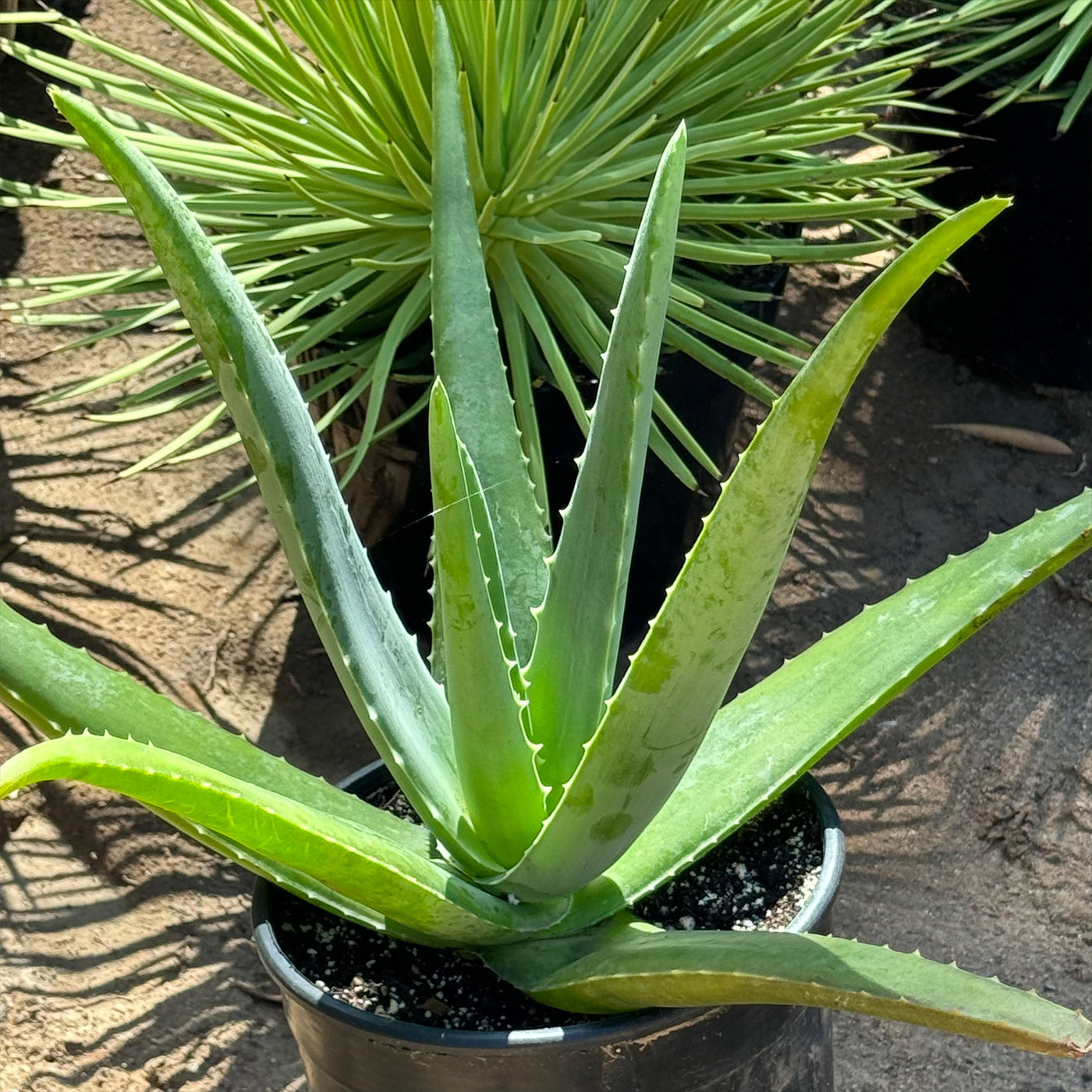
This large Aloe vera plant boasts fleshy lance-shaped grey-green leaves with small white teeth along the edges growing out from a starfish-like basal rosette. 

The edible aloe vera flowers burst into bloom in vibrant shades of yellow at the tips of their stalks when given favorable conditions. Only mature plants will yield flowers, so you'll have to wait at least four years to see an aloe vera bloom. However, in some growing conditions (especially hybrid plants), the flowers can sometimes appear with orange or reddish hues. 

This fast-growing succulent can grow into a large aloe vera plant up to 3 feet tall and 2 feet wide and even produce adorable pups that you can repot or share as delightful gifts with fellow plant enthusiasts.

How to Get Aloe Vera Gel from the plant to use on your skin

  1. Choose and Cut a Leaf: Select a large, healthy leaf from the bottom of the plant. Use a sharp knife to cut the entire leaf off at the base.
  2. Prepare the Leaf: Let the leaf sit upright in a container for 10–15 minutes to allow the yellow sap (aloin) to drain out. This sap can be irritating to the skin.
  3. Slice and Extract the Gel: For a small amount of gel, cut a section from the leaf rather than using the whole thing. Slice the leaf lengthwise to expose the gel. Use a spoon or knife to scoop out the clear gel.
  4. Apply or Store: Apply directly to your skin for soothing relief. Store extra gel in an airtight container in the fridge for a few days.

Aloe vera juice has many benefits for humans, this succulent rich in antibacterial, antioxidant, and anti-inflammatory properties, may enhance digestion, blood sugar levels, and oral health, although certain compounds, particularly aloin, may cause digestive discomfort and other side effects.

An aloe vera indoor plant is a great addition to any home, as it is easy to aloe vera care for and provides a variety of aloe vera benefits. 

According to the American Academy of Dermatology, Aloe vera has anti-inflammatory properties that can help in wound healing. It can also help to moisturize the skin and prevent peeling.

When and How to Water Your Aloe Vera 

As a desert dweller, watering the aloe vera succulent may be tricky, it may shrivel and die if given too little water, but it may also easily rot when given excessive water. So be careful not to overwater your aloe plantyou only want to give it enough to keep it from drying out completely, not drown it! 

A good rule of thumb is to water the Aloe plants deeply and then allow the soil to dry out completely before watering again. In the spring and summer, during the growing season, watering can be done once every 2-3 weeks.

During the winter months, when aloe vera is in a dormant period, it can be watered even less frequently. If you live in a rainy climate, consider planting aloe in gravel or stones. 

It is also important to note that aloe vera plants are sensitive to water quality. They prefer water that is low in minerals and salts, so it is best to use distilled or filtered water. Tap water can be used, but it should be left out for 24 hours before watering the plant to allow the chlorine to evaporate.

Light Requirements - Where to Place Your Aloe Vera Plant 

When growing indoors as a houseplant, place the aloe vera a few feet away from the south-facing window that receives plenty of sunlight, but it is important to avoid direct sunlight, as this can cause the leaves to burn. If the aloe plant is not receiving enough light, the leaves will start to droop and turn brown. In this case, it may be necessary to move the aloe vera plant to a brighter location. 

When planted outdoors, your Aloe plants need their daily dose of sunshine like a beach-loving teenager needs their favorite tunes!

They thrive on at least 6 to 8 hours of direct sunlight, soaking up those glorious rays with joy.

But wait, before you go dragging your aloe plant from its cozy shady spot into the blazing sun, be cautious. That sudden move can dry out your leafy buddy and leave it looking as yellow as a lemon.  

Now imagine you live in one of those cooler climates where clouds have permanent residency or if your home lacks these sunny windows altogether.

Fear not; you can use artificial lights – they're like little suns in bulb form! Hang them about one to two feet above your precious plant during daylight hours (that's roughly 16 hours per day) and watch it flourish happily amidst dim interiors.

Optimal Soil & Fertilizer Needs 

Aloe vera plants prefer well-draining soil that is a mixture of sand, perlite, and peat moss. It is critical to avoid soil that retains excessive moisture, as this can cause root rot. Instead, make or buy a well-draining potting mix, or ideally use our specialized succulent potting mix soil for aloe vera that contains 5 natural substrates and mycorrhizae to promote the development of a strong root system that helps your succulent to thrive.  

In terms of fertilizer, aloe succulents do not require a lot of nutrients. They can be fertilized once a year in the spring with a balanced fertilizer (NPK) of 5-10-5 in ratio. It is important not to over-fertilize the aloe plant, as this can lead to root burn. 

Hardiness Zones & More 

When grown indoors as a houseplant, aloe vera plants prefer a warm and dry environment. They thrive in temperatures between 60°F and 80°F. Aloe vera is a succulent, so it's adapted to arid conditions and doesn't do well in overly humid environments. Aim for a humidity level of around 30% to 40% for your indoor aloe vera plant.

In the United States, this is mostly an indoor plant, but if you live in southern Florida or Hawaii then you can cultivate it outdoors in USDA zones 9-11

Aloe vera can tolerate temperatures as low as 40°F for short periods, but prolonged exposure to freezing temperatures can damage or kill the plant. If you live in a colder climate, it's best to keep your aloe vera indoors or provide protection during winter months.

Aloe vera plants prefer dry air and do not require high levels of humidity. They can tolerate low humidity levels and do not need to be misted or placed in a humid environment. 

Wildlife - Aloe Vera Attracts the Following Friendly Pollinators

Aloe vera plants attract a variety of friendly pollinators, including bees, butterflies, and hummingbirds. These pollinators are essential for the reproduction of aloe vera plants, as they help transfer pollen between flowers, ultimately leading to the production of seeds. Additionally, these pollinators play a crucial role in maintaining biodiversity and ecosystem health.

Butterflies
Bees
Hummingbirds
Lady Bugs
Multi Pollinators
Other Birds

According to the ASPCA, the Aloe vera can be mildly toxic to pets and humans. It is rare but can occur if consumed in large quantities and can cause abdominal cramps, diarrhea, and electrolyte imbalances. It is important to consult a healthcare professional if you experience any adverse effects from consuming aloe vera.

How to Propagate Your Aloe Vera Plant

To propagate your aloe vera plant, you can separate the offsets or "pups" that grow at the base of the main plant. Gently remove these pups and plant them in their own pots with well-draining soil to encourage root growth. Water sparingly until they establish themselves, and place them in a sunny spot to promote healthy growth.

Aloe Vera: The Natural Sunburn Remedy


Aloe vera gel is known for its ability to moisturize the skin, it helps soothe burns and sunburns, as well as being known for its anti-inflammatory and antibacterial properties.

Aloe Vera is also rich in vitamins and minerals that are essential for healthy skin. It is best to use pure aloe gel extracted directly from an aloe vera plant.

To use aloe vera gel to soothe sunburns, cut off a piece of the large aloe vera leaf and open it to reveal the gel.

To maintain the aesthetic appeal of your aloe plant, it is advisable to cut off the entire leaf of the large aloe vera plant when cutting one. Just chop the leaf off as close to the main stem as you can. Cutting leaves from the base of the plant is always preferable. These leaves will be thicker since they are older. If you cut off the tip of a leaf, it will eventually turn brown at the tip because cut leaves keep their scars.

Key Takeaways

  1. Aloe vera is renowned for its medicinal properties, particularly its soothing gel, which is widely used for treating burns, wounds, and skin irritations. Its natural compounds, like aloin and acemannan, have anti-inflammatory and healing properties.
  2. When cut, aloe vera can seal its own wounds by producing protective latex, showcasing its remarkable survival mechanism in harsh environments.
  3. Aloe vera is not just a skincare savior; it also purifies indoor air by removing harmful pollutants like formaldehyde and benzene, making it a great addition to homes and offices.
  4. Native to arid regions, aloe vera thrives in minimal water conditions. It stores water in its thick, fleshy leaves, allowing it to endure prolonged droughts.
  5. The inner gel of aloe vera leaves is edible and used in drinks and food for its health benefits, such as aiding digestion, boosting immunity, and providing hydration. Always ensure proper preparation to remove any bitter or toxic compounds.
  6. The presence of yellow flower buds is a strong indicator of the edible variety.

The Bottom Line

Overall, Aloe vera is a popular plant known for its healing properties and versatility. It has gained popularity for its ability to help heal wounds, cuts, and burns, including sunburns. The gel inside the aloe vera leaves contains soothing and moisturizing properties that can provide relief and promote healing. In terms of care, aloe vera is relatively low-maintenance. It thrives in well-draining soil and requires moderate watering. It prefers bright, indirect sunlight but can tolerate some shade. 

A lot of people have a hard time finding large aloe vera plants, but here at Planet Desert, we regularly have large sizes in stock. Don't miss out on adding an Aloe vera plant for sale to your garden! Order now and enjoy its beauty for years to come. 

Shipping Notes
  • Free Standard Shipping on $100+ Orders to the USA.
  • Except Preorder products are shipped in 48 hours.
  • Delivery to the USA:
  1. Standard Shipping : 3-10 business days
  • If time is of the essence, please consider selecting expedited delivery for faster service.
Exchange/Return Notes
  • We offer a 30-day return/exchange service after receiving.
  • Final sale items are not eligible for returns or exchanges.
  • To process your return/exchange, please contact us at [email protected]
  • Please click here for more details>>> Return & Exchange Policy
SKU: 22289025587

Discover Niche Categories That Outsell where to buy aloe vera plants online

Top-Converting Item to Boost Your Average Order

4.9 ★★★★★
Based on 17 reviews
Sort
Highest Rating
Newest First
Oldest First
Product Reviews
A
Verified Purchase
Alexandra Joseph
Omaha, US
★★★★★ 5
AMAZING BOOK!!!!!
Format: Paperback
AMAZING BOOK!!!!!! WOW!!! everything you need to know about hemodynamics. This book explains the concepts with graphing, images. It also summarizes the key points. I wish I have read that book sooner. I could not believe it that in 1 book I found all the information I needed for the cardiology boards and my daily practice. Thank you o ugh Dr. Hanna for taking the time to write this book. Much Thanks!!!!
WAS THIS REVIEW HELPFUL?YesReportShare
Reviewed in the United States on September 5, 2020
M
Verified Purchase
Mrs. B.
West Palm Beach, US
★★★★★ 5
A welcome addition to training in hemodynamics
Format: Paperback
Purchased this book for my husband, the director of the Invasive Cardiovascular Technologist Program at a small college. He has been very pleased with the book, calling it a long-overdue addition to the field. It's very helpful in training technologists and others working in Cardiac Cath Labs to recognize hemodynamic waveforms and do calculations. It offers a lot of practice questions in addition to explanations.
WAS THIS REVIEW HELPFUL?YesReportShare
Reviewed in the United States on February 24, 2021
N
Verified Purchase
N. J. Manjarrez
Phoenix, US
★★★★★ 4
Clear Concise
Format: Paperback
I like the way that this book is laid out. Rather than long drawn out droning chapters it is split into shorter more specific sections. The graphics are plenty big. The case examples and guided questions are useful in reinforcing the knowledge. A good resource for any new CVT or CVT student.
WAS THIS REVIEW HELPFUL?YesReportShare
Reviewed in the United States on April 13, 2013
M
Verified Purchase
Michael Thompson
Grantham, US
★★★★★ 5
transformative
Format: Hardcover
In what presents itself as a sequel to his previous HarperOne Publications ( and ), N. T. Wright's newest release challenges theoretical Christianity with the ongoing work of the kingdom, most notably through the oft-debated areas of character and virtue. His own words work best to summarize the book: "Christian life in the present, with its responsibilities and particular callings, is to be understood and shaped in relation to the final goal for which we have been made and redeemed" (ix). That is to say, our lives must reflect the faith to which we cling. But, of course, many Christians are able to live out the goal of their faith; it is a challenge to make certain that our faith is properly aligned and set to the right goal. And that is why this book makes an appropriate trilogy with the previous two, that understanding how Christian faith is about the restoration and rejoining of heaven and earth, and how our lives are meant to reflect that in this present inaugurated eschatology. This book then is about the transformation and dedication of human character as the right response to resurrection. It is about the restored humanity which is now possible, though not without its stumbling and searching, as part of the dawning of God's new day. The opening chapter gives a few examples of admirable behavior, where those who were able to instinctively react heroically in certain situations did so because they had lived in certain ways for years before. In like manner, Wright asserts that Christian character is learned and built (and trained) on a daily basis. What am I here for? Transformation! Not just in our own lives, but as agents of God's Spirit to transform the world. Throughout the book Wright continually points to various character traits which are often regarded as worthwhile and challenges the reader to think of them as transformative for the kingdom. "We've had enough of pragmatists and self-seeking risk-takers. We need people of character" (25). Thus, he believes that character is transformed by three things in particular: 1) aiming at the right goal; 2) figuring the steps to reach that goal; 3) allowing those steps to become habitual (29). He spends a good amount in the second chapter interacting with Aristotle, which may be lost on some people but helps establish his foundation nonetheless. Perhaps one of the most interesting chapters in the book is the third, "Priests and Rulers." It is here that Wright asserts that transformation must include a return to the imago Dei which was set within humanity at Creation. Our proper role in the world is thus "worshipping and reigning" - we are priests and rulers(78-79). He builds this concept on solid biblical footing, and begins to build his perspective on character from here. If this is true, then it is the community of believers which is given over to the twin tasks of holiness and prayer (91). From here, the book follows with the implications of being that sort of community. We are to be a people prepared and presently working for the kingdom (he brings in the beatitudes at this point). Wright also asserts that Christian character is not about rules. Rather, it is about freedom to become what we are intended to be, with the parameters of Scripture given as guides along the journey. We are to be transformed by priestly worship, living and working as people of the kingdom on a moment-by-moment basis (cf. 149). This transformation comes through the renewal of our minds, as our thoughts direct us to a new way of living. The latter chapters acknowledge the difficulty of living in such a way, with Wright asserting that this Spirit-enabled life being possible for us to have in this life. ". . . 'Left to myself, doing what comes naturally, I would fail.' But the point of love is that it doesn't" (183). Love, which Paul repeatedly asserts is the greatest virtue, is the ultimate goal of the believer. Not for self, not even for others . . . but for God alone. If all of our character and virtue are directed to him, then true kingdom work and ministry will happen. Wright includes this as well, "Worship must lead to mission" (225). One could reflect on so much Christian thought at this point. At times Wright's model for character sounds like Brother Lawrence, John Wesley, C. S. Lewis, and many Jesus-Creeders throughout the centuries, among others. It is clear that this is a book written from a lifelong reflection on Christian virtue. While there are a few areas of the book that I could present minor quibbles, I now decide not to do so because the present need for Christian character is so high in our culture that I do not want to give any discouragement for approaching this book - and they are quite minor quibbles indeed. My review and summary is brief and wholly inadequate in capturing the overall journey which is presented in this book. I greatly encourage all Christians to work through this trilogy of faith and action . . . worship and reign.
WAS THIS REVIEW HELPFUL?YesReportShare
Reviewed in the United States on March 23, 2010
C
Verified Purchase
C.C.I.Fenn
Alexandria, US
★★★★★ 5
Between Legalism and Lawlessness: A Foundation for Understanding Virtue and Holiness
Format: Paperback, Format: Paperback
What happens after you believe? Since the beginning, there have been two, great, warring factions within Christendom seeking to answer that question. One demands obedience to a list of rules: legalism. The other claims that grace makes all rule-following null and void: lawlessness. And then there is a middle road: the via media. This isn't the easiest path to take. It's effortless to simply run off into the ditch of legalism or lawlessness. It would be easier for me to hand out a list of rules when someone comes to faith in Christ: "Do pray, do read your Bibles, do come to church when the doors are open. Don't drink, don't smoke, don't chew. And don't date folks who do. Follow these rules and you'll be A-Okay!" Or, it would be just as easy to tell those who come to faith: "You're saved and nothing will change that. Even if you completely quit believing in God or become a mass murderer - don't worry. It's all under the blood." It's easier to maintain the extremes. That's why they're so popular. Unfortunately, neither of the extremes are true - or biblical. So what is? N.T. Wright paints a picture of the middle way between legalism and lawlessness in his book, After You Believe: Why Christian Character Matters. Wright notes the two extremes we've already mentioned and he's upfront throughout that he points to a middle way. In the very first chapter, he observes that "many Christians have so emphasized the need for conversion...that they have a big gap in their vision of what being a Christian is all about." I couldn't agree more with this sentiment if I tried. Too many Christians - especially in revival traditions - view the ultimate moment of the Christian life as the moment they first bowed their knee to Christ. But this is like watching baseball and getting all excited - shouting until you're hoarse - the first time your team gets a hit. Hitting the ball is great. But if he's out before he gets to first place - or really, if he's out before he gets home - then all of the excitement and joy is vain. The ultimate moment of the Christian life isn't the first moment we bow our knee. It's the last breath we take, in union with Christ. It's the moment we cross 'home plate'. And yet, for most of us, there's a huge gap between that first bowed knee and that last breath in Christ. What happens in that time? What should be taking place? Legalism says that this time is taken up with keeping all of the right rules (though most legalists can't even agree on which rules are the 'right' rules). Lawlessness says that this time is taken up with waiting for heaven and, perhaps, telling others about God's great grace. But is that it? Are those our only tasks on this earth between conversion and death? God didn't create us merely to follow rules. Neither did he make us to simply enjoy his gifts. When God formed Adam, he gave him a job. "Be fruitful and multiply, and fill the earth, and subdue it..." (Genesis 1:28). God created man as a royal-priest. As Wright writes, "God placed Human in the garden to reflect his image into the new world he was making - that is, to be the means, present and visible, whereby his own care of the garden and the animals would become a reality" (pg 75). This royal-priestly role for man is found scattered throughout the scriptures - in both Old and New Testaments. For example, when God delivers Israel from Egyptian bondage, he tells them, "you shall be to Me a kingdom of priests and a holy nation" (Exodus 19:6). Later, Peter picks this verse up and applies it to the Church (1 Peter 2:9). And Revelation tells us the same thing: "He has made us to be a kingdom, priests to His God and Father" (Revelation 1:6). So, to be human means something. It means being created in the image of God, and with a particular task. And ultimately, that's what Christ is redeeming us to. Jesus' didn't die just so we could go to 'heaven'. He died so that we, as human being, could be what God intended. This is why Paul writes, "But we all, with unveiled face, beholding as in a mirror the glory of the Lord, are being transformed into the same image from glory to glory, just as from the Lord, the Spirit. Therefore, since we have this ministry..." (2 Corinthians 4:1). God has restored our capacity to image him rightly. And he has given us a ministry - a service - a task: the role of royal-priest. A quick aside: I probably should have mentioned this sooner but this book is not filled with 284 pages of practical tips on growing in virtue or holiness. Wright penned this book to lay a theological foundation for understanding why we should want to grow in virtue and holiness in the first place. So if you come to it looking for practical advice, you won't get much. The last chapter is the only place in the book that deals heavily with practice. But that doesn't mean this book isn't worth reading. It is. If you closely follow the argument that Wright constructs, your understanding of the why will be deepened. And as the why is deepened, your desire for the what will grow as well. "God's future is arriving in the present, in the person and work of Jesus, and you can practice, right now, the habits of life which will find their goal in that coming future" (page 103). This is the heart of Wright's thesis. And I don't know about you, but it excites me. Jesus has inaugurated the Kingdom. And he's calling all people, everywhere, to enter and live in it today. But how do we become Christ-focused people? Without Christ, we're hopelessly lost in pride and idolatry. And going to an altar - bowing my knee for the first time - doesn't perfect me. Old habits need killing. Unhealthy desires need eliminating. And attitudes that used to be acceptable are not any longer. We need to learn the language and culture of our new nation: the Kingdom of God. If Wright uses the first half of the book to explain what we're called to, he spends the second half of the book discussing how we live into that calling. In these chapters, he examines Paul's understanding of the spiritual-transformation made possible through Jesus' death and resurrection. He sums up many of the ideas here when he compares cultivating the fruit of the Spirit to gardening. "The key is this: the 'fruit of the Spirit' does not grow automatically...Oh, there may well be strong and sudden initial signs that fruit is on the way...But this doesn't mean it's all downhill from there. These are the blossoms: to get the fruit you have to learn to be a gardener. You have to discover how to tend and prune, how to irrigate the fields, how to keep birds and squirrels away. You have to watch for blight and mold, cut away ivy and other parasites that suck the life out of the tree, and make sure the young trunk can stand firm in strong wings. Only then will the fruit appear" (page 195-196). Throughout these latter chapters, he highlights the importance of the three Christian virtues (faith, hope, and love), the fruit of the Spirit, and the necessity of unity within the body. These make up the Kingdom of God's primary language and culture. Our life on this earth - between now and eternity - consists of growing in these things. My own description of the Church as a 'laboratory of love' fits nicely with the way Wright describes the Church in these chapters. We learn Kingdom-culture there. And we practice the things that we will spend an eternity engaged in. Wright also stresses the twin foci of worship and mission. We need to return to these again and again because we tend to move to one extreme or the other. Wright ends the book with a chapter entitled, 'The Virtuous Circle'. Here, he delineates the five activities that he believes will contribute to our growth in Christian virtue and maturity. The five include scripture, stories, examples, community, and practices. This chapter is helpful and provides a needed practical viewpoint. However, the scripture/stories/examples all sort of flowed into one another. Many of the stories he mentions are stories from scripture. Though he does stress the value in other stories as well - including those that have no Christian background. I tend to agree with him here (though I can imagine others wouldn't). I would also include the telling of testimonies in this category though Wright doesn't explicitly mention that. Wright's focus on the community of faith is a necessary prescription for the anti-establishment movement that has swept so many people into thinking they can live as Christians alone. The problem isn't 'church'. The problem is that too many churches aren't acting like churches. Wright makes a valuable statement about what church should be here: "a community that is practicing the arts of being a royal priesthood, a working and worshipping fellowship for whom faith, hope, and love are being learned and exercised in the service of God's kingdom" (page 275). If Christians would all catch a vision like that (and then live into it), people would be clamoring to join in what God is doing. In his section on practices, Wright notes the basic activities of the Christian life: communion, baptism, prayer, giving, and the reading of scripture. Amen and amen. I can't say more on that front. There may have been a few things I disagreed with as I read but they were incidental to the main thrust of After You Believe (for example, replacing 'man' with 'human' in many scripture references; nothing wrong with it, it just sounds weird). A month or so ago, I finished reading Matthew Bates's Salvation by Allegiance Alone. After You Believe is a great follow-up to that book since many of the threads there weave throughout Wright's book as well. As is usual, I love Wright here. He's a gentle guide who takes your hand and walks you through the scriptures, one thought at a time. Like a pyramid-builder, Wright lays down one idea after another, until he finishes his task. And once finished, the reader comes away with more than just a few tips and tricks for greater spirituality. He comes away with why spirituality is worth pursing in the first place. God calls us to so much more than mere rule-keeping or basking. He calls us to live in eternity today. The question for us is, will we answer the call?
WAS THIS REVIEW HELPFUL?YesReportShare
Reviewed in the United States on May 19, 2017

recommand products