Pay in installments of $5.92 with
 ,
,
 and
and

Shipping Estimate
USA
- USA
- CAN
- USA
- CAN
Ships within 48 hours · Estimated delivery Sep 12 - Sep 17
 Promo Codes Available:
For Your Every Summer RSVP, with Code: SUMMER15
Description
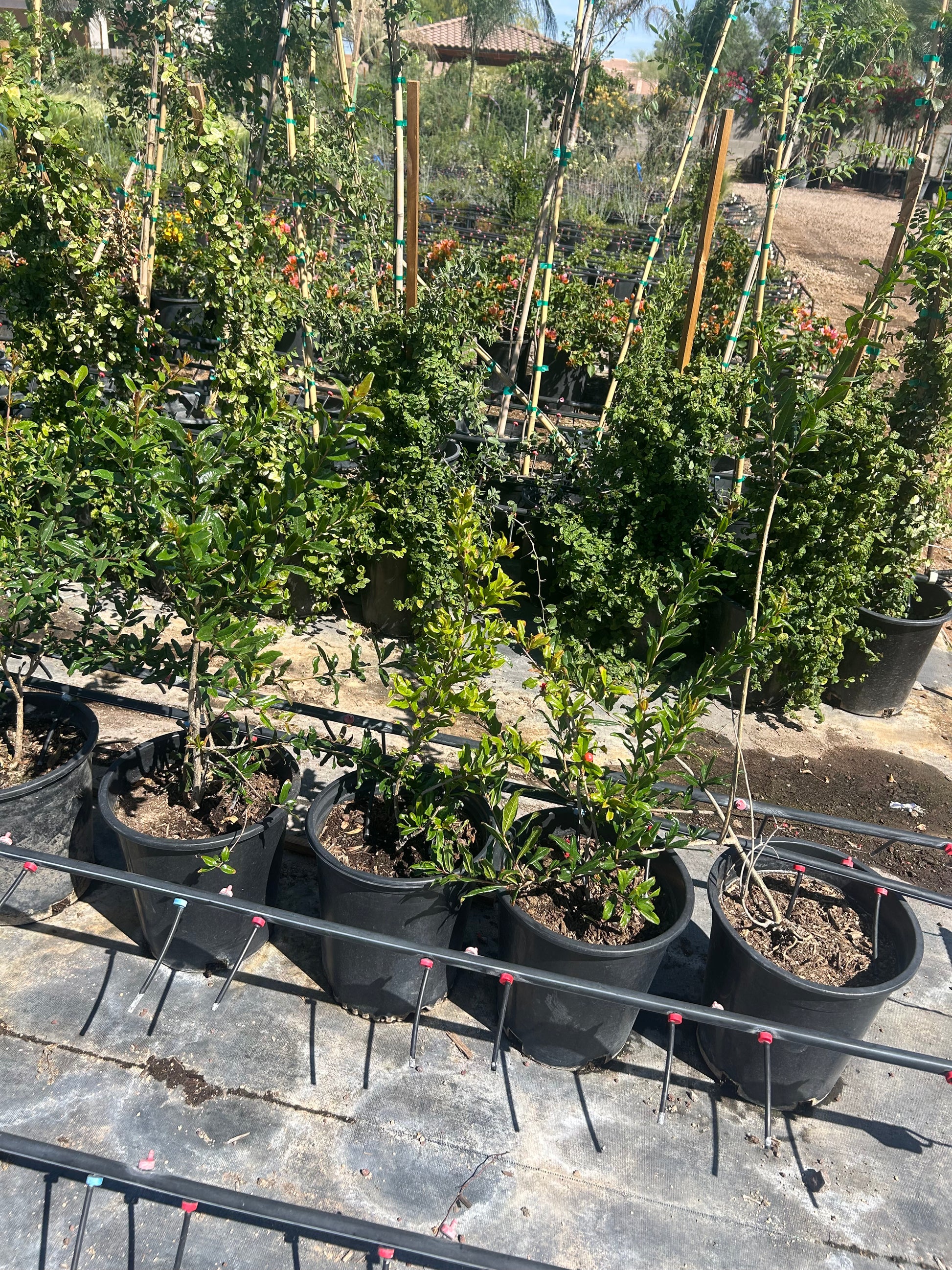
pomegranate plant in pot Buy Pomegranate Tree Phoenix, AZ | Punica granatumThe Ultimate Heat Loving Fruit Tree for Phoenix Landscapes Pomegranate (Punica granatum) is arguably the most perfectly adapted fruit tree for the Phoenix Valley. This drought tough, heat loving deciduous tree thrives in conditions that stress most other fruit trees blazing summer sun, alkaline soil, and minimal water. Growing 620 feet tall depending on variety and pruning, Pomegranate produces gorgeous orange red flowers in spring followed by heavy
The Ultimate Heat-Loving Fruit Tree for Phoenix Landscapes
Pomegranate (Punica granatum) is arguably the most perfectly adapted fruit tree for the Phoenix Valley. This drought-tough, heat-loving deciduous tree thrives in conditions that stress most other fruit trees — blazing summer sun, alkaline soil, and minimal water. Growing 6–20 feet tall depending on variety and pruning, Pomegranate produces gorgeous orange-red flowers in spring followed by heavy crops of jewel-toned fruit in fall. Whether you're planting an edible landscape in Scottsdale, adding a shade-and-fruit tree in Mesa, or creating an orchard corner in Gilbert — Pomegranate delivers beauty, function, and flavor with minimal effort.
Pomegranate Tree Plant Details
| Attribute | Detail |
|---|---|
| Scientific Name | Punica granatum |
| Common Names | Pomegranate, Pomegranate Tree |
| Mature Height | 6–20 feet (depending on variety and pruning) |
| Mature Width | 6–15 feet |
| Growth Rate | Moderate to fast — 1–2 feet per year in Phoenix |
| Sun | Full sun (6+ hrs). Thrives in reflected heat from walls. |
| Water | Low to moderate once established. Very drought-tolerant. |
| USDA Zones | 7–11 (Phoenix is Zone 9b–10a) |
| Soil | Highly adaptable. Tolerates Arizona caliche and alkaline soils. |
| Foliage | Deciduous — bright green leaves turn golden-yellow in fall |
| Fruit Season | September–November in Phoenix |
Pomegranate Tree Uses in Phoenix Landscapes
Edible Landscape & Orchard Tree
Pomegranate is the backbone of any Phoenix edible landscape. A single mature tree can produce 50–100+ fruits per season with almost no pest issues. Plant along a south-facing wall for maximum heat exposure and earlier ripening. The fruit stores well on the tree for weeks after ripening, giving you a long harvest window through the fall months.
Ornamental Shade Tree
Even without harvesting fruit, Pomegranate earns its place as a stunning ornamental. The spring bloom of tubular orange-red flowers is a pollinator magnet, the glossy summer canopy provides filtered shade, and the fall foliage turns brilliant gold before dropping. Multi-trunk specimens make especially striking courtyard or patio trees in Scottsdale and Tempe landscapes.
Privacy Hedge & Screen
Pomegranate can be grown as a dense multi-stemmed hedge when planted 4–6 feet apart and left unpruned. For a 20-foot fence line, use 4–5 plants. The dense branching creates an effective deciduous screen from spring through fall, and the thorny wood deters foot traffic year-round.
Best Time to Plant Pomegranate in Phoenix
Fall (October–November) is the ideal planting window for Pomegranate in the Phoenix Valley. The warm soil supports rapid root establishment while cooler air reduces transplant stress, giving the tree 6–8 months of root growth before its first summer. Late winter (February–March) is also excellent — the tree is still dormant and will wake up rooted in its new home. Avoid planting in the peak of summer if possible.
How to Plant Pomegranate
- Dig wide, not deep — 2–3x the root ball width, same depth
- Check for caliche — break through any hardpan layer for drainage
- Backfill with native soil — Pomegranate actually prefers lean soil; skip heavy amendments
- Spacing — 8–12 ft apart for individual trees; 4–6 ft for hedge plantings
- Water basin — build a 3–4 inch ring around the root zone to direct water
- Mulch — 2–3 inches of bark or gravel mulch to retain moisture and moderate soil temperature
Watering Pomegranate in Phoenix
First Year Watering Schedule
Weeks 1–2: Every 2–3 days, deep and slow (20–30 min). Month 1–3: Every 4–5 days. Month 3–6: Every 7–10 days (5–7 days in peak summer). After Year 1: Every 10–14 days in summer; every 3–4 weeks in winter (or none during dormancy).
Drip Irrigation
Place two 2 GPH emitters 18–24 inches from the trunk on opposite sides. Established Pomegranates are remarkably drought-tolerant and produce sweeter fruit when slightly water-stressed during the ripening period (August–October). Consistent deep watering earlier in summer prevents fruit splitting.
How fast does Pomegranate grow in Phoenix?
Pomegranate grows 1–2 feet per year in the Phoenix Valley with regular watering. Most 15-gallon trees begin producing fruit within 1–2 years of planting and reach full production by year 3–4.
Is Pomegranate drought tolerant?
Yes — Pomegranate is one of the most drought-tolerant fruit trees available. Once established, it survives on deep watering every 2–3 weeks in summer and little to no water in winter.
When do Pomegranates fruit in Phoenix?
In the Phoenix Valley, Pomegranate flowers appear in April–May and fruit ripens from September through November. The fruit is ready when the skin develops deep color and makes a metallic sound when tapped.
Can Pomegranate handle Phoenix summer heat?
Absolutely. Pomegranate is native to the Middle East and Central Asia and actually performs best in hot, arid climates. It handles reflected heat from walls, 115°F+ days, and intense sun without issue.
You May Also Like
Fig Tree — Another heat-loving, low-water fruit tree that thrives in Phoenix backyards.
Pineapple Guava — An evergreen fruiting shrub with edible flowers and tropical-flavored fruit.
Texas Ebony — A tough native shade tree that pairs well with Pomegranate in mixed desert orchards.
Desert Willow — A fast-growing flowering tree that complements Pomegranate with trumpet-shaped blooms.
How Many Pomegranates Do I Need?
Pomegranate is versatile: trained as a single tree it reaches 6 to 15 feet wide, but its dense, multi-stemmed habit also makes a thorny deciduous privacy screen. For a hedge, plant 5 feet on center and leave it unpruned. As an orchard or specimen tree, give each plant 10 feet.
| Run Length | Plants at 5 ft (hedge/screen) | Plants at 10 ft (specimen/orchard) |
|---|---|---|
| 20 ft | 4 plants | 2 plants |
| 30 ft | 6 plants | 3 plants |
| 40 ft | 8 plants | 4 plants |
| 60 ft | 12 plants | 6 plants |
For a single courtyard or patio specimen, allow 8 to 12 feet of clearance so the multi-trunk form shows off.
Pomegranate Season-by-Season in Phoenix
- Spring (Feb–Apr): New leaves flush bright green and the first tubular orange-red flowers open in April, drawing bees and hummingbirds. Late winter into early spring is also a fine planting window while the tree is still settling in.
- Summer (May–Sep): Pomegranate is at its best in extreme heat and reflected sun. Flowering continues and fruit sizes up. Keep deep water steady early in summer to prevent splitting, then ease off during the August to October ripening for sweeter fruit. Monsoon humidity is no problem.
- Fall (Oct–Nov): Peak harvest of jewel-toned fruit, ready when the skin colors deeply and rings metallic when tapped. Foliage turns brilliant gold. This is the prime planting window.
- Winter (Dec–Jan): Fully deciduous and dormant, dropping its gold leaves. Very cold-hardy in its dormant state (rated to Zone 7), so Phoenix winters are no threat. Water little to none, and prune for shape now.
At a Glance
✔ Edible ✔ Drought-Tolerant ✔ Heat-Loving (Reflected-Heat Tolerant) ✔ Pollinator-Friendly ✔ Hummingbird-Friendly ✔ Shade-Providing ✔ Low-Maintenance ✔ Cold-Hardy (Winter Dormant)
Plant It With
- Fig Tree: another heat-loving, low-water fruit tree that thrives on the same lean-soil, deep-water rhythm.
- Desert Gold Peach Tree: low-chill peach that fruits in early summer, ahead of the fall pomegranate harvest.
- Red Baron Peach: showy-flowering peach to add spring color in a mixed desert orchard.
- Texas Sage: a drought-tough flowering shrub that pairs well as a low-water ornamental screen beside the orchard.
Is Pomegranate Right for Your Yard?
Pomegranate is one of the easiest, most heat- and drought-adapted fruit plants for Phoenix. It thrives in full sun and reflected heat, takes lean alkaline caliche soil, and asks for very little water once established. It is not the right pick if you want evergreen structure year-round (it drops its leaves and stands bare in winter), or if you need a thornless plant right next to a high-traffic walkway.
Shipping Notes
- Free Standard Shipping on $100+ Orders to the USA.
- Except Preorder products are shipped in 48 hours.
- Delivery to the USA:
- Standard Shipping : 3-10 business days
- If time is of the essence, please consider selecting expedited delivery for faster service.
Exchange/Return Notes
- We offer a 30-day return/exchange service after receiving.
- Final sale items are not eligible for returns or exchanges.
- To process your return/exchange, please contact us at [email protected]
- Please click here for more details>>> Return & Exchange Policy