SKU: 24083511855
barrel succulent

barrel succulent Shop 'Euphorbia horrida – African Milk Barrel' Care and Growing Guide

Sale price$22.69 Regular price$25.21
Save 10%

Pay in installments of $6.30 with ShopPay, AfterPay and Klarna

Shipping Estimate
USA
  • USA
  • CAN

Ships within 48 hours · Estimated delivery Jul 18 - Jul 23

Promo Codes Available:

For Your Every Summer RSVP, with Code: SUMMER15

Description

barrel succulent Shop 'Euphorbia horrida – African Milk Barrel' Care and Growing GuideIntroducing the African milk barrel, known as the Euphorbia horrida, which is a striking succulent plant that belongs to the Euphorbiaceae family. It is commonly referred to by various names, including the African milk plant, the African milk cactus, the African milk tree cactus, and the toothpick cactus. These names reflect its unique appearance and the milky sap it produces. Native to South Africa, this columnar plant, Euphorbia horrida, offsets the

Introducing the African milk barrel, known as the Euphorbia horrida, which is a striking succulent plant that belongs to the Euphorbiaceae family. It is commonly referred to by various names, including the African milk plant, the African milk cactus, the African milk tree cactus, and the toothpick cactus. These names reflect its unique appearance and the milky sap it produces. 

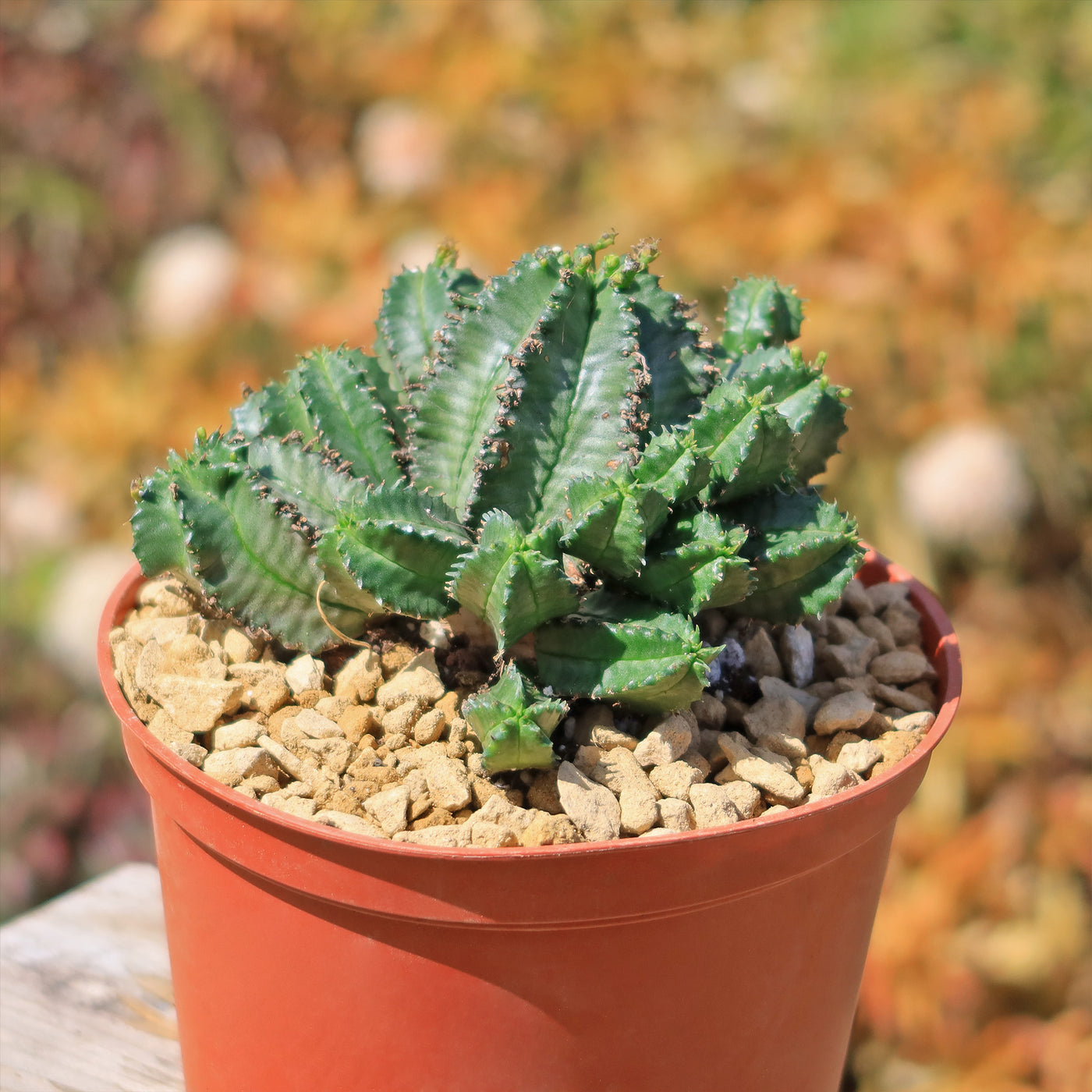
Native to South Africa, this columnar plant, Euphorbia horrida, offsets the base to form clumps. The plant has cylindrical stems with gray-green to blue-gray hues, flattened ribs, and spine-like features.


The Euphorbia horrida can grow up to 5 feet tall and 6 inches wide. The structures that resemble spines are the dried remains of the stalks of cyathia (inflorescence of the plant).

Its stem may be striped with white and green markings. This species is similar to the unrelated barrel cacti in its growth habits.

Over time, the ribs frequently grow wavy. This Euphorbia succulent has sharp ridges lined with thorns.

The Euphorbia horrida flowers bloom during the spring and summer months. They are typically greenish-yellow in color and are arranged in clusters at the top of the stem.

While the flowers themselves may not be the main attraction, they add a touch of beauty to the overall appearance of the plant. You can propagate the African milk barrel by taking stem cuttings. Simply cut a healthy stem from the plant and allow it to dry for a few days.

After that, plant the cutting in soil that drains properly and keep it damp but not soggy until roots form. Another method is by collecting and planting the seeds produced by mature plants. However, keep in mind that germination can be slow and may require patience. 

When and How to Water Your African Milk Barrel 

When it comes to watering, the African milk barrels have low water needs, so it's best to water them sparingly. During the active growing season (spring and summer), water deeply every 2–3 weeks; in fall and winter dormancy, reduce watering to once a month or less. The top inch of the soil should be completely dry before you water again. 

In the spring and summer, water deeply every two to three weeks during the growing season. In the fall and winter, during the dormant season, reduce watering to once a month or even less, as the plant goes into a rest period. 

Grow your succulents in containers with great drainage holes and suitable soil, and water them deeply between periods of drying out. 

Light Requirements - Where to Place Your Euphorbia horrida 

When growing indoors, the African milk barrel needs bright, direct sunlight to thrive for at least 6-8 hours per day.

Place them near a south-facing window or any spot that receives ample bright sunlight throughout the day. You can use artificial grow lights as a supplement if you don't have access to enough natural light. 

If you're growing African milk barrels outdoors, they need full sun exposure to flourish for at least 6-8 hours a day. Find a spot in your garden or patio that receives direct sunlight for most of the day.

These Euphorbia plants love the intense sunlight and warmth, which helps them maintain their unique shape and color. Just be cautious of extreme heat, especially in hotter climates. If the temperature rises too high, provide some afternoon shade to protect the plant from scorching. 

Optimal Soil & Fertilizer Needs 

The Euphorbia horrida favors very airy, sandy soil that drains well. Planting them in ordinary soil will result in compacted roots, stunted growth, and most likely root rot. Instead, make or buy a well-draining potting mix, or ideally use our specialized succulent potting mix, opens in a new tab that contains 5 natural substrates and mycorrhizae to promote the development of a strong root system that helps your succulent to thrive. 

The African milk barrels are not heavy feeders, but they can benefit from a balanced (5-10-5), water-soluble NPK fertilizer once a year in the spring. It's important to note that during the dormant season (fall and winter), African milk barrels do not require fertilizer.

Remember to always follow the instructions on the fertilizer package and avoid over-fertilizing, as it can harm the plant. 

Indoor Growing African Milk Barrel Requirements

When growing indoors, your African milk barrels prefer warm temperatures ranging between 65°F and 85°F during the day. They can tolerate slightly cooler temperatures at night, but it's best to avoid temperatures below 50°F, as it can cause damage to the plant. As for humidity, these plants are accustomed to low humidity levels, so typical indoor humidity is usually sufficient. 

Hardiness Zone & More 

For outdoor cultivation, the African milk barrels are most commonly grown in USDA zones 9 to 11.

These zones generally have mild winters and warm to hot summers, which closely resemble the plant's natural habitat. 

However, if you live in a cooler climate, you can still enjoy growing African milk barrels outdoors during the summer months and bring them indoors during winter to protect them from frost. 

Wildlife  Euphorbia horrida Flowers Attract the Following Friendly Pollinators

Euphorbia horrida flowers are known to attract a variety of pollinators such as bees, butterflies, and hummingbirds. These friendly pollinators help to ensure the continued growth and reproduction of the plant species in their natural habitat.

Butterflies
Bees
Hummingbirds
Lady Bugs
Multi Pollinators
Other Birds

According to the ASPCA, Euphorbia horrida has a milky latex sap that is mildly toxic to humans and pets. If consumed in large amounts, the milky sap can irritate the skin or trigger allergic reactions. If it gets into the eyes, it can cause extreme irritation.

How to Propagate Your Euphorbia horrida

Euphorbia horrida can be propagated through stem cuttings. To do this, cut a healthy stem from the plant and allow it to callous for a few days before planting it in well-draining soil. Keep the cutting in a warm, bright location and water sparingly until roots develop.

Key Takeaways

  1. The African Milk Barrel boasts a striking, cactus-like appearance with deep ribs and bold spines, making it a standout choice for collectors seeking sculptural and dramatic form in drought-tolerant gardens or containers.
  2. Euphorbia horrida naturally produces clusters of offsets (pups) around its base, allowing it to grow into an impressive colony over time and making propagation simple and rewarding.
  3. This succulent stores water efficiently within its thick, ridged stems, giving it excellent drought tolerance and minimal watering needs—ideal for low-maintenance landscapes.
  4. The spines on the African Milk Barrel not only enhance its armored look but also serve a practical purpose, protecting it from herbivores and shading the plant’s surface to reduce moisture loss.

The Bottom Line

Overall, the African milk barrel (Euphorbia horrida) is a fascinating succulent that boasts thick, cylindrical stems covered in sharp thorns. It's a low-maintenance plant that thrives in arid conditions, making it perfect for those who may forget to water their plants regularly.

Just ensure it receives plenty of sunlight and well-draining soil, and you'll have a unique and eye-catching addition to your succulent collection. Be sure to add Euphorbia horrida to your home or garden and enjoy its low-maintenance care, while admiring its impressive display year after year. 

Shipping Notes
  • Free Standard Shipping on $100+ Orders to the USA.
  • Except Preorder products are shipped in 48 hours.
  • Delivery to the USA:
  1. Standard Shipping : 3-10 business days
  • If time is of the essence, please consider selecting expedited delivery for faster service.
Exchange/Return Notes
  • We offer a 30-day return/exchange service after receiving.
  • Final sale items are not eligible for returns or exchanges.
  • To process your return/exchange, please contact us at [email protected]
  • Please click here for more details>>> Return & Exchange Policy
SKU: 24083511855

Discover Niche Categories That Outsell barrel succulent

Top-Converting Item to Boost Your Average Order

4.6 ★★★★★
Based on 18 reviews
Sort
Highest Rating
Newest First
Oldest First
Product Reviews
A
Verified Purchase
Andy Bui
San Leandro, US
★★★★★ 4
Great Outdoor Pickleballs for Practice and Games
Size: 6 Pack, Color: Multi
These pickleballs have been great overall for outdoor play. The colors are bright and easy to see on the court, which is especially helpful during evening games or when playing on darker surfaces. They have a consistent bounce and feel durable compared to some cheaper pickleballs I’ve tried before. I also like that they fly pretty true and don’t wobble too much during rallies. They work well for both casual games and more competitive practice sessions. The balls feel solid off the paddle and provide a good balance of speed and control. The only reason I’m giving 4 stars instead of 5 is because a couple of the balls started showing small cracks after extended outdoor use on rough courts. They still lasted longer than many other brands, but I expected slightly better durability considering the price. They can also feel a bit harder than some softer outdoor balls, especially in colder weather. Overall though, these are reliable pickleballs and definitely a good choice for outdoor play. I’d buy them again for practice and recreational matches.
WAS THIS REVIEW HELPFUL?YesReportShare
Reviewed in the United States on May 6, 2026
C
Verified Purchase
CE
Massapequa, US
★★★★★ 5
Good quality
Size: 3 Pack, Color: Optic Yellow
These are really good quality. The color is easy to see on the outdoor court, especially when the sun is bright. Definitely has good bounce to them.
WAS THIS REVIEW HELPFUL?YesReportShare
Reviewed in the United States on May 28, 2026
T
Verified Purchase
Trevor & Tiffany G
Carnegie, US
★★★★★ 5
Franklin X-40 vs. Dura Fast 40 (vs. Onix)
Size: 12 Pack, Color: Optic Yellow, Size: 12 Pack, Color: Optic Yellow
Review order: Review summary (quick read) Review update (4-13-2021) Full review (long read) Summary: This review might save you a lot of time researching balls, but here's the summary if you don't want to read the full review... For 4.0+ play consider the Dura Fast 40 when preparing for certain tournaments, but expect only about 2 games per ball, which is quite annoying in my opinion... for 95% of players, definitely go with the Franklin X-40 (except when preparing for a Dura only tournament of course). If you just want the ball to last and last year after year and don't care at all about egging or quality of play consider the much softer and much slower and much bouncier Onix ball. The Onix ball is so soft that I can't recommend it for typical play, but it is actually an excellent choice when introducing new players to the game and it is often the preferred ball in 65+ play if mobility becomes a common issue because extra bounce = extra time to get there, but in my area many older players seem to play the X-40 just fine. * * * * * * * * * * * * * * * * * * * * * * * * Update: 4-13-2021: Popularity: Almost everyone in my area is playing the Franklin X-40 in every park. I finally saw a Dura in play yesterday, but it's been a long time! Outdoor tournaments in my state are now about 60% X-40 and about 40% Dura (Washington), so even in tournament play the Dura seems to be going out pretty quick. Seasonal durability of X-40: for the first year I don't think my group cracked a single X-40 (despite having a faster paced game), but using that same batch of balls this Spring, they've all been dropping like flies so now my 1 year old batch of X-40's probably isn't much more durable than brand new Dura's (very annoying to deal with those cracks). I just bought new X-40's yesterday and I'll be discarding the few X-40's that are left from last year when the new stock arrives. It will be new X-40's for me once a year from now on assuming quality doesn't slide... fresh manufacturing is apparently very important, so hopefully Franklin will keep their runs moderate, and maybe that's what Dura did wrong.(?) * * * * * * * * * * * * * * * * * * * * * * * * Full review: This review will focus largely on the physical & quality comparisons between the Franklin Outdoor X-40 pickleball and the Dura Fast 40 pickleball, but I'll also give a summary of my impressions from the mouth of experts and supplement also by my own amateur impressions and measurements. Dura hole specs: 16 drilled holes @ 0.325" & 24 drilled holes @ .264" Franklin hole specs: 40 drilled holes @ 0.288" Both balls have 40 holes with an average hole size of 0.288", but the Dura ball has a far more randomized hole pattern. I personally didn't notice any difference in spin characteristics or any notable advantage to the randomized hole pattern of the Dura. Franklin weight: 26g Dura weight: 25g Both balls are rotationally molded in one continuous piece so the seam is just as strong as the rest of the ball on either ball... the appearance of a seam is on the outside of the ball only but the visual molding mark is not actually separated in any way in the middle of the ball and the inside of the ball will likewise appear 100% seamless on either ball, so no true seam exists (both balls are true "1-piece" balls). The Dura ball has much smoother molding marks w/ no plastic flashing like the Franklin... this is primarily cosmetic but quality in this regard definitely goes to the Dura. Subjective color preference: in the shade I think the Dura "Neon" color looks better (see pic), but in typical full sun the green tint looks dingy on the Dura ball in my opinion, and I feel the Franklin "Optic Yellow" is a crisper color that's probably a little more visible. These are the only 2 ball colors I have to compare. I would prefer more dye to be used for a green ball so it still looks green in full sun because in my experience with disc golf and ball golf neon green is the most visible color and neon pink is good too... with these 2 options I'd pick the yellow... the green tint on the Dura is so subtle in full sun it ends up looking more like a dingy yellow rather than a green. A more apples to apples comparison would be Dura's yellow option but I'm pretty confident Franklin would win that contest also based on the notably higher translucency in the plastic used by Dura. Color: Franklin wins. Franklin X-40 country of origin: China Dura Fast 40 country of origin: Vietnam - - EXPERT INSPIRED IMPRESSIONS - - From what I've gathered, expect much longer play per dollar out of the Franklin and expect very little life out of the Dura. Dura's are supposed to be a little harder/better/faster, but they often only last a few games based on everything I've read and heard. For older players consider the Onix over either of these balls... softer balls bounce higher and hit slower which allows more time to get to the ball for longer rallies... the Onix seems to be the favorite for play in older aged groups. Based on expert advise from the "pickleball kitchen" youtube channel... Best performance award (fastest, hardest): Dura Fast 40 Best Value (also w/ great performance): Franklin Outdoor X-40 - - - except high level players should opt for the Dura due to tournament requirements (note: this observation may be outdated... check tournaments in your state to verify what local tournaments are still using the Dura in your area and which tournaments have switched to the X-40) Longest lasting, but soft and bouncy: Onix Note: I have not seen a single outdoor tournament publish the Onix as their ball. My personal recommendation for most players based on a lot of reviews and some research and a close look would be to skip the Dura and go straight to the Franklin X-40 until you're playing tournaments... if/when you advance to the level of playing serious tournament play I don't think it would take long to transition muscle memory and power from the Franklin outdoor ball to the Dura ball and a lot of money and annoyance can be saved w/ the Franklin over the very brittle Dura... Franklin X-40 balls don't last very long either (according to some... possibly old stock), but compared to the Dura it's a notable improvement strongly worth considering even if you're a quality buff like myself. Manufacturing quality: Dura wins Material durability: Franklin easily wins and Onix lasts much longer still if you don't mind a notably slower game (more similar to indoor) and more egging. Quality of play: Mixed... many elite players prefer the extra speed of the Dura, but I prefer the consistency of virtually everyone using the same ball and even more notably, I'd rather sacrifice just a little speed to get the higher consistency / predictability / reliability of an uncracked ball and I find it distracting to look for cracks all the time. Value (w/o sacrificing much): Franklin Despite the long read, I'm hoping this helps the reader save some time in selecting a pickleball, especially for players new to the game.
WAS THIS REVIEW HELPFUL?YesReportShare
Reviewed in the United States on August 15, 2020
L
Verified Purchase
Lux
Grantham, US
★★★★★ 5
Do not judge it by the color .. but by the quality of its build
Size: 12 Pack, Color: Ember
The most durable ball in South Texas heat. The bright color becomes matte after a few games, which I don’t mind. When I pull them out at local tournaments I get mixed reactions—to some not being yellow is like trying a new religion!. Most people do prefer the color that they’re used, I get that, but when I tell them it’s a fresh Franklin x40 most give em a go. Some even (sorry Trad pickleball gods) convert. When I see others bring their own I feel a level of affirmation on par with accidental cult leader getting their first members. So yeah, it’s a great performing ball in a color that pops, and a great value. I love this game
WAS THIS REVIEW HELPFUL?YesReportShare
Reviewed in the United States on May 2, 2026
R
Verified Purchase
Rob W
Natrona Heights, US
★★★★★ 5
Better quality than the no-name brands
Size: 3 Pack, Color: Optic Yellow
I’ve played with quite a few different pickleballs over the past couple of years, including several cheaper “no-name” brands, and these Franklin X-40 balls consistently perform better for me. The biggest difference is durability. These seem to hold up much better to hard hits and regular outdoor play without cracking as quickly as many lower-cost balls I’ve tried. Even after multiple games, they maintain their shape and playability better than most bargain options. I also really like the bright optic yellow color. They’re easy to track during fast rallies and remain very visible in different lighting conditions, which makes a noticeable difference during competitive games. Performance-wise, they have a very consistent feel and bounce. There’s a reason these are used so widely in organized play and tournaments—they simply play reliably from game to game. While they may cost a little more than generic brands, I’ve actually found them to be a better value over time because they last longer and don’t need replacing nearly as often. Overall, these are my go-to outdoor pickleballs now. Durable, highly visible, and consistent on the court. Definitely worth it if you play regularly.
WAS THIS REVIEW HELPFUL?YesReportShare
Reviewed in the United States on May 28, 2026

recommand products