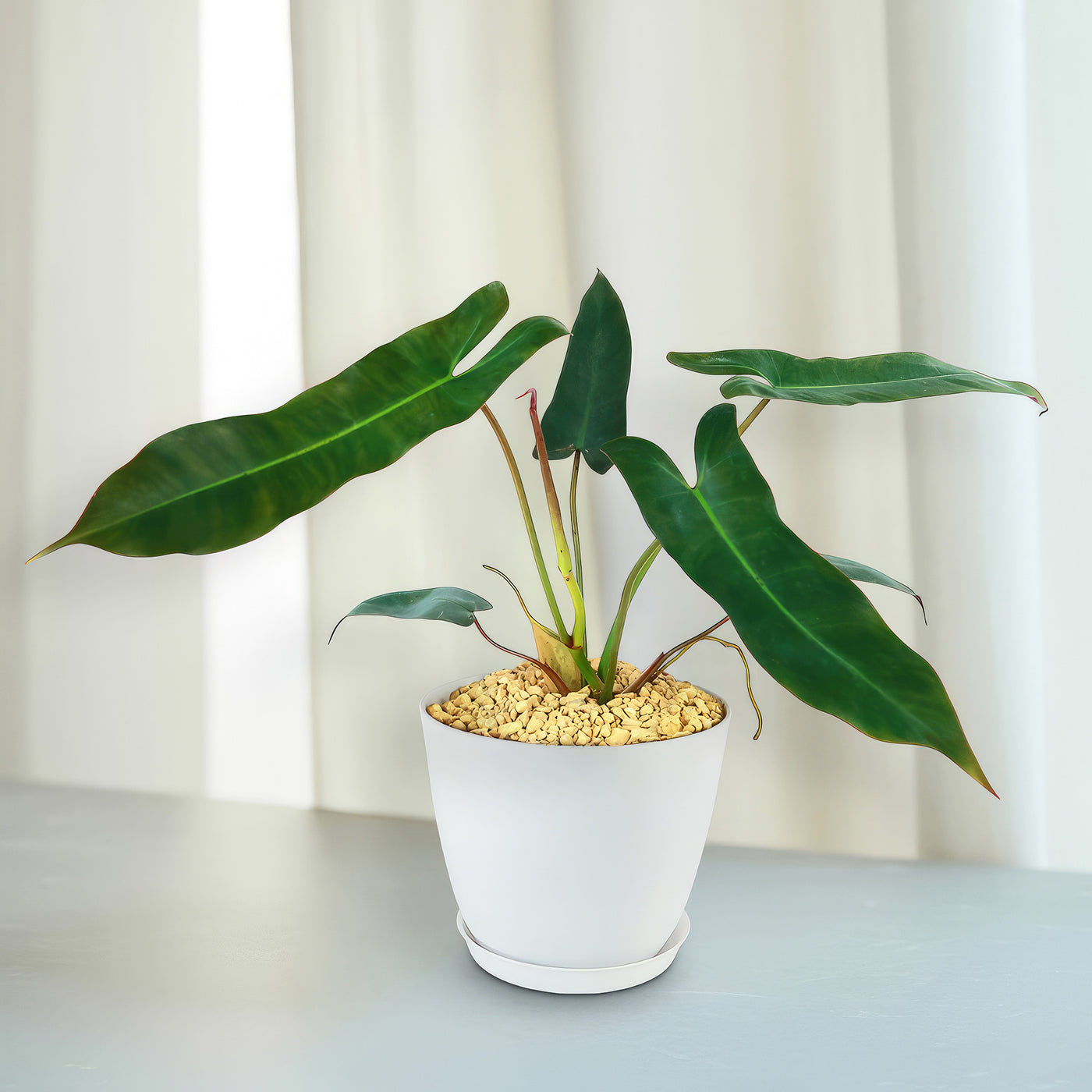
SKU: 24423092299
philodendron drought tolerant

philodendron drought tolerant Philodendron atabapoense 6" Pot / Self Watering / Without Pot

Sale price$20.93 Regular price$23.26
Save 10%

Pay in installments of $5.82 with ShopPay, AfterPay and Klarna

Shipping Estimate
USA
  • USA
  • CAN

Ships within 48 hours · Estimated delivery Oct 19 - Oct 24

Promo Codes Available:

For Your Every Summer RSVP, with Code: SUMMER15

Description

philodendron drought tolerant Philodendron atabapoense 6" Pot / Self Watering / Without PotKey Highlights Philodendron atabapoense The Philodendron atabapoense is highly sought after as a houseplant due to its fast growing, climbing nature and adaptability to indoor conditions. While it thrives in humidity, this plant is surprisingly resilient and can tolerate short dry periods if necessary. Its long, narrow leaves feature deep green tops and striking maroon purple undersides, giving it an exotic appearance. It is a hemi epiphytic plant

Key Highlights - Philodendron atabapoense 

  1. The Philodendron atabapoense is highly sought after as a houseplant due to its fast-growing, climbing nature and adaptability to indoor conditions.
  2. While it thrives in humidity, this plant is surprisingly resilient and can tolerate short dry periods if necessary.
  3. Its long, narrow leaves feature deep green tops and striking maroon-purple undersides, giving it an exotic appearance.
  4. It is a hemi-epiphytic plant that climbs trees in its native habitat and benefits from a moss pole or trellis indoors to encourage larger, elongated leaves.

The Philodendron atabapoense is a striking rare climbing philodendron that has gained popularity among plant collectors due to its elongated, lance-shaped leaves with deep green tops and contrasting maroon undersides. Unlike more common philodendrons, it has a sleek, refined appearance that makes it stand out in any indoor or outdoor plant collection. 

Philodendron atabapoense grows great indoors while maintaining an impressive size, making it a favorite among houseplant enthusiasts. When given proper support, such as a moss pole or trellis, it will produce longer, more dramatic leaves, enhancing its visual impact. In the wild, it grows as an epiphyte, climbing trees and reaching for sunlight while absorbing moisture and nutrients from the humid air. 

Native to the tropical rainforests of Venezuela and Brazil, this plant has long, narrow arrow-shaped leaves with a deep green upper surface and a burgundy to maroon underside with an illustrious shine and sheen.

This color contrast gives it an exotic appearance that is highly appealing to plant collectors.

The plant is also known for its fast-growing nature, especially when provided with adequate support, humidity, and indirect light.

When grown indoors, this Philodendron typically grows up to 6 feet tall and 3 feet wide, depending on its support structure.

In its natural habitat, it can climb much higher, reaching over 10 feet. The leaves can grow significantly longer when provided with optimal conditions, adding to their appeal as a large, dramatic houseplant. 

The flowers of Philodendron atabapoense are small and greenish-white in color. Its blooms consist of a spathe and spadix, which are typical of the Araceae family. The spathe is usually green or maroon on the outside and pale inside, enclosing the spadix that contains tiny flowers. However, it rarely flowers indoors, as it requires specific environmental triggers, including high humidity and warm temperatures. 

One unique aspect of Philodendron atabapoense is its epiphytic and hemi-epiphytic nature, meaning it can grow both in soil and attached to trees. This versatility allows it to adapt well to different growing conditions. It also has a high tolerance for humidity fluctuations, making it easier to care for than some other tropical plants. Its leaves have a leathery texture, helping reduce moisture loss and allowing it to thrive in various indoor environments. 

When and How to Water Your Philodendron atabapoense 

Like other drought-tolerant plants, the Philodendron atabapoense is an excellent choice for plant enthusiasts who prefer low-maintenance greenery. This species can withstand occasional dry spells, thanks to its ability to store moisture in its roots. However, while it is resilient, it thrives best when provided with consistent moisture, allowing the soil to dry out slightly between waterings. Overwatering can lead to root rot, so a well-draining potting mix is essential to prevent standing water.

In the spring and summer, during the active growing seasons, it requires more frequent watering to support its vigorous growth. Water the plant thoroughly when the top 1-2 inches of soil becomes dry, ensuring even hydration. The frequency of watering largely depends on environmental factors such as humidity, light exposure, and pot size. If grown outdoors, the plant may require more frequent watering during hot, dry periods. 

In fall and winter, during the dormant season, your Philodendron enters a slower growth phase and requires less water. Watering should be reduced to prevent excessive moisture build-up in the soil. Ensure the soil is dry at least halfway before the next watering. Maintaining proper humidity levels indoors can help prevent dehydration, but misting is generally unnecessary unless the air is extremely dry. 

Light Requirements – Where to Place Your Philodendron 

When grown indoors as a houseplant, this plant thrives in bright, indirect light. It should be placed near a window with filtered sunlight, such as a north or east-facing window, where it can receive 6 to 8 hours of indirect light daily.

Too much direct sunlight can scorch its leaves, while insufficient light may lead to leggy growth and slower development.

Grow lights can supplement natural light if necessary, ensuring consistent growth throughout the year.

For outdoor cultivation, this Philodendron prefers dappled sunlight or partial shade, similar to its natural rainforest habitat.

It can tolerate morning sun but should be protected from harsh afternoon rays to prevent leaf damage.

If grown under a tree canopy or shaded patio, it will flourish with at least 5 to 6 hours of bright, indirect light daily. In tropical climates, it can be grown outdoors year-round with proper light exposure. 

Optimal Soil & Fertilizer Needs 

The Philodendron atabapoense favors very airy, sandy soil that drains well. Avoid using dense, compacted soils that trap excess water, leading to root rot. Instead, make or buy a well-draining potting mix, or ideally use our specialized potting mix that contains 5 natural substrates and mycorrhizae to promote the development of a strong root system that helps your Philodendron to thrive.

For optimal growth, fertilize Philodendron atabapoense once a year in their actively growing season which is typically spring using a ratio of about 5-10-5 (NPK). Organic options like fish emulsion or worm castings can also boost soil nutrition. Stop feeding in the dormant months when the plant’s growth slows. 

Hardiness Zones & More 

When grown indoors as a houseplant, it prefers temperatures between 65°F and 80°F and humidity levels above 50%. Keeping it in a warm, humid environment mimics its natural tropical habitat, promoting lush growth. Avoid placing it near cold drafts, air conditioners, or heating vents, as extreme temperature fluctuations can stress the plant.

In the United States, this is mostly an indoor plant, but if you live in southern Florida or Hawaii then you can cultivate it outdoors in USDA zones 9-11.

It prefers high humidity and bright, indirect light similar to its rainforest origin.

If growing outdoors in cooler climates, it should be brought inside when temperatures drop below 50°F to prevent cold damage. 

If you are concerned about humidity or notice browning edges on your plant leaves. This addition will dramatically improve the health of your philodendrons. 

Wildlife – Philodendron Flowers Attract the Following Friendly Pollinators  

The Philodendron atabapoense flowers are known to attract a variety of pollinators such as bees, butterflies, hummingbirds, and beetles in their natural habitat. While the plant is primarily grown for its stunning foliage, when it does flower, these pollinators help with its reproductive cycle.

Butterflies
Bees
Hummingbirds
Lady Bugs
Multi Pollinators
Other Birds

According to the ASPCA, Philodendron atabapoense is mildly toxic to humans, and pets such as cats and dogs. The plant contains calcium oxalate crystals, which can cause oral irritation, excessive drooling, and gastrointestinal discomfort if ingested in a large amount. It is safe to touch and handle, making it a popular choice for indoor houseplants.  

How to Propagate Philodendron atabapoense 

The Philodendron atabapoense can be easily propagated through stem cuttings. Select a healthy stem with at least one node and a few leaves, then cut just below the node using sterilized shears. The cutting can be rooted in water or moist sphagnum moss before transferring it to soil. Keep the propagation medium consistently moist and place it in bright, indirect light to encourage root development. 

The Bottom Line 

Overall, the Philodendron atabapoense is a remarkable climbing philodendron with elegant foliage, rapid growth, and stunning leaf contrast. Its adaptability to indoor and outdoor conditions, along with its unique maroon undersides, makes it a favorite among plant collectors. Whether grown on a moss pole or allowed to trail in a hanging basket, it adds a touch of tropical beauty to any space. With proper care, including bright indirect light, well-draining soil, and regular humidity, it will flourish and become a standout feature in any plant collection. Order your very own Philodendron atabapoense for sale today! 

Shipping Notes
  • Free Standard Shipping on $100+ Orders to the USA.
  • Except Preorder products are shipped in 48 hours.
  • Delivery to the USA:
  1. Standard Shipping : 3-10 business days
  • If time is of the essence, please consider selecting expedited delivery for faster service.
Exchange/Return Notes
  • We offer a 30-day return/exchange service after receiving.
  • Final sale items are not eligible for returns or exchanges.
  • To process your return/exchange, please contact us at [email protected]
  • Please click here for more details>>> Return & Exchange Policy
SKU: 24423092299

Discover Niche Categories That Outsell philodendron drought tolerant

Top-Converting Item to Boost Your Average Order

4.0 ★★★★★
Based on 28 reviews
Sort
Highest Rating
Newest First
Oldest First
Product Reviews
S
Verified Purchase
Scot Denhalter
New York, US
★★★★★ 5
A Bitter Pill, but Much Needed Knowledge
Format: Kindle
Its thesis is that we, as humans, are predisposed to emotional, gut-level decision-making. Although most liberals will not want to accept this, author, Drew Westen, makes his case so well even the most inveterate ostriches must pull their heads out of the sand. We believe first, then we seek to support our beliefs. How we come to believe is a complex interaction of genetics and environment, which Westen makes no effort to reveal. What he focuses on is the counter-productive illusion that facts and issues matter more than the emotions underlying the principles we value most in life. And Westen disabuses the reader of this illusion quite completely, giving examples of what should have been said and what should have been done in Democrat campaigns in response to Republican attack. As a psychologist, Westin teaches us how the human brain works and why it is important for liberal politics to know how it works before selecting a candidate and mounting a campaign.
WAS THIS REVIEW HELPFUL?YesReportShare
Reviewed in the United States on June 23, 2013
B
Verified Purchase
Bri
Bozeman, US
★★★★★ 3
good to a point
Format: Paperback
basically what could help democrats win.all well and good,but that side has much of the same donors(drug companies,defense contractors,oil industry,etc.)as the republicans.THAT'S why they don't push back fundamentally. one of my big problems with the author is his unapologetic.uneducated islamaphobia.he sounds like george bush when he mentions muslims actually.he fell for the propaganda.instead of drinking the koolaid of the cult,he should sip from the tea of informed tact. i know right-wingers wear their stances/prejudices on their sleeves,but the problem with the liberal side is the smugness they can exude towards everyone else,when,let's face,they're no better.they went to college to deepen THEIR prejudices with a more expanded vocabulary. otherwise,it's interesting from a psychological standpoint on how and what moves the masses.again,it's worth it to a point,just keep in mind that he's a bit of a meathead
WAS THIS REVIEW HELPFUL?YesReportShare
Reviewed in the United States on November 22, 2020
D
Verified Purchase
Daniel Hahn
Battle Creek, US
★★★★★ 4
The one-stars miss the point:
Format: Hardcover
Thomas J. Farrell and I may be two of a small handful who actually have read Aristotle's Rhetoric. There are good reasons for this. Aristotle's rhetoric is useful to know historically, and gives one the aroma of scholarship, yet only in the sense of one's being well-read but not particularly useful. Westen's point is that Democrats are starving for useful rhetorical advice. Grounding ourselves in material some 2,300 years old is just not sufficient. cglambdin also missed the whole point, but more bluntly and therefore clearly. I would paraphrase Westen's major point as being: as long as you go around thinking "reason, good/everything else, not so good," you lose. Not only do you lose, you DESERVE TO LOSE. Why? In a democracy, "nobody likes a smartass." The corollary to this is: "if you don't know the difference between being smart and being a smartass, you're probably the latter." Now to an ancient aristocrat like Aristotle, the distinction wouldn't have mattered. In the United States of America, it should matter to everyone aspiring to leadership. We common folk expect our leaders to resonate with our values and life conditions. We don't care whether your blood runs a bit blue (as with the Kennedys) as long as you can be with us in spirit when you need to be. It's only polite. In 1992 the smartass class had great fun with Bill Clinton's "I feel your pain" comment, but missed the point that Clinton resonated while President Bush the First's glance at his watch during the same town meeting debate ended the campaign then and there. Drew Westen evokes what I considered state of the art in the communication field when I was in graduate school twenty-five years ago. Because he's a psychologist, and also not a smartass, I didn't expect him to bring up the theoretical language of people ranging from George Herbert Mead to Kenneth Burke. Rather, he demonstrates their insights! We get it! His work also fits well in the tradition of Walter Fisher's groundbreaking . Two things about Westen's book take off a star. Yes, he does meander. Also, his repetitive bashing of Bob Shrum comes off, at last, as an extended hard-sell advertisement for his own political consulting business. Perfection is elusive. Nevertheless, The Political Brain is doggone useful!
WAS THIS REVIEW HELPFUL?YesReportShare
Reviewed in the United States on July 27, 2007
T
Verified Purchase
The Godfather
Alexandria, US
★★★★★ 5
Disturbing but necessary read
Format: Paperback
Feels strange saying that I love a book that is as disturbing as this one is but I love that it's well-written and documented and it exposes some horrendous events in the history of the Americas as well as the world. Americans may well point fingers at the Nazis (and deservedly so) but it's a case of people in glass houses throwing stones. There is no question as to the repulsiveness and inhumanity of the genocide and mass murders perpetrated in Nazi Germany, Stalin's Soviet Union, Mao's China, the Khmer Rouge's Cambodia, and in a host of African nations, to name a few; but in our own not too distant past similar atrocities were perpetrated on the native populations of the Americas by the Spanish, Portuguese, British, and colonists/Americans. While the inhumanity elsewhere in the world is touched upon to show where the mindset of this barbarity likely originated, the focus is on the impact in the Americas -- North, South, and Central. The book contains graphic, disturbing descriptions of the cruelty done to the natives by men who have long been esteemed for their alleged contributions in history. Most notably Christopher Columbus. In my time in grade school, he and the many other conquistadors and explorers were portrayed and men of courage and integrity. This book paints a different picture of them as greedy, bloodthirsty, remorseless killers of peoples who they considered inhuman or subhuman. More troubling is Christianity's participation in these actions. Not to blame Christianity for initiating it but to indict it for condoning and even commending the events. Peaceful races of people minding their own business, living in communities well planned and constructed and advanced for their time, and who welcomed the interlopers were obliterated them. Much of the death and destruction was caused by the introduction of European diseases such as smallpox that killed tens of millions but a large part was also caused by actions of odious proportions. Entire civilizations such as the Aztec and the Inca and the Arawak whose artifacts have since been admired and sought after were wiped off the face of the earth. Tens of millions of people slaughtered. Men, women, children butchered. In numbers likely to exceed those of the aforementioned genocides combined. The purpose being to acquire their lands and their riches. Considered to be no more than animals needed to be exterminated. This is our history. This book should be required reading for everyone. The graphic descriptions of the savagery should cause outrage not only for the acts themselves but for a cultures that has covered up their crimes for centuries. And the holocaust has not ended yet.
WAS THIS REVIEW HELPFUL?YesReportShare
Reviewed in the United States on October 23, 2018
H
Verified Purchase
H S Marks
Lowell, US
★★★★★ 5
THE SINGLE FINEST AND MOST ESSENTIAL BOOK OF THE AGE
Format: Paperback
A masterpiece of scholarship and analysis. This book is nothing less than the single most important work that you will ever read. Our entire culture is built on Holocaust Denial while those most responsible for this abnesia drape themselves in the flag of holocaust memorialism but have little honesty in their true agenda. An agenda that allows in North America alone for there to be at least 50 Holocaust memorials, museums and monuments... only problem is they are ALL about the Holocaust that happened in Europe and NOT about the colossal extermination that took place where they live. It is not only denial on the part of the nations of the Americas and Europe but those responsible for this Holocaust Denial in relation to Indian America insist on an image of being the world's caretakers of holocaust memory. What a bloody audacity. Why do we let the Spanish off the hook so lightly? Why is there no demand for Spain to make its Mea Culpa? Why is there no AMERICAS HOLOCAUST memorial in Madrid, Washington, London and Ottawa ? This brilliant book re-addresses the imbalance. POST SCRIPT.... There is a reviewer further down who uses the monica of "history buff" who rejects the value and integrity of this work. In fact he utterly insults Mr Stannard and his thesis. So I thought I would check out his other reviews...oh boy! One of the remarks he makes in a book claiming that Saddam was behind 9/11 goes "But it is very difficult to argue with the facts that were available to the agencies which pointed to a direct link between Saddam and Al Qaeda." This example of his world view is the mild end of it. So people consider the character of the self-described "history buff" who rejects Stannard's brilliant thesis on the Holocaust in the Americas. The reviewer "history buff" has a world view that comes straight out of the 1950's HUAC committee (he associates all Left wing thought with the Soviet Union not knowing that the Bolshevik regime prohibited the platform of the revolution and that its first victims were in fact the most sincere and dedicated Left revolutionaries. Clearly he has never read the finest autobiography in the history of English language autobiography; Emma Goldman's LIVING MY LIFE volume 1 and volume 2. The latter volume includes a first hand account of the destruction NOT construction of socialism by Lenin and his cohorts ). .
WAS THIS REVIEW HELPFUL?YesReportShare
Reviewed in the United States on June 5, 2006

recommand products