SKU: 251519796
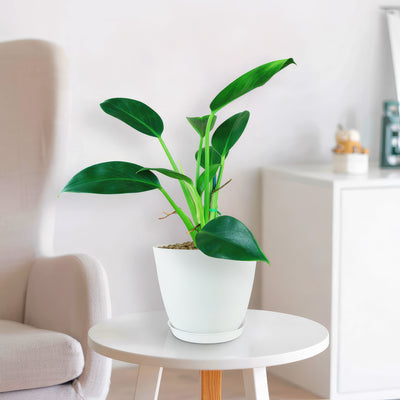
philodendron desk plant

philodendron desk plant ‘Green Princess’ Philodendron 6" Pot / Self Watering / Without Pot

Sale price$24.89 Regular price$27.66
Save 10%

Pay in installments of $6.92 with ShopPay, AfterPay and Klarna

Shipping Estimate
USA
  • USA
  • CAN

Ships within 48 hours · Estimated delivery Jul 17 - Jul 22

Promo Codes Available:

For Your Every Summer RSVP, with Code: SUMMER15

Description

philodendron desk plant ‘Green Princess’ Philodendron 6" Pot / Self Watering / Without PotKey Highlights Philodendron Green Princess The Philodendron Green Princess is known for its glossy, deep green leaves, which add a vibrant and tropical feel to any indoor space. Its compact, bushy growth makes it perfect for desks, shelves, or small corners. The thick, waxy leaves store moisture, allowing the plant to withstand short periods of drought. This makes it a low maintenance choice for those who may occasionally forget to water. It helps to

Key Highlights - Philodendron ‘Green Princess’ 

  1. The Philodendron Green Princess is known for its glossy, deep-green leaves, which add a vibrant and tropical feel to any indoor space. Its compact, bushy growth makes it perfect for desks, shelves, or small corners.
  2. The thick, waxy leaves store moisture, allowing the plant to withstand short periods of drought. This makes it a low-maintenance choice for those who may occasionally forget to water.
  3. It helps to remove toxins such as formaldehyde, thereby improving indoor air quality.
  4. Unlike many philodendrons that trail or climb, ‘Green Princess’ grows in a compact, upright shape, making it ideal for small spaces without the need for support or pruning.

The Philodendron ‘Green Princess’ is a stunning, and beloved evergreen-perennial known for its glossy, deep-green foliage and easy-care nature. This tropical plant is an excellent choice for both beginners and experienced plant enthusiasts due to its adaptability and resilience. Unlike vining philodendrons, ‘Green Princess’ has a more upright, bushy growth habit, making it ideal for indoor spaces where a structured, lush appearance is desired. 

Like most philodendrons, ‘Green Princess’ originates from the tropical rainforests of Central and South America. Due to its popularity as a houseplant, it is now widely cultivated in greenhouses and nurseries worldwide. 

One of the most striking features of the ‘Green Princess’ Philodendron is its lush, deep-green foliage.

The leaves are smooth, slightly elongated, and have a glossy finish, which enhances their vibrant appearance.

Unlike climbing philodendrons, this variety remains compact and bushy, making it perfect for tabletops, shelves, and small indoor spaces.

The plant is also known for being low-maintenance, tolerating lower light conditions, and requiring minimal care compared to other tropical houseplants.

When grown indoors, this ‘Green Princess’ plant typically grows up to 10 inches tall and spreads about 10 inches wide.

Its slow-growing nature makes it easy to manage, and with occasional pruning, it can maintain a tidy, bushy form. While it can grow larger under optimal conditions, it remains significantly smaller than climbing philodendron varieties. 

The flowers of Green Princess Philodendron bloom in spring and summer. The flowers have white petal-like structures called spathes, with a green center (spadix). While this plant is mainly grown for its leaves, these rare flowers can add a nice touch of color to your home. 

The Philodendron Green Princess is a compact and versatile plant, making it perfect for small spaces and a variety of indoor settings. This natural air purifier helps trap dust and improve air quality, while also requiring minimal care, making it ideal for beginners. With its mood-boosting greens, the Philodendron Green Princess adds vitality and a soothing presence to your home, creating a welcoming and refreshing atmosphere.  

When and How to Water Your Philodendron Green Princess 

Philodendron ‘Green Princess’ is a drought-tolerant plant that can withstand periods of dryness, making it an excellent choice for plant owners who may occasionally forget to water. The plant’s thick, glossy leaves help retain moisture, allowing it to survive short dry spells. To ensure proper hydration, always check the soil’s moisture level before watering—water only when the top 1-2 inches of soil feel dry.

In the spring and summer, during the active growing season, the ‘Green Princess’ Philodendron requires more frequent watering to support its lush foliage and steady growth. Typically, watering once every 7 to 10 days is sufficient, but this may vary based on climate and indoor conditions. If grown outdoors, more frequent watering may be necessary during extreme heat. To promote even growth, use lukewarm water and ensure proper drainage. 

In the fall and winter months, the plant enters a semi-dormant stage, requiring significantly less water. Reduce watering frequency to once every 2 to 3 weeks, allowing the soil to dry out more between waterings. Lower temperatures and reduced light exposure slow down growth, minimizing the plant’s water needs. However, ensure the air is not too dry by maintaining adequate humidity. 

Light Requirements – Where to Place Your Green Princess Philodendron 

When growing indoors as a houseplant, this philodendron thrives in bright, indirect light.

Place it near a north or east-facing window where it receives gentle morning sunlight without direct exposure to harsh afternoon rays.

If natural light is insufficient, supplement with a grow light for at least 10-12 hours daily to maintain healthy growth.

Avoid placing it in direct sunlight, as excessive light can scorch the leaves.

For outdoor cultivation, it should be placed in a shaded or partially shaded area, as direct sunlight can cause leaf burns.

Ideally, it should receive 3-5 hours of morning sunlight followed by dappled shade throughout the day. In warm climates, growing it under a tree canopy or a covered patio ensures it receives the right balance of light without stress from intense sun exposure. Whether indoors or outdoors, rotate the plant occasionally to ensure even light distribution and balanced growth. 

Optimal Soil and Fertilizer Needs

Philodendron ‘Green Princess’ thrives in a well-draining, nutrient-rich soil mix. Your soil must have a sandy texture and a low water-holding capacity, just like desert soil.  Soggy wet soil can damage your green princess Philodendron and contribute to bacterial and fungal rot. Ideally, you want to use our specialized potting mix, opens in a new tab that contains 5 natural substrates and organic mycorrhizae to promote the development of a strong root system that helps your Philodendron to thrive.   

For best results, fertilize the plant once a year in the spring using a balanced liquid NPK fertilizer with a ratio of 5-10-5. This promotes lush foliage and steady growth. Avoid over-fertilization, as excessive nutrients can lead to salt buildup and damage the roots.  

Hardiness Zones & More 

When growing indoors as a houseplant, Philodendron ‘Green Princess’ thrives in temperatures between 65-80°F with humidity levels above 50%. Keeping it in a humid environment, such as a bathroom or kitchen, is ideal. If the air is too dry, use a humidifier or pebble tray to maintain moisture levels. Additionally, ensure the plant receives adequate indirect light for at least 10-12 hours daily. 

In the United States, this is mostly an indoor plant, but if you live in southern Florida or Hawaii then you can cultivate it outdoors in USDA zones 9-11.

It can tolerate temperatures down to 50°F but should be protected from cold drafts and frost.

If grown in a container, bring it indoors when temperatures drop.

It thrives in moderate to high humidity and should be placed in a shaded area with 3-5 hours of morning sunlight. 

Wildlife - Philodendron Attracts the Following Friendly Pollinators 

Philodendron ‘Green Princess’ produces unique flowers that can attract pollinators such as beetles, flies, and other small insects. Although it is primarily grown for its foliage, its infrequent blooms add an extra dimension to its appeal.

According to the ASPCA, Philodendron ‘Green Princess’ is mildly toxic to humans and pets due to the presence of calcium oxalate crystals, which can cause irritation if ingested in a large amount. However, it is safe to touch and handle, making it a popular choice for indoor houseplants. 

How to Propagate Your Philodendron Green Princess

You can propagate your plant through stem cuttings. Choose a healthy stem with at least two nodes and cut it with sterile pruning shears. Allow the cutting to dry for a few hours before placing it in water or moist soil. If you propagate in water, change the water every 3-5 days to prevent bacterial growth. Roots should develop within 2-4 weeks, after which the cutting can be transferred to soil.

The Bottom Line 

Overall, the Philodendron ‘Green Princess’ is a beautiful, low-maintenance houseplant that brings a touch of tropical elegance to any indoor space. Its lush, glossy foliage, compact growth, and resilience make it a favorite among plant lovers. Whether placed on a shelf, desk, or in a decorative pot, this philodendron adds a refreshing green presence with minimal effort. With the right care—moderate watering, indirect light, and occasional pruning—it will remain a vibrant and attractive feature in any home or office. 

Shipping Notes
  • Free Standard Shipping on $100+ Orders to the USA.
  • Except Preorder products are shipped in 48 hours.
  • Delivery to the USA:
  1. Standard Shipping : 3-10 business days
  • If time is of the essence, please consider selecting expedited delivery for faster service.
Exchange/Return Notes
  • We offer a 30-day return/exchange service after receiving.
  • Final sale items are not eligible for returns or exchanges.
  • To process your return/exchange, please contact us at [email protected]
  • Please click here for more details>>> Return & Exchange Policy
SKU: 251519796

Discover Niche Categories That Outsell philodendron desk plant

Top-Converting Item to Boost Your Average Order

4.8 ★★★★★
Based on 16 reviews
Sort
Highest Rating
Newest First
Oldest First
Product Reviews
R
Verified Purchase
rkveale
Dallas, US
★★★★★ 4
Good overview of apologetic methods but ....
Format: Paperback
I very much enjoy the counterpoint series by Zondervan. It can help me quickly come up to speed in a variety of theological topics. This book has 5 contributors and each one presents, each one comments on each other's essay and finally each one has some concluding remarks which allows the reader to readily judge the competing opinions. However after reading the various approaches it appears to me that the apologetical approach one uses is not as important as learning the various theistic arguments (both positive and negative) and then putting them into practice. I'm not convinced that studying apologetic methods will be that helpful. This is because the various approaches overlap and also because when actually talking with people one must be very flexible and move deftly with the flow of conversation. Yet still I give this book 4 stars as there are 5 top Christian thinkers contributing to this subject. On a personal note, one reason I read this book is because I was puzzled by presuppositional apologetics. I stand firmly in the reformed camp and I audited iTunesU courses in apologetics from Reformed Theological Seminary and Westminster Theological Seminary and was still confused on how presuppositional apologetics works in actual practice. I must sat that after reading this book I still don't see how this approach is useful in defending the faith. I have respect for John Frame but this apologetical approach seems more like a non-approach. I'll be moving on to more fruitful endeavors such as actually learning specific defenses for the Christian faith.
WAS THIS REVIEW HELPFUL?YesReportShare
Reviewed in the United States on November 23, 2011
S
Verified Purchase
Slemmonade
Bozeman, US
★★★★★ 5
Academically Helpful: Not a How To Book
Format: Kindle
I have to say that I respect all of the apologists who contributed to this book. As a student of apologetics it is interesting to see the perceptions of the different methodologies, but there is no real guidance on "how to defend the faith"...so, there's that. Truth be told, all of their methods have a place and time...it is up to the reader to discern when and where.
WAS THIS REVIEW HELPFUL?YesReportShare
Reviewed in the United States on March 12, 2014
T
Verified Purchase
Theophilos
Carnegie, US
★★★★★ 3
Difficult read, but helpful slightly
Format: Kindle
This book was exhausting, I guess it's because I had to read it quickly for seminary. Either way I don't think the authors intended for the audience to really follow much of what they were saying, it was more like they were in a conversation of their own inner circle, kudos for trying but please make this readable next time... Quite frankly one of the authors I won't say who completely misunderstood presup's understanding of whether or not people can know things. I say that as an avid opponent of the typical presup circular argument. On a positive note, I did learn that all of them share a lot in common and some of them are not different from each other at all. Presup holds in my eyes a highly admired love for the scripture which they often attempt to paint as a separate apologetic from say classical view for example, however it isn't, and always seems to be saying it's the the only show in town. Frame did do a lot of good to show that his view is not the classical presup arrogant argument, by extending commonalities with the other views, however he highlighted the truth, from my understanding, that presup is not an apologetic it at all. It is an attitude of the heart of the apologist. Presup is inconsistent when it tries to say you cannot use evidences and you don't need to when the core of their apologetic argument is an epistemological evidence. The transcendental argument at least in the way presup apologists us it is not actually in the scripture, making it an evidence of philosophy outside the bible. This of course undermines everything they are complaining about in the other camps.
WAS THIS REVIEW HELPFUL?YesReportShare
Reviewed in the United States on January 31, 2016
I
Verified Purchase
Insight Counseling
San Leandro, US
★★★★★ 5
A soaring indictment of what really needs to be reformed in American health care
Format: Paperback
Dr. Brawley has achieved something rare in a non- fiction work. He has combined his clear passion for medicine with a fair but brutal portrayal of what is terribly wrong with our system as it presently stands. Dr. Brawley is highly credentialed and has over 30 years experience in his craft, yet he writes with a balance of humility and moral outrage that is rare in this type of work. I have been in healthcare for over 20 years and have watched horrified as the system has become more, not less broken and ineffectual while at the same time knowing that no American can really know the gaping problems of pharmacuetical companies offering medicines that have questionable merit and do real harm, the multi "tier" system of care where in general the wealthy recieve MORE care, but not necessarily better care and are often over treated for pure profit and the horrific truths about incopetent and dangerous physicians and systems allowed to treat patients while no one dares to ask for QA. "How We Harm" addresses the issues every consumer of medical services need to understand before they or someone they love becomes sick. Sadly some of the families I care for only discover how broken the system is at the moment of their greatest vulnerability- when a family member or themselves become very ill and they are left to fight insurers, billing departments and conflicting prognosises and treatment plans without a rational, science based resource to ensure they are making the right choices. Dr. Brawley describes how the "system" as it currently stands seems to know that sick consumers can not fight for their rights, and are often too frightened and overwhelmed to even ask the right questions when they face major medical decisions. Insurers will be held more accountable after ACA full implementaion in 2014, but this is clearly not enough to fix the systems that you and I the taxpayer supplement when big pharma and for profit medicine have taken all the meager resources that many Americans have to pay for their co-pays and expensive treatments for serious illness. The "system" knows that eventually Medicaid will take over payment for these desperate patients. The case illustrations Dr. Brawley presents are fair and deadly accurate. I see similar terrible outcomes all the time. The book also describes aspects of caring for the 'under served' that are spirtually affirming and make this book a very positive read for that reason alone.Dr. Brawley clearly loves to teach medical students as well and he he even seems to love his patients- a rare but amazing quality in a physician. Dr. Brawley is a national voice of reason and passion for making things right. I look forward to his next move as a leader in American medical reform.
WAS THIS REVIEW HELPFUL?YesReportShare
Reviewed in the United States on April 14, 2013
K
Verified Purchase
Karen Mcwilliams
Lake Worth, US
★★★★★ 5
A MUST READ BOOK ABOUT OUR HEALTH CRISES--REVIEWED BY AN EDUCATOR, PUBLISHED WRITER, AND BOOK REVIEWER
Format: Paperback
I am a former teacher, school librarian, published author, and book reviewer for the Society of Children's Book Writers and Illustrators, as well as judge and book reviewer for the IPPY and MOONBEAM BOOK Awards. Many years ago I was diagnosed with GUILLAIN-BARRE SYNDROME. Since I was diagnosed with this terrible neurological disease, I have continued to experience symptoms which I ignored while finishing my BA and MA degrees, teaching in several school systems including Department of Defense Overseas Schools, and traveling around the world. Even though I was often ill and constantly plagued with symptoms of my disease, I ignored the problems and did not see neurologists or undergo transfusions and/or infusions, as well as be a guinea pig for the huge variety of experimental drugs. I workout daily, eat nutriciously, and try to always be positive, laugh, and have fun. Many people have died from my disease. And I wonder if I am still alive due to NOT SEEING DOCTORS and undergoing UNPROVEN or FLAWED PROCEDURES and DRUGS. Dr. Brawley's book showed me that my choices probably helped me to be active and live, not experience an early death while doctors harmed me with their techniques. I have briefly reviewed Dr. Brawley's outstanding book which helped me to conclude that I made the best choices by not seeing neurologists over the years. Also, I was afraid my neurological disease would be labled a "PRE EXISTING CONDITION" which my insurance policies would not cover. Otis Webb Brawley, author of HOW WE DO HARM; A DOCTOR BREAKS RANKS ABOUT BEING SICK IN AMERICA, is an oncology (Cancer) professor at Georgia's prestigious Emory University as well as the Chief Medical and Scientific Officer of the American Cancer Society. Using personal anecdotes from past patients, Dr. Brawley illustrates many things which are wrong with our medical system as well as medical and nonmedical groups and doctors who need to totally change this system. Every page was packed with specific information about medical problems with protocol, procedures, chemotherapy, and uninformed patients who blindly follow doctors' suggestions as to the best way of treating thier cancers. Much of the medical research is flawed making it almost impossible for patients to research their diseases and make intelligent choices. It is imperative that everyone, men and their well-meaning wives, read about the patient, Ralph, whose wife urged him to get a free PROSTATE PSA TEST in a mall which led to horrendous FLAWED procedures which 'caused him misery and pain until he died an early death. Dr. Brawley thought prostate screening was not at all useful for anyone without symptoms. I also think that many tests we have are just to generate money for doctors and the groups they work for. In fact, just this week they are now saying women should not have MAMMOGRAMS every year as I did since I turned forty. Now the recommendation is for women to have mammograms every three to five years. Dr. Brawley said in his book that women more often find their own cancer, and mammograms should not be taken on a yearly basis. This book was the best nonfiction book I have read in years. But I was disappointed Dr. Brawley did not write a chapter on the FDA, though he referred to the organization many times. I was also interested in more specific information about drugs, particularly STATINS which are taken by most people over 50 even though they have many serious side effects. One chapter was titled GUILLAIN-BARRE SYNDROM but only mentioned the disease briefly. I am a former librarian, and like most librarians look for BIBLIOGRAPHIES, GLOSSARIES, INDEXES, and CHARTS and GRAPHS illustrating important things to better illustrate the text. In the back of the book Dr. Brawley does include specific NOTES about information in each chapter. I could only read a few pages of this information packed book per day, because there was so much information I wanted to retain. I urge every adult of both genders and any age to read this book. And if you are capable and not disabled, volunteer to help the various advocacy groups who are attempting to change our hea;th system. This book was published two years ago before Barack Obama presented his new health care plan, therefore there is nothing in the book about it. Dr. Brawley, I am looking forward to another book from you about the goings on at the FDA, since they release many drugs which are later involved in class action suits. Also, cholesterol and cholesterol drugs should be examined in detail like you did oncology. Also, Dr. B, please have your publisher publish this book in a LARGE PRINT EDITION!!! I first saw Dr. Otis Brawley on BOOKTV.ORG weeks ago. I was so impressed with Dr. Brawley's speech which was perfect as well as his honesty that I bought HOW WE DO HARM. Go to BookTV.org and look for the video of Dr. Brawley's speech. Karen Joan McWilliams, Naples, FL
WAS THIS REVIEW HELPFUL?YesReportShare
Reviewed in the United States on July 6, 2014

recommand products