SKU: 25877504836
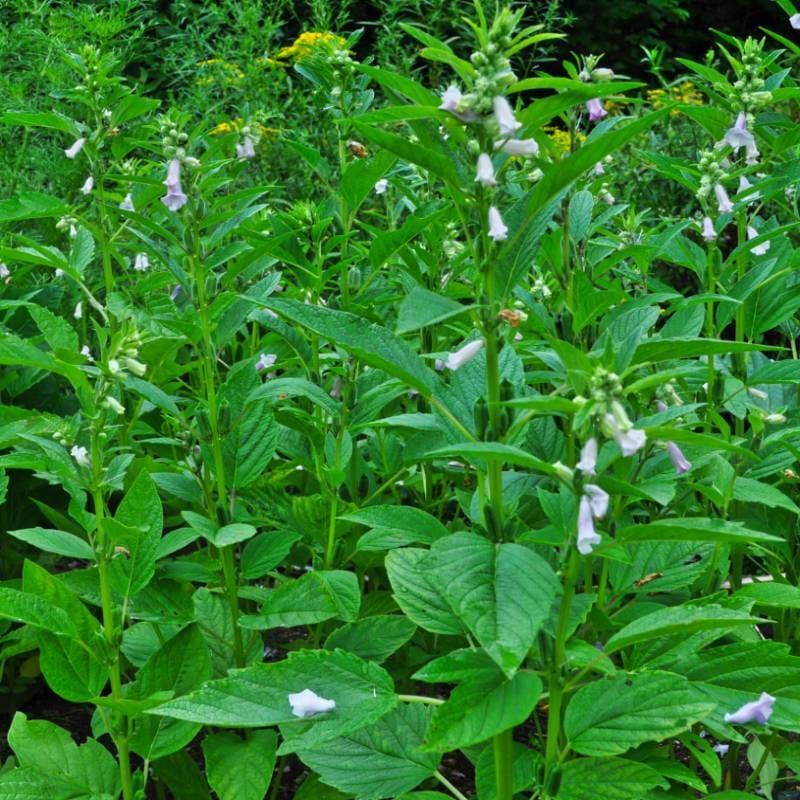
sesame seed plant flower

sesame seed plant flower Kingoma Sesame (85 Days)

Sale price$18.16 Regular price$20.18
Save 10%

Pay in installments of $5.04 with ShopPay, AfterPay and Klarna

Shipping Estimate
USA
  • USA
  • CAN

Ships within 48 hours · Estimated delivery Sep 7 - Sep 12

Promo Codes Available:

For Your Every Summer RSVP, with Code: SUMMER15

Description

sesame seed plant flower Kingoma Sesame (85 Days)Imagine homegrown sesame seed, toasted and sprinkled over your favorite dish or freshly baked rolls. Kingoma Sesame is an ancient crop dating back thousands of years. Tropical like plants thrive in long, hot summers and are easy to grow. Begins flowering approximately 2 months from seeding with tubular shaped flowers growing in clusters around the stem. Older flowers, located lower on the plant, produce the first seed pods while newer flowers begin to

Imagine homegrown sesame seed, toasted and sprinkled over your favorite dish or freshly baked rolls. Kingoma Sesame is an ancient crop dating back thousands of years. Tropical like plants thrive in long, hot summers and are easy to grow. Begins flowering approximately 2 months from seeding with tubular-shaped flowers growing in clusters around the stem. Older flowers, located lower on the plant, produce the first seed pods while newer flowers begin to form above. This process continues throughout the growing season with each plant growing 3-4 feet. Multi-stemmed plants produce 1-2 inch pods with approximately 30 on each stem. Allow pods to dry on or off the plant. They are ready to harvest when the pods begin to split.   

500 seeds


PLANTING

Sesame indicum

Annual

Germination: 7-12 days

Germination Temperature: Optimum soil temperatures 70-85ºF.

Seed Sowing Depth: 1/4” deep

Starting Indoors: 4-6 weeks before the last frost. Sow 2-3 seeds per cell/pot. Thin to the strongest seedling. Provide 70-85ºF soil temperature. Transplant after last frost,  6-12" apart in rows 12-24" apart. Do not overwater seedlings, let the soil dry out between waterings.

Sowing Outdoors: After the last frost when the soil temperature reaches at least 70ºF. Sow 5-6 seeds per foot, thin to 6-12" apart when they are 4" tall.

HarvestPods start ripening from the bottom of the plant and begin to split when they are ready to harvest. In a shorter growing season, you can cut the pod covered stems from the base and dry them indoors on a flat surface. Once the pods have opened collect the seeds by hitting the plants against the side of a container or over a cloth/tarp. Another way is to collect the green pods off the plant and place them in a paper bag until they are dried. 

TipsPlant Kingoma Sesame into average, well-drained soil. Keep well weeded. Do not overwater seedlings, allow the soil to dry out between waterings.

Shipping Notes
  • Free Standard Shipping on $100+ Orders to the USA.
  • Except Preorder products are shipped in 48 hours.
  • Delivery to the USA:
  1. Standard Shipping : 3-10 business days
  • If time is of the essence, please consider selecting expedited delivery for faster service.
Exchange/Return Notes
  • We offer a 30-day return/exchange service after receiving.
  • Final sale items are not eligible for returns or exchanges.
  • To process your return/exchange, please contact us at [email protected]
  • Please click here for more details>>> Return & Exchange Policy
SKU: 25877504836

Discover Niche Categories That Outsell sesame seed plant flower

Top-Converting Item to Boost Your Average Order

4.4 ★★★★★
Based on 25 reviews
Sort
Highest Rating
Newest First
Oldest First
Product Reviews
M
Verified Purchase
Malvin
Omaha, US
★★★★★ 5
A brilliant reassessment of Western intellectual history
Format: Kindle
"Liberalism: A Counter History" by Domenico Losurdo offers a brilliant reassessment of Western intellectual history. Dr. Losurdo is a leading Italian intellectual who has taught at university for many decades. Dr. Losurdo's book will interest readers desiring bold, thoughtful and compelling perspectives on U.S. and European history; with insights that may be very useful to us today. More than anything else, Dr. Losurdo's work articulates a highly original and powerful critique of the ideology of capitalist property relations. Diving into the writings of John Locke, Adam Smith, Bernard de Mandeville and other influential Enlightenment thinkers, Dr. Losurdo explains that the principle goal of liberalism (used here in the European sense of the word) was to secure the rights of property holders over the poor; without the meddlesome interference of church and monarchy. Readers who are accustomed to viewing U.S. history through rose-colored glasses will find their views severely challenged here. Dr. Losurdo persuasively argues that Thomas Jefferson, Benjamin Franklin and other revolutionaries enthusiastically embraced liberal ideology in order to help institutionalize its brutal slave economy. Put another way, it seems that Independence was ultimately about the prerogatives of the elite class who comprised the "community of the free" to buy, sell and own slaves. Dr. Losurdo goes on to explain how Americans put philosophy into service to justify Anglo-Saxon racial superiority and the violent dispossession of native peoples' lands. Dr. Losurdo discusses how liberalism has influenced world history since the American Revolution. Through Dr. Losurdo's scholarship, we gain appreciation for the inherent tension that exists between liberalism's `emancipation' of the people who are privileged by virtue of their race and class; versus the `dis-emancipation' of the working class and poor who are comprised mostly of people of color. So, while liberals' greatest proponents have tended to use violence to lock in elite privilege (colonialism, the U.S. Civil War, the two World Wars), radicals have often struggled in the name of freedom for the people (the Haitian Revolution and the French Revolution). Importantly, Dr. Losurdo challenges us to rethink the idea that progress is a natural by-product of liberalism. It is probably more accurate to say that liberals would be content to have the people live in misery; and that freedoms have been gained by ordinary people through struggle and collective action. The importance of this insight cannot be overstated. By compelling us to think anew about the liberal legacy, we can more easily detect the liberal apologists who pander for the one percent; while empowering the 99 percent of us to speak truth to power. I highly recommend this outstanding book to everyone.
WAS THIS REVIEW HELPFUL?YesReportShare
Reviewed in the United States on April 28, 2014
A
Verified Purchase
A Reader
Draper, US
★★★★★ 4
Excellent critical history
Format: Kindle
A very thorough and important work, astute view and scope of a history of a philosophy and its most sweeping consequences in the modern era. However, this also tends to be postcolonialism in a nutshell and is, from that view, an argument that goes back to at least the 1950s in academia and further if you're looking for straight up anticolonial voices of the past. Also I don't like the way the author cites sources, often giving the reader no clue as to the specific primary source being referenced, instead referencing an entire volume or a generic secondary source. Lastly, the book falls a little short as an interrogation of the marketplace itself.
WAS THIS REVIEW HELPFUL?YesReportShare
Reviewed in the United States on September 7, 2018
F
Verified Purchase
Forrest K.
Bozeman, US
★★★★★ 5
Liberals run and cower, Losurdo is here to destroy you
Format: Paperback
First the physical product review: The book came in a brand new condition with no wonky missprints or anything. Good quality paperback. Now the contents: This book is a complete vivisection of the liberal ideology. Losurdo takes you to the earliest foundations of the liberal ideology and lays bare in great detail its positions and internal contradictions. He studiously walks you through the evolution of the ideology within the context of the times to give the reader a full understanding of how the "great" liberal theorists of the time attempted to navigate the sociopolitical environment, and how their interpretations in turn affected (and continues to affect) the real politick. From the French Revolition to Nazi Germany Losurdo exposes the Liberal ideology for the exclusionary and exploitative sham that it is with Liberal theorists own words and liberal governments' historical actions. If you ever heard the expression "scratch a liberal and a fascist bleeds" this book will fully explain why. Truly a must read that I cannot recommend enough!
WAS THIS REVIEW HELPFUL?YesReportShare
Reviewed in the United States on June 10, 2021
J
Verified Purchase
John C. Landon
Lexington, US
★★★★★ 5
The subtle counterrevolution mixed into the liberal revolutions
Format: Paperback
From the time of Marx/Engels the critique of liberalism has always been set against the heroic tale of its association with the triumph of democracy. As the author here makes clear in close detail the history of the liberal framework is not so transparent, and this can be seen in the way the world of Locke emerges from the radicalism of the English Civil War with a liberalism that will condone slavery. This legacy is inherited by the American Revolution and leaves the whole onset of its democracy ambiguous. This is the classic 'bourgeois' revolution and is what lead to the critiques of the socialists who looked back at the inner failure of the democratic revolutions behind their surface success.
WAS THIS REVIEW HELPFUL?YesReportShare
Reviewed in the United States on July 24, 2016
O
Verified Purchase
orfeo5
Dallas, US
★★★★★ 5
A Must read for all Americans and those who appeal to the American model
Format: Hardcover
Certainly everybody who uses the words, 'freedom' 'liberal' 'democracy', as so many do so loosely, and so many who appeal to the "New'World" model do, should read this; and then take stock of the double standards and hypocrisy that existed in the past, and which still thrive today, based on discredited myths from the past two or three centuries.
WAS THIS REVIEW HELPFUL?YesReportShare
Reviewed in the United States on June 7, 2013

recommand products