SKU: 26460068842
thick succulent plants

thick succulent plants Paddle Plant ‘Kalanchoe thyrsiflora’

Sale price$22.63 Regular price$25.15
Save 10%

Pay in installments of $6.29 with ShopPay, AfterPay and Klarna

Shipping Estimate
USA
  • USA
  • CAN

Ships within 48 hours · Estimated delivery Sep 16 - Sep 21

Promo Codes Available:

For Your Every Summer RSVP, with Code: SUMMER15

Description

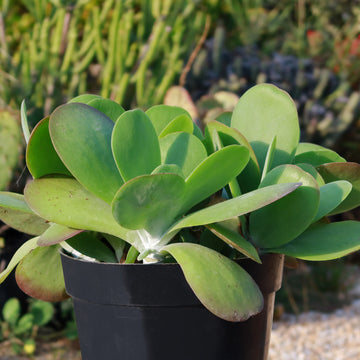
thick succulent plants Paddle Plant ‘Kalanchoe thyrsiflora’The Paddle Plant, also known as Kalanchoe thyrsiflora, is a distinctive succulent admired for its compact rosette of thick, rounded, paddle shaped leaves. Its sculptural form and soft, powdery foliage make it a popular choice among succulent collectors, xeriscape gardens, and low maintenance houseplant enthusiasts. This species is especially valued for its ability to thrive in dry conditions with minimal care, making it highly suitable for arid and

The Paddle Plant, also known as Kalanchoe thyrsiflora, is a distinctive succulent admired for its compact rosette of thick, rounded, paddle-shaped leaves. Its sculptural form and soft, powdery foliage make it a popular choice among succulent collectors, xeriscape gardens, and low-maintenance houseplant enthusiasts. This species is especially valued for its ability to thrive in dry conditions with minimal care, making it highly suitable for arid and water-wise landscapes.

In addition to the common name Paddle Plant, this species is sometimes referred to as the dog tongue, desert cabbage, Flapjack Plant due to its flattened, overlapping leaves that resemble a stack of pancakes.  

Native to South Africa, this succulent features smooth, rounded leaves covered in a white, powdery coating (farina) that helps protect it from intense sunlight and reduces water loss. 

The foliage remains primarily light to medium green and may develop a faint reddish or pinkish blush under strong sun exposure, but it does not typically produce the deep red margins often seen in misidentified forms.

These Kalanchoe thyrsiflora maintain a compact, symmetrical rosette growth habit, making it ideal for container planting, rock gardens, and succulent arrangements. 

It is a slow-growing but highly resilient plant that can reach a moderate size while maintaining a neat, structured appearance. The Paddle Plant is a relatively small succulent that grows up to 18 inches tall and spreads up to 8 inches wide.

In late winter to early spring, mature plants produce a tall flower spike that can reach up to 3 feet in height. The blooms are tubular and yellow, attracting pollinators such as bees. 

After flowering, the main rosette may naturally decline, but the plant often continues its life cycle through offsets that develop around the base, ensuring ongoing growth and propagation.

When and How to Water Your Paddle Succulent 

The paddle succulent plant is a drought-tolerant succulent that prefers to dry out fully between waterings, making it far more forgiving if you forget to water than if you overdo it.

The paddle plant should be watered every 2 to 3 weeks during the growing season, with watering reduced to about once every 4 to 6 weeks during the dormant season, keeping moisture very light.

In the spring and summer, always allow the soil to dry out completely before watering again. This soak and dry approach helps prevent root rot, which is one of the most common issues with this plant.

In the fall and winter, your paddle plant needs even less water as growth slows down. Since cooler temperatures and lower light reduce evaporation, it is best to hold back on watering and only add a small amount when the soil is fully dry.

Related Product

Light Requirements – Where to Place Your Paddle Plant 

When growing indoors, your Paddle kalanchoe thrives in bright, indirect light, which is a key part of proper paddle plant care.

It should be placed near a sunny window, preferably one facing south or west, where it can receive at least 4 to 6 hours of bright light daily.

If natural sunlight is limited, supplement with a grow light to maintain healthy growth and prevent leggy, stretched stems.

Insufficient light can cause the plant to lose its vibrant red margins and slow down its overall growth. 

When growing outdoors, the Paddle Plant prefers the full sun to partial shade. Ideally, it should receive 6 to 8 hours of direct sunlight daily.

Morning sunlight is preferable to intense afternoon sun, which can scorch the leaves if temperatures are excessively high. If growing in hot climates, consider providing some afternoon shade to prevent sun damage, especially during heat waves. 

For both indoor and outdoor growth, it is essential to gradually acclimate the plant to increased sunlight exposure to avoid sunburn. When moving from indoors to outdoors, introduce it to direct sunlight over a week or two, starting with a few hours per day. 

Optimal Soil & Fertilizer Needs 

The Kalanchoe thyrsiflora prefers a very well-draining, sandy or gritty soil mix, along with light fertilization once a year in spring. Planting it in heavy or moisture-retaining soil can lead to compacted roots, poor growth, and eventually root rot, so it is best to use a specialized succulent potting mix with organic mycorrhizae can also support a stronger, healthier root system and help your plant grow more efficiently.

When it comes to fertilizing your kalanchoe plant, apply a balanced, low-strength NPK fertilizer once a year in spring to maintain steady and healthy growth. For best results, use a diluted fertilizer with an NPK ratio around 5-10-5, where slightly higher phosphorus supports stronger roots and fuller leaves.

During fall and winter, when the plant enters dormancy, fertilizing should be avoided completely. Growth slows down during this time, and adding nutrients can build up in the soil and damage the roots.

Hardiness Zones & More 

In the United States, this is mostly an indoor plant, but if you live in southern Florida or Hawaii, then you can cultivate it outdoors in USDA zones 9-11.

It prefers temperatures between 60-80°F and moderate humidity levels. 

Always provide full to partial sun exposure for the best growth and coloration. 

If you live in cooler regions, it is best grown in containers as it is not frost tolerant, and temperatures below 30°F can damage or even kill it. Even light frost can leave marks on the leaves or cause them to become soft and mushy.

How to Grow as a Houseplant

Growing your paddle plant indoors is easy as long as you give it the right environment. It prefers warm conditions, ideally between 60°F to 85°F. It does not handle cold well, so keep it away from drafts, air conditioners, or chilly windows during cooler months. In terms of humidity, it thrives in low to average indoor humidity, which makes it a great match for most homes since it does not need extra misting or moisture in the air.

Set your paddle plant succulent in a bright spot with plenty of indirect sunlight, like near a south or west-facing window.  If your space is a bit dim, you may notice slower growth and less vibrant color, so aim for the brightest area you have without exposing it to intense, prolonged direct rays.

Wildlife Paddle Plant Flowers Attract the Following Friendly Pollinators 

The Paddle plant produces tall, yellow, tubular flowers that attract friendly pollinators such as bees, butterflies, and hummingbirds. These flowers typically appear in late winter or early spring and provide an essential nectar source for beneficial insects. 

Butterflies
Bees
Hummingbirds
Lady Bugs
Multi Pollinators
Other Birds

According to the ASPCA, the Kalanchoe thyrsiflora is considered mildly toxic to cats, dogs, and birds. If ingested in a large amount, it can cause mild to moderate symptoms, including vomiting, drooling, and digestive upset. However, it is safe to touch and handle, making it a popular choice for indoor plants. 

How to Propagate Your Kalanchoe thyrsiflora 

The Paddle plant kalanchoe can be propagated through leaf cuttings or offsets. To propagate through leaf cuttings, simply remove a healthy leaf from the plant and allow it to callous before placing it in well-draining soil. The easiest method is separating offsets that naturally grow at the base of mature plants. Gently remove them, allow the cut ends to callous for 24-48 hours, then plant them in well-draining soil. Keep the soil lightly moist until roots establish.

Key Takeaways

  1. Kalanchoe thyrsiflora is a unique indoor houseplant with thick, paddle-shaped leaves that form a compact, low-growing rosette, making it ideal for bright windows and container displays.
  2. Unlike Kalanchoe luciae, the true Paddle Plant does not develop strong red margins, typically maintaining soft gray-green foliage even in bright light.
  3. As a drought-tolerant succulent, it stores water in its leaves and thrives with simple, low-maintenance care, making it a great choice for busy plant owners.
  4. When mature, it produces a 3-foot-tall flower stalk with fragrant, tubular yellow blooms that attract pollinators like bees and butterflies.
  5. It adapts well to indoor environments, especially when placed in bright, sunny spots where it can maintain its compact shape and healthy growth.

The Bottom Line 

Overall, the Paddle Plant (Kalanchoe thyrsiflora) is a visually stunning and low-maintenance succulent that adds a bold, modern aesthetic to any garden or home. Its stunning red-tinged leaves and attractive yellow flowers make it a popular choice for succulent lovers. With proper watering, light exposure, and temperature considerations, this plant can be grown successfully indoors and outdoors. Whether grown in a container, rock garden, or xeriscape landscape, the Paddle Plant is a resilient and rewarding addition that brings beauty and texture to any space. 
Shipping Notes
  • Free Standard Shipping on $100+ Orders to the USA.
  • Except Preorder products are shipped in 48 hours.
  • Delivery to the USA:
  1. Standard Shipping : 3-10 business days
  • If time is of the essence, please consider selecting expedited delivery for faster service.
Exchange/Return Notes
  • We offer a 30-day return/exchange service after receiving.
  • Final sale items are not eligible for returns or exchanges.
  • To process your return/exchange, please contact us at [email protected]
  • Please click here for more details>>> Return & Exchange Policy
SKU: 26460068842

Discover Niche Categories That Outsell thick succulent plants

Top-Converting Item to Boost Your Average Order

4.3 ★★★★★
Based on 7 reviews
Sort
Highest Rating
Newest First
Oldest First
Product Reviews
C
Verified Purchase
Chongyean Cheang
Lowell, US
★★★★★ 5
An amazing book
Format: Paperback
Silent Spring by Rachel Carson is one book that has opened our minds to how much has gone wrong in the world. It is an immensely powerful scientific book for general readers packed full of verifiable research and data. Rachel Carson wrote the book about the widespread use of chemical pesticides that have wreaked havoc upon the water, the atmosphere, the soil, and the earth since the experiments conducted during World War II. Carson begins the book with a short chapter containing an imaginary scenario of a quiet American countryside in spring devoid of birds and other wildlife. Carson then asks a question which the book attempts to answer: "What has already silenced the voices of spring in many towns in America?" (Carson 1962) The other sixteen chapters fully detail how the use of chemical pesticides and herbicides impacts the environment and silences living species when people do not pay attention. In chapter two she makes the point that humans can alter nature. "The most alarming of all man's assaults upon the environment is the contamination of air, earth, rivers, and sea" (Carson 1962). The author demonstrates that people try to get a quick fix for their small problems but are often unaware of the consequences of their quick fix solutions. "We use the chemicals to kill weeds, insects, and pests…… They should not call insecticides but biocides" (Carson 1962). In the next chapter, "Elixirs of Death," she introduces chemicals which can harm health such as chlorinated hydrocarbons (e.g., DDT), organic phosphates, and other hydrocarbons that are more toxic than DDT such as dieldrin, Aldrin, and endrin. She tells the story of a child and family dog that was suddenly killed by the use on an endrin cockroach spray. When the chemicals are combined with one another, it leads to an unpredictable and harmful result in the atmosphere and living creatures. Carson continues in chapter 4 and five by describing the effect of pesticides in water and soil. Even though low concentrations of insecticide in the water is not detrimental, a habit of putting poison in water builds up and ends up passing into fishes, animals, and humans. DDD and DDE, the toxaphenes used in clear lakes destroy the human adrenal cortex (Carson 1962). Even though the chemicals had been deposited years ago, it was carried on in living species from generation to generation. Similarly, soil can be destroyed if it contains too many pesticides and these chemicals may remain in the ground for an extended period. The following chapter of the book mentioned that there are ways to avoid using insecticides to kill insects such as introducing different species of plants or by introducing plant-eating insects. Carson continues her analysis of the life-threatening consequences of pesticides on the surroundings in chapters 7, 8 and 9. She mentions that the entire population of living creatures, including birds and fish, was killed in sprayed areas. "Aldrin, one of the deadliest of all chemicals, was chosen to kill the Japanese beetles... After a few reports came in of dead birds everywhere…. Dogs and cats sickened" (Carson 1962). The author also provides excerpts of letters from people who lived in the areas saying that these pesticides changed the landscape of the areas in which they lived. One woman reported that the spraying of these chemicals had wiped out robins, chickadees, and cardinals. Other women from Alabama said the result of fire-ant spraying made the birds disappear overnight. Other people in Mississippi saw no land birds for miles after spraying. The author ends the chapter with the question, "Isn't it possible to help the balance of nature without destroying it? Who has the right to decide about the use of chemicals?" Chapter 10 details the death of wildlife when aerial spraying is conducted. She comments on the lack of precaution and foresight being used by the pesticide industry. "No research was done before the launch of million acres aerial campaign" (Carson 1962). It shows the lack of caution and general unawareness of the consequences of their actions. The following chapter examines the evidence that the widespread use of poisonous substances can cause the slow, prolonged destruction of human health. For example, she mentions, "DDT has been found everywhere in processed food and cooked restaurant meals" (Carson 1962). The cumulative effect of using different chemicals is that it is incorporated into our food. It is unpredictable how much it can cause harm. A huge amount of poison is everywhere; people exist in their day-to-day lives without knowing that it is even there. Carson calls it "the age of poison" (Carson 1962). Chapters 12, 13 and 14, Carson directs examines the chemicals harmful to human tissues and organs. Back in the days, we lived in fear of infectious diseases such as smallpox and cholera. Now, we are living with and facing new diseases that Carson calls "the environmental disease." The author gives many examples of the sources of the chemicals and how it reacts and is incorporated into the body. "Dieldrin can have long-term effects such as loss of memory, insomnia, nightmares, and mania" (Carson 1962). At the end of chapter 14, she mentions the statistic that one in every four Americans is developing cancer. The possible explanation is that the sale of chemicals in the market is an accepted part of our lives. She describes how she was slowly dying of cancer as she finished this book. In the next three chapters, Carson describes how insects have developed the ability to reproduce and resist the effects of the sprays. In other words, like the title of Chapter 15 states, "nature fights back." Finally, the final chapter, "The Other Road" presents alternatives to chemical control of pests. Chemical "solutions" should be stopped. Instead, an alternative way is biological solutions based on knowledge of living organisms. She gives examples such as insect sterilization, insect venom as a poison, insect killing microorganisms, and ultrasonic sound to kill mosquito larvae. "The choice, after all, is ours to make" (Carlson 1962). Overall, Silent Spring is all about how the world has changed because of our misguided actions of using harmful chemical pesticides in nature. The book opens our eyes and minds to the fact that these synthetic pesticides have poisoned all living species, destroyed the environment, and contaminated the world. I would recommend this book to all people that are interested in how much the earth is contaminated by humans and want to find a way to help keep the balance of nature without destroying it.
WAS THIS REVIEW HELPFUL?YesReportShare
Reviewed in the United States on February 12, 2018
L
Verified Purchase
Lisa D.
Belleville, US
★★★★★ 5
Book
Format: Paperback
Enjoyed the book
WAS THIS REVIEW HELPFUL?YesReportShare
Reviewed in the United States on April 27, 2026
S
Verified Purchase
SEONGJAE KIM
Alexandria, US
★★★★★ 5
[book review] Silent Spring
Format: Paperback
Author of Silent Spring Rachel Carson points out in Chapter 14 that cancer was increasing not only in the general public but also in youth: “The monthly report of the Office of Vital Statistics for July 1959 states that malignant growths, including those of the lymphatic and blood-forming tissues, accounted for 15 percent of the deaths in 1958 compared with only 4 percent in 1900. Judging by the present incidence of the disease, the American Cancer Society estimates that 45,000,000 Americans now living will eventually develop cancer. This means that malignant disease will strike two out of three families (221)”. “Today, more American school children die of cancer than from any other disease. So serious has this situation become that Boston has established the first hospital in the United States devoted exclusively to the treatment of children with cancer. Twelve percent of all deaths in children between the ages of one and fourteen are caused by cancer” (221). Why there were trends of increasing cancer? To answer the question, this paper delves into the 3 causes of cancers mentioned in this chapter - radiation, chemicals, and lack of oxygen for cells. Furthermore, it explores additional important questions it makes us ask. Cancer can be caused by natural sources such as ultraviolet radiation from the sun, radiation from certain rocks, and other similar sources. While Carson admits they are still a factor in producing malignancy, she argues that since these sources have existed for longer than life on Earth and only those who are resistant to them have survived over time, modern-day organisms must have adapted to living with them. In other words, there are likely other reasons for increasing cancer rates besides natural sources. Carson believed that it was especially due to the widespread use of man-made carcinogens in pesticides and insecticides. Compared to natural cancer-causing materials, man-made carcinogens were brand new forms of chemicals that had never existed in the natural environment before, so human beings’ slow biological evolution has not adapted to them yet. Carson not only suggested this logical process but also shared some real-life examples of how humans started to realize that man-made materials can cause cancer. Some of them were due to a lack of knowledge about carcinogens and were somehow inevitable because it was occupational exposure. For instance, in 1775, Sir Percivall Pott declared that scrotal cancer, which was so common among chimney sweeps, must be caused by the soot that accumulated on their bodies. “In the early 1920’s women who painted luminous figures on watch dials swallowed minute amounts of radium by touching the brushes to their lips; in some of these women bone cancers developed after a lapse of 15 or more years. A period of 15 to 30 years or even more has been demonstrated for some cancers caused by occupational exposures to chemical carcinogens” (226). At least these occupational carcinogen exposures were limited to relatively small populations. However, DDT which has produced suspicious liver tumors on animal subjects during laboratory tests and was given the definite rating of a chemical carcinogen by Dr. Huper of the National Cancer Institute, and other insecticides were widely used. Not only the direct exposure to those chemicals are problem but also they don't simply disappear after they're used. They keep following up the food chain, ending up in humans and potentially causing cancer. How do some chemicals cause cancer? German biochemist, Professor Otto Warburg has proposed a persuasive theory. He believes that these chemicals or radiation agents destroy the respiration of normal cells, depriving them of energy. This theory was confirmed in 1953 when other researchers were able to turn normal cells into cancer cells by depriving them of oxygen intermittently over long periods. The impact of these chemicals is not limited to existing organisms; they can also affect unborn babies. This is because babies have rapid cell divisions, making them more vulnerable to the effects of cancer-producing agents that penetrate the placenta and act on the rapidly developing fetal tissues. Dr. W. C. Hueper of the National Cancer Institute has suggested that congenital cancers and cancers in infants may be related to the action of cancer-producing agents to which the mother was exposed during pregnancy. The long latent period of most cancers is the time required for the infinite number of cell divisions during which fermentation gradually increases after the initial damage to respiration. However, since babies are in the process of rapid cell division, they may develop cancer faster when exposed to carcinogens compared to adults. How do we end up surrounded by chemicals that potentially cause cancers to not only living humans but even further unborn babies? Carson wrote - “The chemical agents of cancer have become entrenched in our world in two ways: first, and ironically, through man’s search for a better and easier way of life; second, because the manufacture and sale of such chemicals has become an accepted part of our economy and our way of life” (242). But we can’t just stop developing chemicals to pursue better and easier lives or change our lives back to primitive levels because unsatisfactory is human nature. Then what’s the practical solution? I’ll say regulators with expertise. Just like we are not using toxic chemicals that were used in the past thanks to regulations, regulations should keep monitoring such potential dangers. Therefore regulators must be experts. But this approach isn’t perfect. Moving legislation to phase out the use of such carcinogenic chemicals has been slow which makes “what the public is asked to accept as “safe” today may turn out tomorrow to be extremely dangerous” (224). It's hard to believe that toxic chemicals like DDT were widely used just a few generations ago. However, it's important to consider that similar practices may be occurring today in the world we live in right now. In Professor Handwerk’s words “Now You See It… Now You Don’t.” and we must keep asking what are the DDTs - something harmful but shocking widely used - nowadays. It’s the important question that Carson made us think further about the cause of the cancer.
WAS THIS REVIEW HELPFUL?YesReportShare
Reviewed in the United States on March 25, 2024
S
Verified Purchase
Sergio denny
Charlottesville, US
★★★★★ 4
A powerful and influential
Format: Kindle
This is an important and eye-opening read for anyone interested in nature, public health and environmental protection.
WAS THIS REVIEW HELPFUL?YesReportShare
Reviewed in the United States on January 31, 2026
L
Verified Purchase
Liz Cole
Boise, US
★★★★★ 5
A True Mystery Story
Silent Spring is as relevant today as it was 50 years ago. Our ground, our air, our food and we are bombarded with chemicals, carcinogens, products of all sorts to kill weeds and bugs and are capable of killing us. Rachel Carson, a biologist and talented writer, walks us through a litany of misuse and overuse of chemicals that have never been tested for safety to humans. Laws are on the books requiring this testing to be done, but it is disregarded because they make our grass greener, our bugs keel over dead and a lot of people rich. Carson is known best for revealing the reason that Bald Eagle eggs had such thin shells that they broke well before the required incubation before hatching. The drastic reduction is successful Eagle births was DDT. Because this is our national bird and is supported by activists in and out of government, DDT was banned and the eagles began producing young again. We have not been so lucky. This book is factual in a clear and understandable way, and it informs us of the human actions and choices that put us all at risk. No alarmist language is employed, but facts lead us to conclusions that are concerning. The stunning fact to me is that the book was written fifty years ago, and the same risks to humanity and our future are being taken today when we could find better ways of solving problems, more cautious ways of using chemicals and restricting their use in sensible ways. As I talk to people about the issues raised in this book, they have not heard of Rachel Carson and have heard nothing of the assured negative effects on our own health from the chemicals we expose ourselves to daily. We knew so much back then when Carson wrote this book. Why hasn't more been researched and shared with us, so we can have current knowledge of the facts and risks. It is important that Carson's writing not be buried on a dusty shelf. It is a real mystery story and we are the cast.
WAS THIS REVIEW HELPFUL?YesReportShare
Reviewed in the United States on November 23, 2016

recommand products