SKU: 27741132903
mother of a thousand succulent

mother of a thousand succulent Mother of Thousands Plant 'Kalanchoe laetivirens' 4" Pot

Sale price$20.58 Regular price$22.87
Save 10%

Pay in installments of $5.72 with ShopPay, AfterPay and Klarna

Shipping Estimate
USA
  • USA
  • CAN

Ships within 48 hours · Estimated delivery Sep 17 - Sep 22

Promo Codes Available:

For Your Every Summer RSVP, with Code: SUMMER15

Description

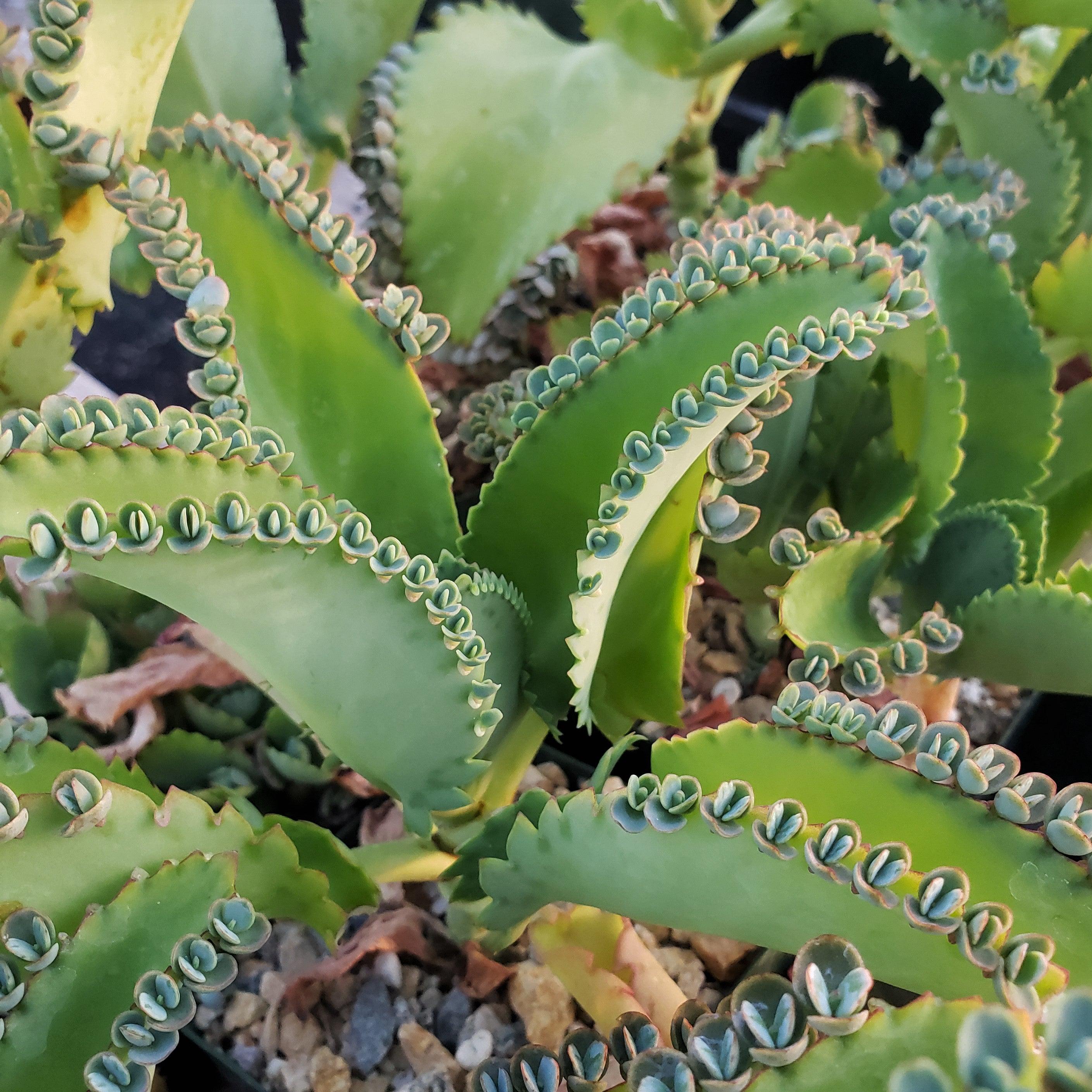
mother of a thousand succulent Mother of Thousands Plant 'Kalanchoe laetivirens' 4" PotIntroducing the mother of thousands plants, scientifically known as Kalanchoe laetivirens, is a fascinating succulent from the Kalanchoe genus that is native to Madagascar. It has several other common names, such as Alligator Plant, Mexican Hat Plant, and Devil's Backbone. However, the true Mother of Thousands is Kalanchoe daigremontiana, which can be identified by the distinctive purplish brown markings on the undersides of its leaves. The mother of

Introducing the mother of thousands plants, scientifically known as Kalanchoe laetivirens, is a fascinating succulent from the Kalanchoe genus that is native to Madagascar. It has several other common names, such as Alligator Plant, Mexican Hat Plant, and Devil's Backbone. However, the true Mother of Thousands is Kalanchoe daigremontiana, which can be identified by the distinctive purplish-brown markings on the undersides of its leaves.

The mother of thousands gets its name from its unique ability to produce a lot of plantlets along the edges of its leaves. These plantlets, also known as "baby plantlets" or "pups," are miniature versions of the mother plant and can easily drop off and take root in the surrounding soil, giving rise to new plants.  

Most people confuse the Kalanchoe plants because of their similarities, but the name "mother of thousands" (Kalanchoe laetivirens) refers to the tiny plantlets that develop along the edges of its leaves, whereas "mother of millions" (Kalanchoe delagoensis) produces plantlets on the tips of its leaves. There's even a hybrid called Kalanchoe houghtonii that combines the features of both plants. It's like a wonderful Kalanchoe family reunion! 

The leaves of this monocarpic mother-of-thousand plant are thick and fleshy, with an attractive grayish-green color. They are often adorned with small, reddish-brown spots or markings, adding to the Kalanchoe plant's visual appeal. The mother-of-thousand succulent has an upright growth habit and can reach a height of up to 3 feet, making it a striking addition to any indoor or outdoor space. 

The flowers of the mother of thousands plants are small, tubular, and bell-shaped. They are typically pinkish-grey in color and can appear in clusters on tall stalks. The flowering season for this mother-of-thousand plant is usually in late winter or early spring, and the flowers can last for several weeks. When grown indoors, it rarely blooms. 

Mothers of thousands are considered to be mildly toxic to pets and humans if ingested. It contains compounds that can cause gastrointestinal discomfort. It's always best to keep it out of reach of curious pets and children. 

You can propagate your alligator plant through its small plantlets. Pick two or three plantlets from the leaves and propagate them properly. The plant does not require any pruning other than the removal of dead stalks and dropped plantlets. It's like a little plant factory!  

It's worth noting that while the Kalanchoe daigremontiana mother-of-thousand plant can be a delightful addition to your plant collection, it can also be considered invasive in some regions. The plantlets it produces can spread easily and take over if not properly managed. So, if you decide to grow this plant, it's important to be mindful of its potential to become invasive and take appropriate measures to control its growth.

When and How to Water Your Mother of Thousands Plant

Just like its closely related Kalanchoe plant, the mother of millions, this succulent is also adapted to arid conditions and is drought tolerant. Mother of thousands needs water at room temperature. Extreme cold or freezing temperatures or extremely hot water damages the roots of your Kalanchoe laetivirens. 

To keep your mother of thousands happy, allow the soil to dry out completely between waterings. Stick your finger about an inch into the soil, and if it feels dry, then it's time to give it a good drink. Remember to use well-drained soil and a pot with good drainage and holes to prevent water from pooling and causing root rot. 

During the cooler months or when the plant is in a dormant phase, you can reduce the frequency of watering even further. These succulents are built to store water in their leaves, so they can handle dry spells better than excessive moisture. 

Light Requirements - Where to Place Your Mother of Thousands Plant 

The mother of thousands loves bright, indirect sunlight. It thrives in a spot where it can soak up plenty of light throughout 4-6 hours of the day. Find a sunny east-facing window or a well-lit area in your home for your Kalanchoe mother-of-thousand succulent to bask in the sunshine. 

However, be careful not to expose the mother of thousands to direct sunlight for extended periods, as it can scorch its leaves. So, a balance of bright, indirect light is ideal for this plant's growth and health. 

Remember, finding the right lighting conditions will help your mother-of-thousand plant flourish and showcase its unique characteristics! 

Optimal Soil & Fertilizers

When it comes to the soil and fertilizer needs of the mother-of-thousand plant, here's what you need to know!

For soil, the mother of thousands prefers well-draining potting soil that allows excess water to flow away. Instead of using the peat-moss-based soil, make or buy a well-draining potting mix, or ideally use our specialized succulent potting mix that contains 5 natural substrates and mycorrhizae to promote the development of a strong root system that helps your succulent to thrive. 

As for fertilizing, the mother of thousands doesn't require frequent feeding. You can use a balanced, natural NPK fertilizer with an equal ratio of about (5-10-5) during the growing season, which is typically spring. 

Remember, it's always best to under-fertilize rather than over-fertilize succulents like the mother of thousands. Too much fertilizer can cause salt buildup and harm the plant. So, a light feeding every few months should be sufficient to keep your plant happy and thriving! 

Hardiness Zone & More 

Typically grown in hot, arid desert regions, the Mother of Thousands plants thrive indoors in warm, dry surroundings. Only in hotter climates, such as Florida and Hawaii, can the slow-growing mother of thousands be grown outside. 

If you live in USDA regions 9 to 11, you can also grow this particular plant outdoors year-round, but they are not frost-tolerant, so you should plant them indoors or put them in a pot and move them indoors during the winter if you live outside of these regions.

Keep your Kalanchoe laetivirens away from cold, drafty windows and air vents if you are growing it indoors in a cold climate. 

As for humidity, this Kalanchoe mother-of-thousands succulent grows wherever it can tolerate a range of levels, but it's important to provide good air circulation.

While household humidity is generally good enough, these mother-of-thousand succulents will do even better with some extra moisture in the air. Set up a humidifier nearby or grow them in naturally humid rooms like your bathroom or kitchen. 

The Bottom Line

Give it a try and enjoy the beauty and intrigue this unique Kalanchoe laetivirens mother of thousands brings to your home or garden! You can find out more information about the difference between the Mothers of Thousands and the Mothers of Millions right here on Planet Desert. 

Shipping Notes
  • Free Standard Shipping on $100+ Orders to the USA.
  • Except Preorder products are shipped in 48 hours.
  • Delivery to the USA:
  1. Standard Shipping : 3-10 business days
  • If time is of the essence, please consider selecting expedited delivery for faster service.
Exchange/Return Notes
  • We offer a 30-day return/exchange service after receiving.
  • Final sale items are not eligible for returns or exchanges.
  • To process your return/exchange, please contact us at [email protected]
  • Please click here for more details>>> Return & Exchange Policy
SKU: 27741132903

Discover Niche Categories That Outsell mother of a thousand succulent

Top-Converting Item to Boost Your Average Order

4.1 ★★★★★
Based on 17 reviews
Sort
Highest Rating
Newest First
Oldest First
Product Reviews
M
Verified Purchase
Minh Ngo
Bozeman, US
★★★★★ 5
My favorite body wash
Scent: Bergamot, Size: 16 Fl Oz (Pack of 1), Scent: Bergamot, Size: 16 Fl Oz (Pack of 1)
My go to body wash, you just get so much for the price and it lasts forever! The smell itself is also very relaxing after a long day. It also lathers quite nicely and does it's job well, would definitely recommend
WAS THIS REVIEW HELPFUL?YesReportShare
Reviewed in the United States on April 13, 2026
J
Verified Purchase
JP De Oliveira Estêvão
New York, US
★★★★★ 5
Smells Like You Have Your Life Together
Scent: Bergamot, Size: 16 Fl Oz (Pack of 1)
Cremo Body Wash with Italian Bergamot, Neroli Blossom, and Fresh Vetiver smells far more expensive than it has any right to. The scent hits that sweet spot between fresh and refined. The bergamot gives it a clean citrus lift, the neroli adds a smooth floral edge, and the vetiver grounds it with a subtle, masculine depth that does not scream but absolutely speaks. The lather is rich and concentrated, so you only need a small amount. It feels more like something you would find in a boutique hotel than on a regular store shelf. The fragrance lingers just enough to be noticed without overpowering your cologne or filling the entire room. If you want to step out of the shower smelling like competence and quiet confidence, this one delivers. It is polished without trying too hard, and it makes everyday showers feel slightly upgraded.
WAS THIS REVIEW HELPFUL?YesReportShare
Reviewed in the United States on February 28, 2026
K
Verified Purchase
Kiley Gallentine
San Leandro, US
★★★★★ 5
Profound and timely
Format: Paperback
If I could give this book 6 stars I would. The way the world is right now, I needed to do a deep dive into anger. And I needed to see how God wants me to handle my anger. There were some very challenging and humbling parts to this book that I needed to hear. All the application questions at the end of each chapter helped me solidify what I learned and what I needed to evaluate personally. Which leads me to the statement that this book was deeply personal to me and I am grateful for the changes it’s helped me make to reflect God more and myself less.
WAS THIS REVIEW HELPFUL?YesReportShare
Reviewed in the United States on March 26, 2026
J
Verified Purchase
John Beeson
Cuba, US
★★★★★ 5
Profoundly biblical and wise
Format: Paperback
David Powlison’s Good and Angry is a powerful book. In the book Powlison dives deep into what anger is and then gets very practical about how to biblically deal with your own anger issues (issues, he assures us, we all have). From the outset, Powlison makes it clear that anger, while dangerous, can be handled to produce good. “At its core anger is very simple,” Powlison says, “It expresses ‘I’m against that’” (39). Powlison says that each of us handles anger differently. Some of us freeze over, some of us quietly brood, some of us simmer, some of us explode. Powlison encourages us not to look at the way others mismanage worse than us, but rather, how do we mismanage anger? Each type has their own blind spots. Powlison then dives into anger itself. Anger is about our displeasure toward something, so what are we displeased with? And why? How are we justified? Unjustified in our anger? And what do I want to happen? Anger is physiological. As embodied beings, anger manifests itself in us physiologically. How is it impacting me when I’m angry? Powlison then dives into mercy, what he calls a constructive displeasure, or constructive anger. When the constructive displeasure of mercy is functioning as it ought, it has four characteristics: patience (a wonderful biblical synonym of patience is “forbearance”), forgiveness (which is “mercifully unfair” (80)), charity (a spirit of magnanimity), and constructive conflict (“Mercy is not a free pass. It is an invitation to turn and repent” (94). All of these fundamentally point to the work of God and his righteous response of anger to our rebellion. “The constructive displeasure of mercy means the redemption of the world” (102). Powlison walks through how God’s anger works: through his righteous and holy response to our sin, to him taking his wrath upon his son on the cross. He concludes, “God’s wrath is your hope. God’s wrath is my hope. We don’t often hear that, but it appears everywhere in the Bible. Wrath is our hope because love masters anger” (121). The final portion of the book steps back and helps us move through analyzing our own anger. Powlison uses James 4:1-12 to help us analyze our own anger issues. At the heart of this analysis is James’s own analysis of his hearer, that they are fighting and quarrelling because of their “desires that battle within” them. In other words, if we have an anger problem (which we all do), we have a malformed desire problem. In other words, we have a heart problem. Significant in digging into this question is the ability to analyze my own motives. The issue isn’t what has happened with me, but is my heart and my heart’s motives and desires in the midst of any given situation. Key questions to ask myself when in a moment of anger are: “what do I want?” “what do I fear?” and “what do I most love?” (154-55). Powlison concludes with a strong word of hope. God is in the process of changing us and reshaping our heart. Our problem, Powlison says, is that we tend to talk to the wrong person in the midst of our anger – ourselves. But when we turn and talk to our Good Shepherd, we will experience hope and change. I’m so grateful for Powlison's Good and Angry. It is a profoundly biblical and wise book with both subtle and profound insights. I know I have been impacted by the book personally and will both turn to it in the future for personal use and as a resource for others who struggle with anger.
WAS THIS REVIEW HELPFUL?YesReportShare
Reviewed in the United States on April 21, 2017
A
Verified Purchase
AMZRKB
Omaha, US
★★★★★ 5
But he is also convinced that your anger does not have to be a problem and this book is intended to help redirect so that we can
Format: Paperback
David Powlison thinks you have an anger problem, and a serious one at that. It is not because he knows you personally, but because he is one who has long studied the fallen heart. But he is also convinced that your anger does not have to be a problem and this book is intended to help redirect so that we can be both good and angry. Anger, as Powlison who is the executive directory of CCEF, defines it, is a sense of opposition to something that is both important and wrong. That means it is a moral response. As those who are created in the image of God we all have come wired for the capacity to express anger. But, as Powlison carefully shows, we have a problem. Our anger is misdirected and misguided because of sin. Not only in the little daily frustrations and irritations, but also in extremely destructive ways. The goal, according to Powlison, is not to eliminate anger, but to have it remade into the image of God by the grace of the gospel. Far from being a therapeutic self-help book, his concern is that we come to understand how anger can coexist with forgiveness, patience, charity, and constructive displeasure. This book should prove to be an excellent resource. However, if you pick it up with the intention to help someone else—your husband, wife, child, friend, or congregant—be prepared to confront the reality of your own anger first. Powlison has a wonderful way of acutely diagnosing anger as a personal problem for all, even those who do not consider themselves angry. A couple of highlights would be his detailed examination of God's wrath showing readers why it is actually because of God's wrath that we have hope. His chapters dealing with every day anger, long-held bitterness, and anger against God also flow from a counselor's heart as he addresses difficult and awful painful truths.
WAS THIS REVIEW HELPFUL?YesReportShare
Reviewed in the United States on September 23, 2016

recommand products