SKU: 28018170087
mexican hat succulent care

mexican hat succulent care Mother of Thousands Plant 'Kalanchoe laetivirens' 4" Pot

Sale price$23.91 Regular price$26.57
Save 10%

Pay in installments of $6.64 with ShopPay, AfterPay and Klarna

Shipping Estimate
USA
  • USA
  • CAN

Ships within 48 hours · Estimated delivery Sep 1 - Sep 6

Promo Codes Available:

For Your Every Summer RSVP, with Code: SUMMER15

Description

mexican hat succulent care Mother of Thousands Plant 'Kalanchoe laetivirens' 4" PotIntroducing the mother of thousands plants, scientifically known as Kalanchoe laetivirens, is a fascinating succulent from the Kalanchoe genus that is native to Madagascar. It has several other common names, such as Alligator Plant, Mexican Hat Plant, and Devil's Backbone. However, the true Mother of Thousands is Kalanchoe daigremontiana, which can be identified by the distinctive purplish brown markings on the undersides of its leaves. The mother of

Introducing the mother of thousands plants, scientifically known as Kalanchoe laetivirens, is a fascinating succulent from the Kalanchoe genus that is native to Madagascar. It has several other common names, such as Alligator Plant, Mexican Hat Plant, and Devil's Backbone. However, the true Mother of Thousands is Kalanchoe daigremontiana, which can be identified by the distinctive purplish-brown markings on the undersides of its leaves.

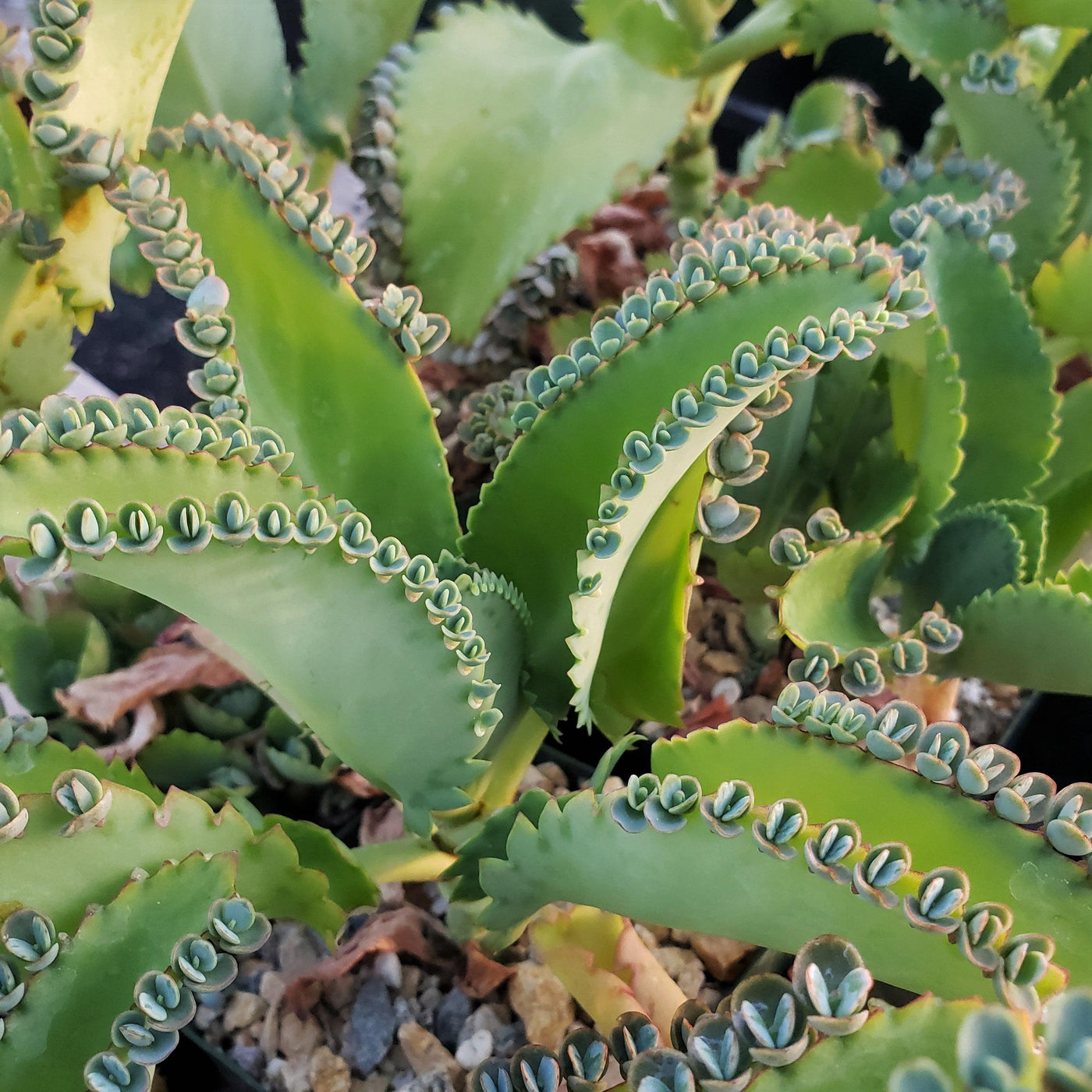
The mother of thousands gets its name from its unique ability to produce a lot of plantlets along the edges of its leaves. These plantlets, also known as "baby plantlets" or "pups," are miniature versions of the mother plant and can easily drop off and take root in the surrounding soil, giving rise to new plants.  

Most people confuse the Kalanchoe plants because of their similarities, but the name "mother of thousands" (Kalanchoe laetivirens) refers to the tiny plantlets that develop along the edges of its leaves, whereas "mother of millions" (Kalanchoe delagoensis) produces plantlets on the tips of its leaves. There's even a hybrid called Kalanchoe houghtonii that combines the features of both plants. It's like a wonderful Kalanchoe family reunion! 

The leaves of this monocarpic mother-of-thousand plant are thick and fleshy, with an attractive grayish-green color. They are often adorned with small, reddish-brown spots or markings, adding to the Kalanchoe plant's visual appeal. The mother-of-thousand succulent has an upright growth habit and can reach a height of up to 3 feet, making it a striking addition to any indoor or outdoor space. 

The flowers of the mother of thousands plants are small, tubular, and bell-shaped. They are typically pinkish-grey in color and can appear in clusters on tall stalks. The flowering season for this mother-of-thousand plant is usually in late winter or early spring, and the flowers can last for several weeks. When grown indoors, it rarely blooms. 

Mothers of thousands are considered to be mildly toxic to pets and humans if ingested. It contains compounds that can cause gastrointestinal discomfort. It's always best to keep it out of reach of curious pets and children. 

You can propagate your alligator plant through its small plantlets. Pick two or three plantlets from the leaves and propagate them properly. The plant does not require any pruning other than the removal of dead stalks and dropped plantlets. It's like a little plant factory!  

It's worth noting that while the Kalanchoe daigremontiana mother-of-thousand plant can be a delightful addition to your plant collection, it can also be considered invasive in some regions. The plantlets it produces can spread easily and take over if not properly managed. So, if you decide to grow this plant, it's important to be mindful of its potential to become invasive and take appropriate measures to control its growth.

When and How to Water Your Mother of Thousands Plant

Just like its closely related Kalanchoe plant, the mother of millions, this succulent is also adapted to arid conditions and is drought tolerant. Mother of thousands needs water at room temperature. Extreme cold or freezing temperatures or extremely hot water damages the roots of your Kalanchoe laetivirens. 

To keep your mother of thousands happy, allow the soil to dry out completely between waterings. Stick your finger about an inch into the soil, and if it feels dry, then it's time to give it a good drink. Remember to use well-drained soil and a pot with good drainage and holes to prevent water from pooling and causing root rot. 

During the cooler months or when the plant is in a dormant phase, you can reduce the frequency of watering even further. These succulents are built to store water in their leaves, so they can handle dry spells better than excessive moisture. 

Light Requirements - Where to Place Your Mother of Thousands Plant 

The mother of thousands loves bright, indirect sunlight. It thrives in a spot where it can soak up plenty of light throughout 4-6 hours of the day. Find a sunny east-facing window or a well-lit area in your home for your Kalanchoe mother-of-thousand succulent to bask in the sunshine. 

However, be careful not to expose the mother of thousands to direct sunlight for extended periods, as it can scorch its leaves. So, a balance of bright, indirect light is ideal for this plant's growth and health. 

Remember, finding the right lighting conditions will help your mother-of-thousand plant flourish and showcase its unique characteristics! 

Optimal Soil & Fertilizers

When it comes to the soil and fertilizer needs of the mother-of-thousand plant, here's what you need to know!

For soil, the mother of thousands prefers well-draining potting soil that allows excess water to flow away. Instead of using the peat-moss-based soil, make or buy a well-draining potting mix, or ideally use our specialized succulent potting mix that contains 5 natural substrates and mycorrhizae to promote the development of a strong root system that helps your succulent to thrive. 

As for fertilizing, the mother of thousands doesn't require frequent feeding. You can use a balanced, natural NPK fertilizer with an equal ratio of about (5-10-5) during the growing season, which is typically spring. 

Remember, it's always best to under-fertilize rather than over-fertilize succulents like the mother of thousands. Too much fertilizer can cause salt buildup and harm the plant. So, a light feeding every few months should be sufficient to keep your plant happy and thriving! 

Hardiness Zone & More 

Typically grown in hot, arid desert regions, the Mother of Thousands plants thrive indoors in warm, dry surroundings. Only in hotter climates, such as Florida and Hawaii, can the slow-growing mother of thousands be grown outside. 

If you live in USDA regions 9 to 11, you can also grow this particular plant outdoors year-round, but they are not frost-tolerant, so you should plant them indoors or put them in a pot and move them indoors during the winter if you live outside of these regions.

Keep your Kalanchoe laetivirens away from cold, drafty windows and air vents if you are growing it indoors in a cold climate. 

As for humidity, this Kalanchoe mother-of-thousands succulent grows wherever it can tolerate a range of levels, but it's important to provide good air circulation.

While household humidity is generally good enough, these mother-of-thousand succulents will do even better with some extra moisture in the air. Set up a humidifier nearby or grow them in naturally humid rooms like your bathroom or kitchen. 

The Bottom Line

Give it a try and enjoy the beauty and intrigue this unique Kalanchoe laetivirens mother of thousands brings to your home or garden! You can find out more information about the difference between the Mothers of Thousands and the Mothers of Millions right here on Planet Desert. 

Shipping Notes
  • Free Standard Shipping on $100+ Orders to the USA.
  • Except Preorder products are shipped in 48 hours.
  • Delivery to the USA:
  1. Standard Shipping : 3-10 business days
  • If time is of the essence, please consider selecting expedited delivery for faster service.
Exchange/Return Notes
  • We offer a 30-day return/exchange service after receiving.
  • Final sale items are not eligible for returns or exchanges.
  • To process your return/exchange, please contact us at [email protected]
  • Please click here for more details>>> Return & Exchange Policy
SKU: 28018170087

Discover Niche Categories That Outsell mexican hat succulent care

Top-Converting Item to Boost Your Average Order

4.4 ★★★★★
Based on 8 reviews
Sort
Highest Rating
Newest First
Oldest First
Product Reviews
A
Verified Purchase
A Happy Atheist
Omaha, US
★★★★★ 1
After five months, it's basically a brick
Color: White
We've had this robot for five months, and it isn't durable. It worked fine for a couple months. But now it works fine for maybe 20 minutes and then just starts spinning around or going back in forth in the same area wasting its battery. The endless troubleshooting does not help. Cleaning all the sensors, resetting the robot, remapping the house ... Nothing helps. It is only being used in about 1100 sq ft of total space, so it's just not that complicated. It's been trying (and failing) to vacuum our smallish living room for nearly five hours, after several resets/etc. Back when it did function, the vacuum is rather loud if you want it to actually pick up anything big enough to see. The vacuum and mop are both terrible at inner corners, and the intersection between rugs and hardwood flooring is a total miss. There's like a 12" strip along all rugs where mopping never occurs. Definitely not a machine to be used without supplemental sweeping and mopping. The machine insists on starting rugs at the corner, so it pulls up even pretty heavy rugs sometimes. It's sucks up items like socks instead of avoiding them. Also, the machine has never successfully left alone no-vacuum rugs or no-go areas, so some rooms (like with high pile rugs or Christmas tree stands) just don't work without physical barricades. Really, really makes me miss the old reliable roombas...
WAS THIS REVIEW HELPFUL?YesReportShare
Reviewed in the United States on April 21, 2026
A
Verified Purchase
Alex Jones
Houston, US
★★★★★ 5
This vacuum is a game changer
Color: White
Not all robotic vacuums are the same, and after testing so many of them in my life this one has outperformed the others hands down! From the suction power, to the battery life, and then the app I can't find a single thing I don't love. The robot is and to pickup small crumbs, dirt, the typical messes, but most importantly it picks up kitty litter like it's nothing. This is an instant game changer. I no longer need to clean up after a robot. It's amazing! The battery life is great! I have a 2500 sq ft house and it can handle all of it before charging. The "home base" makes this effortless where I just schedule my cleans and it takes care of the rest. The app is really nicely built. It's simple and easy to navigate but it also gives me all of the advanced options such as invisible walls and no-go zones. Overall, this is robotic vacuum is my new go-to and I look forward to using it for many years to come!
WAS THIS REVIEW HELPFUL?YesReportShare
Reviewed in the United States on April 14, 2026
K
Verified Purchase
Kallista Anne
Belleville, US
★★★★★ 4
$500, not $600. It isn’t worth $600
Color: White
You’re gonna need to put on some glasses and grab a drink for this one. Cons : - Has issues with “muddy mats” brand rugs and mats, along with light mats - It ate my socks - Will molest your standing fans and shoes and pet toys - Castor wheel is a hair magnet along with the “tangle less” floating brush - Mop heads get dirty after just one run of the entire house - It hates charging cables - And dryer sheets PROS: - Smarter than Shark brand vacuums - Excellent management of houses and avoiding most obstacles - It mops and vacuums well - Cleaning is very easy - Cat litter gets sucked up on the strong setting (not the super strong, though that works too) - Battery lasts for vacuuming most of the house - No navigation issues - Doesn’t mess up your furniture - IT WORKS IN THE DARK the floating brush though where the metal shaft sits inside the brush itself and the miniscule space between the spinning part and the brush itself gathers hair like a magnet and will give constant roller brush errors if not regularly cleaned. The castor wheel I swear has more hair than anything I’ve seen. Even the shark didn’t collect it this bad.
WAS THIS REVIEW HELPFUL?YesReportShare
Reviewed in the United States on April 17, 2026
R
Verified Purchase
Rahul C
Phoenix, US
★★★★★ 5
Value for Money- Exceptional performance and features!!!!
This vacuum/mop system is wonderful! I highly recommend it. This is bi-far the best vacuum and moping system which effectively cleans my floors and carpet. I've always been on the lookout for anything that can lighten my cleaning load. it’s been a real game-changer for my household routine. The self-washing and self-charging features are a huge win. I no longer have to worry about cleaning the mop or making sure it’s charged; it takes care of itself. It moves around furniture and other obstacles smoothly, rarely bumping into anything. It easily navigates tight spaces and corners, making sure every area gets cleaned. Value for Money: Considering all its features and how well it cleans, I think it’s a fantastic investment. It’s made keeping my home clean so much easier and less time-consuming. The robot vacuum was able to map my house successfully, the battery life is a bit longer than my previous robot vacuums, the suction is also great. I saw it go over crumbs in the kitchen and it picked up without any problems, and also has a mop functionality. It has a functioning app, very easy to use. The vacuum is also very quiet. By far, this is my favorite robot vacuum and I’ve tried many as I do not like to go around the house mopping and vacuuming. 10/10 would recommend this model - worth the investment. Overall I could not be happier with this purchase, my home is the cleanest it has been since I’ve first moved in.
WAS THIS REVIEW HELPFUL?YesReportShare
Reviewed in the United States on May 12, 2025
A
Verified Purchase
Amazon user
Massapequa, US
★★★★★ 5
A blessing for “unforgiving” flooring
We bought an 1800s home that was 90% hardwood, but the previous owner made the decision to tear out the hardwood in the kitchen. Unfortunately for us, the flooring we picked to replace it was what I call a very unforgiving. I didn’t realize it until it was too late, but it shows every speck of dust and every muddy paw print. With two dogs, my floors looked like they had not been cleaned in years, but it was being mopped on a daily basis. Enter the Narwal. I’ve included a photo of what the floor looks like today post-clean on a typical winter day in the north (dogs and people running in and out, tracking and mud and snow everywhere). Look at it! It has a shine! In an hour, it will be dull again from the dogs’ next foray into the snowy yard, but right now…glorious! But the best thing is, I no longer care about the dogs tracking up the floor. I can just run the Narwal again. No real extra labor on my part (other than occasionally needing to fill the water container). I want to add a couple of points that I find interesting or that I think people might want to know to make their decision. Both the roller and the side sweeper brushes are meant to prevent hair from getting wound around them. So far I have found this to be true. You can see the videos the manufacturer has provided that show how this works, so I won’t bother to explain it, just point out that I’ve found it does work. I haven’t had to cut any hair out of the roller since I’ve gotten it, and that was previously a weekly thing. It does not self empty after vacuuming. However, it compresses the hair and dirt to take up less space. So while I was emptying my big self-emptying canister (on my Shark) about once a month before, I’ve only actually emptied this smaller dust bin once every one to two weeks. Initially, I was worried that this meant it wasn’t picking up as much debris and hair, but upon review, I discovered the compression factor they describe. You also have the option of using dust collection bags that you can take out and dispose of. To be more environmentally friendly, I have not chosen that option, but for people that may have issues with dust, I’m glad it is an option. It self-cleans and dries the mop pads quite well. I did pick up replacements so that I could wash them, but I’ve needed to wash them with far less frequency than I expected. When I do pull them off to wash, I don’t notice any odor like I was expecting. The mop water is used to both clean the floor and wash the mop pads. I think the majority of the water usage is to clean the pads, however. So you will need to refill that every 2 to 3 mops probably depending on how big your house is. You can use it with or without Narwal cleaner - do not use other cleaners, or you risk the device dying or messing up your floors due to over foaming. My one tip is to use any leftover mop cleaner you may have from your regular mopping, and add a capful into the dirty water bin after you empty and rinse it each time. Because if you do not empty that out every day, the stagnant water WILL be stinky. A little scented floor cleaner has seemed to improve that dramatically for me. Is it expensive? Yes. Is it worth it? RESOUNDINGLY yes. I no longer have to kill myself to have clean floors. And that is the best gift to give myself.
WAS THIS REVIEW HELPFUL?YesReportShare
Reviewed in the United States on December 15, 2025

recommand products