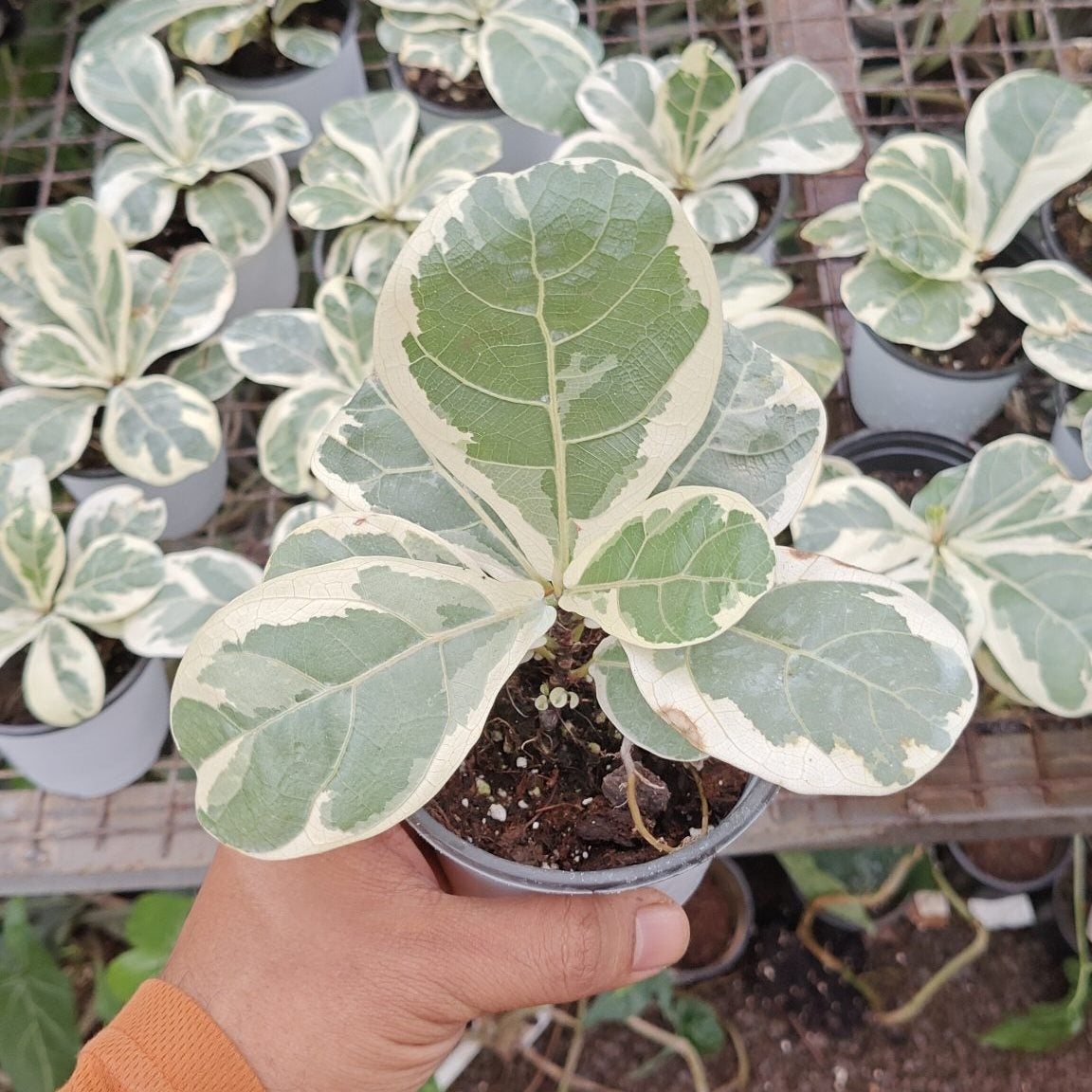
SKU: 28542608769
ficus lyrata variegated fiddle leaf fig

ficus lyrata variegated fiddle leaf fig Variegated Ficus Lyrata (Variegated Fiddle Leaf Fig)

Sale price$21.63 Regular price$24.03
Save 10%

Pay in installments of $6.01 with ShopPay, AfterPay and Klarna

Shipping Estimate
USA
  • USA
  • CAN

Ships within 48 hours · Estimated delivery Sep 11 - Sep 16

Promo Codes Available:

For Your Every Summer RSVP, with Code: SUMMER15

Description

ficus lyrata variegated fiddle leaf fig Variegated Ficus Lyrata (Variegated Fiddle Leaf Fig)The Variegated Ficus Lyrata the Variegated Fiddle Leaf Fig is among the rarest houseplants in the world. The standard Fiddle Leaf Fig is already beloved for its enormous, lyre shaped leaves lyrata, Latin for lyre, the instrument its leaf silhouette resembles and the variegated form takes those same dramatic leaves and layers them in an irregular, tri tonal pattern of dark glossy green at the centre, soft olive green in between, and sweeping cream to

The Variegated Ficus Lyrata — the Variegated Fiddle Leaf Fig — is among the rarest houseplants in the world. The standard Fiddle Leaf Fig is already beloved for its enormous, lyre-shaped leaves — lyrata, Latin for lyre, the instrument its leaf silhouette resembles — and the variegated form takes those same dramatic leaves and layers them in an irregular, tri-tonal pattern of dark glossy green at the centre, soft olive-green in between, and sweeping cream-to-white margins and patches toward the edges. Native to the lowland rainforests of West Africa, it grows into a sculptural, upright tree of 1.5–3 m indoors. Commercially, it is produced by only a handful of specialist growers, primarily in Thailand. Owning one is a genuine statement of collection.

⚠️ The Golden Rule — Find Its Spot and Leave It There The Variegated Fiddle Leaf Fig is acutely sensitive to being moved, rotated, or disturbed. Each time its orientation to light changes, it must recalibrate — and during that adjustment it drops leaves. Choose the brightest, most stable position in your home, place it there, and do not move it again unless absolutely necessary. Even turning it to ensure even growth is not recommended until the plant is fully settled. Consistency is everything with this plant.
💡 Cream Sections Have Less Chlorophyll — What This Means The cream and white variegated areas cannot photosynthesise. The plant relies entirely on its green sections for energy — making it a slower grower than plain Ficus lyrata and more sensitive to low light. It also means the cream sections scorch and brown faster than the green in direct sun or dry air. Bright, consistent, indirect light is the non-negotiable foundation of good care.
☀️

Light

The brightest spot in your home — as close to a window as possible without direct sun touching the leaves. An east-facing window or a south/west-facing window with a sheer curtain is ideal. 6–8 hours of bright filtered light daily. Gentle morning or late afternoon sun can be tolerated once the plant is established. Never move the plant once settled — position it correctly from the start.

💧

Watering

Allow the top 50% of soil to dry before watering — roughly every 10–14 days. Water thoroughly with lukewarm filtered or rainwater until it drains freely, then empty the saucer. The variegated form is more sensitive to over and underwatering than the plain green — a moisture meter is a worthwhile investment. Maintain a consistent watering schedule; irregular watering triggers leaf drop.

💦

Humidity

50–70% preferred. A humidifier nearby is ideal — the cream sections show edge damage sooner than the green in dry air. Keep well away from AC vents, fans, radiators, and heating sources. Do not mist directly — water on the leaves promotes bacterial and fungal infections, to which Ficus lyrata is particularly susceptible.

🌱

Growing Media

Light, fast-draining mix: 50% quality potting soil, 30% perlite, 20% orchid bark. pH 6.0–7.0. A pot with excellent drainage holes is non-negotiable — standing water at the roots is the primary cause of root rot. The plant prefers to be slightly root-bound; repot only when roots visibly emerge from drainage holes, moving up one pot size in spring.

🌾

Feeding

Balanced liquid fertilizer at half strength every two weeks in spring and summer. Use lukewarm water. Stop feeding entirely in autumn and winter. Over-feeding causes leaf drop — less is more. Wipe the large leaves with a soft damp cloth monthly to remove dust, which impedes photosynthesis.

⚠️ Common Issues & Quick Fixes

Leaf Drop

The most common Ficus lyrata complaint — triggered by being moved, rotated, cold drafts, irregular watering, or low light. Identify and fix the cause, then leave the plant completely undisturbed. New leaves will emerge once conditions stabilise. Do not overwater in response to stress — this compounds the problem.

Brown Spots or Edges on Cream Sections

Direct sun, dry air, or tap water minerals. Move to pure indirect light, boost humidity, and switch to filtered or rainwater. Do not mist — it causes bacterial spotting. Existing brown areas are permanent; new growth will be healthy once conditions improve.

Brown Spots with Yellow Halo — Bacterial Infection

Bacterial leaf spot — the most serious Ficus lyrata disease. Caused by overwatering, misting, or poor drainage. Remove affected leaves immediately with clean scissors. Reduce watering significantly, improve drainage, stop all misting, and ensure good air circulation. Do not let water sit on the leaves.

White Raised Dots on Leaves

Completely normal — these are cystolyths, natural calcium carbonate crystal deposits in the leaf cells. They cannot be wiped off and require no treatment. Do not mistake them for pests or disease.

Spider Mites or Scale

Inspect leaf undersides and stems regularly. Wipe with a soft damp cloth then treat with diluted neem oil or insecticidal soap every 5–7 days for 3 weeks. Maintain humidity above 50% to deter spider mites. Do not spray neem oil in direct sunlight.

📋 Quick Plant Profile

Botanical Name Ficus lyrata Warb. 'Variegata'
Name Meaning lyrata = Latin for lyre — the leaf silhouette resembles the ancient stringed instrument
Family Moraceae (mulberry family)
Origin West Africa; lowland tropical rainforest
Variegation Pattern Tri-tonal: dark green centre, olive-green mid, cream-to-white margins and irregular patches
Rarity Extremely rare — commercially produced by specialist growers primarily in Thailand
Golden Rule Find its spot and do not move it — position changes trigger leaf drop
Light Brightest spot available; bright filtered; no direct midday sun; do not rotate
Watering Top 50% dry; lukewarm filtered water; consistent schedule; no saucer standing water
Humidity 50–70%; humidifier preferred; no misting — causes bacterial leaf spot
Temperature 18°C–27°C; stable and consistent; no cold drafts or sudden changes
Mature Height 1.5–3 m indoors; up to 25 m in the wild
Pot Preference Slightly root-bound; repot only when roots emerge from drainage holes
Do Not Mist Water on leaves causes bacterial leaf spot — use humidifier instead
White Dots on Leaves Cystolyths — natural; not pests; do not treat
Ideal For Serious Collectors, Statement Indoor Trees, Bright Living Rooms
Care Level Advanced — consistency and stability are the foundations of success
Shipping Notes
  • Free Standard Shipping on $100+ Orders to the USA.
  • Except Preorder products are shipped in 48 hours.
  • Delivery to the USA:
  1. Standard Shipping : 3-10 business days
  • If time is of the essence, please consider selecting expedited delivery for faster service.
Exchange/Return Notes
  • We offer a 30-day return/exchange service after receiving.
  • Final sale items are not eligible for returns or exchanges.
  • To process your return/exchange, please contact us at [email protected]
  • Please click here for more details>>> Return & Exchange Policy
SKU: 28542608769

Discover Niche Categories That Outsell ficus lyrata variegated fiddle leaf fig

Top-Converting Item to Boost Your Average Order

4.8 ★★★★★
Based on 28 reviews
Sort
Highest Rating
Newest First
Oldest First
Product Reviews
T
Verified Purchase
TRF guy
Phoenix, US
★★★★★ 5
The information in the book is good and goes into good detail about the Halo Universe ...
Format: Hardcover
Bought the book as a gift for my 12 year old son. The information in the book is good and goes into good detail about the Halo Universe and the Human-Covenant War. The art work is excellent. Well worth the cost.
WAS THIS REVIEW HELPFUL?YesReportShare
Reviewed in the United States on July 8, 2014
B
Verified Purchase
Brandon Benz
Waukegan, US
★★★★★ 5
BEAUTIFUL
Format: Hardcover
lARGE AND FULL OF INFO. gOOD FOR ANY hALO COLLECTOR or anyone who wants to know a bit more about the universe. Kind of sad it didn't come in its own plastic wrap but it was in perfect condition and wasn't damaged.. as a collector i was VERY happy
WAS THIS REVIEW HELPFUL?YesReportShare
Reviewed in the United States on October 9, 2013
J
Verified Purchase
Jared L
Lowell, US
★★★★★ 4
Somewhat underwhelming; but still a good book that references a lot of things Halo 4 related
Format: Hardcover
I have been looking forward to this book for several months now, as there is not a lot of material out there that covers Halo 4 or the lore around this newest entry (and upcoming trilogy). There is the "Halo Encyclopedia" (released in 2009), which only covered everything up to Halo 3; and the first "Halo: The Essential Visual Guide" (released in 2011), which covered everything up to Halo: Reach. The first Essential Visual Guide was basically a watered-down version of the Encyclopedia. While both of those are great books, the Encyclopedia is one of the best sources out there for definitive Halo information. So here we finally get a book regarding the new lore of the Halo universe we've been learning about since 2011 (starting with the Forerunner and Kilo-Five novel trilogies, and Halo 4 itself). But don't get your hopes up; unfortunately, this is nothing like the Encyclopedia that we already have access to. Overall, this is a good book, but I was a bit underwhelmed with it. Let me try and explain why. If you are a newcomer to the Halo universe, then obviously this book would do a great job in introducing the new characters/enemies/locations of Halo 4 to you. But if you are a veteran like me, who has been delving into Halo lore for over a decade now, the book doesn't really show or teach you anything new. Each entry is basically a very rushed explanation of what that particular person, ship, location, etc is about. I know it's unfair to assume that this would have been a definitive source for information, but it's just a shame how bland the detail is. Several of the entries in this book have enough information regarding them to where it could cover several pages, yet just about everything in this book is narrowed down to one page. I understand it is a Visual Guide, and not a factual, historical records of Halo events; but even the pictures are somewhat underwhelming. Each entry could have contained so much more information and photos than they had. The UNSC Infinity, for example, was simply stretched out across two pages, with not a lot of information regarding it and a grand total of three pictures (none of which were even of the interior). I will say there were some entertaining parts in the book, especially regarding the Spartans of Majestic Team (since not much background info was explained in the game). But these were so few and far between for me. A good half of the book covers the weapons, vehicles, armor, and multiplayer maps in Halo 4. In my opinion, a lot of that stuff shouldn't have even been covered (since a lot of it has already been covered in the past, in the Encyclopedia and the first Essential Visual Guide). So again, that just goes with my point about the book not meeting my expectations. But let me elaborate one more time, that I am a fanatic of Halo lore. If you are like me, and have been following the franchise since it's beginning, you probably won't find too much stuff in here that you don't already know about, and the book may be kind of a let down because of it. But if you are a newcomer to Halo or simply a casual fan, then this book is a good enough catalog of information regarding just about everything Halo 4 related. The best part of the book were the first 20 pages or so, where they showed off all of the major characters. After that, there just wasn't enough for me to be excited about; simply because I already knew just about everything they were trying to explain. I really wish DK and 343 Industries would update the Halo Enclyclopedia (or just create a brand new one) to include all of the new stuff pertaining to the Forerunner novels, Kilo-Five novels, Halo 4, and everything else post Halo 3 related we have learned in these past several years. But none the less, this book is still a good enough reference for a great price. And I anxiously await to see what 343 Industries does next with the series, regarding both the games and possible novels/comics.
WAS THIS REVIEW HELPFUL?YesReportShare
Reviewed in the United States on September 21, 2013
A
Verified Purchase
Amazon Customer
Alexandria, US
★★★★★ 5
Awesome book!
Format: Hardcover
Bought this for my sons Christmas present (mind you, we don't own the video game) and when I opened it I knew he would HAVE to share with me! This book has great details and pictures to fuel the imagination.
WAS THIS REVIEW HELPFUL?YesReportShare
Reviewed in the United States on November 22, 2013
K
Verified Purchase
Kev
Alexandria, US
★★★★★ 5
Stunning !!!
Format: Hardcover
This is a stunning book with beautiful, vivid art and expose' which for any true Halo(R) fan is a must buy. Your coffee table deserves this book. Pick it up if you don't have it. I paired this book with the Halo(R) The Essential Visual Guide, which covers Halo, Halo 2, Halo 3, Halo 3: ODST, Halo Wars & Halo: Reach.
WAS THIS REVIEW HELPFUL?YesReportShare
Reviewed in the United States on August 28, 2014

recommand products