SKU: 30833363400
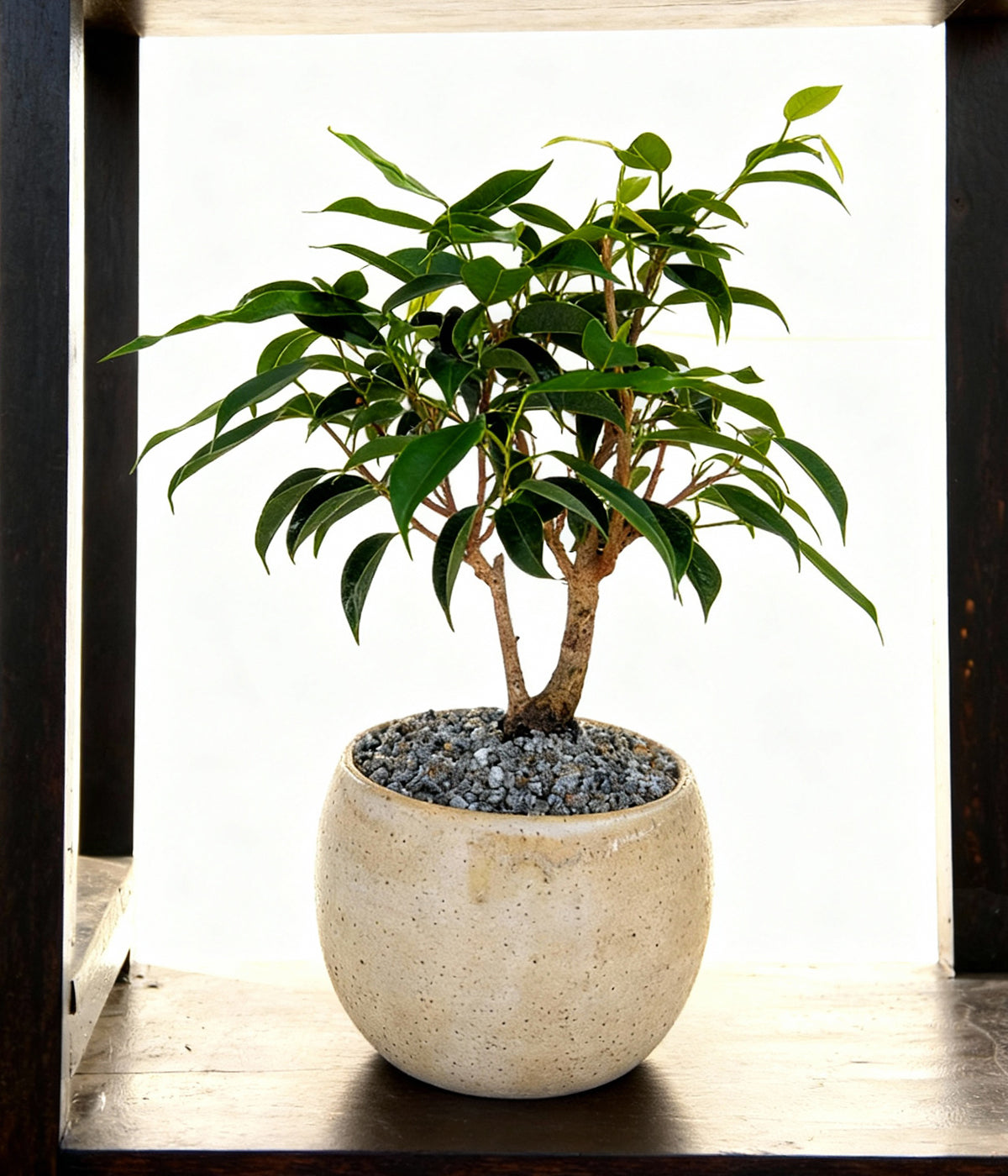
fiddle leaf fig bonsai

fiddle leaf fig bonsai Weeping Fig Bonsai Tree | Ficus Benjamina

Sale price$23.26 Regular price$25.84
Save 10%

Pay in installments of $6.46 with ShopPay, AfterPay and Klarna

Shipping Estimate
USA
  • USA
  • CAN

Ships within 48 hours · Estimated delivery Sep 7 - Sep 12

Promo Codes Available:

For Your Every Summer RSVP, with Code: SUMMER15

Description

fiddle leaf fig bonsai Weeping Fig Bonsai Tree | Ficus BenjaminaFicus benjamina Weeping Fig Bonsai Plant Indoor Ficus Benjamina Native to Southeast Asia and Australia, the Weeping Fig grows tall in the wild but adapts beautifully to indoor spaces when shaped and maintained. Its slim trunk branches into a canopy of glossy leaves, creating an airy silhouette that brings natural rhythm to living and working areas. Each tree is set in a hand crafted Speckled White vessel with a soil blend designed for balanced

Ficus benjamina

Weeping Fig Bonsai Plant | Indoor Ficus Benjamina

Native to Southeast Asia and Australia, the Weeping Fig grows tall in the wild but adapts beautifully to indoor spaces when shaped and maintained. Its slim trunk branches into a canopy of glossy leaves, creating an airy silhouette that brings natural rhythm to living and working areas. Each tree is set in a hand-crafted Speckled White vessel with a soil blend designed for balanced moisture and root health.

Dwarf Tree | Easy Care Indoor Bonsai for Home and Office

Bright conditions suit this bonsai best—full natural light or bright, indirect sun. Water when the pot feels lighter, typically every 5–7 days: submerge up to the rim for 5–10 minutes, then drain fully. Keep away from heaters, AC units, and sudden temperature shifts. Once outdoor temperatures stay above 55°F, it can spend time outside in gentle morning light, protected from intense afternoon sun. Light pruning twice a year maintains its form.

Small Ficus Tree | Versatile Desktop and Shelf Plant

This bonsai fits easily on a bedside table, bookshelf, kitchen island, or work desk. The rounded Speckled White vessel adds a sculptural element that pairs well with ceramic frogs, books, and decorative accents with natural textures. Whether bringing greenery to small apartments, softening office corners, or serving as a thoughtful gift, the Weeping Fig complements a range of interior styles.

Ficus species are often associated with focus, steady development, and long-term growth. In various traditions, they symbolize resilience and thoughtful progression—qualities that make them meaningful additions to workspaces or personal areas.

IN A NUTSHELL

Thrives in bright or bright-indirect natural light; protect from harsh sun and direct heat.

Low to moderate maintenance. Water when the pot feels about half lighter—about every 5–7 days—by submerging up to the rim for 5–10 minutes and draining well.

Prefers temps between 55–80°F; may be placed outdoors in mild weather with gentle morning light.

Light pruning twice a year keeps its canopy shaped and proportionate.

All live plants are non-returnable / non-refundable / not eligible for discounts.

Shipping Notes
  • Free Standard Shipping on $100+ Orders to the USA.
  • Except Preorder products are shipped in 48 hours.
  • Delivery to the USA:
  1. Standard Shipping : 3-10 business days
  • If time is of the essence, please consider selecting expedited delivery for faster service.
Exchange/Return Notes
  • We offer a 30-day return/exchange service after receiving.
  • Final sale items are not eligible for returns or exchanges.
  • To process your return/exchange, please contact us at [email protected]
  • Please click here for more details>>> Return & Exchange Policy
SKU: 30833363400

Discover Niche Categories That Outsell fiddle leaf fig bonsai

Top-Converting Item to Boost Your Average Order

4.6 ★★★★★
Based on 8 reviews
Sort
Highest Rating
Newest First
Oldest First
Product Reviews
J
Verified Purchase
Jc
Phoenix, US
★★★★★ 5
Great Book
Format: Paperback
If you're a K9 handler , this is the IT book. It breaks down everything you need to know to become a successful handler and an even better cop. Plenty of case law inside . Definitely recommend.
WAS THIS REVIEW HELPFUL?YesReportShare
Reviewed in the United States on March 15, 2026
W
Verified Purchase
William
Chelsea, US
★★★★★ 5
Good information
Format: Paperback
Outstanding
WAS THIS REVIEW HELPFUL?YesReportShare
Reviewed in the United States on April 2, 2026
M
Verified Purchase
Mary T
Lowell, US
★★★★★ 5
Great read!
Format: Kindle
In addition to being an engaging lecturer, Stoermer writes beautifully! “Again and again, people confronted the distance between the compact as advertised and authority as exercised.” Gorgeous prose and achingly painful history.
WAS THIS REVIEW HELPFUL?YesReportShare
Reviewed in the United States on June 3, 2026
F
Verified Purchase
Francis J. Casper
Los Angeles, US
★★★★★ 3
No Index or footnotes
Format: Paperback
I have been following Prof Stoermer’s videos preceding this book and pre-ordered it on that basis. I to read it but am a bit disappointed and disturbed that there is nothing by way of an index or footnotes, and no reference I can find that they are available elsewhere. My 3 therefore, has nothing to do with the substance and will update this review after I read it. But I don’t understand the absence of such material.
WAS THIS REVIEW HELPFUL?YesReportShare
Reviewed in the United States on June 4, 2026
K
Verified Purchase
Kindle Customer
Chelsea, US
★★★★★ 5
Every american should be encouraged to read this text
Format: Kindle
This book had a profound impact on me. It has changed how I view all political discussions, history discussions, policy discussions, and race discussions. As a Hispanic Caucasian, I was acutely unaware of much of America's racist history. I knew the obvious examples, but this book really shows how extensive the racism is and its profound effects that are still heavily in effect today. Kendi's thesis is short and simple: racist ideas were created to justify racist policies. This is counter to the common argument that ignorance and racism spurs racist policies. Kendi lays out his main thesis at the beginning of the book and follows it up with example after example to back it up. Keeping the thesis and definition of racism simple really helps emphasize Kendi's point throughout the book. This book is also thorough; so much history is covered by this book. I spent a lot of time looking up some historical events or figures in more detail on Wikipedia to get a fuller picture. If you are unfamiliar with American history, then expect to move very slowly through the text as you look everything up for proper context. I absolutely love this book and strongly encourage everyone to read it. However, I do have a few gripes with it: - Kendi often misled me with his wording or juxtaposition of statements. I understand he is trying to make a statement, but I wish he wouldn't do this. One example that comes to mind is Roosevelt's naming of the White House. Kendi makes it seem like Roosevelt named it the White House after the public uproar over his invitation of Booker T. Washington over for dinner. However, there doesn't appear to be any evidence to support this, and there is some indication the White House was already referred to by that name well before the dinner. To Kendi's credit, he doesn't explicitly say the naming was done to appease the public, he just points out that it happened and people were still upset. Another example is his mention of black unemployment rates rising sharply in the early 1980s. This is true, but all unemployment rates rose during that time due to the recession. Yes, the black unemployment rate was worse, but he doesn't make that point: he only mentions the black unemployment rates. So as a reader you have to be careful of the facts you internalize from the book. - The organization of the book didn't really do anything for me. He tries to break down the text into 4 main sections, each focusing on a different historical figure. However, the focus on the figures didn't really contribute much, in my opinion, to his thesis. It brought some organization to his book, but not much. I would have preferred he spent more of the book going into details of some of the more significant policies or events than to keep looping the historical figure back in. - Text can read a bit haphazardly at times. There are certain sections of the book where I feel Kendi is jumping around history pretty quickly to different events and it becomes difficult for me to follow. Eventually he gets around to making a point, but it usually takes too long for me to fully grasp it at the moment. I have to often re-read these sections a second time to really get it. Again, please buy this book and read it. We would all be better off to know this history and the racist policies behind it.
WAS THIS REVIEW HELPFUL?YesReportShare
Reviewed in the United States on April 4, 2018

recommand products