SKU: 31013596018
dracaena cinnabari trees for sale

dracaena cinnabari trees for sale Dragon's Blood Tree (Canary Islands) – Experimental Farm Network Seed Store

Sale price$26.52 Regular price$29.47
Save 10%

Pay in installments of $7.37 with ShopPay, AfterPay and Klarna

Shipping Estimate
USA
  • USA
  • CAN

Ships within 48 hours · Estimated delivery Sep 13 - Sep 18

Promo Codes Available:

For Your Every Summer RSVP, with Code: SUMMER15

Description

dracaena cinnabari trees for sale Dragon's Blood Tree (Canary Islands) – Experimental Farm Network Seed StoreDracaena draco Origin: Canary Islands via California Improvement status: Unknown Seeds per packet: 10 BOTANICAL SAMPLE NOT GERMINATION TESTED Life cycle: Perennial Along with its cousin, the Socotra Dragon's Blood Tree (Dracaena cinnabari), from an island on the other side of Africa, the Canary Islands Dragon's Blood Tree is one of the major sources of the historically important red colored resin known as "dragon's blood." Long used as a dye, painting

Dracaena draco

Origin: Canary Islands via California

Improvement status: Unknown

Seeds per packet: 10

BOTANICAL SAMPLE - NOT GERMINATION TESTED

Life cycle: Perennial

Along with its cousin, the Socotra Dragon's Blood Tree (Dracaena cinnabari), from an island on the other side of Africa, the Canary Islands Dragon's Blood Tree is one of the major sources of the historically important red-colored resin known as "dragon's blood." Long used as a dye, painting pigment, varnish, incense, toothpaste, and ingredient in compounds both medicinal and magical, the garnet-red sap — which drips like slow-moving blood from any wounds to the plant's bark — has captured imaginations for thousands of years. Since the major sources of the resin were largely found on isolated islands, it was apparently easy for its marketers to pass it off as genuine dragon's blood — for few had firsthand evidence to dispute such tales. It is first mentioned (with the now-anonymous author acknowledging it comes from a plant) as a product of Socotra in a 1st century Greco-Roman periplus, a sort of first-hand travel and trading guidebook, called Periplus Maris Erythraeixi, which detailed economic opportunities for travelers and traders from the Red Sea across the Arabian Sea to modern-day India, almost all the way to Bangladesh (and including an overland route to China as well).

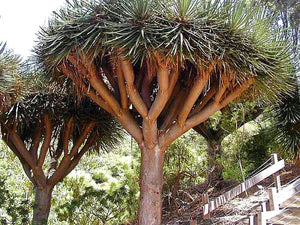
This species, Dracaena draco,  which not only is native to the Canary Islands, but also Cape Verde (Cabo Verde), Madeira, and a few places in western Morocco, is usually called the Canary Islands dragon tree or dragon's blood tree, or just drago. Early Portuguese introductions from Cabo Verde are believed to have given rise to the small population that still exists in the Azores as well. When the Swedish father of taxonomy, Carl Linnaeus, described the tree in 1762, he called it Asparagus draco — and indeed it is still placed in the Asparagaceae family. But this tree is no simple asparagus. It has a very distinctive growth form: young trees grow upward as a single stem topped by a dense crown of long, yucca-like leaves; then after ten years or so, the first pretty white flowers form (looking somewhat like lilies), followed by orange-red fruits; then a crown of buds forms and the plant begins to branch; each branch grows for another decade or so, then also flowers and branches again, in a process repeated over hundreds or thousands of years until the tree has a large, strong, woody trunk, topped with a maze-like crown of interlocking branches topped with a hemispherical crown of green leaves, flowers, and fruit. The oldest, largest individuals are stunning to see.

When the German naturalist and explorer Alexander von Humboldt visited the Canary Islands in 1799 he was shown a massive drago specimen in Tenerife that had been hollowed out by the indigenous Guanche people and used as a sanctuary long before the arrival of Spanish imperialist colonizers. The tree was 70 feet tall (21 meters) and 45 feet in circumference (14 meters) — and estimated to be 6,000 years old. Sadly, it was felled in a storm in 1868.

The resin from this species differs slightly from the resin of the Socotra dragon tree (which was known to Europeans for a millenium and a half longer), but upon its "discovery" in the 1400s, it began being used as a slightly more accessible substitute. It became particularly important as a varnish for the beautiful violins produced in Italy during the time of Stradivarius and his successors. There is little record of how the indigenous Guanche people (related to mainland Northern African Berber peoples), who arrived in the islands by the 6th century BCE, utilized the plant — because most of them were killed or died of exposure to novel diseases in the decades after Spanish conquest began (the language went extinct sometime in the 1600s) — but its likely they found many uses for it as well, as the local inhabitants of Socotra use theirs.

Today, dragon's blood is still used medicinally — primarily for wound healing, digestive issues, and pain relief — with scientists continually probing it for more uses. Modern research has found potent antioxidant, antibacterial, antiviral, anti-inflammatory, and wound-healing properties, validating its traditional uses, and studies note few negative side effects. Bioactive compounds in the plant show promise in the treatment of diabetic wounds, cardiovascular disease, and even cancer.

In most of the US, the tree can only be grown as a houseplant (and many people have very long-lived dragon's blood trees growing in pots, rarely growing taller than 4 or 5 feet over 50 years), but it can tolerate life outdoors in much of USDA Zones 9 to 12. It can tolerate brief dips below freezing, but prefers temperatures to stay above 50°F.

This California-grown seed comes to us from the good folks at Sheffield's Seed in Locke, New York.

GROWING TIPS: To germinate, soak seeds in hot tap water and let sit for 24-48 hours. Sow 1/4 inch deep, keeping soil warm (above 75°F) and moist, but not over-saturated. Seeds should sprout within 4-6 weeks. For potted plants, use regular potting soil in inividual pots. Put them in bright, indirect light. Do not leave roots wet. Trees grow in places that often see very little rain, so using a humidifier to keep your air more humid is sometimes best. You could also use the ice-cube method, placing a few ice cubes on top of the soil (away from the base of the plant) every week or two, to make sure you don't over-water them.

NOTE: The image of the old tree with the door in its trunk, comes from the Wellcome Collection, a website operated by Wellcome Trust, a global charitable foundation based in the United Kingdom. It is shared under the Creative Commons Attribution 4.0 International license. The image of dragon's blood resin may or may not come from this species, but all of the resins look similar (it may be Dracaena cinnabari, as the author believed, or Calamus draco, an unrelated species which produces a similar-looking resin, or Dracaena draco). It is from author Maša Sinreih in Valentina Vivod and is shared under the Creative Commons Attribution-Share Alike 3.0 Unported license. All others are public domain images of Dracaena draco.

Shipping Notes
  • Free Standard Shipping on $100+ Orders to the USA.
  • Except Preorder products are shipped in 48 hours.
  • Delivery to the USA:
  1. Standard Shipping : 3-10 business days
  • If time is of the essence, please consider selecting expedited delivery for faster service.
Exchange/Return Notes
  • We offer a 30-day return/exchange service after receiving.
  • Final sale items are not eligible for returns or exchanges.
  • To process your return/exchange, please contact us at [email protected]
  • Please click here for more details>>> Return & Exchange Policy
SKU: 31013596018

Discover Niche Categories That Outsell dracaena cinnabari trees for sale

Top-Converting Item to Boost Your Average Order

4.6 ★★★★★
Based on 23 reviews
Sort
Highest Rating
Newest First
Oldest First
Product Reviews
R
Verified Purchase
Rikeshay
Belleville, US
★★★★★ 5
Item as described.
Color: Dark Blue
A timeless tradition of a great design and useful watch. Have been using this watch design for over a 30 years.
WAS THIS REVIEW HELPFUL?YesReportShare
Reviewed in the United States on May 27, 2026
B
Verified Purchase
Buck
Lake Worth, US
★★★★★ 5
Great thowback to the OG Ironman, but Amazon's listing gets it undue negativity.
Color: Black/Yellow
Amazon's listing is not very good with it's wording so this watch has gotten undue negative reviews. I've seen this model listed as both the Endure 30 and the Original 30 Shock, it has 1 alarm with 3 different modes (not 3 separate alarms), 200m WR, ISO shock resistance, (reverse) Indiglo with night mode, 2 time zones, 12/24hr time, 30 lap stopwatch, 24hr countdown timer (repeatable), and day/date (MM.DD or DD.MM). Its basically a slightly updated feature set compared to an Ironman 8-lap. This watch is great, it's got the look of the original Ironman 8-lap with modern guts. The only minus for me is it could be a little slimmer on the wrist, but I also didn't realize it was shock resistant when I bought it. For comparison, it is a few mm smaller in all dimensions than a G-Shock G2300/G2310/GW2310 series. The band is similar to G-Shocks in that it is formed/molded around the wrist but like the case it's still slimmer in the way it wears around the wrist. Not as slim as an F91W but not as massive as any G-Shock basically. The module has a better display with bigger numbers than the above mentioned Casios. With the exception of the lap memory, the G23## G-Shocks have more features, but the Endure 30 is much easier to use thanks to the display and larger buttons. If you want 3 alarms you need the very similar Classic 30. The main differences being the Classic has 3 separate alarms (not 1), occasion reminders and 3 time zones but losses the Ironman 8-lap look, the shock resistance and it's only 100m WR. The Classic seems to come in at least two case varieties (chunky or slim), two sizes and many color combinations. If you only need the Endure 30's features but want a different shape/size/style/slimmness, I believe the Essential 10/30 and BASIC Transit models are functionally the same with only different lap memories, WR, and no shock resistance. Unfortunately, Timex doesn't easily identify the actual module used in a watch like Casio, so the best way to figure out what features a watch has is to lookup the watch model on the Timex website. Of course the manuals do not always match the marketing names they have used over the years (Endure/Classic/Essential/etc), and each manual covers a few shapes/sizes of watch but just search for the model number in the manuals sections and you'll eventually find the right one. If no manual pops up right away delete digits from the right end of the model number until a manual is found, I believe those last digits only indicate slight variances in style/color that are not important to functionality.
WAS THIS REVIEW HELPFUL?YesReportShare
Reviewed in the United States on May 31, 2021
H
Verified Purchase
Hudson
Whiting, US
★★★★★ 1
Good interface but unwearable watch band
Color: Black
This review will be divided into 3 sections: looks, usability, and comfort. LOOKS I guess there's not much to say as style is very individual. I think this watch looks good for what you pay for it. USABILITY What I liked about this watch is that I could use it right out of the box. I have had basic Timex digital watches before (never this exact interface), and I was able to quickly figure it out. A quick glance at the manual to make sure I wasn't unaware of any features and I had 100% grasp of all the watch's features. The Timex interface puts many others to shame with its user-friendliness. On this model Timex has added a 'guide' on the display that tells you which button will do what-- increase number, decrease number, etc. This is cool. If you're even remotely handy with interfaces, once you learn this one, you'll know it backwards and forwards, and even if you forget, there's the in-display guide. The functions are standard for a Timex digital-- time and date, stopwatch with lap timing, countdown timer, and alarm. There is a 2nd time zone but no dedicated mode for it. You access it by holding the 'start' button when in the time mode. I like this feature as I occasionally need to know when to call people in 1 particular time zone. But, for example, if you are often switching back and forth between 2 time zones, you will have to reset the time to have the watch display the correct time at all times. And if you need more than 2 time zones, sorry, out of luck. Stopwatch (chrono) is good. Don't use the lap counter much but it seems to work well. Some have complained that the 'start' and 'stop' should be on the same button. Overall, it is a very uncluttered and usable interface. At first I thought it was very inaccurate at timekeeping, but it must have gotten accidentally reset because over the few months since I set it, it's only a couple seconds off from time.gov. very good timekeeping. It seems very water resistant. I have taken it swimming, surfing, and it held up fine. I haven't thoroughly tested its shock resistance but it has done some hiking and climbing where it got banged around a bit and it still works. COMFORT Unfortunately what the watch has in user interface usability, it totally lacks in comfort. The strap is a huge disaster. It is very rigid and uncomfortable. The 'waffling' or indented designs near the bezel on each side of the strap create areas where the strap digs into the wrist. with any prolonged wearing, it gets worse and worse until your wrist is begging you to take it off. The strap is just absolutely godawful. I have read reviews where G Shock owners said it was very good, well though out and comfortable. If that is the case, I shudder to imagine what a G Shock is like on the wrist. If constant pinching around sensitive areas on the side of the wrist seems like it would be the kind of thing to bother you, avoid this watch. I tried swapping it for another Timex band, which amazingly enough was uncomfortable it a DIFFERENT area! It seems Timex doesn't put much thought into their bands-- no part of the band should dig into the wrist. That's just obvious. CONCLUSION I really want to like this watch, I do. It's good-looking. It's very usable in terms of features. But the strap is terrible, so much so that the watch is unwearable. Unfortunately it took me about a week to figure this out, during which time the watch got sufficient wear so that it is no longer new, returnable condition. I am keeping it, using it as a 'beater' watch in the gym (I put my watch on the ground in the gym). If you purchase it I recommend you wear it for a good few hours while not doing anything that will scratch it, so that you can return it if need be.
WAS THIS REVIEW HELPFUL?YesReportShare
Reviewed in the United States on October 5, 2014
C
Verified Purchase
Christine Shawwa
Birmingham, US
★★★★★ 5
Great men’s watch
Color: Silver Watch-G9990
Bought as a gift for my husband still in very good condition as he wears it everyday. He says he gets lots of compliments.
WAS THIS REVIEW HELPFUL?YesReportShare
Reviewed in the United States on June 1, 2026
E
Verified Purchase
erin grohoski
West Palm Beach, US
★★★★★ 5
It’s a great buy for the money
Color: Bule Watch-G9990
My son loves this watch!
WAS THIS REVIEW HELPFUL?YesReportShare
Reviewed in the United States on April 10, 2026

recommand products