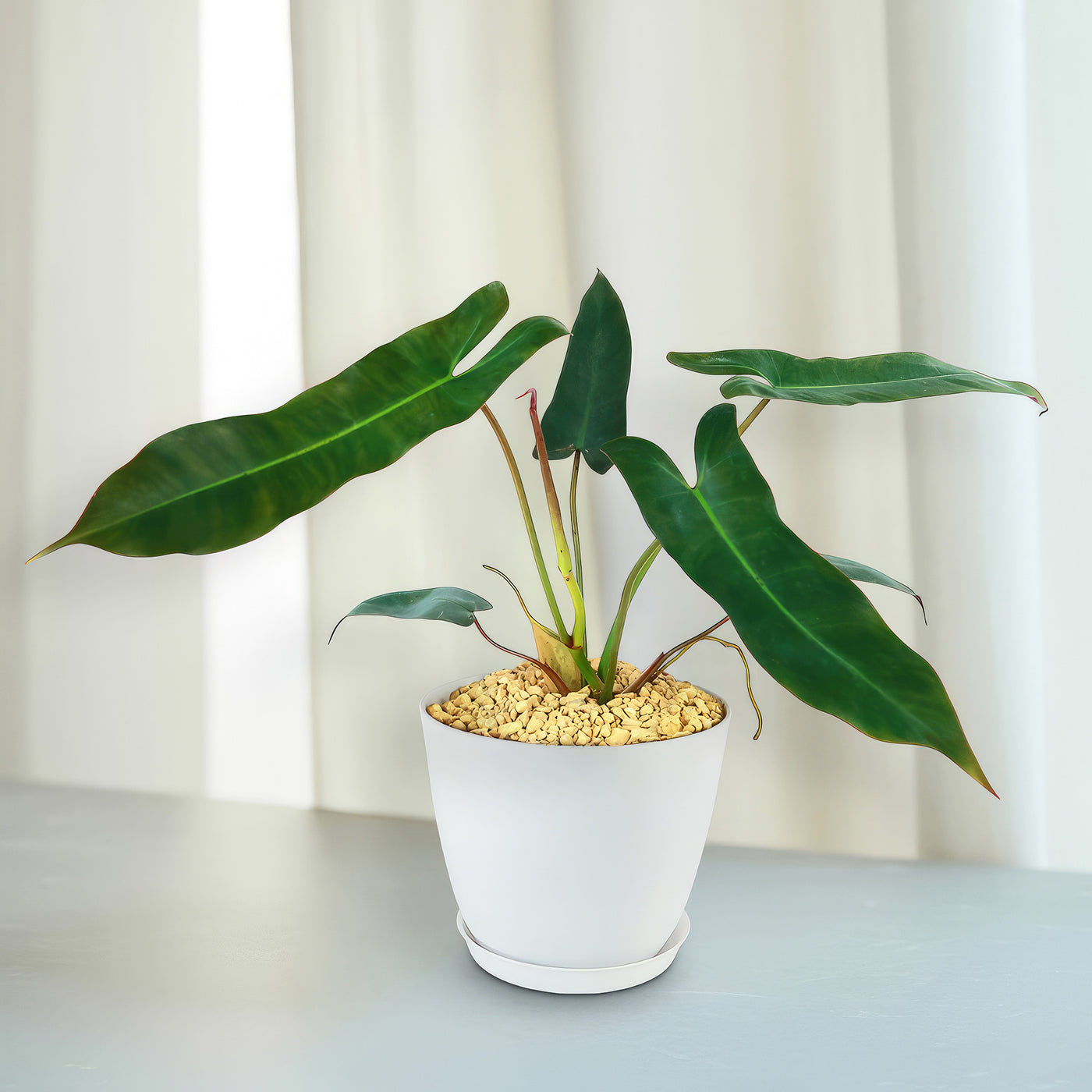
SKU: 3219800419
philodendron greenery

philodendron greenery Philodendron atabapoense 6" Pot / Self Watering / Without Pot

Sale price$22.48 Regular price$24.98
Save 10%

Pay in installments of $6.25 with ShopPay, AfterPay and Klarna

Shipping Estimate
USA
  • USA
  • CAN

Ships within 48 hours · Estimated delivery Jul 27 - Aug 1

Promo Codes Available:

For Your Every Summer RSVP, with Code: SUMMER15

Description

philodendron greenery Philodendron atabapoense 6" Pot / Self Watering / Without PotKey Highlights Philodendron atabapoense The Philodendron atabapoense is highly sought after as a houseplant due to its fast growing, climbing nature and adaptability to indoor conditions. While it thrives in humidity, this plant is surprisingly resilient and can tolerate short dry periods if necessary. Its long, narrow leaves feature deep green tops and striking maroon purple undersides, giving it an exotic appearance. It is a hemi epiphytic plant

Key Highlights - Philodendron atabapoense 

  1. The Philodendron atabapoense is highly sought after as a houseplant due to its fast-growing, climbing nature and adaptability to indoor conditions.
  2. While it thrives in humidity, this plant is surprisingly resilient and can tolerate short dry periods if necessary.
  3. Its long, narrow leaves feature deep green tops and striking maroon-purple undersides, giving it an exotic appearance.
  4. It is a hemi-epiphytic plant that climbs trees in its native habitat and benefits from a moss pole or trellis indoors to encourage larger, elongated leaves.

The Philodendron atabapoense is a striking rare climbing philodendron that has gained popularity among plant collectors due to its elongated, lance-shaped leaves with deep green tops and contrasting maroon undersides. Unlike more common philodendrons, it has a sleek, refined appearance that makes it stand out in any indoor or outdoor plant collection. 

Philodendron atabapoense grows great indoors while maintaining an impressive size, making it a favorite among houseplant enthusiasts. When given proper support, such as a moss pole or trellis, it will produce longer, more dramatic leaves, enhancing its visual impact. In the wild, it grows as an epiphyte, climbing trees and reaching for sunlight while absorbing moisture and nutrients from the humid air. 

Native to the tropical rainforests of Venezuela and Brazil, this plant has long, narrow arrow-shaped leaves with a deep green upper surface and a burgundy to maroon underside with an illustrious shine and sheen.

This color contrast gives it an exotic appearance that is highly appealing to plant collectors.

The plant is also known for its fast-growing nature, especially when provided with adequate support, humidity, and indirect light.

When grown indoors, this Philodendron typically grows up to 6 feet tall and 3 feet wide, depending on its support structure.

In its natural habitat, it can climb much higher, reaching over 10 feet. The leaves can grow significantly longer when provided with optimal conditions, adding to their appeal as a large, dramatic houseplant. 

The flowers of Philodendron atabapoense are small and greenish-white in color. Its blooms consist of a spathe and spadix, which are typical of the Araceae family. The spathe is usually green or maroon on the outside and pale inside, enclosing the spadix that contains tiny flowers. However, it rarely flowers indoors, as it requires specific environmental triggers, including high humidity and warm temperatures. 

One unique aspect of Philodendron atabapoense is its epiphytic and hemi-epiphytic nature, meaning it can grow both in soil and attached to trees. This versatility allows it to adapt well to different growing conditions. It also has a high tolerance for humidity fluctuations, making it easier to care for than some other tropical plants. Its leaves have a leathery texture, helping reduce moisture loss and allowing it to thrive in various indoor environments. 

When and How to Water Your Philodendron atabapoense 

Like other drought-tolerant plants, the Philodendron atabapoense is an excellent choice for plant enthusiasts who prefer low-maintenance greenery. This species can withstand occasional dry spells, thanks to its ability to store moisture in its roots. However, while it is resilient, it thrives best when provided with consistent moisture, allowing the soil to dry out slightly between waterings. Overwatering can lead to root rot, so a well-draining potting mix is essential to prevent standing water.

In the spring and summer, during the active growing seasons, it requires more frequent watering to support its vigorous growth. Water the plant thoroughly when the top 1-2 inches of soil becomes dry, ensuring even hydration. The frequency of watering largely depends on environmental factors such as humidity, light exposure, and pot size. If grown outdoors, the plant may require more frequent watering during hot, dry periods. 

In fall and winter, during the dormant season, your Philodendron enters a slower growth phase and requires less water. Watering should be reduced to prevent excessive moisture build-up in the soil. Ensure the soil is dry at least halfway before the next watering. Maintaining proper humidity levels indoors can help prevent dehydration, but misting is generally unnecessary unless the air is extremely dry. 

Light Requirements – Where to Place Your Philodendron 

When grown indoors as a houseplant, this plant thrives in bright, indirect light. It should be placed near a window with filtered sunlight, such as a north or east-facing window, where it can receive 6 to 8 hours of indirect light daily.

Too much direct sunlight can scorch its leaves, while insufficient light may lead to leggy growth and slower development.

Grow lights can supplement natural light if necessary, ensuring consistent growth throughout the year.

For outdoor cultivation, this Philodendron prefers dappled sunlight or partial shade, similar to its natural rainforest habitat.

It can tolerate morning sun but should be protected from harsh afternoon rays to prevent leaf damage.

If grown under a tree canopy or shaded patio, it will flourish with at least 5 to 6 hours of bright, indirect light daily. In tropical climates, it can be grown outdoors year-round with proper light exposure. 

Optimal Soil & Fertilizer Needs 

The Philodendron atabapoense favors very airy, sandy soil that drains well. Avoid using dense, compacted soils that trap excess water, leading to root rot. Instead, make or buy a well-draining potting mix, or ideally use our specialized potting mix that contains 5 natural substrates and mycorrhizae to promote the development of a strong root system that helps your Philodendron to thrive.

For optimal growth, fertilize Philodendron atabapoense once a year in their actively growing season which is typically spring using a ratio of about 5-10-5 (NPK). Organic options like fish emulsion or worm castings can also boost soil nutrition. Stop feeding in the dormant months when the plant’s growth slows. 

Hardiness Zones & More 

When grown indoors as a houseplant, it prefers temperatures between 65°F and 80°F and humidity levels above 50%. Keeping it in a warm, humid environment mimics its natural tropical habitat, promoting lush growth. Avoid placing it near cold drafts, air conditioners, or heating vents, as extreme temperature fluctuations can stress the plant.

In the United States, this is mostly an indoor plant, but if you live in southern Florida or Hawaii then you can cultivate it outdoors in USDA zones 9-11.

It prefers high humidity and bright, indirect light similar to its rainforest origin.

If growing outdoors in cooler climates, it should be brought inside when temperatures drop below 50°F to prevent cold damage. 

If you are concerned about humidity or notice browning edges on your plant leaves. This addition will dramatically improve the health of your philodendrons. 

Wildlife – Philodendron Flowers Attract the Following Friendly Pollinators 

The Philodendron atabapoense flowers are known to attract a variety of pollinators such as bees, butterflies, hummingbirds, and beetles in their natural habitat. While the plant is primarily grown for its stunning foliage, when it does flower, these pollinators help with its reproductive cycle.

Butterflies
Bees
Hummingbirds
Lady Bugs
Multi Pollinators
Other Birds

According to the ASPCA, Philodendron atabapoense is mildly toxic to humans, and pets such as cats and dogs. The plant contains calcium oxalate crystals, which can cause oral irritation, excessive drooling, and gastrointestinal discomfort if ingested in a large amount. It is safe to touch and handle, making it a popular choice for indoor houseplants.  

How to Propagate Philodendron atabapoense 

The Philodendron atabapoense can be easily propagated through stem cuttings. Select a healthy stem with at least one node and a few leaves, then cut just below the node using sterilized shears. The cutting can be rooted in water or moist sphagnum moss before transferring it to soil. Keep the propagation medium consistently moist and place it in bright, indirect light to encourage root development. 

The Bottom Line 

Overall, the Philodendron atabapoense is a remarkable climbing philodendron with elegant foliage, rapid growth, and stunning leaf contrast. Its adaptability to indoor and outdoor conditions, along with its unique maroon undersides, makes it a favorite among plant collectors. Whether grown on a moss pole or allowed to trail in a hanging basket, it adds a touch of tropical beauty to any space. With proper care, including bright indirect light, well-draining soil, and regular humidity, it will flourish and become a standout feature in any plant collection. Order your very own Philodendron atabapoense for sale today! 

Shipping Notes
  • Free Standard Shipping on $100+ Orders to the USA.
  • Except Preorder products are shipped in 48 hours.
  • Delivery to the USA:
  1. Standard Shipping : 3-10 business days
  • If time is of the essence, please consider selecting expedited delivery for faster service.
Exchange/Return Notes
  • We offer a 30-day return/exchange service after receiving.
  • Final sale items are not eligible for returns or exchanges.
  • To process your return/exchange, please contact us at [email protected]
  • Please click here for more details>>> Return & Exchange Policy
SKU: 3219800419

Discover Niche Categories That Outsell philodendron greenery

Top-Converting Item to Boost Your Average Order

4.8 ★★★★★
Based on 29 reviews
Sort
Highest Rating
Newest First
Oldest First
Product Reviews
C
Verified Purchase
Claudia Gasparrini Etheridge
Battle Creek, US
★★★★★ 4
THE LATEST MASTERPIECE FROM RUSSIA IN A NEW TRANSLATION
This book is a satire of the Soviet Union during Stalin‘s regime. Written between 1928 and 1940, not surprisingly, it remained unpublished until 1967. Later, following the collapse of communism in December 1991, not only did the book start to sell, the title was added to the list of the essential classics of modern Russian literature. Presently, "The Master and Margarita" by Russian author Mikhail Bulgakov is regarded as one of the best novels of the 20th century and remains popular among readers the world over. The novel has had more than enthusiastic readers. Contemporary composer Stephen Johnson enjoyed the book so much that he wrote the music for a ballet celebrating one of the main characters. Titled “Behemoth Dances“, the work centers on the very large by now famous black cat which, in addition to talking, walking on two legs and drinking vodka, now dances as well. The ballet premiered in Moscow on April 23 2016. After that, additional performances took place during the 2016 summer season in various English concert halls - among them, Cadogan Hall in London (May 12) and Symphony Hall in Birmingham (May 14). I have read a good portion of The Master and Margarita and found it to be a strange book, a book that - like many literary works during the twentieth century - is complex and difficult to read. Some of the Amazon.com reviewers believe that the complexity is related, at least in part, to the translation which they consider poor. It is true, the translation can be poor at times, but I do not believe that it contributes to the confusion, certainly not to any extent: translators Diana Burgin and Katherine O’Connor assure us that they made a very special effort to keep the English words and concepts as close in meaning as possible to the original Russian. There are more important factors that make the book confusing. First, there are too many characters, 63 altogether, 22 of them main characters. That is a lot more than those in most novels. Because they are Russian, these characters have usually three names. It is difficult to remember who is who and playing what part, when introduced to that many foreign people - at least it is difficult for some of us. Then there is the plot. The focus is on Satan and his retinue that includes the above mentioned very unusual black cat. There is also a beautiful naked witch named Hella; and a few other peculiar characters, who run around Moscow interfering with the lives of many members of the literary Russian elite. Also included are the stories of the remaining main characters and their friends, relatives, assistants and others. There are two important settings for the plot, as the reader is taken back and forth from: (1) 1930’s Moscow during Holy Week, from Wednesday night to the following Saturday night to be exact; (2) Jerusalem of Pontius Pilate's world - appearing in the pages of the Master's novel, during the same time of the year, but about 2,000 years earlier. The story begins with the appearance of Satan at the Patriarch Ponds in Moscow, disguised as Professor Woland, a mysterious gentleman magician of uncertain origin. Prof. Woland meets in such a location Mikhail Alexandrovich Berlioz, the editor of an anti-religious journal, and Ivan Nikolaevich Ponyrev, a poet employed by Berlioz. He challenges their atheism with a story, during which we are introduced to the second setting, Jerusalem of Pontius Pilate's world. This part of the novel concerns Pilate's trial of Yeshua Ha-Notsri (presumably Jesus) and his reluctant but resigned submission to the unfortunate man’s execution. Berlioz dies early on during the story after being run over by a street car. The poet Ivan Nikolaevich continues on, trying to understand the death of his friend and employer. Interestingly enough, we do not meet the two title characters, the Master and Margarita, until we are well into the story. We meet the Master first, while still in part one, but in one of the later chapters. We are introduced to him - who incidentally does not appear to have a name (thank God!!!) - at the mental hospital where he has been a patient for four months. The Master is a writer by profession, having written, among other narratives, about Pontius Pilate and the story related to the second setting. Unfortunately, he is ridiculed by his Russian peers for daring to write about religious subjects. As for Margarita, we meet her in part two of the novel, although we are introduced to her first through the Master’s description of his relationship with her. The two were lovers, but the Master would rather set her free to avoid the suffering that their relationship would cause her. She has other plans. We learn that the woman is so much in love with the Master, that she is willing to visit Hell for him. By Good Friday, Satan is having his Great Spring Ball as Prof. Woland, at his earthly residence. At such time, he offers Margarita the opportunity to become a witch with supernatural powers. A spring full moon illuminates the Moscow skyline. The same full moon also lights the night sky when Yeshua’s fate is sealed by Pontius Pilate in Jerusalem. This provides a link between the two settings. Capable of flying, due to her new powers as a witch, Margarita soars over the forests and rivers of the USSR, then returns to Moscow to co-host Satan's Ball. Standing by his side, she welcomes the dark celebrities of human history as they arrive from Hell. In recognition for her assistance, Satan grants Margarita her wish to liberate the Master even though she must live in poverty with him. Eventually, the Master and Margarita leave civilization and fly with the Devil, as Moscow's cupolas and windows burn in the setting Easter sun. They are granted "peace" for not having lost their faith in humanity, but are denied "light", consequently they will spend eternity together in a shadowy, although pleasant, region similar to Dante's Limbo. At the same time as the Master and Margarita are set free, Pontius Pilate is released from his eternal punishment, and walks the moonbeam path to Yeshua, where another eternity awaits. That is the story, which I tried to relate in as clear a manner as I could. If you are not confused, and if you have the patience to read the entire book, slowly, while trying to make some sense out of the many characters and events, you will probably come to the conclusion that it was worth the effort.  
WAS THIS REVIEW HELPFUL?YesReportShare
Reviewed in the United States on May 10, 2017
I
Verified Purchase
Ioana
Battle Creek, US
★★★★★ 5
Brilliant, Visceral Portrayal of the Eastern-Block Landscape and Imagination
Wow-just WOW! Bulgakov simply blew me away with his dark & very eastern-block humor, twisted ironies, brilliant metaphors, infinite layers of meaning, his surrealist aesthetic and refusal to follow any "rules" of any particular genre. Within a few chapters, this book quickly moved up to my #1 Most Brilliant Books Ever Written list, and after the last pages, I have a feeling it will stay here for a long time (perhaps until I take up Gogol, or so I am told). There are many layers to this novel, a plethora of imagery, metaphors, and references that have been studied in hundreds of scholarly articles and tens of thousands of journalistic/reviewer articles, so I will not attempt to gloss superficially over any themes. Rather I will focus on the ironic humor, which touched me most profoundly, as a person born and raised under Ceausescu's regime (Romania). Ironic, tragic, dark and depressing humor was central to Eastern European resistance to communism, and served a healing as well as communal/relational function. Even today, visiting Bucharest, the dark humor remains, and is spoken, without reservation, between strangers at bus stations, intimate family members, colleagues at the office, etc--it is a key thread of our identity and how we relate to and understand the world. I have never ready any work that captures this humor better than Bulgakov. A process that is emphasized in the literature on communism is the development of a duality of psychic space, a mode of schizophrenic resistance. To many who sought refuge in books and humor, this fragmentation transformed into a positive experience: a honed, rich duality was a sign of strength, showing how one could successfully detach herself from the absence of things and to fill space with meaning in spite of adversity. These processes were transmitted historically, and taught one how to survive without alienating oneself psychologically. Andrei Pleşu remembers humor about lack as a "prop of survival". Oana-Maria Hock remembers the theatre as providing a "surrogate toughness", a form of resistance in the face of material insecurity. In a place in which material necessities were difficult to come by, disassociation, particularly through artistic release, served to create spaces of plenty. Even though this work may be read by any audience, and though most find it brilliant, it particularly speaks to those who have lived through the horrors of Eastern-block communism and its historical particularities in this region; the humor especially is not only deeply ironic and depressing, but also is born of an experience difficult to describe if one has not lived it: the reference, for example, to "second-grade-fresh" fish. It may seem superficially funny to anyone who has not experienced rationing as a way of life, but the phrase has many layers of meaning: first, as a reference to the rationing process/how hard it was to find food, second as a reference to the Eastern-block communist way of meticulously categorizing all things (such as different grades of products, of which "first grade" was of course never available to the non-connected citizen), third as reflection of how people in this region relied on deeply disturbing humor to pacify, at least temporarily, their disquietude, fourth, illustrating the peculiarities of communication during this time (when everything had at least a double meaning, under the politically correct and allowed language), and fifth, it brings back the embodied feeling itself of how one used to imagine the world before 1989--it is absolutely *visceral*, because this is EXACTLY how people talked. Everything was a private joke--and every comment was either ironic or meant something other than what it actually said. Another example: in the Epilogue, when Bulgakov takes on the narrator role and tells us what happened after the Devil left Moscow, he first mentions the plight of black cats: "A hundred or so of these peaceful animals... were shot or otherwise destroyed in various parts of the country"... The ridiculousness of his concern for the cats considering circumstances is another perfect example of the twisted humor used during this period as a means of resistance. Further, Bulgakov continues his story, citizens were goaded into public vigilantism of capturing black cats and reporting with them to police stations; there is even a story of a woman who comes to a station to vouch for the "character" of her cat. Clearly, this is not a story about cats, but a reference to the Secret Police, the dreaded disappearances, and the ways in which regular citizens were complicit in the process--yet at the same time, it is also a story about how Eastern block policies/dictators actually did value "cats"/animals above people (not to mention that people were treated AS animals, another double meaning). In an even darker twist, after several pages, Bulgakov moves on from the cat stories: "Besides the cats, there were a few people who suffered some minor unpleasantness. Several arrests were made... A lot of other things happened, but one can't remember everything." And with this poignant reference to the communist culture of "forgetting" (scrubbed history books, banned authors, emphasis on the present and future at the expense of the past incarnated in communist policies, purging of national archives, etc) Bulgakov ends by reminding us of the dark and tragic experience of Eastern-Block communism.
WAS THIS REVIEW HELPFUL?YesReportShare
Reviewed in the United States on December 12, 2013
B
Verified Purchase
Blake Ray
Fort Morgan, US
★★★★★ 5
Outstanding edition of important and thrilling novel
Format: Kindle
This review is for the novel "The Master and Margarita" in the Kindle edition translated by Diana Burgin and Katherine Tiernan O'Connor. I just finished reading this novel for the third time. Ages ago I read it for a college 20th Century Russian Literature class in the Mirra Ginsburg translation, and loved it so much that as soon as I finished it I started over at the beginning without even getting up from my chair to read it a second time. Somehow this edition got lost; probably I loaned it to a friend and never got it back. In subsequent years I tried to read it again, in the P&V translation and in another that is no longer available, but I just couldn't make any headway, and abandoned these after two chapters. I have not sat down to compare line by line this translation with a Russian version, which I also have, but the translation in the version under discussion seems to me to be stellar. It read smoothly and vividly, and captured the movement and extravagant energy of the original. This is a tough novel to translate since the writing style changes drastically in some chapters. Tone and topic are intimately intertwined, and the stylistic virtuosity of Bulgakov is one of the book's primary charms. (Read it and you will find out why.) This edition also has extensive notes at the end, general guidance for making sense of references and allusions, and these are very helpful and beautifully written by Ellendea Proffer. These notes are followed by an outstanding essay on the novel, as well as a brief biographical sketch of the author, and these are likewise very helpful, thoughtful, well-written and not overly long. (These are also by Ellendea Proffer. She really hits a home run with her essay, in my humble opinion.) I am hooked now, and am sure I will be returning to this novel many times. Although I enjoyed immensely my first two readings of this novel, I feel now that three readings is not enough to grasp it. I will have to go back to it, but it's worth it! This is a novel for those who can keep an open mind and who are not bothered by satire or surrealist elements, and who can accept puzzling ambiguities and deep philosophical and moral questions for which there are no easy answers. I am so glad I decided to take a chance on this wonderful translation.
WAS THIS REVIEW HELPFUL?YesReportShare
Reviewed in the United States on April 5, 2023
D
Verified Purchase
D. Mikels
Natrona Heights, US
★★★★★ 3
"The devil knows why. . ."
I have mentioned before in a distant review of the past that each book has a "moment of truth," that shimmering macrosecond where the reader either becomes hooked (and therefore can't wait to finish the work), or disappointed (whereby the book is either put aside, or finished grudgingly). For me, alas, Bulgakov's THE MASTER AND MARGARITA evoked the latter, although I finished the book and readily appreciated the author's rather fantastic and satirical story of Satan and his pesky retinue wreaking havoc in 1930s Moscow. That Mikhail Bulgakov is an exceptional writer is a given; if only I was fluid in Russian where I could read his words as written I would no doubt be even more impressed with his prose and style. This Vintage Press edition (translated by Diana Burgin and Katherine Tiernan O'Connor) certainly pays homage to this classic with a meticulous eye for detail, followed by notes on each chapter that I found to be invaluable. So then, what's the problem? Well, I enjoy humor and satire as much as the next guy (I suppose), but a story depicting Satan as some sort of instrument of salvation--an instrument in alliance with Yeshua--for the book's two protagonists was just. . .too much. The Master, a writer who cannot endure the pain of rejection, is one-dimensional and sullen, while Margarita, his love, becomes a willing pawn of the devil. And the story blithely suggests that death through its mortal release is preferable to life (which is understandable, given Bulgakov's failing health as he finished the book). The fantastic notion of the story--of illusion, madness, a huge talking cat, flying through the air, and a Satanic ball--is a clever device, but eventually it wears thin. As a playwright, Bulgakov uses an abundance of theater officers, bureaucrats, and authors as unhappy victims of Satan's antics (no doubt the author was settling countless scores); unfortunately, the names of these characters are in Russian, and many of the names vary by a vowel or a letter, making it very difficult for the reader to keep track of "who's who." And the parallel story of Pontius Pilate and the crucifixion--told from a political, not spiritual, perspective--was interesting, yet bizarre. In fact, "bizarre" is a good word to describe THE MASTER AND MARGARITA in its entirety; it's an interesting, fantastic, metaphysical tale, yet requires too much suspension of disbelief. --D. Mikels
WAS THIS REVIEW HELPFUL?YesReportShare
Reviewed in the United States on May 24, 2004
D
Verified Purchase
Dr. Mike
Fort Morgan, US
★★★★★ 5
If you read rarely, or all the time, don't miss this! (It's easy to do)
This is simply one of the best works of literature, allegory, and even poetry, ever put together. It took decades for Mikhail Bulgakov to write this actually, and over the past century, his Faustian flavored tale about the nature of people and the power religion vs. the state vs. the devil knows.... has become a cult classic in Russia. Note that this is pure Bulgakov (as author) and this listing names one of the 2 wonderful translators who collaborated on getting the flavor of the language just right. They make it clear that this was a total collaboration of expert translators. At the end they offer additional notes about some of the details and finer points of history or the Russian language. There are also some additional passages included for the first time, which the earlier translation omitted. I read this when it was first translated (80s?) and a college friend who had escaped from Communism insisted I read this. It was great then, as literature, human drama, and superb writing. Bulgakov amassed a huge following once his work was actually published, after his death. Some of his work is only now being published and read. I recently found myself in front of Flat #50, near Patriarchs Ponds (Moscow), the setting where the first part of this addictive novel begins. Berlioz (in the guise of literary czar, not the famous composer) is arguing with a poet about the existence of G-d when interrupted by, who the devil knows, but soon it is clear that literary and bureaucratic Moscow have become friends to the devil. Mr. Woland and his interesting entourage are about to put on a show at the theater, promising to be magical. Great book. Like other great Russian *stories*, this captures human nature, anguish, curiosity and the variations in the rules of right/wrong, possible/impossible. It's quite a ride through the supernatural as well as theological and even medical., If you immerse yourself in it, you'll see many foreshadows of Harry Potter magic. Serious must read, for the adventure, mystery, the Faustian morality play, which takes pokes at both religion and "civil" humankind. A#1 recommend - and it may help to understand Russian (and human) psychology, and how we use words to invent smoke, mirrors, and fables which mirror life and death and love.
WAS THIS REVIEW HELPFUL?YesReportShare
Reviewed in the United States on July 16, 2014

recommand products