SKU: 33078632623
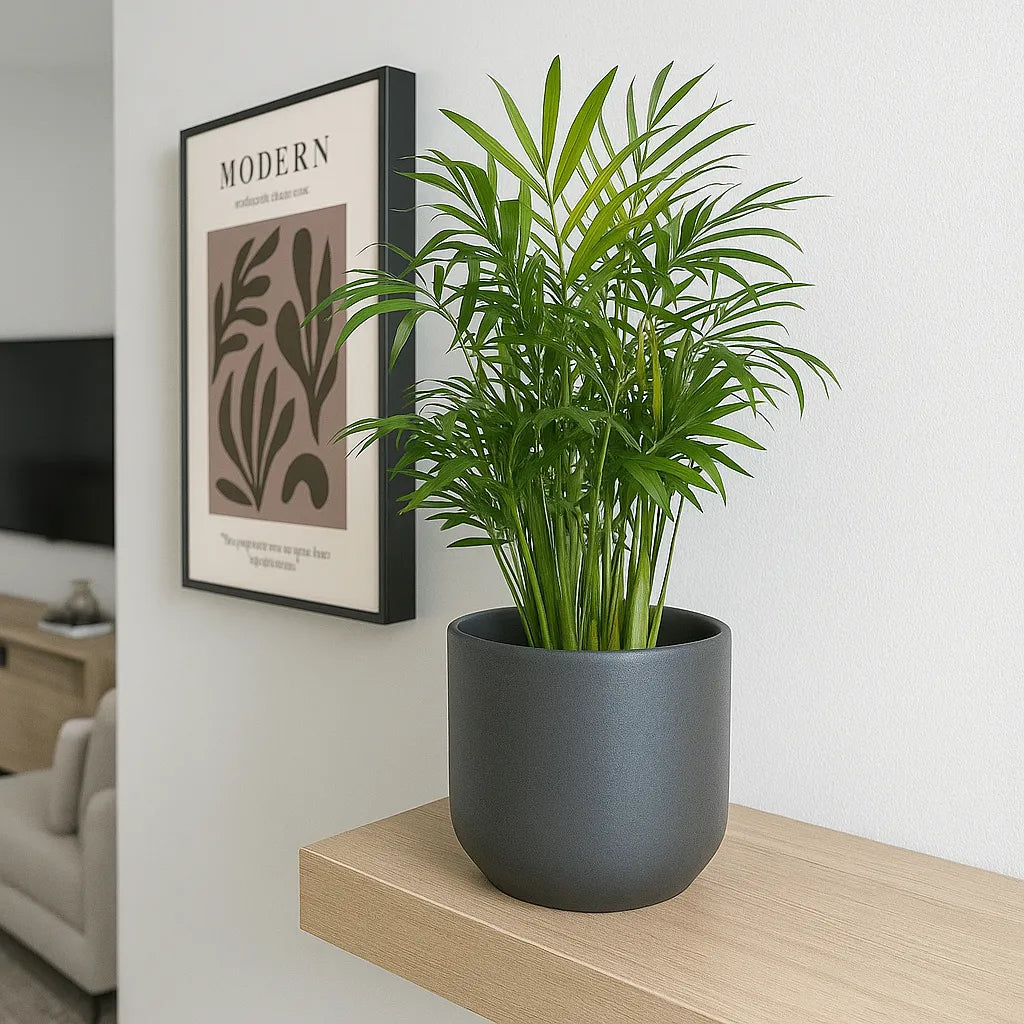
chamaedorea indoor plant

chamaedorea indoor plant 20

Sale price$21.49 Regular price$23.88
Save 10%

Pay in installments of $5.97 with ShopPay, AfterPay and Klarna

Shipping Estimate
USA
  • USA
  • CAN

Ships within 48 hours · Estimated delivery Sep 8 - Sep 13

Promo Codes Available:

For Your Every Summer RSVP, with Code: SUMMER15

Description

chamaedorea indoor plant 20Chamaedorea elegans, widely known as the Parlour Palm or Neanthe Bella Palm, is one of the most popular and elegant indoor palms in the world. Native to the rainforests of Southern Mexico and Guatemala, this member of the Arecaceae family has graced homes, conservatories, and offices since the Victorian era, prized for its graceful form and easy going nature. The plant forms slender green stems topped with arching fronds of narrow, delicate leaflets,

Chamaedorea elegans, widely known as the Parlour Palm or Neanthe Bella Palm, is one of the most popular and elegant indoor palms in the world. Native to the rainforests of Southern Mexico and Guatemala, this member of the Arecaceae family has graced homes, conservatories, and offices since the Victorian era, prized for its graceful form and easy-going nature.

The plant forms slender green stems topped with arching fronds of narrow, delicate leaflets, creating a soft, feathery appearance. Compact and slow-growing, it naturally maintains a tidy shape, making it ideal for tabletops, desks, or small spaces. Mature plants may even produce small, yellow flower clusters indoors under the right conditions.

With its air-purifying qualities, elegant foliage, and low-maintenance temperament, Chamaedorea elegans is the perfect palm for adding a calming, tropical feel to any interior.


Chamaedorea elegans – Care Guide

Light

Thrives in bright, indirect light but tolerates lower-light conditions better than most palms. Avoid harsh direct sunlight, which can scorch its delicate fronds.

Watering

Water when the top 2–3 cm of soil feels dry. Keep the soil lightly moist, but ensure good drainage to prevent waterlogging. In winter, allow the soil to dry out slightly more between waterings.

Temperature and Humidity

  • Temperature: Prefers 18–26°C. Avoid draughts and cold air below 12°C.

  • Humidity: Adapts well to average household humidity but will appreciate occasional misting in dry conditions.

Soil and Potting

Use a rich, free-draining peat-free compost mixed with a little perlite or sand for aeration. Repot every 2–3 years in spring, moving up only one pot size to prevent overpotting.

Feeding

Feed every 4–6 weeks during spring and summer with a diluted, balanced liquid fertiliser. No feeding is needed in winter.

Pruning and Maintenance

Remove any brown or yellowing fronds at the base to maintain a tidy appearance. Wipe leaves occasionally with a damp cloth to remove dust and encourage healthy photosynthesis.

Growth and Maturity

A slow-growing palm that typically reaches 60–120 cm indoors. It forms a bushy, clumping habit with multiple stems over time.

Common Issues

  • Yellowing leaves: Overwatering or poor drainage.

  • Brown tips: Low humidity or fluoride in tap water — use filtered or rainwater if possible.

  • Pests: Occasionally spider mites or mealybugs.

Background and Benefits

Chamaedorea elegans has been cherished as a houseplant since the 1800s, when it became a symbol of sophistication in Victorian parlours — hence the name. Its tolerance for low light, compact form, and ability to purify air have kept it among the most enduring and best-loved indoor palms.


Quick Care Summary

  • Light: Bright, indirect; tolerates low light

  • Water: Lightly moist; allow topsoil to dry slightly

  • Temperature: 18–26°C; protect below 12°C

  • Humidity: Average indoor; mist occasionally

  • Soil: Rich, free-draining peat-free compost

  • Feed: Every 4–6 weeks in spring/summer

  • Growth: Compact palm, 60–120 cm; slender stems with elegant, feathery fronds

Shipping Notes
  • Free Standard Shipping on $100+ Orders to the USA.
  • Except Preorder products are shipped in 48 hours.
  • Delivery to the USA:
  1. Standard Shipping : 3-10 business days
  • If time is of the essence, please consider selecting expedited delivery for faster service.
Exchange/Return Notes
  • We offer a 30-day return/exchange service after receiving.
  • Final sale items are not eligible for returns or exchanges.
  • To process your return/exchange, please contact us at [email protected]
  • Please click here for more details>>> Return & Exchange Policy
SKU: 33078632623

Discover Niche Categories That Outsell chamaedorea indoor plant

Top-Converting Item to Boost Your Average Order

4.7 ★★★★★
Based on 20 reviews
Sort
Highest Rating
Newest First
Oldest First
Product Reviews
R
Verified Purchase
Rachel S.
Bozeman, US
★★★★★ 5
Exquisite, enrapturing
Format: Paperback
Loved the gritty, visceral language and the epic nature of this poem. Notely blows me away -- the loss of memory, the tangled and eternal subway, the owls and masks.
WAS THIS REVIEW HELPFUL?YesReportShare
Reviewed in the United States on May 29, 2014
E
Verified Purchase
Eileen O Malley Callahan
Houston, US
★★★★★ 5
Five Stars
Format: Paperback
Brilliant, lucid, engaging and brave, a feminist chthonic journey shimmering with poetic bravado.
WAS THIS REVIEW HELPFUL?YesReportShare
Reviewed in the United States on December 18, 2014
J
JeFF Stumpo
Cuba, US
★★★★★ 5
A Feminist Divine Comedy?
Format: Paperback
Let me start with this: The Descent of Alette is difficult to read at first. Notley "puts quotation marks around" "groups of words" "in lines" "that can be off-putting." Note that I'm not quoting from the book there, just giving an example of what the book's text appears like. This forces us to read more slowly, taking in each line a few words at a time. What appears to be awkward is in fact a great solution to the speed-reading most of us do these days. That being said, it's troublesome for the first few poems, less so after that, virtually invisible by the end of the first section. When talking about this book, I immediately compare it to Dante's Divine Comedy, and I commonly see others do the same (see an earlier review here on Amazon.com). Exchange Hell for a subway, and you've basically got it: an underground realm ruled over by a Tyrant, poor souls being tortured, though in this case there is no indication that they have done anything to deserve it. Notley's language might not be quite as beautiful/harsh as Dante's, but her images stand with anything he created. After introducing two characters on a subway, a woman and her baby, both on fire, Notley writes: "another woman" "in uniform" "from above ground" "entered" "the train" "She was fireproof" "she wore gloves, & she" "took" "the baby" "took the baby" "away from the" "mother" "Extracted" "the burning baby" "From the fire" "they made together" "But the baby" "still burned" ("But not yours" "It didn't happen" "to you") "We don't know yet" "if it will" "stop burning," "said the uniformed" "woman" "The burning woman" "was crying" "she made a form" "in her mind" "an imaginary" "form" "to settle" "in her arms where" "the baby" "had been" "We saw her fiery arms" "cradle the air" "She cradled air" ("They take your children" "away" "if you"re on fire") "In the air that" "she cradled" "it seemed to us there" "floated" "a flower-like" "a red flower" "its petals" "curling flames" "She cradled" "seemed to cradle" "the burning flower of" "herself gone" "her life" ("She saw" "whatever she saw, but what we saw" "was that flower") After surviving the horrors of the subway, Alette goes even deeper underground, passing through a series of psychological challenges that at times seem straight out of Freud, at times out of Classical mythology, at times out of collective dreams. Throughout it all, we learn more and more about Alette, who is not just a "hero" who goes through the motions necessary to the plot, but who considers and stumbles and is confused and learns. The third section of the book is a rebirth, wherein Alette finds a source for a stronger power than the Tyrant's, and it is distinctly feminist in its nature. I need to note here for those who react to feminism in a knee-jerk way: Notley's feminism is not a militant feminism, though it requires brief "military" action on Alette's part. Men are helpful in the story, have purpose besides being the bad guy. If anything, what Notley attacks in the form of the Tyrant is the idea of a corrupt masculinity, a kind of Big Brother who would easily stand as an antagonist in any number of 20th/21st century literary works. Alette's feminism is the discovery of her place in the world, and that place is not slaving away mindlessly for the Tyrant, not acting as just a womb or pair of hands or pretty face. It's a nuanced message, despite the epic (and therefore presumably black-and-white) nature of the whole book. The fourth section is the showdown with the Tyrant, a great deal of philosophizing, and an ending that I actually find more satisfying than that of Paradiso. I won't spoil it here, but it just works extremely well in conjunction with the themes of Descent as a whole. If you want to be challenged, if you want to think deep thoughts, if you want surreality and magic, pick up The Descent of Alette. For even more interesting reading from the author and her partner, you could also turn to The Scarlet Cabinet, which contains but actually predates the on-its-own publication of Descent.
WAS THIS REVIEW HELPFUL?YesReportShare
Reviewed in the United States on October 11, 2010
K
Kent Shaw
Waukegan, US
★★★★★ 5
A Contemporary Epic
Format: Paperback
I have a complicated relationship with most of the books I've read by Alice Notley. I admire her facility with the lyric, her ability to get just beneath a concept or sentiment using a very talk-y style so that I always feel like I'm with whatever speaker she's using, inside that mind and her mind all at once. This is a good kind of complication. It's one I yearn for with poems. The unpleasant complications are when I feel as though I'm just being subjected to her unedited notebook entries. Too much, too much, too much. It comes up especially with her book Mysteries of Small Houses. I mention these difficulties only to sharpen the accomplishment of The Descent of Alette. Like other reviewers, I feel the tonal similarities to Dante's Inferno. Which becomes a subversive allusion considering Alette seeks after a male Tyrant in order to destroy him, while Dante sought after his Beatrice out of desire. But I read and reread Alette, because Notley continually subverts patriarchal conventions in the book. I actually find I crave the speaker's intellect, and the mythic logic that gives the book its arc. I want it more. Yes, there are quotations around each fragment in the poems. I actually appreciate them for slowing my reading down, and for sharpening my focus on the use of Notley's language. And it's not just a stylistic tic, or something to be endured. It could actually be described as further subversion of The Tyrant Alette pursues.
WAS THIS REVIEW HELPFUL?YesReportShare
Reviewed in the United States on August 25, 2011
R
Verified Purchase
Raquel Wilbon
Massapequa, US
★★★★★ 2
Imagery and diction
Format: Paperback
This book was very challenging to read because everything was written in quotations however, it was intriguing as a different way of writing poetry.
WAS THIS REVIEW HELPFUL?YesReportShare
Reviewed in the United States on August 11, 2020

recommand products