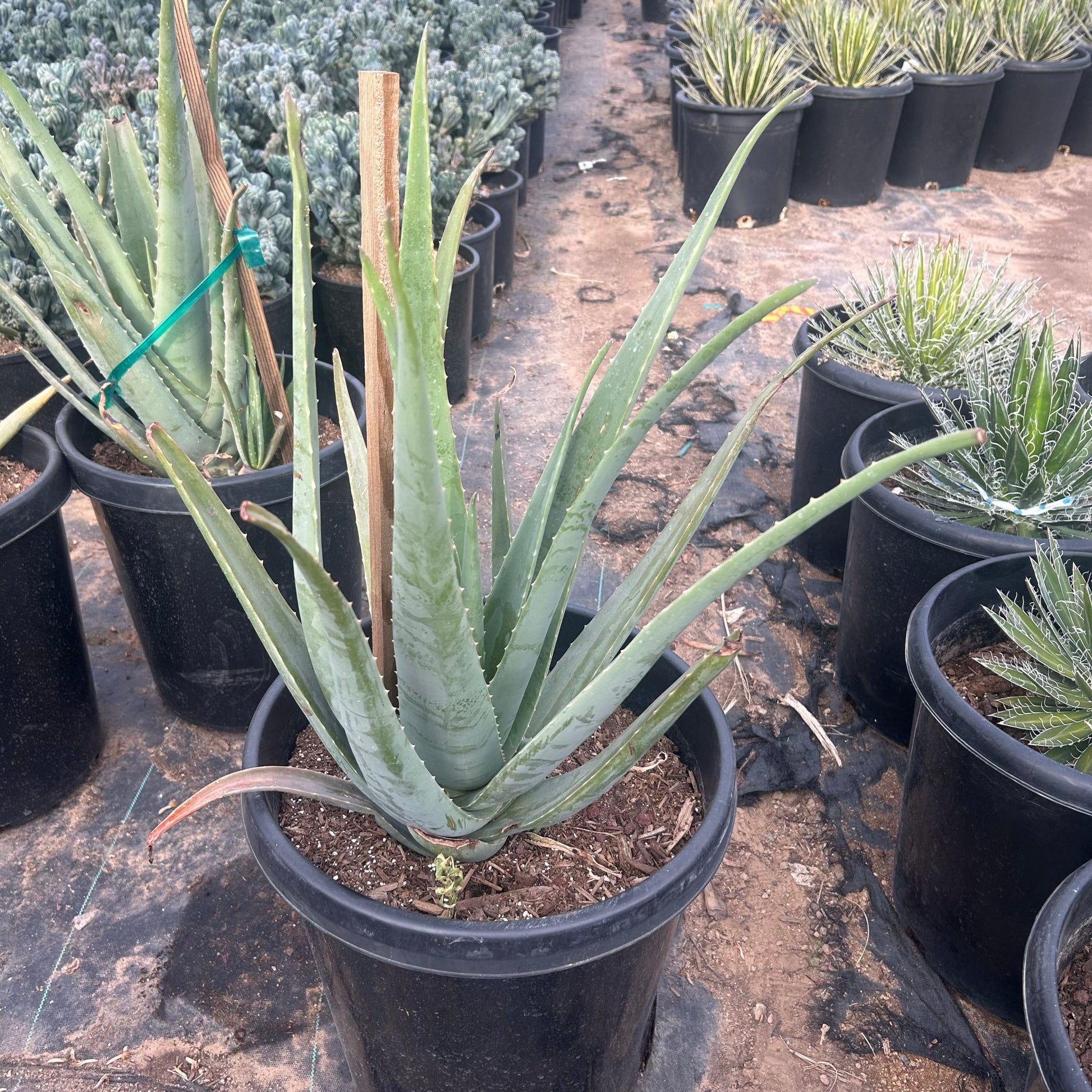
SKU: 33104930261
aloe vera plant nursery

aloe vera plant nursery Buy Aloe Vera Yellow Phoenix, AZ | Aloe barbadensis

Sale price$19.32 Regular price$21.47
Save 10%

Pay in installments of $5.37 with ShopPay, AfterPay and Klarna

Shipping Estimate
USA
  • USA
  • CAN

Ships within 48 hours · Estimated delivery Sep 5 - Sep 10

Promo Codes Available:

For Your Every Summer RSVP, with Code: SUMMER15

Description

aloe vera plant nursery Buy Aloe Vera Yellow Phoenix, AZ | Aloe barbadensisPhoenix's Classic Medicinal Aloe With Sunny Yellow Blooms Aloe vera (Aloe barbadensis) yellow flowering variety is the iconic medicinal aloe that thrives effortlessly across the Phoenix Valley. This fast growing succulent forms large rosettes of thick, gel filled leaves used for centuries to soothe burns and nourish skin, while producing cheerful yellow flower spikes that brighten the winter and spring landscape. Whether you're starting a medicinal

Phoenix's Classic Medicinal Aloe With Sunny Yellow Blooms

Aloe vera (Aloe barbadensis) — yellow flowering variety — is the iconic medicinal aloe that thrives effortlessly across the Phoenix Valley. This fast-growing succulent forms large rosettes of thick, gel-filled leaves used for centuries to soothe burns and nourish skin, while producing cheerful yellow flower spikes that brighten the winter and spring landscape. Whether you're starting a medicinal herb garden in Scottsdale, filling a sunny border in Tempe, or creating a drought-tolerant mass planting in Gilbert — yellow Aloe Vera is one of the easiest, most rewarding desert plants you can grow.

Aloe Vera (Yellow) Plant Details

Attribute Detail
Scientific Name Aloe barbadensis (Aloe vera)
Common Names Aloe Vera, Medicinal Aloe, Yellow Aloe Vera
Mature Height 1–2 feet
Mature Width 2–3 feet
Growth Rate Fast — fills in quickly in Phoenix's warm climate
Sun Full sun to partial shade. Handles reflected heat.
Water Low once established. Highly drought-tolerant.
USDA Zones 9–11 (Phoenix is Zone 9b–10a)
Soil Well-draining. Adapts to Arizona caliche soils.
Foliage Evergreen — thick, gel-filled leaves year-round
Bloom Color Yellow flower spikes, winter to spring
Special Feature Medicinal gel — soothing for burns and skin care

Aloe Vera (Yellow) Uses in Phoenix Landscapes

Medicinal & Herb Gardens

Yellow Aloe Vera is the must-have plant for any medicinal garden in the Phoenix area. Keep it near your kitchen or patio door for instant access to fresh soothing gel whenever you need it for sunburn, minor burns, or skin irritation. It pairs beautifully with rosemary, lavender, and other useful desert herbs.

Mass Plantings & Ground Cover

With its fast growth and prolific pup production, yellow Aloe Vera makes a fantastic living ground cover for sunny slopes, median strips, and large landscape beds. Space plants 2–3 feet apart and they'll fill in within a season. When the yellow flower spikes emerge in winter, the effect across a mass planting is spectacular — neighborhoods in Chandler, Mesa, and Peoria use this technique to great effect.

Pool-Friendly & Foundation Plantings

Aloe Vera's clean rosette form and lack of sharp spines make it ideal around pools, patios, and along foundation walls. It tolerates splash-out chlorine, won't drop messy leaves, and stays evergreen year-round. The sunny yellow blooms add warmth to any outdoor living space.

Container Gardens

Yellow Aloe Vera thrives in containers on patios, balconies, and porches throughout the Valley. Use a well-draining cactus mix in a pot with drainage holes. Containers make it easy to share pups with friends and neighbors — this is one of the most generous plants in the desert.

Best Time to Plant Aloe Vera in Phoenix

Fall (October–November) is the ideal window — warm soil encourages rapid root growth while cooler air reduces transplant stress, giving the plant 6–8 months of establishment before summer. Spring (February–April) is the second-best option. Aloe Vera is tough enough to plant almost year-round in Phoenix, but avoid the peak summer months (June–August) if possible.

How to Plant Aloe Vera

  1. Dig wide, not deep — 2–3x the root ball width, same depth as the container.
  2. Check for caliche — break through any hardpan layer for good drainage.
  3. Backfill with native soil — Aloe Vera is not fussy; a light 20% perlite blend improves drainage.
  4. Spacing — 2–3 feet apart for mass plantings; 3 feet for individual specimens.
  5. Water basin — build a 3–4 inch ring to direct water to roots during establishment.
  6. Mulch — 2–3 inches of gravel or decomposed granite around the base.

Watering Aloe Vera in Phoenix

First Year Watering Schedule

Weeks 1–2: Every 2–3 days, deep and slow. Month 1–2: Every 3–4 days. Month 3–6: Every 7–10 days (every 5–7 days in peak summer). After Year 1: Every 10–14 days in summer; every 3–4 weeks in winter. Aloe Vera stores water in its thick leaves — overwatering is the most common mistake.

Drip Irrigation

Place one 1-GPH emitter 8–12 inches from the base. Run for 20–30 minutes per session. Established plants are remarkably drought-tolerant and may only need supplemental water every 2–3 weeks in summer.

How fast does yellow Aloe Vera grow in Phoenix?
Very fast. A 1-gallon plant can reach its full 2–3 foot spread within 1–2 years in the ground, and it produces abundant pups (offsets) that can be divided and replanted.

What's the difference between yellow and orange Aloe Vera?
The yellow and orange varieties are the same species (Aloe barbadensis) with different flower colors. Growth habit, size, medicinal properties, and care are identical — choose whichever bloom color you prefer.

Is the gel in yellow Aloe Vera the same as regular Aloe Vera?
Yes. The thick, clear gel inside the leaves has the same soothing, moisturizing properties regardless of flower color. Simply slice a mature outer leaf and apply the gel to minor burns, sunburn, or irritated skin.

Does Aloe Vera spread on its own?
Yes — Aloe Vera produces abundant offsets (pups) around the base of the mother plant. These can be left to form a colony or divided and replanted elsewhere. It's one of the easiest plants to propagate and share.

You May Also Like

Aloe vera - orange — The orange-flowering version of the same classic medicinal aloe.

Aloe Hybrid — A variegated hybrid aloe with colorful spotted rosettes and vibrant blooms.

Aloe humilis — A compact clustering aloe perfect for rock gardens and small spaces.

Aloe Banseii — A tree-forming aloe that adds dramatic height to succulent gardens.

How Many Aloe Vera Do I Need?

Yellow Aloe Vera is a fast, clumping rosette 2 to 3 feet wide that pups freely, so it reads as a living groundcover when planted in drifts. Use roughly 30-inch spacing (center to center) for solid coverage. Plant the table counts below, then let the pups knit the gaps closed within a season.

Area to cover Plants needed (30 in spacing)
25 sq ft 4 plants
50 sq ft 8 plants
100 sq ft 16 plants
200 sq ft 32 plants

For a single accent or container specimen, one plant is plenty: it will form its own colony over time.

Aloe Vera (Yellow) Season-by-Season in Phoenix

  • Spring (Feb to Apr): Tail end of the yellow bloom spikes, with a strong flush of new leaves and pups as soil warms. Excellent second planting window.
  • Summer (May to Sep): Takes full Valley heat and reflected heat in stride. Growth slows at the hottest peak. Monsoon humidity is fine as long as the soil drains: avoid standing water.
  • Fall (Oct to Nov): Prime planting season. Roots establish fast in warm soil ahead of the cool months.
  • Winter (Dec to Jan): Cheerful yellow flower spikes rise above the rosettes. Aloe Vera is lightly frost-tender: leaf tips can scorch below about 28 to 30°F. In a hard Valley frost, cover the plants overnight or site them under eaves or a canopy.

At a Glance

✔ Hummingbird-Friendly   ✔ Pollinator-Friendly   ✔ Heat-Loving (Reflected-Heat Tolerant)   ✔ Drought-Tolerant   ✔ Pool-Friendly (Low-Litter)   ✔ Spineless   ✔ Evergreen   ✔ Low-Maintenance   ✔ Deer & Rabbit-Resistant

Plant It With

  • Aloe vera - orange: The orange-blooming twin, for a two-tone medicinal aloe drift.
  • Aloe Hybrid: Spotted, colorful rosettes that add pattern next to the clean green leaves.
  • Aloe humilis: A compact clumping aloe that fills the front edge of the bed.
  • Aloe Banseii: A taller tree-forming aloe for height behind the mass planting.

Is Aloe Vera (Yellow) Right for Your Yard?

Yes if you have full sun to light shade, fast-draining or amended caliche soil, and want an easy, useful, spineless succulent that is safe beside pools, walkways, and play areas. It shrugs off heat and drought and shares pups generously. Not the best fit if your spot stays wet or poorly drained, or if it sits in an unprotected frost pocket where temperatures regularly drop below the upper 20s without any cover.

Shipping Notes
  • Free Standard Shipping on $100+ Orders to the USA.
  • Except Preorder products are shipped in 48 hours.
  • Delivery to the USA:
  1. Standard Shipping : 3-10 business days
  • If time is of the essence, please consider selecting expedited delivery for faster service.
Exchange/Return Notes
  • We offer a 30-day return/exchange service after receiving.
  • Final sale items are not eligible for returns or exchanges.
  • To process your return/exchange, please contact us at [email protected]
  • Please click here for more details>>> Return & Exchange Policy
SKU: 33104930261

Discover Niche Categories That Outsell aloe vera plant nursery

Top-Converting Item to Boost Your Average Order

4.1 ★★★★★
Based on 27 reviews
Sort
Highest Rating
Newest First
Oldest First
Product Reviews
M
Verified Purchase
Mary T
Phoenix, US
★★★★★ 5
Great read!
Format: Kindle
In addition to being an engaging lecturer, Stoermer writes beautifully! “Again and again, people confronted the distance between the compact as advertised and authority as exercised.” Gorgeous prose and achingly painful history.
WAS THIS REVIEW HELPFUL?YesReportShare
Reviewed in the United States on June 3, 2026
F
Verified Purchase
Francis J. Casper
Lexington, US
★★★★★ 3
No Index or footnotes
Format: Paperback
I have been following Prof Stoermer’s videos preceding this book and pre-ordered it on that basis. I to read it but am a bit disappointed and disturbed that there is nothing by way of an index or footnotes, and no reference I can find that they are available elsewhere. My 3 therefore, has nothing to do with the substance and will update this review after I read it. But I don’t understand the absence of such material.
WAS THIS REVIEW HELPFUL?YesReportShare
Reviewed in the United States on June 4, 2026
K
Verified Purchase
Kindle Customer
Dallas, US
★★★★★ 5
Every american should be encouraged to read this text
Format: Kindle
This book had a profound impact on me. It has changed how I view all political discussions, history discussions, policy discussions, and race discussions. As a Hispanic Caucasian, I was acutely unaware of much of America's racist history. I knew the obvious examples, but this book really shows how extensive the racism is and its profound effects that are still heavily in effect today. Kendi's thesis is short and simple: racist ideas were created to justify racist policies. This is counter to the common argument that ignorance and racism spurs racist policies. Kendi lays out his main thesis at the beginning of the book and follows it up with example after example to back it up. Keeping the thesis and definition of racism simple really helps emphasize Kendi's point throughout the book. This book is also thorough; so much history is covered by this book. I spent a lot of time looking up some historical events or figures in more detail on Wikipedia to get a fuller picture. If you are unfamiliar with American history, then expect to move very slowly through the text as you look everything up for proper context. I absolutely love this book and strongly encourage everyone to read it. However, I do have a few gripes with it: - Kendi often misled me with his wording or juxtaposition of statements. I understand he is trying to make a statement, but I wish he wouldn't do this. One example that comes to mind is Roosevelt's naming of the White House. Kendi makes it seem like Roosevelt named it the White House after the public uproar over his invitation of Booker T. Washington over for dinner. However, there doesn't appear to be any evidence to support this, and there is some indication the White House was already referred to by that name well before the dinner. To Kendi's credit, he doesn't explicitly say the naming was done to appease the public, he just points out that it happened and people were still upset. Another example is his mention of black unemployment rates rising sharply in the early 1980s. This is true, but all unemployment rates rose during that time due to the recession. Yes, the black unemployment rate was worse, but he doesn't make that point: he only mentions the black unemployment rates. So as a reader you have to be careful of the facts you internalize from the book. - The organization of the book didn't really do anything for me. He tries to break down the text into 4 main sections, each focusing on a different historical figure. However, the focus on the figures didn't really contribute much, in my opinion, to his thesis. It brought some organization to his book, but not much. I would have preferred he spent more of the book going into details of some of the more significant policies or events than to keep looping the historical figure back in. - Text can read a bit haphazardly at times. There are certain sections of the book where I feel Kendi is jumping around history pretty quickly to different events and it becomes difficult for me to follow. Eventually he gets around to making a point, but it usually takes too long for me to fully grasp it at the moment. I have to often re-read these sections a second time to really get it. Again, please buy this book and read it. We would all be better off to know this history and the racist policies behind it.
WAS THIS REVIEW HELPFUL?YesReportShare
Reviewed in the United States on April 4, 2018
A
Verified Purchase
A. H. Wagner
Los Angeles, US
★★★★★ 5
A very painful but highly illuminating must-read on how racism took root and persists in the US
Format: Kindle
About halfway through reading this book, I realized I was highlighting almost every single page and had to start color-coding my highlights so as to make a little more sense of why certain passages struck me—a visual testimony of how illuminating Stamped from the Beginning is. With a primary focus on racism toward African-Americans and people identified as Black, this book is a thoroughly researched, sweepingly comprehensive survey of racism from its first traceable roots in ancient Greece when Aristotle said Africans had “burnt faces” to the start of the African slave trade in 15th century Europe, to the first recorded slave ship arriving in colonial America in 1619, all the way through the Civil War, the Jim Crow laws, the 1960s Civil Rights movement, and up to the present day. In order to help readers navigate this extensive timeline, author Ibram X. Kendi divides the book into five parts, featuring one historical figure as a sort of tour guide or anchor for each part. Very few individuals or institutions mentioned in this book come off as completely free of racist thinking; even many abolitionists and civil rights activists are revealed to have held racist ideas that contradicted their cause. This made me realize the extent to which racism has ensnared the United States in its pernicious roots. In Stamped from the Beginning, Kendi presents two main ideas about racism that helped me understand its influence and progress over the centuries. First, he explains that “Hate and ignorance have not driven the history of racist ideas in America. Racist policies have driven the history of racist ideas in America.” The author admits, “I was taught the popular folktale of racism: that ignorant and hateful people had produced racist ideas, and that these racist people had instituted racist policies. But when I learned the motives behind the production of many of America’s most influentially racist ideas, it became quite obvious that this folktale, though sensible, was not based on a firm footing of historical evidence.” As Kendi explains further, “Racially discriminatory policies have usually sprung from economic, political, and cultural self-interests, self-interests that are constantly changing.” Now that I understand self-interest—not hate or ignorance—has been the driving factor behind racist policies, I can better understand why racism hasn’t died out with the Emancipation Proclamation or desegregation or any of the Civil Rights Acts passed in this country. Tragically, racism persists and continues to evolve according to the current self-interests of people and institutions in power. It’s why, after slavery was abolished, segregation and the Jim Crow laws rushed in to replace it, and long after segregation has been outlawed, African-Americans continue to be oppressed by disproportionate mass incarceration as well as disadvantaged by fewer, inferior housing and employment opportunities. Second, Kendi points out that racism is not simply a debate between those who support racist ideas and those who oppose racist ideas. Throughout history, three–not two–viewpoints on racism have persisted: “A group we can call segregationists has blamed Black people themselves for the racial disparities. A group we can call antiracists has pointed to racial discrimination. A group we can call assimilationists has tried to argue for both, saying that Black people and racial discrimination were to blame for racial disparities.” As much as I would like to believe I am firmly in the antiracist camp, reading this book made me realize I have held a lot of racist ideas from an assimilationist viewpoint that I need to correct. Kendi gives many examples of well-meaning civil rights activists, including some African-Americans, who upheld assimilationist ideas. Some persisted with these ideas their entire lives, others realized their error and later self-corrected to an antiracist viewpoint, and still others upheld both antiracist and assimilationist ideas, often not realizing the contradiction. Thus, a tragic pattern that has repeated itself throughout American history is the persistence of many assimilationists in seeking to abolish racist policies and ideas with the same flawed strategies that never work. Indeed, the African-American author admits, “Even though I am an African studies historian and have been tutored all my life in egalitarian spaces, I held racist notions of Black inferiority before researching and writing this book.” I think it’s crucially important that Kendi tells readers about his mistaken notions of race—not to make readers feel better about their own ignorance, but to demonstrate how deeply racist ideas have taken root in American culture. Hopefully this admission on the author’s part will ease readers out of their defensive mode and open their minds to the disturbing truth that racism is a lot more pervasive among us Americans than we would like to believe. If you want to understand exactly how racism took root in the United States and why it has persisted through the present day, if you are prepared for a very sobering, very painful, and often highly disturbing look at the many flaws, hypocrisies, and atrocities in the American notions of democracy, exceptionalism, and “liberty and justice for all,” then Stamped from the Beginning is a must-read. Ultimately, what the author conveys with copious examples is that “Black Americans’ history of oppression has made Black opportunities—not Black people—inferior.” An absolutely necessary emendation to the traditionally accepted canon of American history.
WAS THIS REVIEW HELPFUL?YesReportShare
Reviewed in the United States on April 26, 2017
J
Verified Purchase
James H. Lee
Cuba, US
★★★★★ 5
Painful but excellent exploration of racist ideas in American history
Format: Kindle
Professor Kendi's fine study, which deservedly won a National Book Award, illuminates in a new way the history of racism in the US. Focusing on ideas rather than government policy, he documents the tenacity of an outlook that has stained the 400 year history of the American people. He begins with a simple, and I think unimpeachable, definition of racism: any argument or idea that attributes to an entire ethnic group intellectual or moral superiority or inferiority. Racists invariably explain these differences between ethnic groups as a product of biology, in an effort to shelter behind a scientific patina ideas that cannot survive rigorous scientific investigation. He organizes the book around five American thinkers, Cotton Mather, Thomas Jefferson, Frederick Douglass, W.E.B. Dubois, and Angela Davis. In each section, he also discusses the ideas of contemporaries of these individuals, dividing people into one of three groups: segregationists (racists who blamed blacks for their own plight); assimilationists (whites and even some blacks who attributed inequality partially to environment but still accepted the racist idea that all blacks shared some responsibility for discrimination); antiracists, who rejected the notion that any type of inferiority could be associated with all African Americans. Kendi has written an angry book, as would any author sensitive to the devastating impact of America's original sin. He shows how racist ideas, like the villain in contemporary horror movies, never suffer a final defeat. As soon as one explanation for alleged racial differences falls out of favor, a different one emerges from the (so far) undrainable swamp of prejudice to take its place. This resiliency demonstrates that racism does not stem from ignorance, but reflects the self-interest of those who benefit from the privileges conferred by supression of ethnic equality. The author's anger does not target any specific group. Few of his subjects (including himself) escape unscathed from his sharp analysis. Probably the most surprising revelation of this book is the extent to which even fierce defenders of black equality sometimes accepted some of the insidious ideas of racism and blamed African Americans for the discrimination they experienced. Thus the real target of Professor Kendi's anger is racism itself, the pervasiveness of which does not exempt even black Americans from its influence. Even this fine work of scholarship is not, in my opinion, free of flaws. In his evaluation of historical figures, he seems to judge them by their conformity to our values and standards. To judge Abraham Lincoln and Frederick Douglass for their failure to measure up to this generation's views of racism may accurately pinpoint some of the shortcomings especially in Lincoln's attitudes. But to criticize a 19th century president, caught in the impossible pressures of a savage civil war for having mixed motives in his emancipation policy displays a willful refusal to evaluate his behavior according to the context of the times in which he lived. (Absurd comments to the effect that Lincoln was "scared to death" when Lee threatened Washington during his invasion of the north in 1862 reveal more about Kendi than they do about the president.) But even if I have correctly identified flaws in the book, this is an important and exceptionally fine work of scholarship, which anyone concerned about the future of race relations in the US should read.
WAS THIS REVIEW HELPFUL?YesReportShare
Reviewed in the United States on August 8, 2017

recommand products