Pay in installments of $5.02 with
 ,
,
 and
and

Shipping Estimate
USA
- USA
- CAN
- USA
- CAN
Ships within 48 hours · Estimated delivery Sep 12 - Sep 17
 Promo Codes Available:
For Your Every Summer RSVP, with Code: SUMMER15
Description
plant an orange tree from seed Osage Orange – Experimental Farm Network Seed StoreMaclura pomifera Origin: Pennsylvania Improvement status: Wild Seeds per packet: ~40 BOTANICAL SAMPLE NOT GERMINATION TESTED Life cycle: Perennial Also called "hedge apple", "horse apple," "bois d'arc", "bodark"(and sometimes "monkey brain tree"!), or simply "hedge," this typically thorny native tree is most often grown as a natural hedge said to be "pig tight, horse high, and bull strong." First brought to the attention of non indigenous people by
Maclura pomifera
Origin: Pennsylvania
Improvement status: Wild
Seeds per packet: ~40
BOTANICAL SAMPLE - NOT GERMINATION TESTED
Life cycle: Perennial
Also called "hedge apple", "horse apple," "bois d'arc", "bodark"(and sometimes "monkey brain tree"!), or simply "hedge," this typically thorny native tree is most often grown as a natural hedge — said to be "pig tight, horse high, and bull strong." First brought to the attention of non-indigenous people by Lewis and Clark, who sent cuttings to Thomas Jefferson, a mythology sprang up around Osage oranges that was very much tied up with "manifest destiny" ideology. Jonathan Turner, a professor who helped found the University of Illinois said that "God designed Osage Orange especially for the purpose of fencing the prairies." By 1869, there were an estimated 60,000 miles of Osage orange fencing across the Midwest. But by a decade or so later, barbed-wire became popular, cheap, and easier to deploy, so Osage orange hedges became far less common.
Osage oranges are in the mulberry family (Moraceae), and as such their leaves can also be used as food for silkworms, though silkworm farming is also far less common compared with a hundred years ago. Doubtless the most important use of Osage orange today is for it's impressive wood: the hardest, most durable, hottest-burning wood native to North America. Our beloved sorghum mill is powered by a decades-old "swing arm" made from the fallen limb of an osage orange tree (see photo). It's still in great condition. Fence-posts made from Osage orange can survive in soil and rain for a century or more. And the wood burns with such intense heat and sometimes produces so many sparks (especially when not properly dried) that it can crack chimneys and even blow up cast-iron stoves. Nevertheless, properly treated, it can provide excellent long-lasting heat when burned. Most famously, the wood is considered superior to all others for making bows and arrows (hence the name "bois d'arc"), and it's also perfect for docks and piers, musical instruments, and tool handles. The only downside is that trees seldom grow straight and tall, and many limbs tend to make it knobby. But its strength and versatility are more important than any drawbacks. It was once a favorite for wagon wheels, since it has a bending strength (MOR) of 20,000 psi (pounds per square inch), 50% higher than red oak's (another very hard and durable native wood). This bending strength is why it makes such perfect bows — one early 19th century account noted that a quality bow was worth as much as a horse and a blanket!
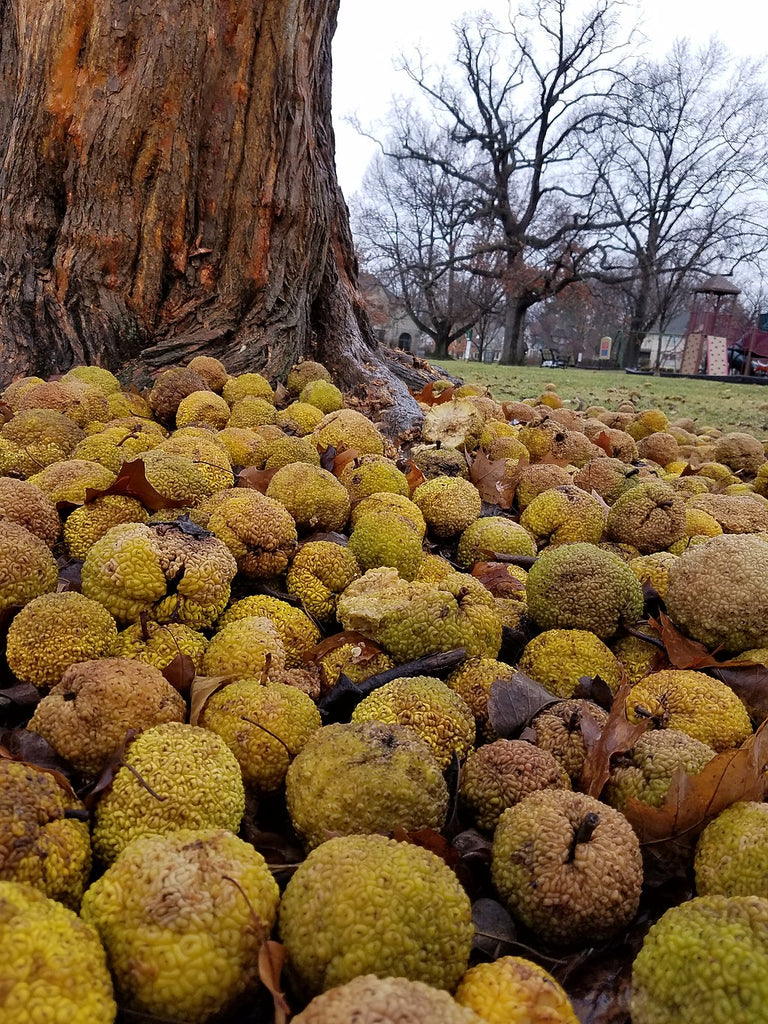
Most people only ever realize they're in the presence of an Osage orange tree in the fall, once it starts dropping its grapefruit-sized green fruit (which do bear a striking resemblance to a brain). These fruit can be processed into an edible starch, and some animals eat them, but they contain a very sticky latex that makes any processing challenging. They're also aromatic, and they have long been touted as a natural pest repellant, though there's apparently little evidence to support this claim. Nevertheless, some people line them up along the interior of doors to the outside to keep creepie-crawlies like cockroaches and mice from scuttling in. Extracts of the fruit have been found to have significant anti-cancer, anti-inflammatory, and anti-oxidative properties.
One enduring mystery surrounding Osage oranges is why they evolved such large and unusual fruit. Squirrels sometimes eat the seeds, but they don't spread them far. Many people have theorized that they evolved as food for giant megafauna that used to roam across North America. Seeds were found in the remains of 12,000 year-old mastadon dung in Florida, and DNA fragments were found in dung from a Pleistocene era ground sloth. Horses can eat them, but they don't like them, and if they try to eat one whole it may choke them (as has often been a problem for cattle grazing around Osage oranges), leading to recommendations that only pollen-bearing (a.k.a. male) trees be planted as hedges.
Some Osage oranges are naturally thornless, so don't be surprised if some of yours are not thorny as advertised. This seed comes to us from Pennysylvania via the good folks at Sheffield's Seeds in Locke, New York.
GROWING TIPS: Seeds benefit from cold moist stratification for 30 days before planting. They may be fall planted as well. Keep young seedlings well weeded until they are strong enough to compete on their own.
Shipping Notes
- Free Standard Shipping on $100+ Orders to the USA.
- Except Preorder products are shipped in 48 hours.
- Delivery to the USA:
- Standard Shipping : 3-10 business days
- If time is of the essence, please consider selecting expedited delivery for faster service.
Exchange/Return Notes
- We offer a 30-day return/exchange service after receiving.
- Final sale items are not eligible for returns or exchanges.
- To process your return/exchange, please contact us at [email protected]
- Please click here for more details>>> Return & Exchange Policy