SKU: 36845688957
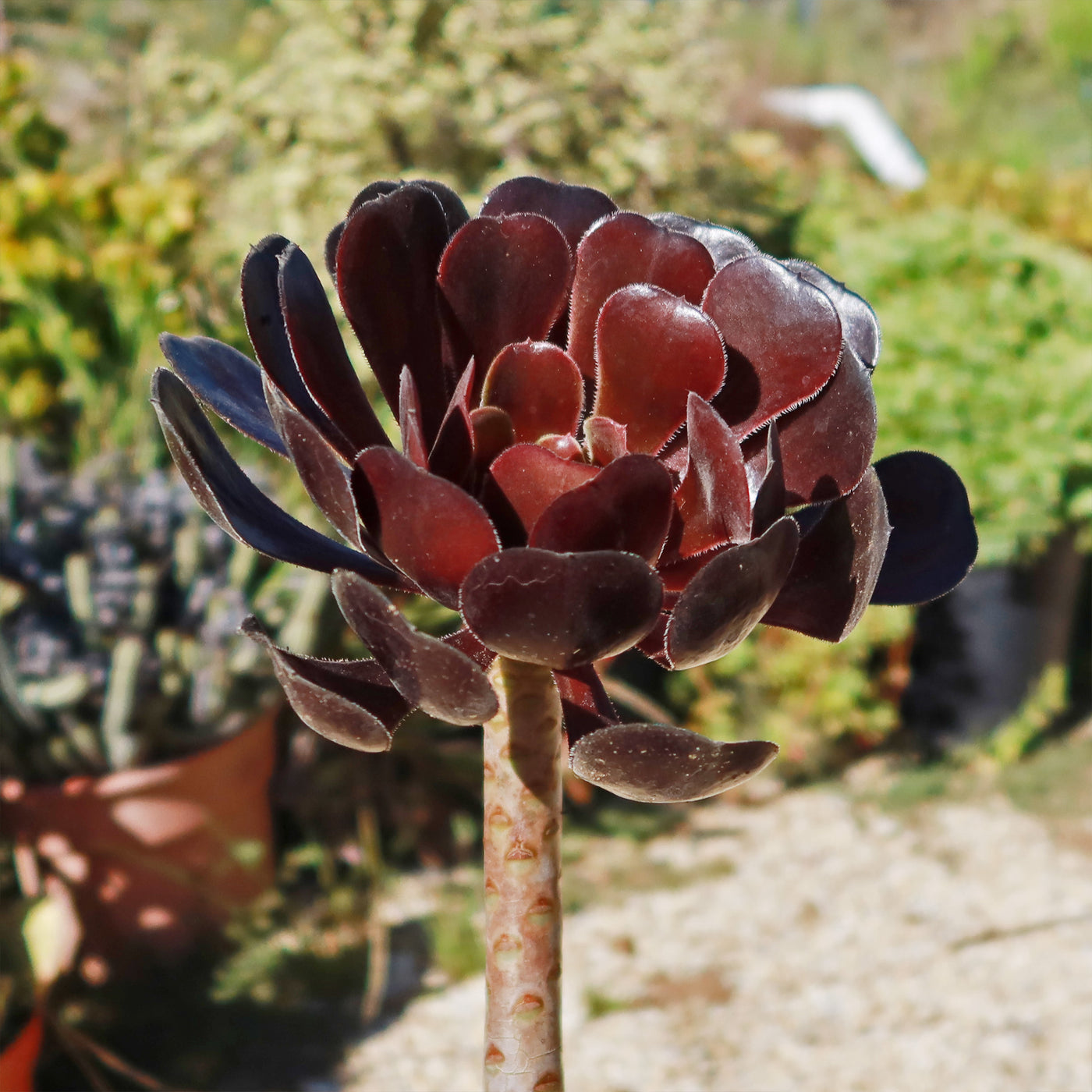
dark succulent plant

dark succulent plant Shop 'Black Rose Succulent - Aeonium Zwartkop' Care and Info

Sale price$24.33 Regular price$27.03
Save 10%

Pay in installments of $6.76 with ShopPay, AfterPay and Klarna

Shipping Estimate
USA
  • USA
  • CAN

Ships within 48 hours · Estimated delivery Sep 1 - Sep 6

Promo Codes Available:

For Your Every Summer RSVP, with Code: SUMMER15

Description

dark succulent plant Shop 'Black Rose Succulent - Aeonium Zwartkop' Care and InfoIntroducing the black rose, known as Aeonium Zwartkop', a beautiful variety of Aeonium arboreum. The name "Black Rose" comes from its leaves, which have a deep purple black tint that resembles roses. It is not a rose, but a succulent plant from the Crassulaceae family. The black rose Aeonium zwartkop has several other common names, such as Aeonium arboreum zwartkop, Aeonium black rose, purple crest aeonium, Aeonium 'black beauty', or tree aeonium.

Introducing the black rose, known as Aeonium Zwartkop', a beautiful variety of Aeonium arboreum. The name "Black Rose" comes from its leaves, which have a deep purple-black tint that resembles roses. It is not a rose, but a succulent plant from the Crassulaceae family.

The black rose Aeonium zwartkop has several other common names, such as Aeonium arboreum zwartkop, Aeonium black rose, purple crest aeonium, Aeonium 'black beauty', or tree aeonium. 

Hailing from the Canary Islands and reaching 5 feet in height and 3 feet in diameter at maturity, the black rose aeonium forms clumps and is sure to make a statement wherever it's planted.

When grown in full sun, the foliage takes on a deep, almost black color, which is why it's often referred to as the "Black Rose."

When grown in partial shade, the rosettes display a beautiful combination of purple-red hues with a green center. It's such a versatile plant that can add a touch of elegance and drama to any garden or succulent collection.

The flowers of Aeonium zwartkop bloom in the spring and produce clusters of small, yellow, star-shaped flowers that emerge from the center of its rosette-shaped foliage. The contrast between the dark purple-black leaves and the bright yellow flowers creates a stunning display. The flowers attract bees and other pollinators, adding life and movement to your garden.

Being a winter-growing plant, the Aeonium arboreum enters a state of dormancy during the scorching hot summer; during this time, the older leaves simply curl towards their points of growth rather than falling off entirely, giving the appearance of a black rosebud that is about to bloom. It's like a little garden masterpiece!

When and How to Water Your Black Rose  

From fall through spring, during its active growing season, Aeonium 'Black Rose' should be watered every 7–10 days, only when the top 1-2 inches of soil is completely dry. This is when the plant is most active, producing new leaves and expanding its rosettes. If under-watered during the growing season, you may notice the stems shriveling and leaves slightly puckering, but they'll quickly bounce back once hydrated.

In the summer months, when the plant enters dormancy, watering is reduced drastically to every 2–4 weeks or less. Aeonium 'Black Rose' naturally slows its growth or temporarily halts it during hot summer weather, especially in warmer zones or indoor conditions.

The plant conserves moisture during this rest period, so watering too often can lead to leaf drop or root problems. Only water if the plant begins to look overly stressed or if the soil has been dry for a prolonged time, again, always check at least two inches deep before watering.

Light Requirements - Where to Place Your Black Rose Succulent 

When growing the black rose succulent indoors, it's important to provide it with bright, indirect light for at least 4-6 hours a day. Keeping it in a well-lit area will help maintain the deep coloration of its leaves and promote healthy growth.

When grown outdoors, the black rose aeonium thrives in full sun to partial shade. In full sun, the foliage of this succulent turns almost black, which is why it's often referred to as the "Black Rose."

The intense sunlight brings out the deepest coloration in its leaves, creating a striking visual contrast. However, if you prefer a different look, placing it in partial shade will result in rosettes that display purple-reddish hues with a green center.

Remember, if your Aeonium 'Zwartkop' is exposed to too much direct sunlight and is not used to it, then there is a chance that the leaves might get damaged. It's critical to remember that during a heatwave or periods of extreme heat, your black rose succulent can get sunburned. You can protect the plant in this situation by moving it indoors or to a shaded area.

Optimal Soil & Fertilizer Needs 

The Aeonium zwartkop prefers sandy, well-drained soil, as excess moisture can promote root and stem rot. Planting them in ordinary soil will result in compacted roots, stunted growth, and most likely root rot. Instead, make or buy a well-draining potting mix, or ideally use our specialized succulent potting mix that contains 5 natural substrates and mycorrhizae to promote the development of a strong root system that helps your Aeonium succulent to thrive.

A small amount (5-10-5) of NPK fertilizer once a year in the spring will do wonders for your plant's health and growth. Using a natural fertilizer ensures that other beneficial compounds and microbes are added to the soil without the use of harsh chemicals. Show your succulent some love with awesome natural fertilizer and watch it thrive.  

Optimal Indoor Temperature & Humidity 

Aeonium 'Black Rose' thrives indoors at temperatures between 65–75°F with low to moderate humidity levels around 30–50%.

Keep your Aeonium away from cold drafts, heating vents, and sudden temperature changes. Place it near a bright window with indirect light, and ensure the space remains dry and airy to mimic its native Mediterranean-like climate.

Hardiness Zones & More

In the United States, this is mostly an indoor plant, but if you live in southern Florida or Hawaii, then you can cultivate it outdoors in USDA zones 9-12.

They are not cold- or frost-tolerant, you should plant them indoors or put them in a pot.

Move them indoors during the winter if you live outside of these regions. 

As for humidity, this succulent is adaptable and can tolerate average indoor humidity levels. However, it's important to provide good air circulation to prevent any issues with excessive moisture or stagnant air.

Wildlife - Black Rose Succulent Attracts the Following Friendly Pollinators

The Black Rose Succulent is known to attract a variety of friendly pollinators such as bees, butterflies, and hummingbirds with its vibrant blooms and sweet nectar. These pollinators play a crucial role in the plant's reproduction process by transferring pollen from one flower to another, ultimately helping the succulent thrive and produce seeds.

Butterflies
Bees
Hummingbirds
Lady Bugs
Multi Pollinators
Other Birds

According to the ASPCA, the Black Rose Succulent is non-toxic to humans and pets. It is safe to touch and is a popular choice for indoor houseplants due to its unique appearance and low maintenance requirements.

How to Propagate Your Black Rose Succulent

To propagate the black rose aeonium, one common method is through stem cutting. Simply take a healthy stem from the mature plants, making sure it is at least a few inches long. Allow the cutting to dry for a few days to form a callus, which helps prevent rotting. Then, plant the cutting in well-draining soil and keep it lightly moist until roots develop. With minimal water and full sun exposure requirements, this perennial is perfect for those looking for a low-maintenance addition to their garden or indoor space.

Key Takeaways

  1. The Black Rose Succulentis famous for its dramatic, rosette-shaped foliage in deep burgundy to nearly black hues, making it a striking focal point in any garden or collection.
  2. In late winter to early spring, mature plants produce tall stalks with clusters of bright yellow, star-shaped flowers, creating a striking contrast against the dark foliage.
  3. Aeonium ‘Zwartkop’ is highly drought-tolerant, requiring minimal watering, making it an excellent choice for xeriscaping or low-maintenance gardening.
  4. This winter-growing perennial, enters dormancy during hot summers, with older leaves curling towards growth points, resembling a black rosebud about to bloom.

Final Thoughts

Overall, the Aeonium zwartkop (black rose) is a unique and elegant succulent that can be a great addition to any indoor or outdoor space. Its dark foliage adds elegance and can be easily cared for with bright, indirect light indoors or full sun to partial shade outdoors. Keep your black rose aeonium away from cold, drafty windows and air vents if you are growing them indoors in a cold climate. The plant's distinctive black foliage or vibrant purple-reddish hues make it a standout in any garden or indoor decor. Its rosette-shaped leaves and compact growth habit add visual interest and can be a conversation starter.  

Be sure to add the ‘Aeonium arboreum ‘Zwartkop’ (black rose succulent) to your collection today and elevate the beauty of your home or garden, with this stunning-looking plant. 

Shipping Notes
  • Free Standard Shipping on $100+ Orders to the USA.
  • Except Preorder products are shipped in 48 hours.
  • Delivery to the USA:
  1. Standard Shipping : 3-10 business days
  • If time is of the essence, please consider selecting expedited delivery for faster service.
Exchange/Return Notes
  • We offer a 30-day return/exchange service after receiving.
  • Final sale items are not eligible for returns or exchanges.
  • To process your return/exchange, please contact us at [email protected]
  • Please click here for more details>>> Return & Exchange Policy
SKU: 36845688957

Discover Niche Categories That Outsell dark succulent plant

Top-Converting Item to Boost Your Average Order

4.5 ★★★★★
Based on 20 reviews
Sort
Highest Rating
Newest First
Oldest First
Product Reviews
E
Verified Purchase
evelyn
San Leandro, US
★★★★★ 5
Purse companion
Size: 27 Count (Pack of 1)
I carry these lozenges in my purse. It tastes good, and truly helps with dry mouth!
WAS THIS REVIEW HELPFUL?YesReportShare
Reviewed in the United States on May 22, 2026
S
Verified Purchase
Sher
Alexandria, US
★★★★★ 5
Great lozenge! Tastes very good.
Size: 27 Count (Pack of 1)
Very effective and tastes good. I will continue using it after my chemo treatment is finished.
WAS THIS REVIEW HELPFUL?YesReportShare
Reviewed in the United States on May 1, 2026
S
Verified Purchase
Shop Queen
Pawtucket, US
★★★★★ 3
Dry mouth is miserable.
Size: 27 Count (Pack of 1)
The mouth lozenges for dry mouth were excellent at first, but I have dry mouth all day, and they started upsetting my stomach. I guess I was taking too many. Since I switched to the spry, I don't have a problem. I keep the a small bottle of the spray in my pocketbook, because I need it sporadically. It is probably different with each individual.
WAS THIS REVIEW HELPFUL?YesReportShare
Reviewed in the United States on April 11, 2026
R
Verified Purchase
Rusky
Lake Worth, US
★★★★★ 5
Well researched, solidly faithful; undoes the harm of decades of scholars' attempts to debunk the Gospels
Format: Hardcover
Lots of reviewers have written great reviews, so this one will be fairly brief. Brant Pitre's books, this one included, are an example of what is best in the new scriptural studies emerging today. His research is solid and meticulous - no sloppiness here! - and he writes with a refreshingly strong Catholic faith. This book carefully and effectively undoes the harm of decades of scholars' attempts to debunk the Gospels. He very effectively rebuts 20th century scholars' claims that we don't know who wrote the Gospels, and that they were written so long time after Jesus' time on earth that they lack credibility as eyewitness, historical accounts. Step by step, with each chapter building on the next, Pitre shows the opposite to be true. Christians who have been disturbed by the debunkers will be strengthened, confirmed, and given much joy by this book. I've just purchased three more copies to give to friends - one of them a Catholic high school teacher and two, Catholic priests. But I think Christians of any denomination will welcome this book. Pitre's writing style is a joy to read: lucid, clear, and very easy to understand (even when I'm tired at the end of the day), without being annoyingly clever (as some popularizers can be) or pushy (as some apologists are). (I see Pitre as neither a popularizer nor an apologist; he is a scripture scholar who also is a fantastic communicator.) Without any attempt on his part to be "entertaining," Pitre has written a cliff-hanger - I couldn't put the book down! His insights - and now I'm speaking of the insights in all three of his books that I've read so far - Jesus and the Jewish Roots of the Eucharist, Jesus the Bridegroom, and this book, The Case for Jesus - are profound and deeply enriching spiritually. Although I've questioned a few of his insights, most of them have moved me profoundly, with a sense of wonder, and deep love and gratitude to Our Lord. Reading his books is, for me, a real form of prayer. I am looking forward to reading Jesus and the Last Supper (borrowed from the library to see whether I'll want to buy my own copy); this last book, per its reviewers, is aimed at a scholarly audience and different in tone from the three very accessible books I named above, but I'm expecting this book to be a treasure, too. In all of his books, Brant Pitre's lucid writing style, coupled with his solid scholarship, deep faith, and beautiful love for Our Lord, makes for a very special reading experience. I appreciate his respect for and great knowledge of Judaism, and the way he helps us to see the rich continuity between the Jewish and Christian faiths. Brant Pitre’s books are a real gift to us all.
WAS THIS REVIEW HELPFUL?YesReportShare
Reviewed in the United States on January 27, 2017
M
Verified Purchase
M. L. Asselin
Dallas, US
★★★★★ 5
Who is Jesus: A Case for Jesus’ Divinity
Format: Hardcover
I thoroughly enjoyed reading Brant Pitre’s “The Case for Jesus.” The New Testament scholar’s contribution to Catholic popular literature on the identity of Jesus stands well above much of the plethora of material available to Christian readers today. Pitre (mostly) convincingly builds his case through careful, fact-based argumentation--even if one could draw different conclusions from the same evidence. What case is Pitre trying to make? In effect, he makes several cases leading up to his central point of who Jesus was and is. In the first part of this slim volume, he treats the authorship of the Gospels. In this matter, as in most of the book, his principle foil seems to be Bart Ehrman, a former Fundamentalist Christian-turned-apostate scholar whose popular works attempt to undermine the validity of the Gospels as meaningful historical documents and specifically the claim that Jesus is the Son of God. Contrary to Ehrman, Pitre argues for the traditional authorship of the Gospels. As two significant pieces of evidence, Pitre points out that even the earliest Gospel manuscripts and secondary references to the Gospels include the writers’ names by which we know them. The Gospels, then, were never really “anonymous.” This leads Pitre to challenge the scholarly consensus on the dating of the Gospels, and the more controversial hypothesis that Matthew and Luke were based in part on a hypothetical, now lost (and, as Pitre points out, never referenced) book of Jesus sayings denoted by scholars as the “Q” source. As for the so-called lost or apocryphal gospels, Pitre shows that they were never really lost, that most of them were known by early Christian writers, who regarded them as forgeries. In the case of the apocryphal gospels, then, even though the internal evidence suggests that they were written by the apostles to whom they were ascribed, the attributions were never accepted. Ehrman has argued that the apocryphal gospels were not accepted by mainstream or orthodox Christianity, but were embraced by the communities, such as the Gnostics, for whom they were written. In a way, Pitre and Ehrman aren’t in contradiction here, but they just interpret the data differently. In other words, if you accept that the Church Fathers are espousing the correct version of Christianity, then Pitre’s point stands; if you hold on to the view that the Church Fathers represented one view of Christianity among many, all to be regarded equally, then the criticism of the (orthodox) Church Fathers matters less. Pitre, while not dismissing the validity of literary criticism, argues for the historical value of the Gospels. He wants to treat the Gospels as biographies of Jesus. Their inconsistencies and apparent contradictions stem not, as Ehrman would have it, from a “telephone game”-like process of accretions and alterations over time, or even so much from the requirements of the communities for which they were written, as from the different perspectives and life experiences of their writers. Pitre notes the similarities between the Gospels and ancient Greco-Roman biographies in countering the ideas of Ehrman and before him, Rudolf Bultmann, in thinking of the Gospels as akin to folktales, fairy stories, and myths. Pitre stands for the literal truth of the Gospels as far as they will allow in part because two of the four Gospels tell us that they are true (Lk 1:1-4; Jn 19:35, 21:24-25). There’s a bit of circularity in that argument. The main case for Jesus that Pitre wants to make is for His divinity. The Gospels, as Luke Timothy Johnson and other scholars have explained, try to answer, however obliquely, the question Jesus himself poses to Peter: “But who do you say that I am?” (Mk 8:29). Pitre makes the case that the Gospels--even the synoptic Gospels--speak to Jesus’ being God. Pitre makes a lively, even entertaining, argument, using some passages, e.g., the reference to the sign of Jonah, in ways I certainly hadn’t thought of before. Even though as a Catholic I accept Jesus’ divinity, I am willing to allow that others may look at Pitre’s argument and reasonably come to different conclusions. One train of thinking might be this: Pitre notes that Jesus speaks in parables and riddles, and so His claims to divinity are indirect. Moreover, an outright and indeed blasphemous claim to His divinity might have put an even earlier end to Jesus’ three years of ministry. But the Gospel writers should not have been constrained by either Jesus’ particular application of rhetoric or his need to be circumspect; why did the Gospel writers not forthrightly declare that Jesus was God? I think the proper response to this is that Matthew, Mark, Luke and John wanted the person encountering the Gospels to answer for themselves who Jesus was and is. In other words, by transmitting the way Jesus conveyed who He was to His disciples perhaps they, too, would draw in and win over later followers of Christ. It’s much more efficacious to engage the potential convert that way than simply to assert that Jesus is God. Brad Pitre has written a wonderful and engaging book. Even if you don’t agree with all of his conclusions, you will appreciate his logical and engaging discussion. This book is meant for the general reader, although it does have a scholarly apparatus by way of careful notes. An index would have been nice but this is a short book of a couple hundred pages. If you’re on a long flight, this book would be the perfect company.
WAS THIS REVIEW HELPFUL?YesReportShare
Reviewed in the United States on October 28, 2016

recommand products