SKU: 38657788503
garden wise grass seed

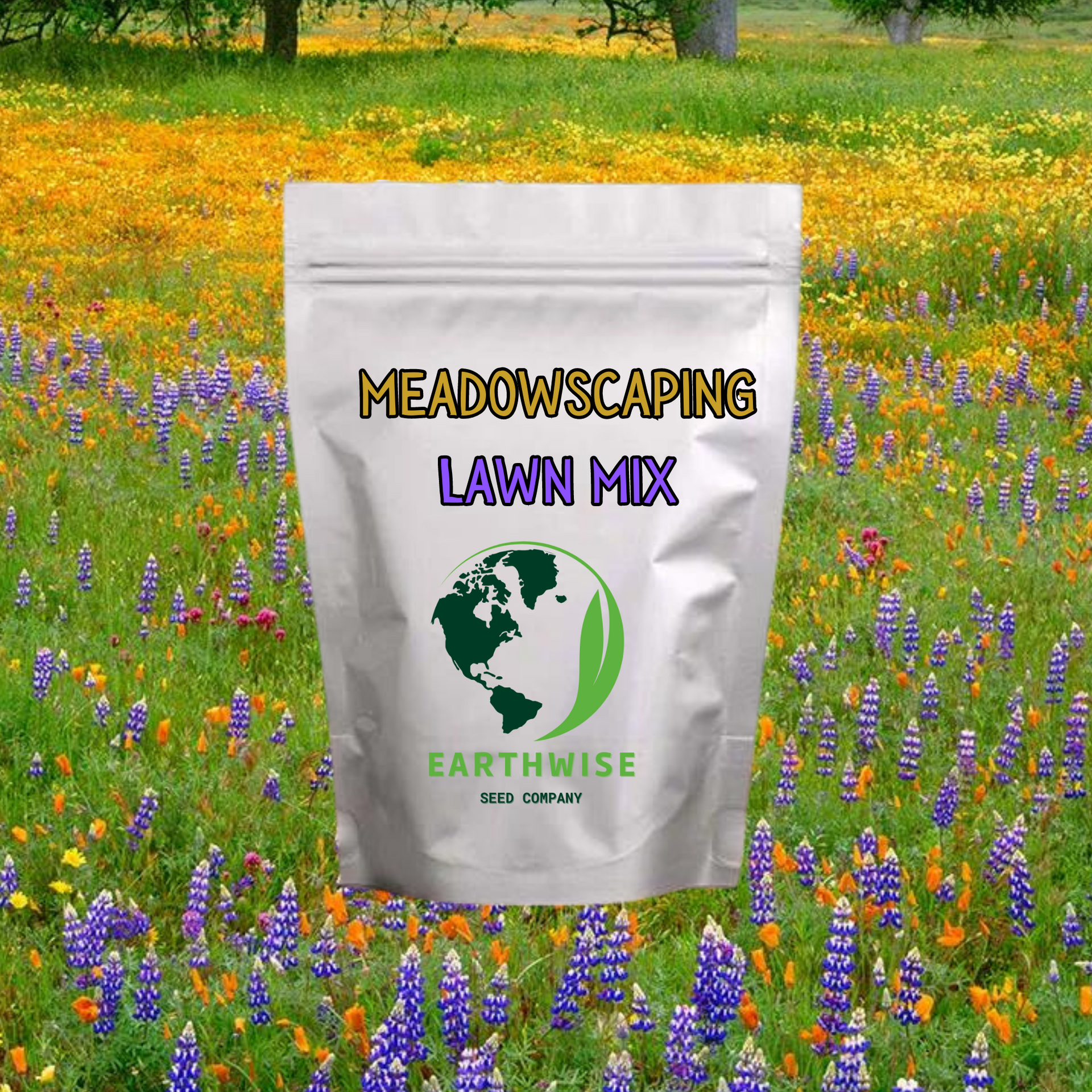
garden wise grass seed Meadowscaping Mix Alternative Lawn Seed — for Low-Maintenance, Eco-Friendly Lawns

Sale price$19.42 Regular price$21.58
Save 10%

Pay in installments of $5.39 with ShopPay, AfterPay and Klarna

Shipping Estimate
USA
  • USA
  • CAN

Ships within 48 hours · Estimated delivery Sep 16 - Sep 21

Promo Codes Available:

For Your Every Summer RSVP, with Code: SUMMER15

Description

garden wise grass seed Meadowscaping Mix Alternative Lawn Seed — for Low-Maintenance, Eco-Friendly LawnsGrass + Wildflowers 70% fine fescues, 30% Knee High Wildflower Mix Low Maintenance Lawn Alternative natural meadow look with NO mowing Water Wise thrives with minimal irrigation once established Biodiversity Boost supports a healthy, balanced ecosystem Pet & Family Safe chemical free and safe for outdoor living Pollinator Magnet wildflowers attract bees, butterflies & hummingbirds Soil Friendly builds organic matter and improves soil health Earthwise

🌱 Grass + Wildflowers – 70% fine fescues, 30% Knee-High Wildflower Mix
🍃 Low-Maintenance Lawn Alternative – natural meadow look with NO mowing
💧 Water-Wise – thrives with minimal irrigation once established
🌎 Biodiversity Boost – supports a healthy, balanced ecosystem
🐾 Pet & Family Safe – chemical-free and safe for outdoor living
🦋 Pollinator Magnet – wildflowers attract bees, butterflies & hummingbirds
☀️ Soil-Friendly – builds organic matter and improves soil health

Earthwise Seed Company is delighted to introduce our new Meadowscaping Blend, the ultimate in alternative lawn solutions. This innovative blend combines our top-performing seeds into one convenient package, making meadowscaping simpler and more accessible than ever before.

Why You'll love it

Our Meadowscaping Blend is designed as a vibrant, eco-friendly alternative to traditional grass lawns. It features a rich tapestry of fine fescues, diverse flowers, and clover species, forming a dense, low-growing ground cover. This blend not only offers a stunning array of colors but also requires minimal maintenance, making it a perfect choice for those seeking beauty with ease.

Environmental Impact and Benefits:

  • Sustainable: Reduces the need for mowing, watering, and chemical treatments.
  • Pollinator Friendly: Supports local wildlife, including butterflies and beneficial insects, with its extended blooming period.
  • Low Maintenance: Grows to a maximum height of 20 inches, eliminating frequent trimming requirements.
  • Eco-Friendly: Promotes a healthier ecosystem by foregoing pesticides and fertilizers.

Composition and Care

Our proprietary blend is carefully crafted with a mix of native and non-native seeds, tailored to thrive in a variety of regions, including the Northeast, Southeast, Midwest, West, Southwest, and Pacific Northwest. It's easy to grow and comes back year after year, offering a sustainable carpet of color that stays low to the ground.

Detailed Seed Composition: Below is a chart detailing the wildflowers and grasses included in our Meadowscaping Blend, ensuring a diverse and vibrant lawn.

Wildflowers  Grasses
Baby Blue Eyes* Sheep's Fescue
Blackeyed Susan* Chewings Fescue
Blanketflower Creeping Red Fescue
Blue Flax
Butterfly Milkweed
California Poppy*
Canada Milkvetch
Clasping Coneflower*
Corn Poppy*
Cornflower*
Drummond Phlox*
Dwarf Blanketflower
Dwarf Red Coreopsis*
Golden Alexander
Indian Blanket*
Lance Leaf Coreopsis
Leadplant
Mexican Red Hat
Perennial Lupine
Purple Coneflower
Purple Prairieclover
Red Yarrow
Scarlet Flax*
Shasta Daisy
Shell Leaf Beardtongue
Siberian Wallflower*
Spiked Gayfeather
Upright Coneflower
White Prairieclover

*Annuals

Species and quantities of species can change due to availability.

Embrace the change with Earthwise Seed Company’s Meadowscaping Blend. Create a lush, low-maintenance, and environmentally friendly landscape that you and your family will enjoy, while contributing positively to the local ecosystem

Add Seed-Tac to your order, Seed-Tac can be used on most any substrate to help keep new seeds in place and boost the germination time & success rate! 

Our Guarantee

Shipping Notes
  • Free Standard Shipping on $100+ Orders to the USA.
  • Except Preorder products are shipped in 48 hours.
  • Delivery to the USA:
  1. Standard Shipping : 3-10 business days
  • If time is of the essence, please consider selecting expedited delivery for faster service.
Exchange/Return Notes
  • We offer a 30-day return/exchange service after receiving.
  • Final sale items are not eligible for returns or exchanges.
  • To process your return/exchange, please contact us at [email protected]
  • Please click here for more details>>> Return & Exchange Policy
SKU: 38657788503

Discover Niche Categories That Outsell garden wise grass seed

Top-Converting Item to Boost Your Average Order

4.3 ★★★★★
Based on 27 reviews
Sort
Highest Rating
Newest First
Oldest First
Product Reviews
R
Verified Purchase
R. B. Daytona
Lake Worth, US
★★★★★ 5
Great book
Format: Paperback
Interesting approach to the study of lynching. Thought- provoking and well reasoned thesis. The author adds a new dimension to the lynching literature
WAS THIS REVIEW HELPFUL?YesReportShare
Reviewed in the United States on September 7, 2013
J
Verified Purchase
Jerry Saperstein
Pawtucket, US
★★★★★ 5
A valuable book for non-lawyers and lawyers
Why would non-lawyers want to read a book on persuading judges? For several reasons actually. First, many of us are involved in work that requires persuading others to adopt our views. While legal argument is substantially more formal and rule-driven than what most of us do, learning how to construct a logical argument as if it were to be delivered to the court, that Is governed by deadlines, restrictions on length, the need to adhere to established fact (or to establish those facts) and to be neither groveling nor inflammatory can be applied to selling your widgets. Perhaps more important is the fact that most people don't understand the impact of the court's decisions on our daily lives, our pocketbooks and our freedoms. Nine people sit on the Supreme Court. They cannot be removed except for the most grievous crimes and then only if Congress were to agree. More than one Justice has demonstrated that you can be senile and sit on the nation's highest court. Going down the food chain, the same applies to the federal appellate and trial courts. It is unlikely that one person in a hundred can even name a local federal district court judge and probably not one in a thousand could name the nine Supreme Court justices. Yet these men and women have tremendous impact on our lives, as do the thousands of state court justices. I am not a lawyer, but I consult to them and am not a stranger to the courtroom, writing drafts for legal briefs, doing legal research and the like. I have seen a lot of judges in action and have learned, in general, to fear them. They can - and do - cause tremendous harm through ill-considered decisions, making decisions with insufficient facts, assuming they know more than they do and myriad other reasons. They are gods in their courtrooms and if your lawyer fails to persuade them of the justness of your cause, you lose. Just how do these people reach their decisions? While justice is supposed to be blind (fat chance!), the justices are human and thus persuadable. Bryan Garner is a noted writer on legal writing. He is actually quite witty as he explains the use of the English language to lawyers who have had their understanding of words driven out of them in law school. Antonin Scalia is a hero to many for the courageousness of his decisions and dissents, his belief that the Constitution is to be strictly interpreted and his generally brilliant writing style. In 115, frequently witty, short chapters the two authors (who occasionally openly disagree) lay down their thoughts on how judges can be persuaded. It is not all about legal writing; e.g, advice to not chew your fingernails and dressing appropriately for court. They advise on giving your oral argument, which a lot of sales and marketing people would do well to read, especially the guidance to "never speak over a judge". In a sales situation, I am surprised at how often the sales person displays his or her contempt for me by not only not listening to me, but presuming they understand the point I was going to make before they spoke over me. I don't know about you, but a lot of salespeople have lost business with me for doing that. Some of the points the authors make are points of contention themselves: i.e., "swear off substantive footnotes - or not". None of the material in this book is truly new. Law students get elements of it in their first year as do some college students. A lot can be found in books on to be a better salesperson: i.e., don't chew your fingernails, etc. And a lot of it is plain commonsense. But that doesn't mean this book is unhelpful. First, it reveals in tiny part how Scalia evaluates the briefs he reads and arguments he hears, which in itself is a fascinating peek. The authors also put things many people may have forgotten through lack of use into perspective. Finally, they remind lawyers and non-lawyers alike that you often have only one shot at winning your argument so you had best put your best foot forward. Scalia and Garner show you how to do it. Overall, this is a fun, informative and helpful read. Jerry
WAS THIS REVIEW HELPFUL?YesReportShare
Reviewed in the United States on February 8, 2010
R
Verified Purchase
Rod Sullivan
Massapequa, US
★★★★★ 5
Like Having an Expert Looking over Your Shoulder
I am a law professor who spent 25 years as a Plaintiff's lawyer before deciding to teach. I've been before the U.S. Circuit Courts of Appeal many times and state appellate courts a few times. One caveat to consider: I expect to be arguing before the United States Supreme Court in the future. I hesitate to be too ebullient, lest you think that I'm trying to curry favor. However, I think that this book is great. Why do I recommend it? First, it is short. This book will accomplish much of what other books try to teach about advocacy, but in many fewer pages. Secondly, it is practical. It teaches writing skills, speaking skills, and how to be persuasive with limited time. Finally, it is not just for lawyers. Anyone trying to be persuasive can apply the same skills to other situations. For those of you who are politically opposed to Justice Scalia (which, believe it or not, includes some law professors)this is a joint effort by Garner and Scalia, and they frequently disagree. Hearing both sides of the argument on how to write or speak persuasively will help you decide how you want to present your arguments. How do my political opinions and Justice Scalia's opinions mesh? Can I be fair? I think so. He's a Federalist, I consider myself an Anti-Federalist. He as supporter of administrative delegation, I think delegation of congressional responsibilities to administrative agencies is congressional abdication. In short, I'm not recommending this book because Justice Scalia and I agree on policy, because on many policy matters we don't. I'm recommending it because I think it will help you. You wont be disappointed with the book.
WAS THIS REVIEW HELPFUL?YesReportShare
Reviewed in the United States on January 29, 2009
X
Verified Purchase
xiwaeo
Grantham, US
★★★★★ 5
Great Read
Great book, I enjoyed reading it. I am non-lawyer so I spent time having to read and re-read sentences and paragraphs but darn good book. Highly recommend it. Sometimes a person can be in discussion with an official, doctor, lawyer, cop ..whatever--it helps to remember arguments made in this book. Most folks just try to explain a situation, heaven forbid standing in front of a court or judge in a legal matter. But, this type of reading builds confidence, a strong vocabulary and so forth. It matters most trying to persuade a person or an institution..just winning, making your point in a clear coherent and cognizant way. This book can teach you these things.
WAS THIS REVIEW HELPFUL?YesReportShare
Reviewed in the United States on June 20, 2025
J
Verified Purchase
Jeff Wade
West Palm Beach, US
★★★★★ 4
You don't have to like Justice Scalia to like his book.
Perhaps an appellate brief that you wrote would have been perfect if only the judge had read it. The lesson you learned, hopefully, was that there is no guarantee that a judge will read your brief. The lesson you can learn from "Making Your Case" is how to write so that the judges will read what you wrote - preferably before your oral argument. Writing in a quite candid, lucid and entertaining style, Scalia and Garner serve up tips that even the most experienced lawyers can learn from. If you find yourself approaching the court's word limit, for example, you may be minimizing the chances of having your brief read, as judges really do favor brevity. How do you write for a court that is notoriously dismissive of higher court precedents? How do you best respond to a judge who asks whether you would be content with a remand? These and other critical questions are addressed simply yet insightfully. If your legal education stressed the IRAC approach (Issue, Rule, Application, Conclusion), Scalia and Garner take you a step further by stressing a syllogistic approach. Even if you have already been exposed to all the best ideas about persuading appellate judges, you are still likely to gain much rom reading "Making Your Case" because the authors organize all those ideas in a way that makes them much easier to remember and keep them in mind as you prepare your written and oral arguments. Justice Scalia calls his approach to legal reasoning and argument "textualism," which I understand to mean that his decisions are driven by the language of the law and of the case. My impression from reading many of his decisions is that he is often driven by ideology, so I can't quite square his book with his decisions. I also question the book's fundamental statement that the overriding objective of a brief is to make the court's job easier, as I prefer to write primarily for the purpose of winning the case. My criticisms of "Making Your Case" are miniscule compared to those thrown at it by Richard Posner. But although I find Judge Posner's decisions generally more fair than those of Justice Scalia, I prefer the clarity of Justice Scalia's writing - especially when he teams up with Bryan Garmer. Judge Posner notwithstanding, Scalia and Garner have put together a gem that is likely to prove invaluable for law students as well as for trial and appellate lawyers who are still interested in improving their game. If you fall into either category, buy this book, read it two or three times, and then keep it handy as a reference. It should help you make your case.
WAS THIS REVIEW HELPFUL?YesReportShare
Reviewed in the United States on December 18, 2012

recommand products