SKU: 39126546649
aloe vera plant edible

aloe vera plant edible Aloe Vera

Sale price$26.70 Regular price$29.67
Save 10%

Pay in installments of $7.42 with ShopPay, AfterPay and Klarna

Shipping Estimate
USA
  • USA
  • CAN

Ships within 48 hours · Estimated delivery Sep 14 - Sep 19

Promo Codes Available:

For Your Every Summer RSVP, with Code: SUMMER15

Description

aloe vera plant edible Aloe VeraIntroducing the fabulous Aloe Vera plant also known as Aloe barbadensis 'miller,' it is also known as a medicinal aloe and burn plant. The Aloe vera plant is by far the most popular out of over 400 varieties of the Aloe genus. This incredible tropical succulent is not your average houseplant. It's a superstar known for its leaves, which hold a magical aloe vera gel for soothing sunburn and as a popular drink to help your stomach. This large Aloe vera

Introducing the fabulous Aloe Vera plant- also known as Aloe barbadensis 'miller,' it is also known as a medicinal aloe and burn plant. The Aloe vera plant is by far the most popular out of over 400 varieties of the Aloe genus.

This incredible tropical succulent is not your average houseplant. It's a superstar known for its leaves, which hold a magical aloe vera gel for soothing sunburn and as a popular drink to help your stomach.

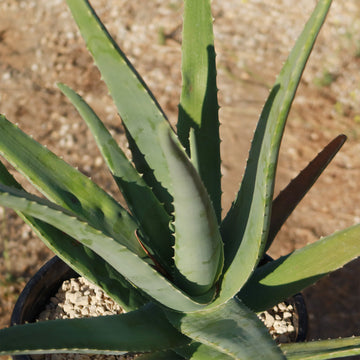
This large Aloe vera plant boasts fleshy lance-shaped grey-green leaves with small white teeth along the edges growing out from a starfish-like basal rosette. 

The edible aloe vera flowers burst into bloom in vibrant shades of yellow at the tips of their stalks when given favorable conditions. Only mature plants will yield flowers, so you'll have to wait at least four years to see an aloe vera bloom. However, in some growing conditions (especially hybrid plants), the flowers can sometimes appear with orange or reddish hues. 

This fast-growing succulent can grow into a large aloe vera plant up to 3 feet tall and 2 feet wide and even produce adorable pups that you can repot or share as delightful gifts with fellow plant enthusiasts.

How to Get Aloe Vera Gel from the plant to use on your skin

  1. Choose and Cut a Leaf: Select a large, healthy leaf from the bottom of the plant. Use a sharp knife to cut the entire leaf off at the base.
  2. Prepare the Leaf: Let the leaf sit upright in a container for 10–15 minutes to allow the yellow sap (aloin) to drain out. This sap can be irritating to the skin.
  3. Slice and Extract the Gel: For a small amount of gel, cut a section from the leaf rather than using the whole thing. Slice the leaf lengthwise to expose the gel. Use a spoon or knife to scoop out the clear gel.
  4. Apply or Store: Apply directly to your skin for soothing relief. Store extra gel in an airtight container in the fridge for a few days.

Aloe vera juice has many benefits for humans, this succulent rich in antibacterial, antioxidant, and anti-inflammatory properties, may enhance digestion, blood sugar levels, and oral health, although certain compounds, particularly aloin, may cause digestive discomfort and other side effects.

An aloe vera indoor plant is a great addition to any home, as it is easy to aloe vera care for and provides a variety of aloe vera benefits. 

According to the American Academy of Dermatology, Aloe vera has anti-inflammatory properties that can help in wound healing. It can also help to moisturize the skin and prevent peeling.

When and How to Water Your Aloe Vera 

As a desert dweller, watering the aloe vera succulent may be tricky, it may shrivel and die if given too little water, but it may also easily rot when given excessive water. So be careful not to overwater your aloe plantyou only want to give it enough to keep it from drying out completely, not drown it! 

A good rule of thumb is to water the Aloe plants deeply and then allow the soil to dry out completely before watering again. In the spring and summer, during the growing season, watering can be done once every 2-3 weeks.

During the winter months, when aloe vera is in a dormant period, it can be watered even less frequently. If you live in a rainy climate, consider planting aloe in gravel or stones. 

It is also important to note that aloe vera plants are sensitive to water quality. They prefer water that is low in minerals and salts, so it is best to use distilled or filtered water. Tap water can be used, but it should be left out for 24 hours before watering the plant to allow the chlorine to evaporate.

Light Requirements - Where to Place Your Aloe Vera Plant 

When growing indoors as a houseplant, place the aloe vera a few feet away from the south-facing window that receives plenty of sunlight, but it is important to avoid direct sunlight, as this can cause the leaves to burn. If the aloe plant is not receiving enough light, the leaves will start to droop and turn brown. In this case, it may be necessary to move the aloe vera plant to a brighter location. 

When planted outdoors, your Aloe plants need their daily dose of sunshine like a beach-loving teenager needs their favorite tunes!

They thrive on at least 6 to 8 hours of direct sunlight, soaking up those glorious rays with joy.

But wait, before you go dragging your aloe plant from its cozy shady spot into the blazing sun, be cautious. That sudden move can dry out your leafy buddy and leave it looking as yellow as a lemon.  

Now imagine you live in one of those cooler climates where clouds have permanent residency or if your home lacks these sunny windows altogether.

Fear not; you can use artificial lights – they're like little suns in bulb form! Hang them about one to two feet above your precious plant during daylight hours (that's roughly 16 hours per day) and watch it flourish happily amidst dim interiors.

Optimal Soil & Fertilizer Needs 

Aloe vera plants prefer well-draining soil that is a mixture of sand, perlite, and peat moss. It is critical to avoid soil that retains excessive moisture, as this can cause root rot. Instead, make or buy a well-draining potting mix, or ideally use our specialized succulent potting mix soil for aloe vera that contains 5 natural substrates and mycorrhizae to promote the development of a strong root system that helps your succulent to thrive.  

In terms of fertilizer, aloe succulents do not require a lot of nutrients. They can be fertilized once a year in the spring with a balanced fertilizer (NPK) of 5-10-5 in ratio. It is important not to over-fertilize the aloe plant, as this can lead to root burn. 

Hardiness Zones & More 

When grown indoors as a houseplant, aloe vera plants prefer a warm and dry environment. They thrive in temperatures between 60°F and 80°F. Aloe vera is a succulent, so it's adapted to arid conditions and doesn't do well in overly humid environments. Aim for a humidity level of around 30% to 40% for your indoor aloe vera plant.

In the United States, this is mostly an indoor plant, but if you live in southern Florida or Hawaii then you can cultivate it outdoors in USDA zones 9-11

Aloe vera can tolerate temperatures as low as 40°F for short periods, but prolonged exposure to freezing temperatures can damage or kill the plant. If you live in a colder climate, it's best to keep your aloe vera indoors or provide protection during winter months.

Aloe vera plants prefer dry air and do not require high levels of humidity. They can tolerate low humidity levels and do not need to be misted or placed in a humid environment. 

Wildlife - Aloe Vera Attracts the Following Friendly Pollinators

Aloe vera plants attract a variety of friendly pollinators, including bees, butterflies, and hummingbirds. These pollinators are essential for the reproduction of aloe vera plants, as they help transfer pollen between flowers, ultimately leading to the production of seeds. Additionally, these pollinators play a crucial role in maintaining biodiversity and ecosystem health.

Butterflies
Bees
Hummingbirds
Lady Bugs
Multi Pollinators
Other Birds

According to the ASPCA, the Aloe vera can be mildly toxic to pets and humans. It is rare but can occur if consumed in large quantities and can cause abdominal cramps, diarrhea, and electrolyte imbalances. It is important to consult a healthcare professional if you experience any adverse effects from consuming aloe vera.

How to Propagate Your Aloe Vera Plant

To propagate your aloe vera plant, you can separate the offsets or "pups" that grow at the base of the main plant. Gently remove these pups and plant them in their own pots with well-draining soil to encourage root growth. Water sparingly until they establish themselves, and place them in a sunny spot to promote healthy growth.

Aloe Vera: The Natural Sunburn Remedy


Aloe vera gel is known for its ability to moisturize the skin, it helps soothe burns and sunburns, as well as being known for its anti-inflammatory and antibacterial properties.

Aloe Vera is also rich in vitamins and minerals that are essential for healthy skin. It is best to use pure aloe gel extracted directly from an aloe vera plant.

To use aloe vera gel to soothe sunburns, cut off a piece of the large aloe vera leaf and open it to reveal the gel.

To maintain the aesthetic appeal of your aloe plant, it is advisable to cut off the entire leaf of the large aloe vera plant when cutting one. Just chop the leaf off as close to the main stem as you can. Cutting leaves from the base of the plant is always preferable. These leaves will be thicker since they are older. If you cut off the tip of a leaf, it will eventually turn brown at the tip because cut leaves keep their scars.

Key Takeaways

  1. Aloe vera is renowned for its medicinal properties, particularly its soothing gel, which is widely used for treating burns, wounds, and skin irritations. Its natural compounds, like aloin and acemannan, have anti-inflammatory and healing properties.
  2. When cut, aloe vera can seal its own wounds by producing protective latex, showcasing its remarkable survival mechanism in harsh environments.
  3. Aloe vera is not just a skincare savior; it also purifies indoor air by removing harmful pollutants like formaldehyde and benzene, making it a great addition to homes and offices.
  4. Native to arid regions, aloe vera thrives in minimal water conditions. It stores water in its thick, fleshy leaves, allowing it to endure prolonged droughts.
  5. The inner gel of aloe vera leaves is edible and used in drinks and food for its health benefits, such as aiding digestion, boosting immunity, and providing hydration. Always ensure proper preparation to remove any bitter or toxic compounds.
  6. The presence of yellow flower buds is a strong indicator of the edible variety.

The Bottom Line

Overall, Aloe vera is a popular plant known for its healing properties and versatility. It has gained popularity for its ability to help heal wounds, cuts, and burns, including sunburns. The gel inside the aloe vera leaves contains soothing and moisturizing properties that can provide relief and promote healing. In terms of care, aloe vera is relatively low-maintenance. It thrives in well-draining soil and requires moderate watering. It prefers bright, indirect sunlight but can tolerate some shade. 

A lot of people have a hard time finding large aloe vera plants, but here at Planet Desert, we regularly have large sizes in stock. Don't miss out on adding an Aloe vera plant for sale to your garden! Order now and enjoy its beauty for years to come. 

Shipping Notes
  • Free Standard Shipping on $100+ Orders to the USA.
  • Except Preorder products are shipped in 48 hours.
  • Delivery to the USA:
  1. Standard Shipping : 3-10 business days
  • If time is of the essence, please consider selecting expedited delivery for faster service.
Exchange/Return Notes
  • We offer a 30-day return/exchange service after receiving.
  • Final sale items are not eligible for returns or exchanges.
  • To process your return/exchange, please contact us at [email protected]
  • Please click here for more details>>> Return & Exchange Policy
SKU: 39126546649

Discover Niche Categories That Outsell aloe vera plant edible

Top-Converting Item to Boost Your Average Order

4.4 ★★★★★
Based on 10 reviews
Sort
Highest Rating
Newest First
Oldest First
Product Reviews
M
Mr. T
Carnegie, US
★★★★★ 5
Amazing deal on everything you need to keep your Omni C20 going for years
First and foremost, when I opened the package all the side brushes were all bent up crazy and all over the place (appearing to be ruined) but there was a little business card tucked away in the bag (I included a picture) that tells you to put them into 80 degree Celsius water (which is 176 degrees Fahrenheit BTW) and that they would straight and I have to admit I was skeptical... until about 5 minutes ago. WOW - I mean WOW - they straightened right up like it was poetry in motion, very cool to see it work - in my case I dipped the ends in individually 1 by 1 with all 6 of them and they're good to go now. Tested the pads for size and fit as well as the rollers, filters and bags the other day and they were all perfect matches as well. They also packed it extremely efficiently in a nice bag which is very reusable for long term storage. Also included is a detangle cutter if you have people with long hair in the house - and a brush for filter and roller cleaning if needed. It's such an incredible set that LITERALLY every single Omni C20 should buy. It's a no brainer.
WAS THIS REVIEW HELPFUL?YesReportShare
Reviewed in the United States on April 19, 2026
M
MrRE3Nemesis
Grantham, US
★★★★★ 5
Replacement Kit for Eufy C20 Omni
I got this 28-piece accessory kit for my robot vacuum, and it is a great value for the price. It contains everything you need for several rounds of maintenance, including main brushes, filters, side brushes, mop pads, and dust bags. It even comes with a small cleaning tool and a screwdriver to help with the installation. Everything in the pack fits the C20 Omni perfectly and works just as well as the original parts. The mop pads are absorbent and easy to wash in the machine, and the brushes do a good job of picking up dust and hair. It’s much cheaper than buying brand-name replacements and makes it easy to keep the robot running at peak performance. Overall, it is a functional and complete product that does exactly what it is supposed to do. It is a simple and cost-effective way to stock up on all the replacement parts you'll need for several months.
WAS THIS REVIEW HELPFUL?YesReportShare
Reviewed in the United States on April 17, 2026
W
Verified Purchase
whmitty
Natrona Heights, US
★★★★★ 5
Roborock S7 MaxV keeps my laminate floors dust free.
Although the Roborock S7 MaxV is not light on the wallet it has proven thus far to have been well worth the money spent. I did several weeks worth of research before buying this robotic vacuum cleaner. I chose not to buy the new S8 because I have all laminate flooring, no carpet anywhere and the S7 single roller seemed the logical choice. I ended up getting the black S7 MaxV and the white Auto-Empty charging dock separately because it was cheaper and there did not seem to be anyplace selling both the units in black. === THE VACUUM CLEANING UNIT === * The initial rapid (no vacuuming option) LIDAR MAPPING is exceptional in it's accuracy although if a room has ceiling to floor mirrors the LIDAR laser ranging will think that what's in the mirror is another room and it will show on the map on your cell phone app. Just create a "no-go" zone for that area and no problem. With each successive cleaning the machine seems to fine tune it's "understanding" of each room. However if one completely rearranges everything in a room it may take a run or two for it to fully adapt. * The OBSTACLE AVOIDANCE artificial intelligence exceeded my expectations. That said, when I do manual vacuuming I always move things around some to get to various tight spots so I do something similar for this robotic vac before turning it loose and I'm not lugging around a manual vac while doing so. Obviously if an object is very small it will not be considered an obstacle and it will go over it and try to suck it into it's dust bin. Sometimes an A/C power cord will fall into this category and it will wrestle with it and in my experience it eventually just leaves it but I just make sure I clear such wires before sending the gizmo on it's vacuum run. The obstacle avoidance feature has 2 settings with one being less strict than the other setting. I use it on the less strict setting so that it navigates narrow spaces more thoroughly. This can result in it bumping a door that is ajar such that it shuts itself into a room and can't get out by itself to either go on the next room to vac or to the charging dock. I just wedge rubber door stops under the ends of such doors and they stay put during operations. The MaxV variant of the S7 has the more advanced AI obstacle avoidance system and to me was worth the extra cost. The newer S8 units have similarly capable obstacle avoidance systems using just slightly different technology. * Roborock's mapping app for the cell phone does the job and and can be updated automatically. My only very minor issue with it is that when dividing rooms or marking off "no-go" zones on my smaller Android phone it can get a bit fiddly but I think most people have iPad sized phones these days so likely won't find this an issue. === THE AUTO-EMPTY DOCKING UNIT === * The docking unit is pretty straight forward and does a stellar job of emptying 95-100% out of the vacuum's sealed on-board dust bin into the sealed bag within the sealed container on the dock. The dock has an additional HEPA filter which prevents essentially any particles from escaping into the air around it. It can be rather loud during this operation which will at most only last 30 seconds. The empty frequency can be adjusted from "Smart", "Light", "Balanced" and "Max". the "Max" runs the full 30 secs and the other 3 are pretty much left up to the AI to figure out. Not sure what the diff is between the "Smart" and "Balanced". I just use "Balanced" and if in doubt manually run it from the app which will go 30 secs. I haven't filled the bag yet because it claims to hold 1-4 months worth of dust but that depends on how many pets, kids, foot traffic and where one lives as to how much service will be had from the bag. Also with this older (released early-2022) Roborock Auto-Empty units used with the model S7 MaxV vacuum a non-bag canister can be obtained which I purchased just in case inflation (no pun) makes buying bags a "no-go" zone. I don't think Roborock is offering that option with their latest S8 units. I just swap the container holding the bag with the special container using no bag. === THE APP USED TO CONTROL EVERYTHING === * I mentioned what I deemed the most significant aspects of the app above but it has other features which can be found in the manual and on Youtube. Bottom line is I am most pleased with my new Roborock vac. It keeps my house clean with really minimal effort. I am a bit of a technical geek (retired programmer/analyst) so maintaining the thing is more fun than a chore to me. It also made me laugh one time when I sent it on a mission to vacuum the wash room. I heard the unit's voice announce that it was leaving the dock to go clean. It rolled out into the living room where I was sitting and at first seemed to be looking around as though lost moving to and fro then after a few seconds of roving it suddenly figured out what to do and went straight through the dining are to the wash room to finish it's mission. This likely is not as amusing put into words as it was to watch. UPDATE 05-05-2023: After more time with this Roborock S7 MaxV I felt relating some additional experiences may be useful to some. Although I have not used the vacuum's mopping feature at all because my main interest is in it's vacuuming and superior navigational capability over time I began noticing my laminate flooring suddenly looking shinier. Mind you I hadn't manually mopped in an embarrassingly long time so this vac was doing better than I with my excellent Miele canister vac which I now only use to occasionally tune up the Roborock of accumulated surface dust from it's missions. The robot vac shamed me into actually doing a proper mopping of the floor. Now it will stay that way. The point here is that prior to using this type vacuum it is very useful to first thoroughly clean the floors (or carpets) as a baseline THEN use this spiffy device to keep it that way on a daily basis as it has for me. I'm an older widower living alone now for 8 years and I try to keep the place as clean as possible. With the S7 MaxV it's like having a service regularly vacuuming the floors. I live in the mountains and it takes no time for dust to accumulate here so again I am quite satisfied with this particular robotic vacuum. UPDATE 06-06-2023: After a couple months of owning the Roborock S7 MaxV and it's self-empty docking station I can say that using it to clean my laminate flooring once a week is more than adequate for a single guy living in a 2050 square foot single story home. I fired if up a lot the first week or so to assess it's capabilities. It was cleaning overkill for my purposes BUT I have zero pets and just one person with no carpets. My experience might have been different had I not first baseline super cleaned the house before beginning to use this vacuum. I mention this because I watched many reviews with videos showing problems with too much pet hair or "dirt" accumulated in the vacuum's dust bin before the thing could even finish a trip around their home's flooring. I've concluded that carpets are tougher for these machines which is why I have no issues with it's performance. Also if a home has 2 adults, 3 kids, 3 dogs, a cat or two and live in the country expecting one of these things to do a perfect job might be a big ask. Particularly if one does not have regular vacuum schedule adjusted to the amount of daily/weekly accumulated dirt. I get buy once a week but a household such as the one described above might require a daily run to avoid massive dirt accumulation in the dust bin before it's finished doing it's thing. The bottom line here is that this machine appears to be well designed both from a hardware and software standpoint but even artificial intelligence and sturdy hardware have their limitations.
WAS THIS REVIEW HELPFUL?YesReportShare
Reviewed in the United States on April 28, 2023
N
Verified Purchase
Nicole B.
Belleville, US
★★★★★ 5
Fabulous robovac
Color: Black01
I bought this as a replacement for my iRobot Roomba j7+ (7550). We have been loyal iRobot fans for years but their quality lately has been subpar. The j7+ was a perfect example of it...I spent so much time messing with it getting stuck & having issues I might as well have pulled out the Kirby and just vacuumed myself. After research this machine constantly came back as highly recommended. So far, I can see why!! It does occasionally get stuck under my Island but other than that it works wonderfully and my floors are cleaner than they've been in a long time. The app features are great...I love that I can see mid function exactly where it has cleaned, it was easy to use and program. It works so fast too! The Roomba used to take 6 hours or so to do the 2200 sq feet on our first floor but this one usually does it in less than half that time. And it's soooo much quieter. I've been on Teams meetings with it in my office w/me and no one noticed. I highly recommend this unit!!
WAS THIS REVIEW HELPFUL?YesReportShare
Reviewed in the United States on May 14, 2026
L
Verified Purchase
Linda Sherry
Lowell, US
★★★★★ 5
It’s not quite perfect, but it’s so much better than cleaning by hand.
I’m going to frame this review as a series of responses to what I imagine are common concerns for potential buyers. Q. This version doesn’t come with the fancy dock. Is that bad? A. Yes and no. The robot has an internal dustbin of perhaps 20 cubic inches volume, which is enough to clean a few large rooms in a row without filling up, but only if they’ve been cleaned already recently (which thankfully is usually the case after a while if you’ve set a proper cleaning schedule). That said, since the robot runs as little as once per week or as much as 4 full runs per day (“full run” here meaning the robot runs until its battery reaches 20% and it has to return to dock), depending on your schedule, if a lot of dirt is introduced or you haven’t run it recently, it can get tiresome to empty the dustbin manually. On the one hand, that’s still a lot less effort than manually shoving a vacuum into every corner of the space, but since the robot uses a semi-enclosed dustbin rather than a filter bag, you have to shake all the dust and fibers out of the bin by hand which inevitably leads to a small cloud of dust in your face and around your trash bin. I lasted less than a week before I decided to order the auto- empty, or “plus” dock. Q. What about my privacy? I heard this model has a camera. A. It does. It also has an onboard AI to process the images from the camera so it doesn’t need to send them to the cloud for processing. It’s not my job nor my area of expertise to tell you how much privacy you need, but i will say that I’ve had the robot for most of a week and my router has logged a total traffic of about 500MB from the robot. Since I’ve been monitoring the robot from my phone at work and used the remote access function, that’s a reasonable amount. Q. Remote access?! But what if someone used that to drive around my home taking pictures of my stuff? A. Well, assuming that they didn’t go to the effort of brute forcing their way past the encryption on the connection, they’d have to have your login information for the app (they’d have to know which brand of robot you got to even know which app to use) and they’d have to enter the dot-pattern lock code that the app asks for every time you use the remote function, and that’s assuming you enabled that function at all, as it’s disabled by default and can only be enabled by physically interacting with the robot. But even assuming that they got past those hurdles, they’d then have the privilege of directing the robot to crawl across your floor at ~5 inches per second while announcing that “remote viewing is active”, and they’d still only have a camera view from 1.5 inches over the ground, which isn’t a great perspective from which to steal someone’s data. Combine that with the fact that the robot is incapable of opening doors and the remote connection can be terminated by pushing any of the easily accessible buttons on the slowly moving robot, and you aren’t exactly left with the stuff of nightmares. Q. What about the AI? Is it going to take over the world? A. Well, I can’t be sure about larger AIs, but the one in this robot is nearly smart enough to avoid getting the robot trapped by chairs with crossbars for feet and not quite smart enough to find a way to roll over ethernet cables without tangling them. It helps the robot navigate and it lets you look at pictures of objects the robot has identified as obstructions (if you have that option enabled), but it’s not going to be thinking circles around even the average housepet. Q. What about this mopping function? A. I wish I could say that it’s amazing and I don’t think I’ll ever mop again, but that just isn’t so. Mostly it’s because my house was built over half a century ago and the robot was designed last year, but my kitchen is the main area that needs to be mopped and it is unfortunately filled with the sort of cupboards that overhang the floor by a couple inches - just low enough that the robot can’t get under them. As a result, the major splash zones right under the ledge go completely untouched by the mopping operation. As if that weren’t annoying enough, the mop attachment has no way to actually remove fluid from the surface it’s cleaning, so cleaning with it is kinda like putting a moist washcloth on a string attached to a stick and kinda dragging along the ground over the stains: not the most immediately effective option. That said, with enough passes and cleaning of the mop attachment proportional to the amount of material to be cleaned, it eventually gets most of the floor pretty clean. And since individual passes are essentially free as far as personal effort goes… it’s good enough I guess. I just wouldn’t go for this model if all you need done is mopping. Q. What about the price? A. Well, at 2-5 times the cost of manually operated vacuums, it is definitely an investment, and it does fall a little short in some ways. For example, it doesn’t agitate carpet as energetically as most vacuums and doesn’t suck quite as hard either, so it’s unlikely to get as much cleaning done on the first pass as other vacuums. Then again, each pass is a significant investment of your time and effort with a regular vacuum, whereas with the robot you just have to tell it where you want it to clean, how many times, and what level of suction or scrubbing to do and it will do the rest on its own (note: it will charge in between cleaning cycles if it needs more charge to be able to finish, but it will resume once it has enough charge and will remember where it left off. second note: depending on which dock you have, you may be required to intervene to empty the dustbin, as well). The other main flaw is that there are some things it just can’t do. The robot is incapable of fitting into tight spaces and can’t climb stairs, so cleaning those areas is right out. In addition, the vacuum roller is several inches from the edge of the robot, so while the side brush can sometimes push loose debris into the vacuum, that pretty much only works on tile, wood and other flat non-porous surfaces. Thankfully, humans and most of our preferred living partners tend not to travel those areas much either, but you can still expect to occasionally need to shove a conventional vacuum around into those awkward spaces. And of course the stairs. In any case, I suppose it’s a long investment, but some napkin math tells me that over the course of the next year, I’ll save approximately 40 hours of cleaning. Assuming the robot lasts past the initial year (given how easy it is to maintain, I rate that as very likely), it will have paid for itself by then in saved labor. Q. If there was one more thing you’d add to make this product better, what would it be? A. Fast charging. The robot will automatically attempt to return to its dock when it drops below 20% power. Using the basic charging dock, it takes just over 4 hours to charge after that. In a world where most phones can charge from 20% to 80% in less than an hour (some in less than 15 minutes), I’m not entirely sure why this robot takes over 4 hours to charge. There is something to be said for the longevity gains to be had from slow charging over fast charging, but I think I would have preferred a setting in the app with an explanation attached and a slot on the side of the robot for installing a new battery. I’d like to stress that this is not a critical feature of this robot, but it would be nice to be able to schedule all the cleaning for when I’m at work, but it requires too much battery charge, and the dock can’t replenish it fast enough. Q. Overall, are you happy with the robot? A. Yes. Very. I was happy enough with it when all it had done was clean my carpets, but for an extra kick, I decided to ask it to clean my garage, in which everything from woodworking to machining to welding is performed and which hadn’t been cleaned for 2 years. Not only did the robot not catch fire or explode (not even a little, though it did ask me to clean its roller), but it actually cleaned up all the dust, sawdust, metal filings, welding sparks and stray leaves! I honestly hadn’t been sure it would survive that sort of torture test, especially since the manual says it’s only for indoor home use and my garage is not the environment the designers meant when they wrote that. So far, I’m quite impressed and I just hope I can find a way to make it do its job without buying every accessory and replacement part under the sun, since you kind of have to expect that sort of nonsense with companies that try to convince you their product catalogue is a lifestyle.
WAS THIS REVIEW HELPFUL?YesReportShare
Reviewed in the United States on September 18, 2022

recommand products