SKU: 39512469634
toe succulent

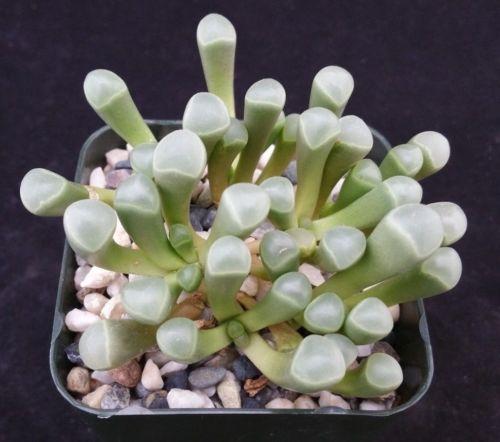
toe succulent Baby Toes 'Fenestraria rhopalophylla'

Sale price$23.17 Regular price$25.74
Save 10%

Pay in installments of $6.43 with ShopPay, AfterPay and Klarna

Shipping Estimate
USA
  • USA
  • CAN

Ships within 48 hours · Estimated delivery Jul 28 - Aug 2

Promo Codes Available:

For Your Every Summer RSVP, with Code: SUMMER15

Description

toe succulent Baby Toes 'Fenestraria rhopalophylla'Attention Gardeners, are you looking for a plant that will make your garden stand out? Look no further than the Fenestraria rhopalophylla, also known as baby toes or baby's toe, and window plant! These little clump forming baby toes succulents, hailing from Namibia and South Africa truly live up to their nickname. With their tiny, rounded leaves resembling the toes of an infant, it's hard not to fall in love with them at first sight! But wait until

Attention Gardeners, are you looking for a plant that will make your garden stand out? Look no further than the Fenestraria rhopalophylla, also known as baby toes or baby's toe, and window plant! These little clump-forming baby toes succulents, hailing from Namibia and South Africa truly live up to their nickname. 

With their tiny, rounded leaves resembling the toes of an infant, it's hard not to fall in love with them at first sight! But wait until you get a closer look - these window-leafed succulents have transparent tips (like a window) reaching the height of 3 inches and 4 inches in diameter in their natural habitat, it almost seems like something out of a fairy tale. These tiny toes' translucent tips allow light to pass through them and reach the baby toe's underground stem, which helps them to survive in its arid desert environment. 

Let's not forget about those delicate white or yellow flowers they produce in the early spring and fall! It's no wonder why these baby succulents are often referred to as living stones - they look like tiny rock formations with rounded baby toes sticking out. Propagating baby toes succulent plants from seeds and offsets is the easiest way to enhance your succulent collection. 

These green toes are unlike anything you've seen before with their low maintenance. Imagine having this unique and eye-catching plant in your collection. Your garden will be the envy of all who see it! 

Watering Requirements 

Fenestraria can typically don’t need much water, so they are harder to kill than most houseplants; it can store water in its leaves. They still require infrequent but effective watering to maintain their cuteness and recharge their water storage.  To determine when it's time to water, check the soil in-between waterings and wait until the first inch of soil is dry to the touch before watering again.  

You should decrease the watering frequency to once a month or less in autumn.  It's recommended to give them a deep-water soak once or twice a month when the soil is dry, during the active growing period in spring and winter, and sparingly during their dormant period in summer. 

It's important to avoid over-watering baby toes or other succulents though, as it can lead to waterlogging or soggy conditions that can easily damage the plant. A baby toe succulent that has been overwatered can easily be identified by a crack or split on its leaves. Placing it somewhere dry, well-lit, and with controllable water intake can help solve this issue. 

Light Requirements 

The baby toes succulents should be planted in full sun outdoors and need a minimum of 5-6 hours of bright light daily to stay compact (usually refer to leaves that are smaller than usual, and that are closely spaced on the stem).  

If they are not receiving enough sunlight, they may produce leaves that are elongated, thin, and pale in color, rather than compact and succulent. Without enough light, the plant may become leggy and weak, and its leaves may lose their distinctive shape and texture.  

When grown indoors, place it in the sunniest place in your house. This baby succulent may benefit from shade in consistently hot climates. Growing this baby succulent in a west- or south-facing window is best. Most light will enter through a south-facing window. East and West windows are excellent, too! Northern-facing windows provide the least amount of light, so avoid them.  

Optimal Soil & Fertilizer Needs 

When it comes to choosing the right soil or succulent food for your adorable baby toes plant, you need to be careful! It's like picking out the perfect outfit for a date - you want to make sure everything is just right so there are no surprises later on. 

You see, the amount of moisture in the soil can literally make or break your little green-toe friend. Too much water and BAM! You've got root and stem rot faster than you can say "Cactus." That's why we at Planet Desert have got your back with our specialized succulent potting mixGo to soil cactus mix blend 1 gal 4 qt cacti succulent dirt compost growing media, or regular potting succulent soil. This organic substrate has mycorrhizae which help to grow a healthy root system that makes all those spiky stems stand up tall and proud.  As an okay alternative, you can create your own potting mix by combining equal portions of perlite, coarse sand, and good natural potting soil. 

Natural fertilizers with a balanced ratio of NPK (5-10-5) also last longer and keep your soil alive by adding other beneficial compounds and microbes that encourage plant health and nutrient absorption. So, skip those harsh chemicals and give your succulent some love with some awesome organic fertilizer! 

Hardiness Zones & More 

Typically grown in hot, arid desert regions, the baby toes succulent thrives indoors in warm, dry surroundings. In general, a humidity level of 40% is sufficient to keep this plant happy and thriving.  

If you live in USDA regions 10 to 12, you can also grow these baby succulents outdoors year-round, but they are not cold- or frost-tolerant, so during cold winters, you should plant them indoors or put them in a pot and move them indoors during the winter if you live outside of these regions. Keep your baby toes away from cold, drafty windows and air vents if you are growing them indoors in a cold climate. 

Don't miss out on adding the Fenestraria rhopalophylla baby toes to your garden today! Order now and enjoy its beauty for years to come. 

Shipping Notes
  • Free Standard Shipping on $100+ Orders to the USA.
  • Except Preorder products are shipped in 48 hours.
  • Delivery to the USA:
  1. Standard Shipping : 3-10 business days
  • If time is of the essence, please consider selecting expedited delivery for faster service.
Exchange/Return Notes
  • We offer a 30-day return/exchange service after receiving.
  • Final sale items are not eligible for returns or exchanges.
  • To process your return/exchange, please contact us at [email protected]
  • Please click here for more details>>> Return & Exchange Policy
SKU: 39512469634

Discover Niche Categories That Outsell toe succulent

Top-Converting Item to Boost Your Average Order

4.0 ★★★★★
Based on 5 reviews
Sort
Highest Rating
Newest First
Oldest First
Product Reviews
W
Verified Purchase
Walter W. Olson, Ph.D, P.E.
Houston, US
★★★★★ 3
A military reading: The cover is misleading
This book is purported to be a translation of China’s Masterplan to Destroy America written by two Colonels in the People’s Liberation Army in 1999. There is reason, but not confirmed, to doubt this. The authors of the book are clearly Chinese. Whether or not the authors are Colonels in the PLA, I feel, is in doubt, as such a plan would never be available to Western sources as quickly as it was after drafting. The book is no “master plan.” It is a discussion of modern warfare strategy written by readers of the worldwide military strategy publications. Most of the publications have been in the United States and China. The cover of this book is misleading with the statement, “Wake up, America.” This book should be little interest to the non-military American. But it should be read by anyone with potential requirements for field grade service (Major and above,) or higher (and equivalent strategy levels in the Marines, Air Force, and Navy.) As far as “Wake Up,” I can recall discussions about strategy that contained most of the information provided within the book as a staff field grade officer in the US Army. While as military officers, we need to be aware of these issues, we are not entirely ignorant of them. The book provides a somewhat different perspective of the issues from a Chinese viewpoint. The first point the authors make, how technology precedes its best employment in warfare. Most of the technology discussed concerns the information processing capabilities of both computers and software. It is more than computerized warfare. A large part of this is based on the technology to US Forces but not entirely. Part of the problem with technology is that mankind becomes so used to using technology to solve today’s problems that previous methods of solving problems are lost. Thus, if the technology can be crippled, it represents an exploitable weakness in war. The second point made, is that the military forces now must consider nonmilitary actions if it is to be effective in both defense and offense. Warfare developed from point battlefields (using swords, knives, etc.,) to linear battlefields (using machine guns and artillery,) to area battlefields, to 3D battlefields (using aircraft and missiles,) to modern infinite-dimensional battlefields which include space, electromagnetic spectrums, and civilian actions. If one can start a war in a computer room or a stock exchange, is there a non-battle space anywhere? Warfare that transcends military boundaries is “unrestricted warfare.” A “kinder warfare” with critical attacks that take no lives is now possible. Technology is providing a means to attack and enemy’s nerve centers without directly harming anything else. Such nerve centers exist in an enemy’s financial systems, their economic systems, their environmental systems, their public media systems, their political systems, their power and energy systems, and their logistics centers. A third point made is that coalitions of disparate forces, internationally, nationally, and military, are formed and broken very quickly, as quickly as within 24 hours! For example, in Desert Storm, the United States weaved together more than 30 nations in various roles. The author’s prescient comment foresaw the alignments that occurred immediately following the 9/11 attack, although this was after the book was written and not available to the authors to use as an example. There was also unity of command established. This, the authors say, stemmed from the US DoD Reorganization Act passed by Congress in 1986. All of the air forces and naval forces were under General Schwartzkopf despite the desires of the individual forces to operate independently. The air tasking order (a 300-page document) drafted in joint sessions by the Air Force, Navy and Marines, had to be approved by General Schwartzkopf before commands were issued to the various forces. The Kuwaiti Invasion Plan that the Marines wanted was put off in favor of the plan that General Schwartzkopf endorsed. Media personnel were incorporated into the military units but controlled with definitions of release timing and content. A fourth point is that Americans want wars which achieve its national interests while having no causalities. This promotes an over-reliance on technology and an unwillingness to support prolonged war. Americans have a blind faith in technology always thinking that the road to victory is with the highest technology weapons. American military budgets are based largely on the acquisition of expensive weapon systems, and little thought given to their integrated use within the military services. American military theory is behind (consistent with point one above.) But the overriding goal is victory without casualties. Thus, the authors recommend that the secret to war with America is to kill its rank and file soldiers. The style of the book is somewhat elliptical: it is written in the Chinese manner which often dances around a subject before coming to its subject. For example, there is a discussion of the Golden Ratio (1:0.618) before the authors show how it can be found in various ancient and modern military operations. There is considerable Chinese military philosophy discussed including the 36 Strategies, which most American military readers have not encountered ( did not at West Point when I was a Cadet studying Chinese!) I first encountered these after a reference from a Chinese Professor while I was teaching in China and then read Sun Tzu in Chinese. Sun Tzu was not the original author of these. In my personal opinion, an English translation this short book should be required reading for all Cadets at West Point. I rate the book 3 stars for several reasons. I don’t feel the book is well written. Many of the references are transliterations of the author’s names in Chinese which do not read as the real names. At this time, the book is somewhat dated having been written in 1999. I also doubt the attribution of the source and authors of the book. The concepts presented in the book are worth thinking about for a person developing military strategies.
WAS THIS REVIEW HELPFUL?YesReportShare
Reviewed in the United States on September 16, 2019
B
Verified Purchase
Beth Rohl
New York, US
★★★★★ 5
No complaints
Format: Paperback
Knowledge is power and everybody should read this book
WAS THIS REVIEW HELPFUL?YesReportShare
Reviewed in the United States on December 3, 2025
C
Verified Purchase
Cita
New York, US
★★★★★ 5
Fascinating and beautifully written.
Format: Hardcover
Clear and compelling reading of the much-neglected history of Carthage -- all its histories had been written by the victors in Rome. BTEW y four-colour photo insert was missing a page....shame on Norton, the puboisher.
WAS THIS REVIEW HELPFUL?YesReportShare
Reviewed in the United States on March 25, 2026
N
Verified Purchase
Nana & Granddad
Battle Creek, US
★★★★★ 4
Excellent Overview of Carthage
Format: Hardcover
293 pages of text/maps/b&w figures; 8 pages of color plates; 15 pages of end notes (mostly citations); 20 page Bibliography; 6 page Primary Bibliography; 2 page Acknowledgements; 8 area maps; 1 battle map [Cannae]. This is a well written history of Carthage. It provides a one source overview of the background and history of the city/empire. As a reasonably well read layperson, I am familiar at an overview level with the Punic Wars, Rome, Alexander, and the Alexandrine successor states and this book packaged Carthaginian information very well while adding interesting information that I hadn't come across before. I was somewhat disappointed (hence the 4 star rather than 5 star rating) that there was a very limited drill down to a lower level of detail, particularly from such a noted author. However, this is probably an unfair criticism given the limited amount of archeological information available and the millennia of effort that has been spent in pigeonholing Carthage according to the desired perceptions. I recommend the book highly as a well written overview of Carthage.
WAS THIS REVIEW HELPFUL?YesReportShare
Reviewed in the United States on April 2, 2026
N
Verified Purchase
Norm G
Grantham, US
★★★★★ 5
Brilliant book
Format: Hardcover
Brilliant book. An insightful synthesis of history, myth, and archaeology. Highly recommend.
WAS THIS REVIEW HELPFUL?YesReportShare
Reviewed in the United States on February 22, 2026

recommand products