Pay in installments of $7.14 with
 ,
,
 and
and

Shipping Estimate
USA
- USA
- CAN
- USA
- CAN
Ships within 48 hours · Estimated delivery Sep 10 - Sep 15
 Promo Codes Available:
For Your Every Summer RSVP, with Code: SUMMER15
Description
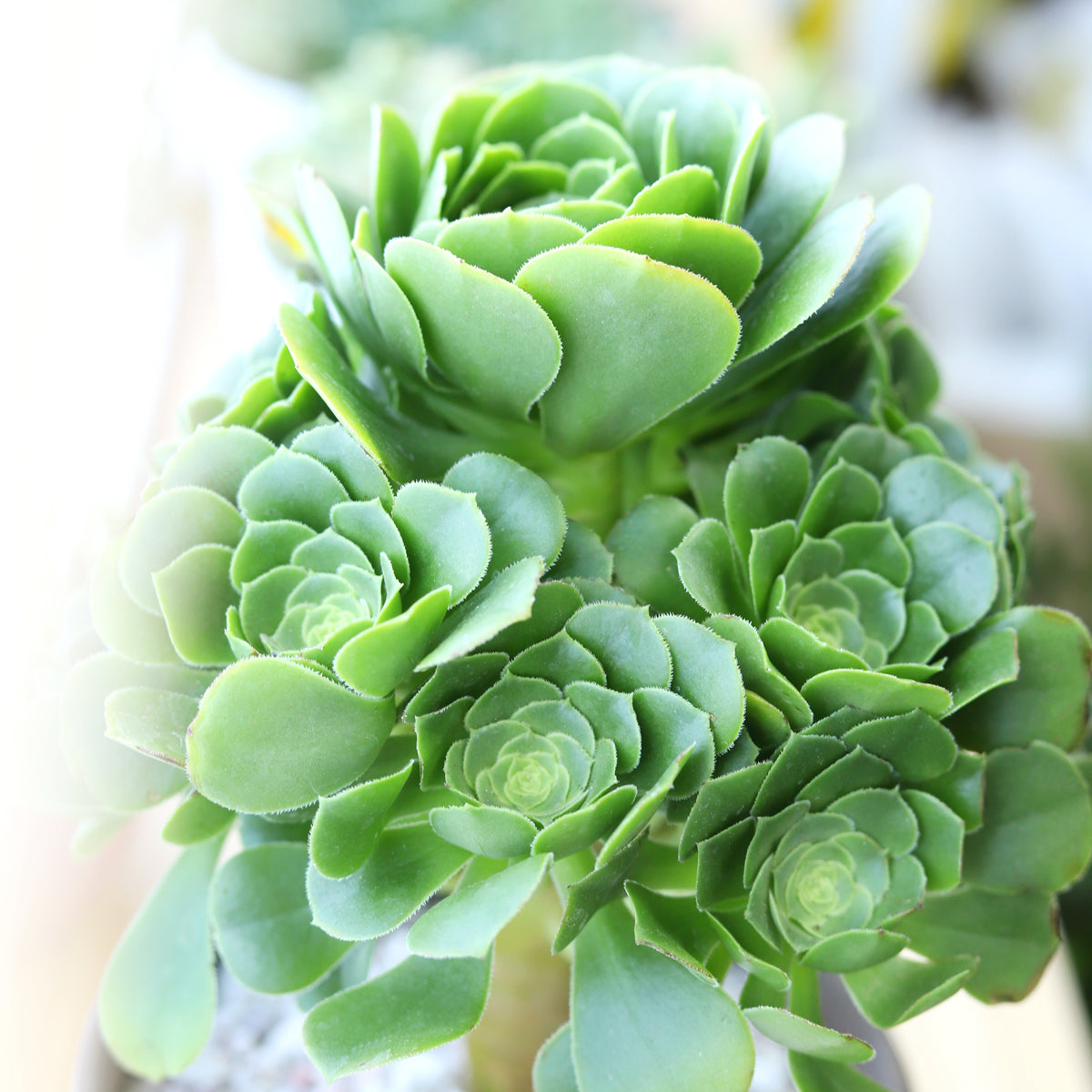
aeonium rosette succulent Aeonium Green PlattersDescription Light Soil Water Hardiness Aeonium Green Platters or Aeonium Pseudotabuliforme is a succulent plant with flat rosettes up to 6 10 inches wide of rounded and shiny green leaves, easy to care. It blooms yellow flowers in spring on a pyramidal inflorescence though quite infrequently. It is perfect as a groundcover or in containers. Aeoniums are one of the most ornamental of all the succulents. Even those that don't appreciate succulents seem
-
Aeonium Green Platters or Aeonium Pseudotabuliforme is a succulent plant with flat rosettes up to 6-10 inches wide of rounded and shiny green leaves, easy to care. It blooms yellow flowers in spring on a pyramidal inflorescence though quite infrequently. It is perfect as a groundcover or in containers.
Aeoniums are one of the most ornamental of all the succulents. Even those that don't appreciate succulents seem to like these plants. Perhaps it is the fact they look like large, colorful, rubbery flowers that these popular plants have such an appeal. And luckily many are easy plants to grow as well.
All of the plants may be shipped bare root -
Full sun, Partial sun, Partial shade.
Porous and well-drained potting mix.
This plant only needs a low to moderate amount of water. Water thoroughly only when soil is dry to the touch, then let drain completely.
You can easily propagate Aeonium Green Platters by stem cuttings. -
USDA zones: 9 – 11
Winter Hardiness: 25-30° F
Shipping Notes
- Free Standard Shipping on $100+ Orders to the USA.
- Except Preorder products are shipped in 48 hours.
- Delivery to the USA:
- Standard Shipping : 3-10 business days
- If time is of the essence, please consider selecting expedited delivery for faster service.
Exchange/Return Notes
- We offer a 30-day return/exchange service after receiving.
- Final sale items are not eligible for returns or exchanges.
- To process your return/exchange, please contact us at [email protected]
- Please click here for more details>>> Return & Exchange Policy
4.6 ★★★★★
Based on 16 reviews
Sort
Product Reviews
★★★★★ 5
Awesome
Organization is good fit for all my jewels
WAS THIS REVIEW HELPFUL?YesReportShare
Reviewed in the United States on March 26, 2026
★★★★★ 5
So cutie
Color: Cloud White, Material Type: Paper, PU
This is a bit large for a travel size jewelry box lol I really thought it was going to be a bit smaller than what it was. I can see why some of the ladies in the comments are saying they’re using it as their main jewelry box since they don’t have much jewelry for a standard sized jewelry box.
With that being said, it’s cute and CAN be small enough for travel. It fits a lot and I got this one in particular bc I like that it has a bigger lower compartment for larger pieces. It’s a nice quality travel jewelry box. It’ll fit my needs. But if you have a knack for packing small and you value space. I’d say skip on this one or do due diligence to double check the measurements to see if it’s something you’re okay with packing.
WAS THIS REVIEW HELPFUL?YesReportShare
Reviewed in the United States on January 31, 2026
★★★★★ 5
Good value
Color: Jelly Pink, Material Type: Paper, PU
This is a great jewelry box for travel or to just keep at home. Very stylish and holds more than it looks like it would.
WAS THIS REVIEW HELPFUL?YesReportShare
Reviewed in the United States on February 10, 2026
★★★★★ 5
CUTE
Color: Cloud White, Material Type: Paper, PU
I absolutely love this jewelry organizer! The 2-layer design gives it plenty of space without being bulky, making it perfect for travel. I was able to neatly store my earrings, necklaces, rings, and bracelets without anything getting tangled.
The interior is soft and protects my jewelry really well, and the compartments are thoughtfully designed to keep everything in place. The compact size fits easily in my suitcase or handbag, which is a huge plus.
The cloud white color looks elegant and makes it feel like a great gift option too. Overall, it’s practical, stylish, and very convenient for keeping jewelry organized on the go. Highly
WAS THIS REVIEW HELPFUL?YesReportShare
Reviewed in the United States on April 20, 2026
★★★★★ 5
I bought myself one and this one was gift for a friend.
Color: Cloud White, Material Type: Paper, PU
Very classy travel jewelry box. Just the size. Made well.
WAS THIS REVIEW HELPFUL?YesReportShare
Reviewed in the United States on May 19, 2026