SKU: 45247843024
lithops succulent types

lithops succulent types Shop 'Lithops olivacea' Care and Growers Guide

Sale price$21.35 Regular price$23.72
Save 10%

Pay in installments of $5.93 with ShopPay, AfterPay and Klarna

Shipping Estimate
USA
  • USA
  • CAN

Ships within 48 hours · Estimated delivery Jul 26 - Jul 31

Promo Codes Available:

For Your Every Summer RSVP, with Code: SUMMER15

Description

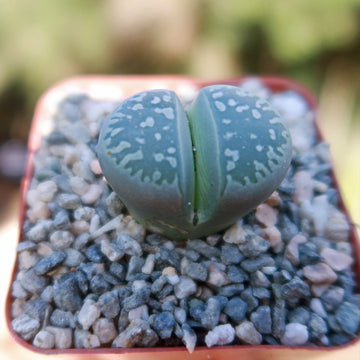
lithops succulent types Shop 'Lithops olivacea' Care and Growers GuideIntroducing the Lithops olivacea, also known as the Olive Green Living Stone. Native to South Africa, these little wonders are known for their striking resemblance to stones or pebbles, which helps them blend seamlessly into their natural desert habitats. Lithops olivacea features a compact, low growing habit with pairs of leaves that are fused together at the base. The leaves have a smooth texture or olive green windows, hence the species name

Introducing the Lithops olivacea, also known as the Olive Green Living Stone. Native to South Africa, these little wonders are known for their striking resemblance to stones or pebbles, which helps them blend seamlessly into their natural desert habitats. 

Lithops olivacea features a compact, low-growing habit with pairs of leaves that are fused together at the base. The leaves have a smooth texture or olive-green windows, hence the species name "olivacea."

Collecting different varieties of lithops can be such a fascinating and visually stunning hobby. These unique succulents, commonly known as "living stones," come in a wide range of shapes, colors, and patterns. When you gather a diverse assortment of lithops and place them together, it creates a mesmerizing display that resembles a collection of various rocks. If you are interested in getting multiple types of lithops then this Multiple lithops plant cluster is a great choice.  

With time, the Lithops olivacea plant produces enormous clumps of up to thirty bodies and can grow up to 11 inches tall. The thick, fleshy leaves have gray sides that are often colored greenish-yellow or reddish, and olive-green or greyish-green windows with a few softer or almost absent dots. The tops of the leaves have a slightly convex shape, mimicking the smooth surface of a stone. This adaptation allows the plant to camouflage itself, protecting it from herbivores and harsh environmental conditions. 

When it comes to flowering, Lithops olivacea produces dainty, daisy-like flowers that emerge from the center cleft between the leaves during late summer and early fall. The flowers can vary in color, ranging from shades of yellow to white or even pink. Though the flowers are small, they add a delightful touch to the plant's overall appearance. 

Taking care of Lithops olivacea is easy. Make sure this winter-growing plant gets plenty of bright, indirect sunlight for at least 4 to 5 hours a day. When it comes to watering, be careful not to overdo your Lithops plant. Let the soil dry out completely between waterings, especially during its dormant periods in the summer. Use a well-draining soil mix, and keep the humidity levels low. In terms of temperature, aim for a warm indoor environment during the day and slightly cooler temperatures at night. You can grow outdoors in USDA zones 10–11. You can fertilize lightly once a year during the growing season in the spring. 

Propagation of Lithops olivacea can be done through seeds or by division. However, it's important to note that Lithops can be a bit challenging to propagate, requiring specific conditions to successfully germinate and grow. Patience and attention to detail are key when attempting to propagate these fascinating plants. 

Our collection features a variety of stunning lithops living stones with various shapes, colors, and patterns. From the deep red Lithops optica 'Rubra' to the intricate Lithops aucampiae, Lithops salicola, Lithops julii, Lithops urikosensis, Lithops hookeri, and Lithops susannae, each variety has distinct markings, making it an excellent addition to any collection. So, feel free to explore our collection and discover the captivating world of lithops! 

Additionally, Lithops olivacea is generally considered non-toxic to humans and pets. Give it a try and enjoy the beauty and intrigue this unique Lithops olivacea for sale brings to your home or garden! 

Shipping Notes
  • Free Standard Shipping on $100+ Orders to the USA.
  • Except Preorder products are shipped in 48 hours.
  • Delivery to the USA:
  1. Standard Shipping : 3-10 business days
  • If time is of the essence, please consider selecting expedited delivery for faster service.
Exchange/Return Notes
  • We offer a 30-day return/exchange service after receiving.
  • Final sale items are not eligible for returns or exchanges.
  • To process your return/exchange, please contact us at [email protected]
  • Please click here for more details>>> Return & Exchange Policy
SKU: 45247843024

Discover Niche Categories That Outsell lithops succulent types

Top-Converting Item to Boost Your Average Order

4.5 ★★★★★
Based on 17 reviews
Sort
Highest Rating
Newest First
Oldest First
Product Reviews
J
Verified Purchase
J. Lyda
Natrona Heights, US
★★★★★ 5
Superb!
Format: Paperback
This was my first read on Bowen Family Systems. I was pleasantly surprised at the value and relevance of the ideas. For example, that all intimate relationships produce some anxiety in the partners! We cope with that anxiety using behaviors which may cause excessive 'distancing' from our loved one.(Something of a push-pull going on here). Another simple idea is that keeping some type, any type, of connection (ie. avoiding a 'cut off') with members of our family of origin (brother, sister, parent, child) is vital to having good relationships with our chosen loved ones. I don't recall ever hearing that idea before. Unlike many psychological revelations, this one is fairly simple to assess in our own lives - just look at your family of origin and see what kind of relationships you have! Gilbert is realistic that big changes in ourselves are not likely, but even incremental small steps forward can have profound impact on our relationships. Gilbert is a very good writer, with occasional (rare?) understated humor, which makes the material easy to access for anyone interested enough to try. Highly recommended.
WAS THIS REVIEW HELPFUL?YesReportShare
Reviewed in the United States on March 8, 2008
C
Verified Purchase
Carl K.
Battle Creek, US
★★★★★ 4
Loaded with Information
Format: Paperback
Roberta Gilbert's overview of Murray Bowen's Family Systems Theory is a thorough introduction on how we build individuality through constant interaction. Although it takes a few chapters to understand the terminology ("anxiety", "differentiation", etc.), Gilbert pieces together the general concepts of Bowen's theory through analytical study and real world interpretation. The idea of triangulating and the importance of original family relationships stand out to me as the overwhelmingly important activities which many people don't think twice about. This isn't to discount other aspects of relationships- such as Overfunctioning/underfunctioning, conflict, distance, and cutoff- but these certainly stand out due to the attention Gilbert gives to them. The one point that I disagree with (although Bowen would say I am in denial) is the urge to put yourself on a different emotional in any and all connections. I understand the benefits to this, but the idea that I would detach and remain coolly above all interactions between those closest to me strikes me as depressing. I feel differentiation and togetherness (which he calls "fusion") do not have to be mutually exclusive. This critique is grounded in pure opinion. My critique from an analytical perspective centers on her ignorance, which could even be called contempt, of love in a relationship. Her rudimentary overview of love in relationships places it neatly in a box next to cutoff, triangulating, and other day-to-day activities. I don't see myself as a hopeless romantic, but the unique attributes of love is noted near unanimously. Viktor Frankl, a noted psychologist himself, wrote about it in his excellent book "Man's Search for Meaning". Nevertheless, I recommend Extraordinary Relationships for those who really want to dig into ways of improving themselves and the relationships around them. Although the concepts might be a little narrow, the general Bowen Family Theory idea should not be ignored.
WAS THIS REVIEW HELPFUL?YesReportShare
Reviewed in the United States on October 1, 2012
R
Verified Purchase
Rachel Adams
Cuba, US
★★★★★ 5
It was easy to read
Format: Paperback
This book is written so I can refer back to it from time to time. It was easy to read, not a lot of jargon. I am really enjoying reading this book, Extraordinary Relationships: A New Way of Thinking About Human Interactions by Roberta M. Gilbert, M.D. It kept my interest. It is only 168 pages, plus a few more pages that has reading notes, epilogue, a glossary, and of course the index. The book about developing yourself so that you can further develop your relationships. kudo to the author and her mentor.
WAS THIS REVIEW HELPFUL?YesReportShare
Reviewed in the United States on August 12, 2014
M
Verified Purchase
mysticelder
Draper, US
★★★★★ 5
Gilbert conveys the principles of BFST in easily understood and engaging ways
Format: Paperback
Roberta Gilbert ' s book is simply transformative. Be forewarned, if you seriously apply Gilbert's principles from Bowen family systems theory your life will never be the same. Gilbert conveys the principles of BFST in easily understood and engaging ways. Your life and your relationships with others will become extraordinary as you become more emotional mature in your interactions with others. In short, an extraordinary book!
WAS THIS REVIEW HELPFUL?YesReportShare
Reviewed in the United States on January 5, 2015
S
Verified Purchase
S Mancusi
Boise, US
★★★★★ 3
A bit repetitive
Format: Paperback
The Family Systems approach makes a great deal of sense and is very helpful. But this book seems to be somewhat formulaic - every case looks the same.
WAS THIS REVIEW HELPFUL?YesReportShare
Reviewed in the United States on September 13, 2013

recommand products