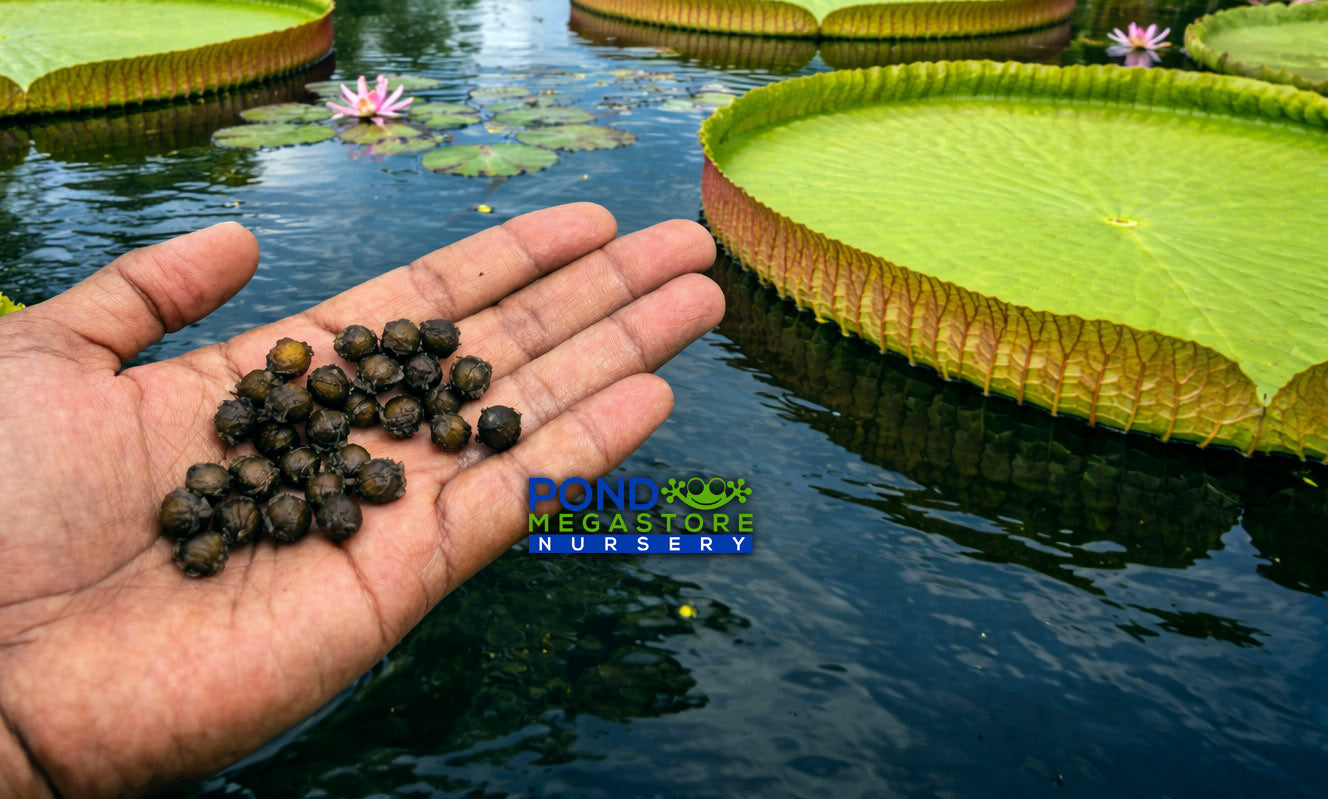
SKU: 45266946174
seeds for water garden

seeds for water garden Victoria Bolivia (5 SEEDS) Water Lily Platter Exclusive* Pond Megastore

Sale price$19.97 Regular price$22.19
Save 10%

Pay in installments of $5.55 with ShopPay, AfterPay and Klarna

Shipping Estimate
USA
  • USA
  • CAN

Ships within 48 hours · Estimated delivery Jul 21 - Jul 26

Promo Codes Available:

For Your Every Summer RSVP, with Code: SUMMER15

Description

seeds for water garden Victoria Bolivia (5 SEEDS) Water Lily Platter Exclusive* Pond MegastoreVictoria 'boliviana' Worlds Largest Water Lily Species (5 Pack Seed) Limited & hard to obtain. Victoria boliviana is the largest water lily speciesnew to science in 2022 and recognized by Guinness World Records for its extraordinary size. Note, yes these are expensive but you should be able to get a few plants if you follow the directions from these they have a good germination rate when directions are followed. In cultivation, its floating pads can

Victoria 'boliviana' — World’s Largest Water Lily Species (5-Pack Seed) Limited & hard to obtain. 

Victoria boliviana is the largest water lily species—new to science in 2022 and recognized by Guinness World Records for its extraordinary size. Note, yes these are expensive but you should be able to get a few plants if you follow the directions from these they have a good germination rate when directions are followed. 


In cultivation, its floating pads can exceed 2.8 m (9+ ft) and the record pad measured 3.2 m (10 ft 6 in) in Bolivia. Flowers can reach up to 36 cm (about 14 in) wide in ideal conditions.

Pond Megastore 2026 release: This listing is sold as a 5-pack of seed to start in spring. It is NOT sold as a late-spring young plant like our Victoria cruziana. Seeds require time, warmth, and careful steps—please read the directions fully.


Why water gardeners want Victoria boliviana

  • The largest water lily species ever confirmed

  • A newly recognized species that was long misidentified until DNA + historic records confirmed it

  • A true collector “giant water platter” that becomes a pond centerpiece


What you’re buying

  • 5 seeds (time-sensitive spring start)

  • Intended for growers who can provide heated water and strong light

  • Expect thorns/spines on giant Victoria plants—handle carefully as they mature


Seed germination (clear, time-sensitive steps)

Botanic gardens commonly germinate Victoria seeds in heated water around 80°F (≈28–30°C).

1) Prepare the sowing pot (community pot works great):

  • Plant 5 seeds in one pot to start.

  • Sow seeds about 1.5× the seed’s diameter deep.

2) Soil mix:

  • Use heavy soil (clay-leaning loam is ideal) and add coarse grit at about 5:1 soil:grit.

  • No fertilizer at this seed stage (the seed’s stored food carries it early).

3) Heat & light:

  • Keep water ~80°F while waiting for germination.

  • Provide bright light (greenhouse sun or strong grow lights).

4) What seedlings look like (normal progression):

  • First leaf is thread-like, then a triangular leaf, and by the third leaf you’ll see the “platter” look begin.

5) When to pot individually:

  • Once seedlings have 1–2 floating leaves, separate into individual pots.

  • Begin fertilizer at about ¼ strength at this stage, then increase as growth accelerates.

6) Keep upsizing pots (don’t let them root-bind):

  • Repot as needed so growth doesn’t stall.


    _______________________________
    Exact comments from other victoria from Longwood gardens:


Victoria care once established (big plant rules)

  • Warm water is everything. Kew germinates and grows giant Victorias in warm water (about 28°C / 82°F) for strong growth.

  • Heavy feeder. Botanical collections fertilize these weekly or consistently through peak growth.

  • Flowers are short-lived and dramatic. Giant Victoria flowers open at night, begin white and then turn pink, and the bloom cycle is brief.

  • Likely beetle-pollinated in nature (research ongoing for V. boliviana specifically).


Do’s ✅ / Don’ts ❌ (giant Victoria edition)

Do
✅ Keep water warm and light strong during seedling stage
✅ Use heavy loam/clay-leaning soil + grit for stability
✅ Pot up before plants become root-bound
✅ Handle mature plants carefully—Victorias can be spiny

Don’t
❌ Don’t start without a heater—cool water = stalled growth
❌ Don’t fertilize the seed pot at sowing (wait until floating leaves)
❌ Don’t delay potting up once seedlings have floating leaves

______________________________________________

How Victoria boliviana differs from amazonica and cruziana (rims + range)

All three are giant “water platter” lilies with upturned rims, but V. boliviana has a distinctive rim behavior and a different native range.

Rim and underside differences (easy ID cues)

  • Victoria amazonica
    Giant leaves with upturned rims and a purplish-red underside armed with sharp spines.

  • Victoria cruziana
    Known for very thick, upturned rims (often reported up to ~20 cm in cultivation) and generally a greener look to the rim compared with amazonica.

  • Victoria boliviana (largest known species)
    Kew notes a large rim ~7 cm tall and an outer rim that appears bright red.
    The formal species description also reports a unique rim color variability: the underside of the upturned rim can vary between individual plants in the same locality from dark maroon to very pale green/whitish—a characteristic noted as not seen in the other species.
    Boliviana is recognized as the largest known Victoria, with leaves observed >3 m and record leaves at 3.2 m.

Why they remained separate species (geography + genetics)

These Victorias occur in different river basins/regions, limiting gene flow and helping them stay genetically distinct over time:

  • V. amazonica: Amazon basin and other major basins (including Guaviare/Orinoco tributary and Essequibo).

  • V. cruziana: Paraná River system and tributaries (the temperate member of the group).

  • V. boliviana: Bolivian wetlands (Llanos de Moxos), with records concentrated in the Mamoré river basin.

Kew also emphasizes that DNA analysis showed V. boliviana is genetically very different from the other two species (and closely related to V. cruziana).

Germination note (our honest observation)

Many growers find Victorias variable from year to year. In our experience so far, boliviana seed tends to germinate a bit more readily than cruziana, but it still requires warm water and careful timing. (Results can vary with seed freshness and conditions.)

How Victoria boliviana differs from amazonica and cruziana (rims + range)

All three are giant “water platter” lilies with upturned rims, but V. boliviana has a distinctive rim behavior and a different native range.

Rim and underside differences (easy ID cues)

  • Victoria amazonica
    Giant leaves with upturned rims and a purplish-red underside armed with sharp spines.

  • Victoria cruziana
    Known for very thick, upturned rims (often reported up to ~20 cm in cultivation) and generally a greener look to the rim compared with amazonica.

  • Victoria boliviana (largest known species)
    Kew notes a large rim ~7 cm tall and an outer rim that appears bright red.
    The formal species description also reports a unique rim color variability: the underside of the upturned rim can vary between individual plants in the same locality from dark maroon to very pale green/whitish—a characteristic noted as not seen in the other species.
    Boliviana is recognized as the largest known Victoria, with leaves observed >3 m and record leaves at 3.2 m.

Why they remained separate species (geography + genetics)

These Victorias occur in different river basins/regions, limiting gene flow and helping them stay genetically distinct over time:

  • V. amazonica: Amazon basin and other major basins (including Guaviare/Orinoco tributary and Essequibo).

  • V. cruziana: Paraná River system and tributaries (the temperate member of the group).

  • V. boliviana: Bolivian wetlands (Llanos de Moxos), with records concentrated in the Mamoré river basin.

Kew also emphasizes that DNA analysis showed V. boliviana is genetically very different from the other two species (and closely related to V. cruziana).

Germination note (our honest observation)

Many growers find Victorias variable from year to year. In our experience so far, boliviana seed tends to germinate a bit more readily than cruziana, but it still requires warm water and careful timing. (Results can vary with seed freshness and conditions.)

There are no returns on victoria boliviana seeds. 


Shipping Notes
  • Free Standard Shipping on $100+ Orders to the USA.
  • Except Preorder products are shipped in 48 hours.
  • Delivery to the USA:
  1. Standard Shipping : 3-10 business days
  • If time is of the essence, please consider selecting expedited delivery for faster service.
Exchange/Return Notes
  • We offer a 30-day return/exchange service after receiving.
  • Final sale items are not eligible for returns or exchanges.
  • To process your return/exchange, please contact us at [email protected]
  • Please click here for more details>>> Return & Exchange Policy
SKU: 45266946174

Discover Niche Categories That Outsell seeds for water garden

Top-Converting Item to Boost Your Average Order

4.9 ★★★★★
Based on 24 reviews
Sort
Highest Rating
Newest First
Oldest First
Product Reviews
F
Fred
Massapequa, US
★★★★★ 5
Stable, flexible in deployment configuration, creates true privacy and looks great.
Size: 3 Panel 12FT W
This is the second room divider panel I have installed, and there are several features about this one that I like much better than my older one. The fact that there are no gaps and that the material is thicker means you get more privacy or more hiding power, if you wish. My older divider has vertical spaces between each of the panels and the panels are half as wide as the Siebwin panels, so there are many vertical spaces. The Siebwin divider really creates privacy. Another feature that I really appreciate is that the legs are wider and stand off from the floor. On my older one the legs are flat and they're rather awkward to adjust because they create more drag on the floor. The feet on the older one also loosen if you turn them counter clockwise, so adjustments of configuration that require the feet to be moved are more complex. The older divider also must be deployed in a zig-zag fashion because he feet are not as wide, but this new one can be deployed and stable in a straight, an "N" shape or an arc. They are both the same length, but because the older one must be use in a zig-zag deployment it doesn't reach to the length of the new one. The Siebwin divider definitely costs more at $103.48, but it sports several features and advantages over the other brand, so it does a better job and is worth the extra cost.
WAS THIS REVIEW HELPFUL?YesReportShare
Reviewed in the United States on May 25, 2026
C
Computer
Whiting, US
★★★★★ 4
Easy to assemble, does the job, material is shiny nylon and shows creases, minor defects, sloppy
Size: 3 Panel 12FT W, Size: 3 Panel 12FT W
The Siebwin room divider is a good idea, and for the price, it mostly delivers on the intended functionality. I ordered the 12 foot, 3-panel version mainly to hide an unfinished basement storage area that had become an eyesore. It works well for that purpose and gives the space a cleaner appearance without spending the kind of money that more decorative dividers or custom partitions cost. If you need something temporary, portable, or mainly functional, this is a viable option. There are a few limitations that became obvious during setup and use. The first thing I noticed was that the weld quality on some of the metal poles is fairly sloppy. Once the cover is installed, you do not really see it, but up close, it does not look especially refined or professional. The blackout material also is not a matte canvas style fabric as I expected. It has more of a shiny nylon appearance, and the creases are fairly visible. Being that it’s more of a nylon, I’d be hesitant to try steaming it to remove the creases. However, the creases do not matter if you are using it in a basement, dorm, or shared room, but for photography, video work, or a professional office setting, the appearance could be disappointing. The fabric is thick enough, though. It blocks visibility well enough, but strong light behind it still shows through to some extent, nothing deal-breaking. Also, my fabric appeared to be slightly defective. The hook and loop strip on one of the bottom sections was off-center and couldn't be totally attached because it was lined up with one of the legs. I originally hoped to use this as a video backdrop, but I will probably end up replacing the fabric with a proper green screen or canvas material while continuing to use the frame itself. For now, it does a good job of covering my basement junk. Assembly was actually easier than I expected and took roughly 15 to 20 minutes. The longer vertical poles are tethered together similarly to tent poles, which made setup straightforward and fairly intuitive. The shorter horizontal pieces slide and snap together to the top and bottom of the vertical assembly. After each section is assembled, the divider panels connect together with metal plates and two knurled screws (at the top and bottom), so no tools are really required. A few screws were difficult to start because paint had gotten into the threads, but once they caught, they tightened down normally. The feet install with similar knurled fasteners and help keep the divider reasonably stable. One thing to watch for during setup is the fabric orientation. There is one arrow indicator in the middle of the fabric to indicate up. However, if you need another indicator, the smaller hook and loop strip goes on the bottom while the longer strip goes on top. I realized mine was upside down right before finishing and had to redo it. I wasn't difficult to redo, despite the defect in mine. The overall design is practical and easy to move around. I do like that the panels can fold and bend into different shapes depending on the space. The widened feet help stability, although when trying to stretch the fabric tight, I noticed the poles sometimes wanted to overlap slightly at the joints. Tightening everything helped somewhat, but it still happened occasionally. The divider feels adequate for normal indoor use, though I would not expect premium durability or luxury-level fit and finish at this price point. The entire device can also be easily disabled and stored in a tote if you need it completely out of the way. It comes with assembly instructions, but even if you didn’t have them, it’s easy to build without them (save a mistake or two). In terms of value, I think the Siebwin divider mostly matches its price. Around $100 gets you a large freestanding partition with decent usability and easy assembly, but there are compromises in materials, appearance, and refinement. The defects are also off-putting, but hopefully you won't have them. Higher-end room dividers can easily cost two or three times more, so some of the tradeoffs are expected. I also noticed cheaper alternatives online, but based on the quality here, I suspect those would probably have even more issues. For practical home use, temporary privacy, hiding storage areas, or separating shared spaces, this is a good option as long as expectations stay realistic.
WAS THIS REVIEW HELPFUL?YesReportShare
Reviewed in the United States on May 18, 2026
T
Trendy Tales
Port Orchard, US
★★★★★ 3
Works well but takes up more space than expected
Size: 2 Panel 8FT W, Size: 2 Panel 8FT W
This room divider does the job for creating a little extra privacy and was easy enough to set up. The panels feel decent quality and the wider feet help keep it more stable than some cheaper screens I’ve tried. My only issue is that it takes up a bit more room than I expected, especially with the feet sticking out. It’s still portable and folds away nicely, but definitely measure your space first. Overall it works well for separating a room or blocking off an area temporarily. i wish it came in other colors
WAS THIS REVIEW HELPFUL?YesReportShare
Reviewed in the United States on May 26, 2026
K
Katrina Rhodes
Carnegie, US
★★★★★ 5
Nice divider, serves it's purpose well!
Size: 3 Panel 12FT W
This room divider worked out very well for what I needed. I wanted a simple way to create a little more privacy and separation in a larger room without doing anything permanent, and this divider was an easy solution. The panels provide good coverage, and the black color gives it a clean, modern appearance that blends in nicely with different décor styles. Assembly was fairly straightforward, and once set up, the wider feet helped keep the divider stable on the floor. I was especially happy with how flexible the panels are to arrange. You can keep it mostly straight, angle it around furniture, or create a more enclosed private space depending on the layout you need. The material allows light to filter through slightly while still offering a noticeable sense of privacy. I’ve used it for separating a workspace area, but it would also work well in bedrooms, apartments, dorms, studios, or shared living spaces. Another plus is that it can be folded and moved without too much effort when you want to change the setup. Overall, this divider delivers a good balance of functionality, portability, and appearance. It’s a practical option for anyone needing temporary room separation without installing permanent walls or curtains.
WAS THIS REVIEW HELPFUL?YesReportShare
Reviewed in the United States on May 26, 2026
J
Jamie K.
Port Orchard, US
★★★★★ 5
Perfect for Adding Privacy to a Piano Studio
Size: 2 Panel 8FT W, Size: 2 Panel 8FT W
I Ordered the 2 Panel version which is way too big for my needs... that's on me. So keep in mind that the picture shows a fabric made for two panels only being used on one and hence it is not pulled tight; it would pull tight and not be so wrinkly if it was set up properly as two panels. The metal pools that make up the panels seem to be well made, stable, and of good quality. They were very easy to put together and they stand up tall with plenty of height. The appearance of it with the fabric on it isn't as elegant as it could be, but it still looks good enough. The material is plenty solid, not allowing light through it, and thereby making a solid barrier. I am using it to block the view out the studio door when a student is sitting at the piano to avoid distractions from the hallway. It will allow a student to enter the studio with our distracting the student who is at the piano.
WAS THIS REVIEW HELPFUL?YesReportShare
Reviewed in the United States on May 18, 2026

recommand products