| Child Fit Information | |
|---|---|
| Rear-facing Harnessed Weight | 5 - 50 lbs |
| Rear-facing Harnessed Height | Less than 49" |
| Forward-facing Harnessed Weight | 22 - 65 lbs |
| Forward-facing Harnessed Height | Less than 49" |
| Belt Positioning Booster Weight | 40 - 120 lbs |
| Belt Positioning Booster Height | 44 - 63" |
Pay in installments of $5.35 with
 ,
,
 and
and

Shipping Estimate
USA
- USA
- CAN
- USA
- CAN
Ships within 48 hours · Estimated delivery Jul 23 - Jul 28
 Promo Codes Available:
For Your Every Summer RSVP, with Code: SUMMER15
Description
britax click safe Britax One4Life ClickTight All In One Car SeatOne4Life convertible to booster car seat grows with your child for 10 yearsfrom 5 120 lbs & up to 63 tall. As the only all in one with ClickTight, its easy to install in seconds, so youll know its right. Every time. Travel with peace of mind, knowing your child is surrounded in Trusted Britax Safety and Full Body Protection.. The new One4Life Premium ClickTight All in One (Ace Black) is dressed in a chic black knit fabric with luxe camel colored vegan
One4Life convertible to booster car seat grows with your child for 10 years—from 5-120 lbs & up to 63” tall. As the only all-in-one with ClickTight, it’s easy to install in seconds, so you’ll know it’s right. Every time. Travel with peace of mind, knowing your child is surrounded in Trusted Britax Safety and Full Body Protection..
The new One4Life Premium ClickTight All-in-One (Ace Black) is dressed in a chic black knit fabric with luxe camel-colored vegan leather accents. It offers effortless maintenance with lasting mess-proof protection thanks to the exclusive combination of StayClean: stain, moisture, and odor resistant technology + SafeWash: washer/dryer friendly, naturally flame retardant with no added chemicals.
Allow for 2 week shipping time.
Features you will love:
Converts from a rear-facing infant seat (5- 50lb) to a forward-facing 5-point harness seat (22-65 lbs) to a high-back belt-positioning booster seat (40- 120lb).
10 years of use: grows with your child from 5 – 120 lbs.
ClickTight Installation. Install with confidence, every time. You’ll know it’s right in just 3 easy steps: Pinch to open. Thread & buckle. Click it closed.
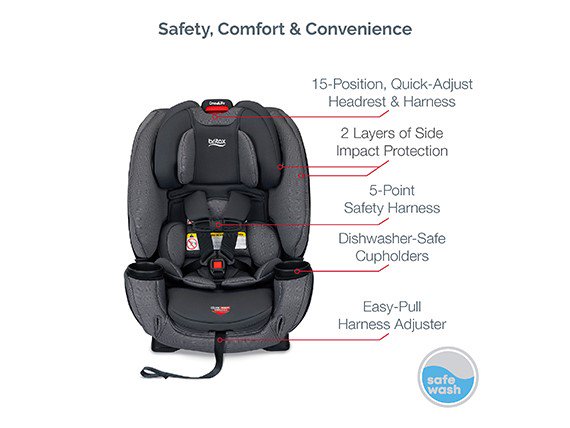
15-Position, Quick-Adjust Headrest & Harness create the proper fit as your child grows.
Patented V-Shaped Tether with staged-release stitches helps slow and reduce forward movement during a crash.
High Strength Steel Frame reinforces the seat structure to help keep it sturdy and stabilized.
Quick-Push, 9-Position Recline helps you find the most comfortable fit for your child and the best fit for your vehicle.
SafeCell Technology acts as a crumple zone, absorbing crash energy to help keep it away from your child.
Easy-Read Level Indicators help you find the correct recline angle when installing the car seat.
2 Layers of Side Impact Protection: Energy-absorbing shell and foam-lined surround your child’s head, neck & torso.
Stay-Put, Soft Comfort Pads help prevent the harness from rubbing against your child’s delicate neck.
Flip-Forward Buckle Pad stays out of the way for easy boarding; made with extra padding for premium comfort.
Built-In Cooling Channels & Ventilated Mesh improve air flow to keep your child comfortable.
Color-Coded Belt Guides make it easy to route the seat belt through the correct paths for rear-facing, forward-facing, and booster mode.
Removable Cover for easy cleaning without taking off the harness.
Harness Compartment neatly stores straps and buckles within the seat while in booster mode.
Dishwasher-Safe Cupholders easily twist out for cleaning between rides.
Removable Infant Insert helps keep your tiny baby safe and comfortable under 20 lbs.
Removable Head Pillow provides additional comfort for your growing baby.
Easy-Pull Harness Adjuster lets you tighten the harness using just one hand.
Harness Holder Slots keep the harness straps out of the way while your child gets in and out of the seat.
Tether Storage keeps the tether straps organized and out of the way when not in use.
Built-In Arm Rests keep your child happy and comfortable while they ride.
5-Point Safety Harness with diamond weave webbing.
Tag-Free Headrest supports your child’s head and neck without irritation.
Product Size
| Exterior Product Dimensions | |
|---|---|
| Product Weight | 30 lbs |
| Product Dimensions (L x W x H) | 20.5" (L) x 19.5" (W) x 25" (H) |
| Headrest Fully Extended Height | 33.5" |
| Fully Reclined Depth | 30" |
| Fully Reclined and Headrest Fully Extended Depth | 35.5" |
| Interior Product Dimensions | |
|---|---|
| Seating Area Depth | 13.25" |
| Seating Area Width | 11" |
| Shoulder Width | 14" |
| Harness Slot Heights | 15 positions, 9" - 19" |
| Buckle Strap Positions | 5.5" / 6.75" / 8.75" |
| Recommendation |
|---|
| Britax strongly recommends that children should be secured with a harness system until they exceed the weight or height limits specified. |
Care
Read how to care for your car seat here
Warranty
Limited 1 year warranty information can be found here. 10 year expiration.
Video
Product Origin: Proudly designed, tested and built in the USA with US and global components for safety and quality.
About Britax
At Britax, we believe family life should be lived without limit. A world where parents and children are free to make the most of every moment together. And we think it's our responsibility to make this happen. By driving safety standards to ensure children have never been better protected on the move. By pushing boundaries in smart design to make life in motion run smoothly. By extending a helping hand – or two – and always celebrating the journey.
We've been leading the way in child safety technology for more than 70 years. Always innovating, always focusing on what's best for the child, always going beyond 'good enough'. From Europe's best-selling car seat brand, we've become one of the brands most trusted by American families since we launched here in 1996.
Since then, we've revolutionized side impact protection, transformed safe seat installation, and introduced a range of smart strollers designed around the changing needs of today's families.
Our ongoing, open-ended conversation with parents is complemented by our work with car manufacturers, government bodies, and child passenger safety experts – collaborating, advising and using our industry-leading testing facilities to continually find ways to give parents the products and the reassurance to live family life without limit.
Because we believe in helping every parent and every child find their family freedom.
Shipping Notes
- Free Standard Shipping on $100+ Orders to the USA.
- Except Preorder products are shipped in 48 hours.
- Delivery to the USA:
- Standard Shipping : 3-10 business days
- If time is of the essence, please consider selecting expedited delivery for faster service.
Exchange/Return Notes
- We offer a 30-day return/exchange service after receiving.
- Final sale items are not eligible for returns or exchanges.
- To process your return/exchange, please contact us at [email protected]
- Please click here for more details>>> Return & Exchange Policy
4.9 ★★★★★
Based on 7 reviews
Sort
Product Reviews
★★★★★ 4
35% cotton shirt, 25% linen suit
Color: White, Size: 6, Color: White, Size: 6
This formal suit is not as white as I thought it was going to be. It’s off white due to it having 25% linen, which gives it a natural, “more expensive” sort of look.
My 5yo said “it’s a little itchy but looks nice”. I think it’s just stiff because it’s new. I’m going to wash the button shirt and see how it is after washing. I do wish it was 100% cotton. The button shirt is made of a cotton blend with 35% cotton.
The stitching is very clean. Well made. As you can tell, it’s a little loose on my average size 5yo. I got him size 6.
This will be a great suit for one of the kids piano recitals.
WAS THIS REVIEW HELPFUL?YesReportShare
Reviewed in the United States on September 18, 2025
★★★★★ 5
Traje joven
Size: 14, Color: Beige
Compré este traje tipo esmoquin para la confirmación de mi hijo de 13 años y quedé encantada. La calidad de la tela es súper buena, se ve elegante y tiene un acabado muy bonito. Además, orma excelente y le quedó perfecto. Se veía muy elegante para una ocasión tan especial. Definitivamente lo recomiend
WAS THIS REVIEW HELPFUL?YesReportShare
Reviewed in the United States on May 26, 2026
★★★★★ 5
Great suit
Size: 12, Color: Mint Green, Size: 12, Color: Mint Green
Very nice suit. Love the material. My 11 year old is tall and slim- 5’3”, 80 lbs. I got a size 12 for the length. The jacket fit perfectly, the pants was good length and has elastic in the waist to adjust for size. Overall, it’s a good suit and I’d recommend it.
WAS THIS REVIEW HELPFUL?YesReportShare
Reviewed in the United States on May 21, 2026
★★★★★ 1
Horrible
Size: 5, Color: Sky Blue
Ordered this for my son’s graduation! They send an entirely different set! It wasn’t even a suit!! It was a shirt and pants which were dark as ever and not light blue! Please do not order this! Quality was cheap for the price as well!
WAS THIS REVIEW HELPFUL?YesReportShare
Reviewed in the United States on June 5, 2026
★★★★★ 4
Nice Suit - Light Gray Color OF Suit IS Not A Solid Light Gray, It Has Linear Designs
Size: 12, Color: Light Grey, Size: 12, Color: Light Grey
I had purchased this polyester and linen blend suit for my son, in size 12Y for him in the color light gray. The color of the suit depicted in the advertisement arrived to be a bit different upon arrival. It's not a solid color light gray, it actually has small black liner lines dispersed all over the suit. The coat features a single button in the center, and there are two side pockets fairly decent sized. Unfortunately right above the pockets are red colored lineal horizontal lines. I don't think those lines are part of the coat's design, there definitely is some printing malfunction. It is hard to see in the pictures advertised, you can see it in the pictures and video I have posted clearly.
The material of the suit is fairly acceptable, actually better than expected. The child can actually wear it multiple times for various occasions. The suit emits grace along with acceptable stitching in every apparel along with the bowtie. The suit did arrive in a slide bag all folded up, so there were a number of wrinkles especially on the coat, its as if it had lost its shape. I will definitely need to steam iron it before it will be worn.
Just like the coat has pockets the tailored pants also have two side pockets, and belt loops in case need of belt if the pants are loose.
I'm actually glad I had ordered two sizes up because compared to his current measurements the suit is big on, especially the pants waist and length. I had measured the suit myself and below are the measurements.
Pants Waist - 15.25 Inches
Pants Length - 35.75 Inches
Pant's Inseam 25 Inches
Coat's Length - 24.5 Inches
Coat's Shoulders - About 14.5 Inches
Coat's Sleeve Length - 22 Inches
Coat's Chest - 15.5 Inches
In addition to the suit, I also received a solid colored light gray, bowtie. The bowtie has an adjustable strap, so you can set the bowtie to your comfort in the collar. You can wear it along the suit or without it if needed to match with something and still manage to look a show topper!.
The coat has nice shoulder padding therefore it sits across the shoulders nicely having it hold its shape and style.
Overall it's not a bad purchase, suits like these always come in handy for a unexpected or expected events. I'm glad I had purchased this suit I'm sure it'll come to use one day.
WAS THIS REVIEW HELPFUL?YesReportShare
Reviewed in the United States on March 10, 2026