SKU: 45415900179
looks like a snake plant

looks like a snake plant Shop 'Sansevieria laurentii - Variegated Snake Plant' - Care and Info

Sale price$18.06 Regular price$20.07
Save 10%

Pay in installments of $5.02 with ShopPay, AfterPay and Klarna

Shipping Estimate
USA
  • USA
  • CAN

Ships within 48 hours · Estimated delivery Jul 27 - Aug 1

Promo Codes Available:

For Your Every Summer RSVP, with Code: SUMMER15

Description

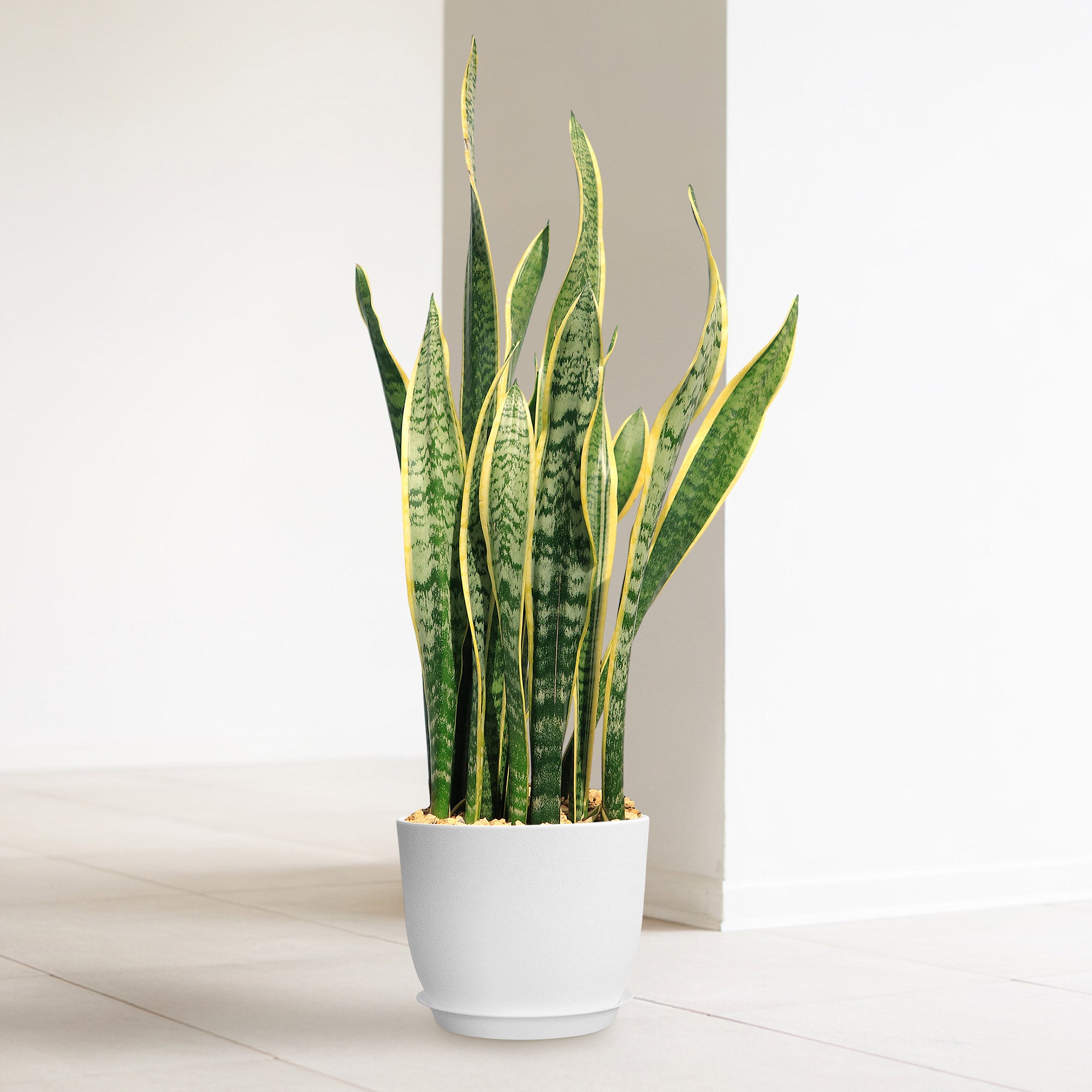
looks like a snake plant Shop 'Sansevieria laurentii - Variegated Snake Plant' - Care and InfoIntroducing the Sansevieria laurentii, known as the variegated snake plant, is one of the most popular snake plant varieties. Native to Tropical West Africa, the Sansevieria laurentii has several other common names, such as snake plant laurentii, variegated mother in law's tongue plant, Sansevieria trifasciata laurentii, or striped snake plant. The Sansevieria laurentii differs from the other main type of snake plant, Sansevieria zeylanica because of

Introducing the Sansevieria laurentii, known as the variegated snake plant, is one of the most popular snake plant varieties. Native to Tropical West Africa, the Sansevieria laurentii has several other common names, such as snake plant laurentii, variegated mother-in-law's tongue plant, Sansevieria trifasciata laurentii, or striped snake plant.


The Sansevieria laurentii differs from the other main type of snake plant, Sansevieria zeylanica because of its green leaves with yellow striped edges and larger size.

The plant has tall, rigid sword-like leaves that grow upright and can reach up to 8 feet tall.

Its leaves provide a striking contrast between their dark green color and the dazzling gold variegation around the edges. 

The flowers of this variegated snake plant are creamy white, pale green, and bloom from late winter through early spring, making it a true showstopper in any garden. This perennial Sansevieria laurentii succulent is perfect for those looking for a low-maintenance addition to their garden or indoor space.  

Sansevieria is part of our clean air plant collection, which filters airborne toxins. The Laurentii snake plant is a popular plant that can be grown in both rock gardens and landscaping, as well as in decorative pots indoors. It's a versatile plant that adds beauty to outdoor spaces and brings a touch of greenery to indoor environments. 

However, because this snake plant laurentii grows slowly, large plants can be expensive

When and How to Water Your Variegated Snake Plant 

The Variegated Snake Plant is a drought-tolerant succulent that should be watered every 2–3 weeks during spring and summer and only once every 4–5 weeks during fall and winter, allowing the soil to dry completely between waterings.

From March to August, during the growing season, water your Sansevieria laurentii every 2 to 3 weeks, giving just enough water to moisten the root zone. This is when the plant is actively photosynthesizing and may absorb water more quickly, especially in warm, bright indoor conditions. Always ensure excess water drains out fully and never let the pot sit in water.

From September to February, during the dormant season, reduce watering to once every 4 to 5 weeks, or only when the soil is bone dry. The plant’s growth slows down significantly during cooler months, and its water needs decrease accordingly. Overwatering in winter can easily lead to soft, rotting roots or fungal issues.

Thanks to CAM photosynthesis, this snake plant opens its stomata at night, conserving water efficiently throughout the day. This adaptation, along with its thick, moisture-retentive leaves, means it’s better to underwater than overwater. Wrinkling or slight leaf shriveling are early signs it’s time to water, while mushy or yellowing leaves indicate excess moisture and possible root rot.

Light Requirements - Where to Place Your Variegated Snake Plant

If growing indoors, place your Sansevieria succulents directly in front of a west- or south-facing window, where it gets 4-6 hours of bright, indirect light.

If Sansevieria laurentii don't receive enough bright light, their dark green leaves with yellow variegated edges may grow leggy, become paler, and shorten.

So, make your succulent happy and give your variegated snake plant plenty of brighter light.

When growing outdoors, this Sansevieria laurentii prefers full sun to partial shade for at least 4-6 hours but can also tolerate low light conditions, making it a great choice for rooms with limited natural light. Direct sunlight should be avoided because it can burn your variegated snake plant leaves.

Remember, it's important to gradually acclimate it to the outdoor environment to prevent sunburn. Start by placing it in a shaded area and gradually move it to a spot with more sunlight over a few weeks. This will help the plant adjust to the increased light levels.

Optimal Soil & Fertilizer Needs 

The Sansevieria laurentii snake plant thrives in well-drained soil and should be fertilized once a year in spring. Moisture can be a real killer, leading to root and stem rot in no time. But fear not, my fellow green thumbs! Planet Desert has got your back with our specialized succulents potting mix that includes organic mycorrhizae – perfect for promoting healthy roots and happy Sansevieria laurentii. 

When it comes to fertilizing your variegated snake plant, it only needs a small amount of fertilizer applied once a year in the spring. Succulents prefer a fertilizer with lower doses of NPK, with a maximum ratio of 5-10-5 that is higher in phosphorus than nitrogen. 

Hardiness Zones & More 

In the United States, this is mostly an indoor plant, but if you live in southern Florida or Hawaii, then you can cultivate it outdoors in USDA zones 9-11. 

This plant thrives in dry, semi-tropical conditions, but it goes dormant when temperatures dip, slowing its growth significantly.

If exposed to prolonged cold or frost, especially below 50°F, the leaves may suffer scarring, mushiness, or collapse.

Even in zones where outdoor cultivation is possible, it’s best to grow them in containers so they can be easily relocated when temperatures become unfavorable.

How to Grow Variegated Snake Plant Best Indoors

To grow your Variegated Snake Plant successfully indoors, maintain a warm, stable environment with temperatures between 65°F and 75°F, which closely mimics its native tropical climate. This plant does not tolerate frost or cold drafts, so it should always be kept away from open windows in winter or air conditioning vents. High humidity can also be problematic, as it increases the risk of rot, so aim for dry, well-ventilated indoor conditions. Its upright, sword-shaped leaves not only make it a great vertical accent in tight spaces but also help purify indoor air, making it both a functional and decorative choice for homes and offices.

Wildlife - Variegated Snake Plant Attracts the Following Friendly Pollinators

The variegated snake plant produces small, fragrant flowers that attract a variety of friendly pollinators such as bees, butterflies, and hummingbirds. These pollinators are essential for the plant's reproduction and play a crucial role in maintaining biodiversity in the ecosystem.

Butterflies
Bees
Hummingbirds
Lady Bugs
Multi Pollinators
Other Birds

According to ASPCA, the variegated snake plant is mildly toxic to humans and pets if ingested. The entire plant contains saponins, which can cause gastrointestinal issues like nausea, vomiting, and diarrhea. However, it is safe to touch and handle, making it a popular choice for indoor decoration in homes with pets or children.

How to Propagate Your Sanseveria laurentii

The Sansevieria laurentii can be propagated through division or leaf cuttings. To propagate through division, carefully separate the plant into smaller sections with roots attached and replant them in fresh soil. For leaf cuttings, simply cut a healthy leaf into smaller sections and plant them in soil to root.

Key Takeaways

  1. The variegated snake plant stores water in its thick, upright leaves, making it extremely drought-tolerant and perfect for forgetful waterers or low-maintenance homes.
  2. Its striking vertical foliage is edged with golden-yellow margins, giving it a bold, architectural look that stands out in any modern interior.
  3. This plant improves indoor air quality by filtering toxins like formaldehyde and benzene, making it both beautiful and functional for home or office spaces.
  4. Thanks to CAM (Crassulacean Acid Metabolism) photosynthesis, it absorbs carbon dioxide at night, making it one of the few houseplants ideal for bedroom air purification.
  5. It’s nearly indestructible in the right pot, tolerating low light, dry air, and minimal care, yet leaf damage can occur if temperatures drop below 50°F.

Final Thoughts

Overall, the Sansevieria Laurentii (snake plant laurentii) is a beautiful and resilient plant suitable for indoor spaces due to its ability to tolerate various conditions. Its upright leaves and variegated pattern add elegance to any room. It is low-maintenance, thrives in well-draining soil, and prefers bright, indirect light. Watering should be minimal to prevent overwatering. It can withstand neglect and drought periods. Sansevieria Laurentii's air-purifying qualities make it an excellent choice for improving indoor air quality.  

With the easy-to-care-for variegated snake plant - Sansevieria laurentii, you'll start to spend less time maintaining your garden and more time taking in its beauty! 

You may also like the other popular snake plant varieties, including the moonshine snake plant, the mother-in-laws snake plant, the Cylindrical snake plant, and the Zeylanica snake plant.

Shipping Notes
  • Free Standard Shipping on $100+ Orders to the USA.
  • Except Preorder products are shipped in 48 hours.
  • Delivery to the USA:
  1. Standard Shipping : 3-10 business days
  • If time is of the essence, please consider selecting expedited delivery for faster service.
Exchange/Return Notes
  • We offer a 30-day return/exchange service after receiving.
  • Final sale items are not eligible for returns or exchanges.
  • To process your return/exchange, please contact us at [email protected]
  • Please click here for more details>>> Return & Exchange Policy
SKU: 45415900179

Discover Niche Categories That Outsell looks like a snake plant

Top-Converting Item to Boost Your Average Order

4.5 ★★★★★
Based on 17 reviews
Sort
Highest Rating
Newest First
Oldest First
Product Reviews
J
Verified Purchase
Houston, US
★★★★★ 5
Looks nice, good construction and good value
Color: Warm Gold
Looks nice, good construction and good value. Stays in place when tearing off sections of paper towels and looks more expensive than it was.
WAS THIS REVIEW HELPFUL?YesReportShare
Reviewed in the United States on December 5, 2025
M
Verified Purchase
MommaWolf
Belleville, US
★★★★★ 5
Great product!
Color: Oil Rubbed Bronze
Beautiful and easy to assemble and use, good weight to it so doesn’t get knocked over. I have three of these and love them!
WAS THIS REVIEW HELPFUL?YesReportShare
Reviewed in the United States on September 19, 2025
B
Verified Purchase
B. Marold
Port Orchard, US
★★★★★ 5
Great Guide for Specialized Bible Study or Pastoral Use.
Format: Hardcover
`Commentary on the New Testament Use of the Old Testament', edited by G. K. Beale and D. A. Carson supports the idea that given any approach to the examination of the New Testament you may think of, someone has written a book about it. And a superb book it is, if you have need for an examination of this subject from almost every angle. I say almost, because there is actually one thing I would like to have seen in this book, and it is not there. More on this anon. For the lay reader, be aware that this is a scholarly book, with all the Greek, Hebrew, Aramaic, and (I suspect) even Coptic terms used freely, just when I've gotten in the habit of tracking down Greek, I have to deal with two even more difficult languages. I mention that primarily for those who are allergic to footnotes and phrases in languages other than English. Otherwise, I am delighted in how easy the reading is in all the contributions from eighteen (18) major scholars on the New Testament. Much of this is attributable to the marching orders given to the writers by the two editors. This list of guidelines makes the diverse contributions very uniform, which contributes to the value of this book as the guide to a specialized type of Bible study based on this book's subject. Anyone who has tracked down more than a handful of OT passages used in the NT will realize that the NT writers often take some liberties with their interpretations, reading in a prophesy about Jesus which, in the original text actually referred to something completely different. And, one has also run across a wide range of different ways in which OT texts are used, from `exact' quotes to paraphrases to allusions. The editors address this range by asking all authors to address their OT citations from at least five different points of view. These are: 1. What is the NT context of the citation? What is the genre and literary structure of the book or chapter? 2. What is the OT context of the citation? Do these Markan citations come directly from Exodus, for example, or are they quoted from Isaiah's use of Exodus verses? 3. How was the OT quote handled or interpreted by Second Temple Judaism, or early Judaism in general? 4. From what text is the OT quotation copied. The Septuagint (LXX), the Masoretic text, or a Targum (scripture translated into Aramaic or Coptic). 5. What is the ultimate use or connection being made by the NT author's use of the OT. Is it simply to emote a connection, is it a use of a common OT idiom, is it a parable use, shorthand to evoking an OT story, or is there a belief that events in NT times fulfill a specific OT prophecy. Of course, many commentaries on individual NT books do this as well, but most do not go into detail on points 2, 3, and 4. In looking at those parts of the NT I know best, I find this book delivers everything it promises on these five points, but that the book cannot replace good commentaries and study Bibles for NT books. In looking at one of the most famous uses of OT scripture in Luke, at 4:18 - 19, where Jesus teaches from Isaiah 61:1 - 2, the authors, David Pao and Eckhard Schnabel cover all the editors' points admirably, including references to important opinions by famous scholars such as Rudolph Bultmann. For this passage and for all others in this chapter on Luke, the actual passage is NOT presented in any translation. Therefore, one has to have a copy of the Bible open to the passage, as you read the authors' interpretation of it. Less important is the fact that the explanation of this section of Luke on Jesus' teaching in the Nazareth synagogue says nothing about the puzzling climax, where the congregation turns on Jesus. But that is a logical limitation of the approach, and is not relevant to the subject of the book. The introduction to Lucan passages was illuminating, as it tells us that even though one of Luke's primary objectives was to show the resolution of OT prophesies, Luke actually uses fewer OT quotes than Matthew. This is rarely discussed in commentaries on Luke. So, especially with regard to the synoptic Gospels, this would be an excellent book to use as a guide to OT references in the NT. For the scholar, there is the usual tower of bibliographical references after each article, plus the usual index to Biblical citations at the back of the book. There was just one thing I wanted which is missing. This is a `reverse' index, if you will, of OT books, with the number and locations of where verses are cited in the NT. The reason for wishing such an index is as a guide to selecting which OT books may best be studied together, as with Luke and Deuteronomy (some commentators claim the 10 chapter journey of Jesus to Jerusalem is patterned after Deuteronomy). Ultimately, this is a great reference if you make a habit of studying NT scriptures in depth, as either a pastor or bible study teacher.
WAS THIS REVIEW HELPFUL?YesReportShare
Reviewed in the United States on December 19, 2007
D
Verified Purchase
DJ
Los Angeles, US
★★★★★ 5
Most Amazing
Format: Kindle
To look at the New Testament through the same thought process of those that wrote it is nothing short of ingenious. It takes nothing away from the Word being written by the Holy Spirit through men. In fact, it adds to the validity of the cohesion between the Old and New Testament while giving insights rooted in God’s Word written centuries before the coming of Christ. It does include the Apocryphal books as well and it’s citations of OT are well documented to work both from the OT to the NT or from the NT to the OT which is the purpose of this book. I would highly recommend this book to anyone who desires to dig deeper into the thought process of God and move beyond the regular commentary process that tends to be limited to the author’s insights and singular theological perspective. Further, if you desire to answer the question of why is this written or how did this come to be, many passages point to multiple references from the OT giving substance to Paul’s letter to encourage a young pastor to hold onto what has been given to him. Not a new teaching as we would assume, but a correct understanding of the Hebrew Testament in light of Jesus death, resurrection, and ascension into the Ancient of Days court as described in Daniel 7. Jesus is clearly more than a teacher when viewed through the eyes of the Hebrew Testament, He is the second person of the Holy Trinity for which this Old Testament confirms multiple times over. The downside of this extensive commentary is the use of technical jargon and the assumption that the reader has fluency in Hebrew and Greek. However, if you are a student who sits in the front of the classroom because you want to learn more and miss nothing (and not up there because the teacher desires to keep a closer eye on you) this book will not disappoint you. On the contrary, you will find it’s usefulness beyond sermon and Bible Study preparation. You will get the opportunity to sit in the dirt and learn from the Master as Mary did and will find it is hard to move onto the rest of your list that needs to get done for the day.
WAS THIS REVIEW HELPFUL?YesReportShare
Reviewed in the United States on August 9, 2022
F
Verified Purchase
Fnord Fjamily
Natrona Heights, US
★★★★★ 5
Essential Commentary, I Use it Every Time
Format: Hardcover
I won't write an exhaustive review, but I can easily commend this commentary to any seminary student by saying this: it goes into my pile of reference books for nearly every paper I write, on any subject. It's always relevant. If I'm dealing with any New Testament text, it's worth looking up in this commentary to see if it has an OT basis, if it's an allusion, a quote, or something similar. This adds dimensionality and thoroughness to my treatment of the NT, putting it in perspective. There is a similar volume, which I use just as often, called 'Commentary on the Old Testament Use of the Old Testament.' For OT studies, I use it along with 'The Context of Scripture' (which is basically ANET with cross-indexed biblical passages and ancient texts). There have been a few times when I've followed the chain all the way from NT text -> NT use of OT -> OT text -> OT use of OT -> Context of Scripture. If you're a Bible nerd, you can imagine this is basically cause to run around the neighborhood six times shouting 'Hallelujah' while the neighbors scratch their heads or close their blinds. I use this book as much as NICNT for NT studies, which is to say, any time I study the NT. This commentary is amazing, it earns its footprint on my booksehelf. Absolutely recommend it.
WAS THIS REVIEW HELPFUL?YesReportShare
Reviewed in the United States on January 1, 2026

recommand products