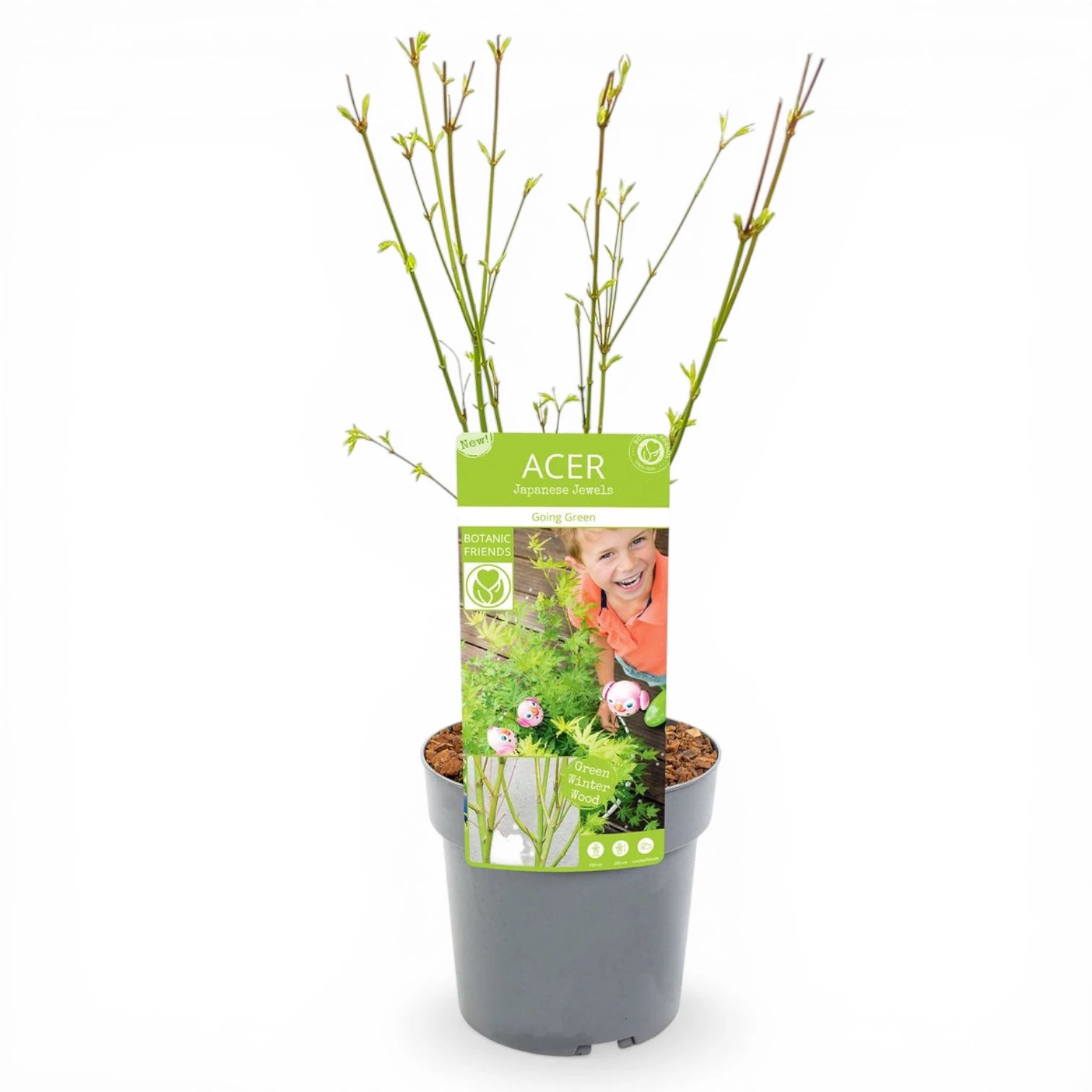
SKU: 49111418659
planting acers in pots

planting acers in pots Acer palmatum 'Going Green' | Outdoor Plant

Sale price$22.91 Regular price$25.46
Save 10%

Pay in installments of $6.37 with ShopPay, AfterPay and Klarna

Shipping Estimate
USA
  • USA
  • CAN

Ships within 48 hours · Estimated delivery Jul 19 - Jul 24

Promo Codes Available:

For Your Every Summer RSVP, with Code: SUMMER15

Description

planting acers in pots Acer palmatum 'Going Green' | Outdoor PlantAcer palmatum 'Going Green' is a green leaved Japanese maple selected for luminous stems and a clean, rounded canopy. Fresh spring growth opens lime green, settles into bright summer green, then shifts into orange and red tones in autumn. When leaves fall, green bark and smooth branching keep the outline lively through winter, especially once the lower crown is gently lifted to show the stems. In open ground, this cultivar matures into a substantial

Acer palmatum 'Going Green' is a green-leaved Japanese maple selected for luminous stems and a clean, rounded canopy. Fresh spring growth opens lime-green, settles into bright summer green, then shifts into orange and red tones in autumn. When leaves fall, green bark and smooth branching keep the outline lively through winter, especially once the lower crown is gently lifted to show the stems.

In open ground, this cultivar matures into a substantial small tree, ultimately reaching 4-8 m tall with a 2.5-4 m spread. Planted in a container, growth runs slower and the plant stays more compact than in open ground, which makes it workable for patios and courtyards when the pot is generous and watering is consistent.

Green stems that carry the season

Stem colour is a defining feature of Acer palmatum 'Going Green'. Young stems glow green and stay clean-looking as the plant ages, creating a bright framework behind the leaves in summer and a clear silhouette after leaf-fall. Leaves are typically seven-lobed with long, pointed segments, giving a crisp texture that reads clearly both up close and across the garden.

Light and exposure

Sun to part shade suits Acer palmatum 'Going Green'. A sheltered position improves foliage quality, especially in sites with dry wind or strong midday heat. Part shade often keeps the canopy looking fresh through summer, while sun can work well where soil moisture stays reliable. If a site is exposed, plants respond best when placed where a wall, hedge, or larger shrubs break the wind.

  • Best placement: sheltered border, lawn specimen, or woodland-edge style planting
  • Sunlight: sun to part shade
  • Exposure: sheltered, protected from drying winds

Soil, drainage, and moisture balance

This cultivar grows well in moisture-retentive, well-drained soils. Clay, loam, and sand can all work, provided drainage is steady and the root zone keeps some moisture between waterings. A layer of organic mulch helps buffer summer drying, supports fine root growth near the surface, and keeps soil temperatures more even.

Soil reaction can be acid, neutral, or alkaline. In alkaline ground, organic matter additions and a consistent mulch layer help keep root conditions stable and support nutrient availability. On heavier clay, planting on a slight mound and mixing in coarse organic material can improve structure and drainage while still holding moisture.

Planting for a strong start

Autumn or spring planting gives Acer palmatum 'Going Green' time to root into surrounding soil before summer heat. Set the plant so the top of the root ball sits level with the surrounding ground, then water thoroughly to settle soil around the roots. A wide mulch ring helps reduce competition from grass and keeps the root zone more even in moisture and temperature.

  • First season watering: deep watering during dry spells until new growth feels steady
  • Mulch: 5-8 cm of composted bark or leaf mould, kept clear of the trunk
  • Staking: only when the site is windy or the plant has a tall, top-heavy framework

Ongoing care through the year

Japanese maples respond best to steady conditions. In most gardens, a spring top-dress of compost and an annual mulch refresh are enough. Feeding can stay light; vigorous fertilising tends to push soft growth that marks more easily in wind and heat. During prolonged dry spells, deep watering supports the canopy and helps keep leaf edges clean.

Fallen leaves can be left in place as a light woodland mulch in planting beds, or cleared and composted for future mulch. In lawns, a clear mulch ring around the trunk reduces mowing damage and keeps moisture more reliable around shallow surface roots.

Pruning and shaping

Acer palmatum 'Going Green' naturally forms a rounded, bushy crown and rarely needs routine pruning. Where shaping is useful, work in dormancy (late autumn through winter) and focus on structure: remove damaged wood, thin crossing branches, and refine the outline with small cuts. If a multi-stem form is preferred, select and keep several strong stems and remove weak competing shoots over time. For a small-tree look, lift the canopy gradually by removing a few lower branches over several seasons.

Container growing that lasts

Large containers suit Acer palmatum 'Going Green' well, especially on patios where stem colour can be enjoyed at close range. Use a pot with generous drainage holes and a stable, moisture-retentive mix that still drains freely. A loam-based compost with added pine bark and a mineral component (pumice or grit) helps keep structure over time.

  • Pot size: start roomy; a wider pot supports stability and moisture buffering
  • Watering: check frequently in warm weather; water deeply until excess drains
  • Repotting: refresh the mix every few years; light root pruning keeps plants vigorous when pot size stays the same
  • Winter: insulate the container or move it to a sheltered corner, as roots in pots experience colder swings

Typical issues and how they show up

Leaf scorch can appear in hot, dry weather, especially when wind combines with strong sun and the root zone dries quickly. Consistent moisture, shelter, and a mulch layer usually keep foliage looking its best. In heavier soils that stay wet for long periods in winter, root stress can develop; improved soil structure, raised planting, and reliable drainage support long-term health.

Aphids and other sap-feeding insects can appear on soft spring growth. Natural predators often keep populations in check. Good air movement through the crown helps reduce leaf-spot problems in humid summers, while steady watering reduces stress that can make plants more vulnerable.

Design notes

Acer palmatum 'Going Green' works well as a specimen where stem colour and branch structure can be appreciated. Underplant with shade-tolerant perennials and spring bulbs, or pair with fine grasses and ferns for a layered, woodland feel. In winter, the green framework stands out against darker evergreens and stone, keeping the garden interesting beyond the leaf season.

Shipping Notes
  • Free Standard Shipping on $100+ Orders to the USA.
  • Except Preorder products are shipped in 48 hours.
  • Delivery to the USA:
  1. Standard Shipping : 3-10 business days
  • If time is of the essence, please consider selecting expedited delivery for faster service.
Exchange/Return Notes
  • We offer a 30-day return/exchange service after receiving.
  • Final sale items are not eligible for returns or exchanges.
  • To process your return/exchange, please contact us at [email protected]
  • Please click here for more details>>> Return & Exchange Policy
SKU: 49111418659

Discover Niche Categories That Outsell planting acers in pots

Top-Converting Item to Boost Your Average Order

4.7 ★★★★★
Based on 29 reviews
Sort
Highest Rating
Newest First
Oldest First
Product Reviews
K
Verified Purchase
KJP
Belleville, US
★★★★★ 5
Works Great!!!
Size: 18"X24"
I have 2 pugs and have trained them to "go" on a grid. I started with another brand (Klean Paws) but found this brand (Petphabet Puppy Training Pad Holder) to be superior in several ways. This training pad holder is designed much better. The plastic grid is well supported so the puppy does not get wet paws when waling on the grid. The overall design of the training pad holder makes it very easy to replace training pads. Standard training pads (17.5" x 23.5") fit the medium Petaphet puppy training pad holder perfectly. Just lay the pads flat on the bottom, place the grid on top and clip it all into place with the frame. The frame holds everything in place and keeps any loose ends, hidden from mischievous puppies. It takes a lot of effort to train puppies to "go" on a grid, but it's worth it. I started with one grid in a crate. Then, I gaited off my kitchen area, with 4 medium grids (as shown in the video). You cannot expect a puppy or dog to just go to one spot and do their thing. Dogs like to sniff and walk around before they "go." They need room. I suggest 2 medium girds per medium-sized dog. I have 2 pugs and 4 grids. I reward them with a pinch of peanut butter, whenever I see them go on the grid. I simply pickup the #2 with TP and flush it down the toilet. I replace the pads, in the 4 grids, once a day. NOTE: The sellers of the dog training pad holders seem to come and go. If you cannot find this particular training pad holder, do a search for Mesh training pad holder. Be sure to get a training pad holder that has 3 parts -- the bottom tray, the mesh grid, and a frame that holds it all together. Some of the simpler grids have just 2 parts (bottom tray and top). They are simpler, but do NOT keep paws dry.
WAS THIS REVIEW HELPFUL?YesReportShare
Reviewed in the United States on October 1, 2018
M
Verified Purchase
Miriam Velez
Grantham, US
★★★★★ 4
Good quality, but my dog didn’t like it
Size: 24"X24"
The product arrived in perfect condition and looks well made. It’s sturdy and easy to clean, so I can see it working well for many dogs. However, my Cavapoo (17 lbs, 1 year old) never liked it. I tried for several weeks, but there was no way to get him to use it. I think it depends on the dog’s preference. For us, it didn’t work, but the product itself is good quality.
WAS THIS REVIEW HELPFUL?YesReportShare
Reviewed in the United States on August 20, 2025
K
Verified Purchase
Kindle Customer
Charlottesville, US
★★★★★ 5
Excellent pee pad tray has "legs" to keep feet off of the pad
Size: 18"X24", Size: 18"X24"
My 10 week old Pekingese learned quickly to use it, and Pekingese are a very stubborn breed. We started training her by removing the grid because she was used to paper. It snaps out easily. We used pee pads with sticky tabs to attach the pad, then snapped the "frame" in place without the grid. Within a few days, she had figured it out, so we snapped the grid back in so her feet never touch the used pad. No more wet feet. I bought the medium size that is aqua blue. For those that ask if it will fit their crate...measure your crate! My large crate is 42" x 23" and the tray fits two ways as seen in the pictures. My small crate is 23" x17" and the tray does NOT fit. I wish the company made a 10" x 14" tray for traveling. (pink???) Start using it when you have a couple of days to give your puppy 100% of your attention. 100% attention!! If she/he does not use it, then it is your fault for not paying attention. My puppy would go every 15 minutes at first! Put a WHITE plastic shower curtain liner on your floor so you can see if she misses it. The liner wipes off easily with Clorox wipes or goes in the washing machine. For those puppies who stand on the edge of the tray, but still miss it because their back legs are barely on it, help them walk forward and put plastic under the tray to catch any misses. Now, at 4 months old, she seldom uses it, but it is available. Her pen is getting larger and larger. After she pees outside, we let her run around in in the living room for about an hour, then she goes back in the pen. Her attention span is short and she can't always make it back to her tray in the pen. My husband always brings her in the house after she has peed one time outside, but if I take her outside, I wait until she goes at least 3 times and there won't be accidents in the house. Sometimes, it takes more than 1 time to empty their bladder. This pad tray is not like others on the market. Look closely at other grids, and you will see that other trays do not have the "legs" on the under side of the grid that keep the plastic grid from touching the used pad. My puppy tried to chew on the plastic tray, but she is always in our vision so we just say, "Ahhh!" and she leaves it alone. No problems with chewing. The Ahhh!" stops her every time, and we say it to stop her from doing anything wrong. Some people say their dog chews on it. Just like children, dogs need to be taught. Don't complain about how the pee pad or pee tray doesn't work. Teach your dog or your dog to not chew on it. Like others have mentioned, my puppy likes sleeping on the tray at night, because it has air circulating under it, so it is cooler than her bed. (Not the fault of the product!) We can't break her of that habit without confusing her or removing the tray. She may stop using it if we teach her to get her off it. I have been putting frozen gel compresses wrapped in a towel in her play pen during the day, and as long as the compress stays cold, she will lay on it instead of the pad tray. Always watch, so a dog doesn't chew on the gel compresses. I don't know why some people have said that urine runs out, because it is sealed. Maybe they are not changing the pads often enough. I started out changing them twice a day, then since my puppy started flea and tick medicine, she could start going outside. I changed the pad once a day then. Now, at 4 months old, she goes outside, but we put it in her large kennel at night. (The tray is too big to fit in her small dog kennel.) For the last three days and nights, she has not used it at all, but it is there just in case. If your tray does not have rubber pads on the bottom, buy some or put the tray on a piece of rubber kitchen shelf liner. My tray doesn't slide. If your dog runs to it and jumps on quickly, it may slide, so put something under it. Remember, your dog may not want to walk on it, but it is up to you to teach the dog to walk on it. They don't get a choice! You are in charge!
WAS THIS REVIEW HELPFUL?YesReportShare
Reviewed in the United States on September 17, 2020
A
Verified Purchase
Alejandra S Moreno
Port Orchard, US
★★★★★ 5
Hands down, best pee pad holder
Size: 18"X24"
I did so much research to find the right puppy pad holder. I would give this 10 stars if I could. It’s softer plastic but not flimsy. The holes are comfortable for puppy feet. I see a lot with metal grates and pictures of injured doggy feet. Our pups are small and they walk on it just fine. I used to go through 10 pee pads a day. Now one pad lasts all day. Pups can’t go wee wee and trail it all over the house. Since it’s the same pee pad, pups look for the smell and are motivated to pee pee in the same spot. Puppies used to wake up several times a night because they would pee, step in it, tear up the pee pad, make a mess. The night time drama has definitely decreased significantly. Easy to lock, puppies can’t get into it. Easy to open to change out the pee pad. Comfortable to clean in a larger kitchen sink. Lightweight. Sometimes the doodie will go through the grates and sometimes it sits right on top, depending on the size of the doodie. Cleaning doodie stuck in the grate is never fun, but I use an old toothbrush and it works just fine. Very happy with this item.
WAS THIS REVIEW HELPFUL?YesReportShare
Reviewed in the United States on January 29, 2026
L
Verified Purchase
L
San Leandro, US
★★★★★ 1
easily destructed by puppy that chews
Size: 24"X24"
disappointed in this purchase. It comes in 2 pieces, which are not exactly easy to fit together and cumbersome. This design flaw also makes it very easy for puppies who are prone to chewing to destroy. It last 1 day then i had to toss it
WAS THIS REVIEW HELPFUL?YesReportShare
Reviewed in the United States on January 29, 2026

recommand products