SKU: 49760505875
elephant ear velvet plant

elephant ear velvet plant Green Velvet Alocasia – Plant Detectives

Sale price$23.98 Regular price$26.65
Save 10%

Pay in installments of $6.66 with ShopPay, AfterPay and Klarna

Shipping Estimate
USA
  • USA
  • CAN

Ships within 48 hours · Estimated delivery Jul 22 - Jul 27

Promo Codes Available:

For Your Every Summer RSVP, with Code: SUMMER15

Description

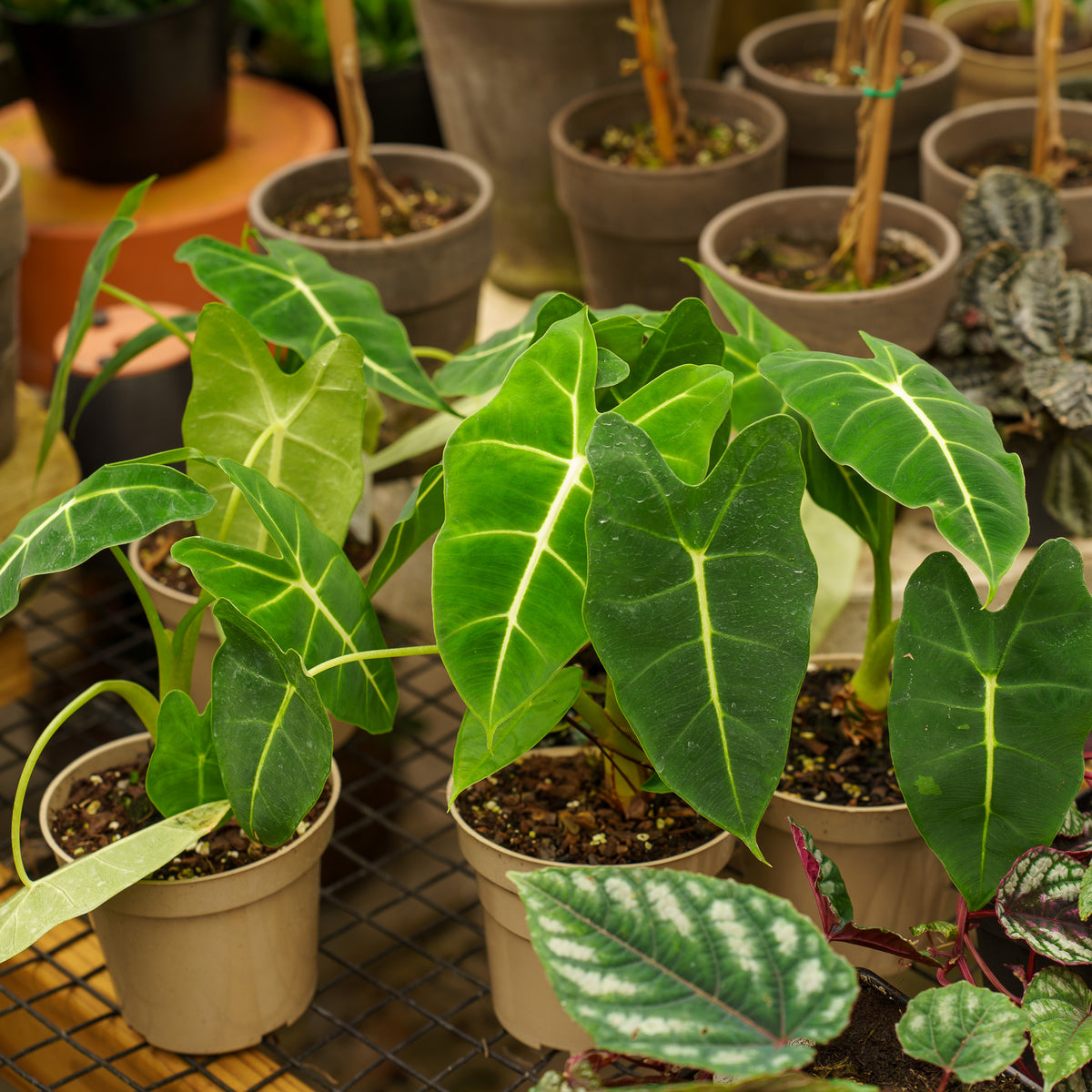
elephant ear velvet plant Green Velvet Alocasia – Plant DetectivesGreen Velvet Alocasia (Alocasia micholitziana 'Frydek') Green Velvet Alocasia is a striking tropical houseplant valued for its dark velvety foliage, bright white veining, and elegant upright form. Its arrow shaped leaves create strong contrast and texture, making it a standout plant for shelves, plant stands, tabletops, offices, and bright indoor corners. This compact Alocasia brings the bold look of an elephant ear into a more manageable indoor size.

Green Velvet Alocasia (Alocasia micholitziana 'Frydek')

Green Velvet Alocasia is a striking tropical houseplant valued for its dark velvety foliage, bright white veining, and elegant upright form. Its arrow-shaped leaves create strong contrast and texture, making it a standout plant for shelves, plant stands, tabletops, offices, and bright indoor corners. This compact Alocasia brings the bold look of an elephant ear into a more manageable indoor size. With bright indirect light, warmth, humidity, steady moisture, and a chunky well-drained mix, Green Velvet Alocasia adds refined tropical character to indoor plant collections.

Distinctive Features

Green Velvet Alocasia is best known for its narrow, arrow-shaped leaves with a soft velvety surface and prominent white to pale green veins. The foliage is typically deep green with burgundy-toned undersides, giving the plant a rich, layered look from different angles. Its upright, clumping habit keeps the plant compact while still providing strong architectural structure. Flowers may appear occasionally on mature plants as a spathe and spadix, but this Alocasia is grown primarily for its dramatic foliage and rarely blooms as a houseplant.

Growing Conditions

  • Sun: Grows best in bright indirect light, with protection from harsh direct sun that can scorch or mark the velvety foliage.
  • Soil: Prefers a chunky, well-drained aroid mix with organic matter and added aeration from materials such as bark, perlite, or similar amendments.
  • Water: Keep soil lightly and evenly moist during active growth, allowing the upper portion to dry slightly before watering again, and avoid soggy conditions.
  • USDA Zones: Best grown as a houseplant in most climates and outdoors year-round only in frost-free tropical conditions, generally USDA Zones 9 to 11.
  • Mature Size: Typically reaches about 2 to 3 feet tall indoors and about 1 to 2 feet wide, depending on pot size, light, humidity, and care.
  • Habit: Forms a compact, upright, clumping tropical houseplant with velvety arrow-shaped leaves rising from the base on sturdy petioles.

Ideal Uses

  • Focal Point: Use as a dramatic indoor focal point on plant stands, tabletops, office desks, shelves, or bright corners where its dark leaves and white veining can stand out.
  • Tabletop Plant: Place in a decorative container where its compact size and bold foliage can add impact without taking up much room.
  • Collector Plant: Feature in a specialty tropical plant collection where its velvety texture, bright veining, and burgundy leaf backs can be appreciated up close.
  • Interior Accent: Pair with lighter green houseplants, ferns, pothos, or trailing plants to create contrast in leaf color, shape, and texture.
  • Container Planting: Grow in a well-drained pot with drainage holes, using a container that supports steady moisture without trapping excess water.

Low Maintenance Care

  • Watering: Water when the upper soil begins to dry, then allow excess water to drain fully so the roots stay moist but never waterlogged.
  • Humidity: Provide moderate to high humidity indoors to help reduce leaf edge browning and support clean foliage growth.
  • Light Care: Keep near a bright window with filtered light and rotate the pot occasionally for balanced growth.
  • Leaf Care: Dust leaves gently with a soft cloth or brush to preserve the velvety surface and keep the white veining visible.
  • Fertilizing: Feed lightly during the active growing season with a balanced houseplant fertilizer, following label directions.
  • Dormancy: Reduce watering if growth slows in winter, since Alocasia may rest or drop leaves when light and temperatures decline.

Why Choose Green Velvet Alocasia?

  • Velvety Foliage: Displays dark green arrow-shaped leaves with a soft texture and bold white to pale green veining.
  • Compact Size: Fits tabletops, shelves, plant stands, offices, and smaller rooms better than many larger elephant ear plants.
  • Collector Appeal: Offers a distinctive foliage look for tropical plant enthusiasts who want texture, contrast, and refined detail.
  • Architectural Shape: Adds upright structure and tropical character to interior plant displays without relying on flowers.
  • Container Friendly: Performs well in decorative pots when given bright indirect light, steady moisture, warmth, humidity, and excellent drainage.

Green Velvet Alocasia is an excellent choice for anyone who wants a compact houseplant with bold contrast, rich texture, and refined tropical appeal. Its velvety dark leaves, bright veining, burgundy undersides, and manageable size make it a standout plant for bright indoor spaces where foliage detail and structure matter.

Shipping Notes
  • Free Standard Shipping on $100+ Orders to the USA.
  • Except Preorder products are shipped in 48 hours.
  • Delivery to the USA:
  1. Standard Shipping : 3-10 business days
  • If time is of the essence, please consider selecting expedited delivery for faster service.
Exchange/Return Notes
  • We offer a 30-day return/exchange service after receiving.
  • Final sale items are not eligible for returns or exchanges.
  • To process your return/exchange, please contact us at [email protected]
  • Please click here for more details>>> Return & Exchange Policy
SKU: 49760505875

Discover Niche Categories That Outsell elephant ear velvet plant

Top-Converting Item to Boost Your Average Order

4.6 ★★★★★
Based on 18 reviews
Sort
Highest Rating
Newest First
Oldest First
Product Reviews
B
Verified Purchase
Brian Tarbox
San Leandro, US
★★★★★ 4
Very accurate view of admission (I worked there); compelling read, enlightening even for people who think they already know
Format: Kindle
I was a Senior Interviewer during my senior year at Wesleyan 1981 and so I worked with many of the main characters in the book. Although the book describes a later time period it rang entirely true to me. The volume of applications...the controlled chaos...the searching for a hook or a champion for an application was very familiar. At least at Wes it seemed (and seems) that unless one's application has some unusual feature that the school is looking for that year (a particular athlete or a particular musician or a particular tough background that was overcome) the road to admission will be challenging. An area that did surprise me was the emphasis on the family of the applicant...and the degree to which an applicant was held to a higher standard if their parents were deemed to be college fluent. I guess this makes sense and actually provides a leveling of the playing field but it was surprising none the less. It may also be surprising to some that these days you don't just need to convince the gatekeepers that you could be successful at the school..you must also show how your presence would enhance the school. This is of course an enormous burden for most teenagers. Like it or not this is the reality at many "top" schools. If you or your child is applying to college you owe it to yourself to read this book....either to understand the game or to make an informed decision not to play.
WAS THIS REVIEW HELPFUL?YesReportShare
Reviewed in the United States on May 20, 2013
P
Verified Purchase
P. Meltzer
Grantham, US
★★★★★ 5
What is better? The overachieving 6 or underachieving 8?
Format: Hardcover
First, let me say that I thought that this was an excellent book and would recommend it to anyone who is at all interested in the college admissions process. Second, I was surprised at how many of the reviewers seemed shocked--shocked!--that applicants got bonus points for coming from minority backgrounds. Was this some kind of revelation? However one thing that surprised me a little bit is how--even moving beyond race entirely--the more advantages you have had in life, the more disadvantageous it will be for your admissions process. For example, I was unaware that having successful parents would be, in essence, held against you on the theory that more would be expected of you. While other reviewers have (jokingly?) said that they would advise their white kids not to check the "Caucasian" box, I might advise my (still very young) kids to say that their parents have been unemployed their whole life. I suppose that the main issue which this whole process really boils down to is the following: As a college applicant, is it more important to succeed in life relative to the world around you (i.e. relative to your classmates, to others of your race, to others of your geographical area, to your own parents' life and accomplishments, etc.) or is it more important to succeed absolutely and not on a relative scale. This book clearly informs us that the answer is the former and not the latter. Whether that should be the answer is another question. For example, say that a student's entire life could be distilled into 2 numbers each on a sliding scale from 1-10. The first number is simply your academic performance (grades, SAT's, course load, etc.) The second number is your background (race, economic circumstances, gender, etc.) In the case of Wesleyan, it seems clear to me that they would rather have a student whose first number was, say, a 6 if his or her second was a 2 (take Mig for example in Steinberg's book) than a student whose first number was an 8 if the second number was a 9 or 10 (take Tiffany Wang for example). Whether that is the right approach is certainly a legitimate issue for discusion and I'm not saying that it's not. I suppose that one of the things that would be interesting to know (even though one never really can know of course) is whether those numbers will change in the future. For example, if one were to know that Mig would always be a 6 and Tiffany would always be an 8, would that change the analysis as to which is the right approach? I suspect that part of the reason that a school like Wesleyan would favor the overachieving 6 over the underachieving 8 is due to the hope or expectation that those trends will continue in the future and that one day the 6 will actually be ahead of the 8. And maybe that's the way it works. Who knows.
WAS THIS REVIEW HELPFUL?YesReportShare
Reviewed in the United States on February 28, 2003
J
Verified Purchase
Jeremy W.
Dallas, US
★★★★★ 5
You will find out how a selective private college evaluate and admit students
Format: Paperback
I'm a high school counselor and college advisor. Fifteen years ago when I started my college counseling position, I struggled to understand or explain to students and their parents how a selective private college evaluate and admit students. It was this book that helped me understand the essence of selective private college admissions. Compared to other dry theory books, this book tells the admissions practice as stories that are easy to read, understand, and associate with. I highly recommend this book to students, parents, and new counselors.
WAS THIS REVIEW HELPFUL?YesReportShare
Reviewed in the United States on December 5, 2024
M
Verified Purchase
M. Tucker
Lowell, US
★★★★★ 3
Who edited this mess?!?!?!?
Format: Kindle
This is a very interesting work of nonfiction. I found it intriguing and read it very quickly. I actually got invested in these students and their stories and their journey to get admitted to the college that was right for them. BUT, and this is a big but, this book is so poorly edited, it is disgraceful! If a person were reading this for research purposes, and it could be useful for just that, good luck to them. The dates are all over the place. At one point, the kids are being considered for the class of 2004, then it makes a reference to the current year as 2000, then it reverts back to 2004 for a long while, then it mentions how the kids--currently at their various chosen colleges--reacted to the events of 9/11/01. What the hell? It's very confusing. It makes it very difficult to keep things in context.
WAS THIS REVIEW HELPFUL?YesReportShare
Reviewed in the United States on August 8, 2013
A
Verified Purchase
Amazon Customer
Belleville, US
★★★★★ 5
Abundant information but needs update
Format: Kindle
I struggled a little when try to decide how many star to give. It's an excellent book and very informative. It feels like I was not reading a college admission advisory book, which very often are dry and mechanical. It feels like reading stories of students and AOs, I got attached and involved emotionally, and really felt for them. But there were abundant information in the book, I was able to use the book to answer most my questions. If you need a list of YESs, Nos, Warnings..., then this is not the book for you. If you need to know what happens during admission process, then this is an excellent book for you. Based on the information in this book, I was able to extract my own conclusions. The reason I hesitated if I should rate this book as a five stars book is how long ago it was written. A lot has changed. Many aspects stayed same, but many aspects changed. It will be misleading if this is the only guide book you are using. Wish everyone a great college application season.
WAS THIS REVIEW HELPFUL?YesReportShare
Reviewed in the United States on September 12, 2015

recommand products