SKU: 49983905546
best place to buy aloe vera plant

best place to buy aloe vera plant Cape Aloe

Sale price$23.86 Regular price$26.51
Save 10%

Pay in installments of $6.63 with ShopPay, AfterPay and Klarna

Shipping Estimate
USA
  • USA
  • CAN

Ships within 48 hours · Estimated delivery Jul 25 - Jul 30

Promo Codes Available:

For Your Every Summer RSVP, with Code: SUMMER15

Description

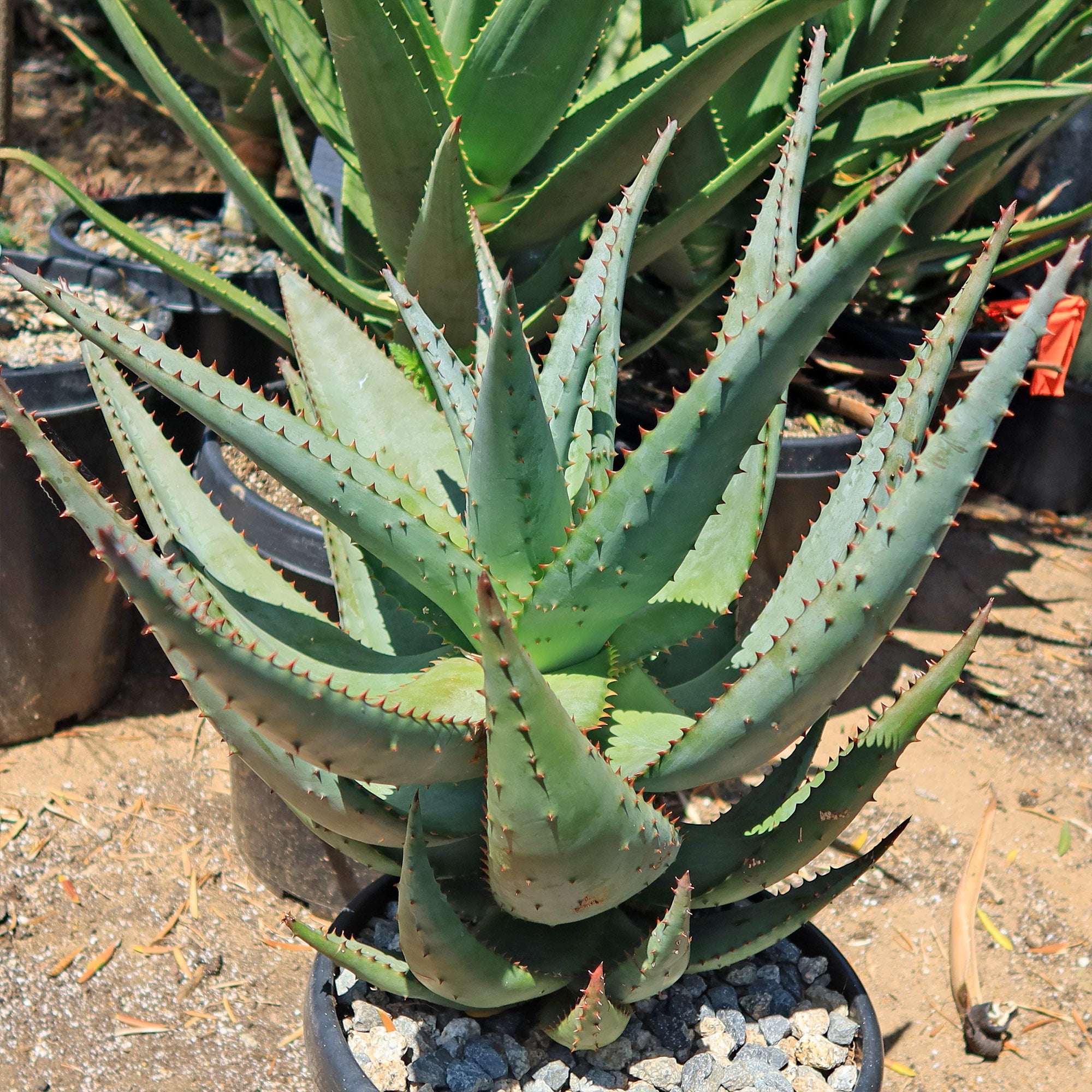
best place to buy aloe vera plant Cape AloeIntroducing the Aloe ferox, also known as cape aloe, which is a vibrant member of the Aloe genus. The name "ferox" derives from the Latin word meaning "fierce" or "wild," which reflects the plant's spiky leaves and hardy nature. Aloe ferox goes by several common names, including Cape Aloes, Bitter Aloes, Red Aloe, and Tap Aloe. Native to Southern Africa, the Aloe ferox, a single stemmed succulent with an upright trunk, grows in a dense rosette

Introducing the Aloe ferox, also known as cape aloe, which is a vibrant member of the Aloe genus. The name "ferox" derives from the Latin word meaning "fierce" or "wild," which reflects the plant's spiky leaves and hardy nature. Aloe ferox goes by several common names, including Cape Aloes, Bitter Aloes, Red Aloe, and Tap Aloe.  

Native to Southern Africa, the Aloe ferox, a single-stemmed succulent with an upright trunk, grows in a dense rosette pattern. The blue-green, stiff lance-shaped leaves have small, brown prickles that resemble spines on both the upper and lower surfaces of the leaves. They are armed with sharp, spiky teeth along the edges, which act as a defense mechanism against herbivores. The dried leaves form a petticoat on the stem. The leaves can grow up to 12 feet tall and 5 feet wide, making them quite impressive. 


When the Aloe ferox plant matures, it produces tall, sturdy tubular flower spikes that can reach up to 10 feet in height.

The flower spikes are adorned with orange or red flowers that attract pollinators like birds, bees, and insects.

The blooming period usually occurs during the spring months, adding a vibrant touch to the plant's overall appearance.

Aloe ferox can be
propagated through pups or seeds. One common way is through offsets, also known as "pups," which are small plantlets that grow at the base of the mother plant.

These can be carefully separated and replanted to establish new Aloe ferox plants. Additionally, seeds can be collected from the flowers and sown to grow new young plants themselves, although this method takes longer to produce mature plants. 

When it comes to the benefits of Aloe ferox, this popular medicinal plant has similar medicinal qualities to Aloe vera.  Like Aloe vera, the aloe gel of Aloe ferox has traditional cosmetic and medicinal applications, for many conditions such as moisturizing hair and skin, treating sun burns, and treating skin irritations. Aloe vera lacks laxative and purgative properties; in contrast, the gel-like flesh of Aloe ferox that is extracted from the trunk possesses these qualities. 

Additionally, the Aloe ferox is non-toxic to both humans and pets. These aloe plants are suitable for xeriscaping, desert gardens, and rock gardens. 

Watering Needs 

Like most succulents, Aloe ferox prefers infrequent but deep waterings. It's important to let the soil dry out almost completely between waterings. Overwatering can lead to root rot, so it's better to underwater than overwater. 

In the spring and summer, during the growing season, water your Aloe Ferox thoroughly once every two to three weeks. This allows the roots to soak up the water and then dry out before the next watering. 

In the winter months, when the plant is in its dormant phase, you can reduce the frequency of watering. Watering once a month should be sufficient during this time. Just make sure the soil is completely dry before watering again. 

Remember, the key is to provide enough water to hydrate the plant without letting it sit in soggy soil. Aloe ferox is adapted to survive in arid conditions, so it's important not to overdo it with watering. Keep an eye on the succulent plant and adjust the watering schedule as needed based on the moisture level of the soil. 

Light Requirements 

When growing Aloe ferox indoors, it's important to provide it with bright, indirect sunlight. Place your plant near a window that receives plenty of sunlight throughout the day. A south or west-facing window is usually ideal. Aloe ferox can tolerate some direct sunlight, but too much can cause the leaves to burn. If you notice the leaves turning brown or developing sunburn spots, it's a sign that the plant is getting too much direct sunlight. In that case, you can move it slightly away from the window or provide some light shade. 

If you don't have access to a window with sufficient sunlight, you can also use artificial grow lights. LED grow lights are a great option as they provide the right spectrum of light for plant growth. Place the lights about 12 to 18 inches above the plant and keep them on for about 12 to 14 hours a day. 

When growing Aloe ferox outdoors, it thrives in full sun to partial shade. It can handle direct sunlight for several hours a day, but providing some shade during the hottest part of the day can help prevent leaf burn. If you live in a region with extremely hot and intense sunlight, providing some afternoon shade can be beneficial. Aloe ferox can tolerate a wide range of light conditions, but too much intense sunlight can stress the plant. 

It's important to note that Aloe ferox is a succulent species, and it can adapt to different light conditions to some extent. However, for optimal growth and health, providing it with bright, indirect sunlight or partial shade is recommended. 

Remember, finding the right balance of light is crucial for the well-being of your Aloe ferox. Monitor how the plant responds to its current light conditions and make adjustments accordingly. If the leaves start to stretch or become pale, it's a sign that the plant is not getting enough light. On the other hand, if the leaves become yellow or develop brown spots, they may be getting too much direct sunlight. 

Optimal Soil & Fertilizer Needs 

Aloe ferox prefers well-draining soil that mimics its natural habitat. A sandy or sandy-loam soil mix works best. This type of soil allows excess water to drain away, preventing the roots from sitting in soggy conditions, which can lead to root rot. Planet Desert specializes in succulents and has specialized succulent potting soil that includes an organic substrate with mycorrhizae to help with the growth of a healthy root system to help your succulents thrive. As an okay alternative, you can create your own potting mix by combining equal portions of perlite, coarse sand, and good natural potting soil. 

Aloe ferox doesn't require frequent or heavy feeding. During the growing season, in the spring, you can fertilize your Aloe ferox once a year. Use a balanced (5-10-5), water-soluble NPK fertilizer specifically formulated for succulents or cacti. In the dormant season, which is usually during fall and winter, you can reduce or stop fertilizing altogether. Aloe ferox tends to slow down its growth during this time, so it doesn't require as much nutrient supplementation. 

Remember, it's always a good idea to observe your Aloe ferox plant and adjust your care routine based on its specific needs. If you notice the leaves turning yellow or the plant showing signs of stress, it may be a sign of over-fertilization. In that case, it's best to reduce the frequency or strength of your fertilizer application. 

Hardiness Zones & More 

Aloe ferox is typically grown as a houseplant in regions where the climate is not suitable for outdoor cultivation. It can thrive indoors in temperatures between 60°F and 80°F during the day. It can tolerate slightly cooler temperatures at night, but it's best to avoid exposing it to temperatures below 50°F. In terms of humidity, Aloe ferox is adaptable and can tolerate average indoor humidity levels. However, it appreciates a slightly drier environment, so it's not necessary to increase humidity levels artificially. 

Native to southern parts of South Africa, the Aloe ferox thrives outdoors in warm, arid climates in USDA zones 9 to 11, where temperatures rarely drop below 20°F. As for humidity, Aloe ferox can handle a broad range of humidity levels, including dry conditions. It is relatively drought-tolerant and can withstand periods of low rainfall. 

Remember, these are general guidelines, and it's important to consider your specific location and microclimate when growing Aloe ferox. Always monitor your plant for any signs of stress, such as wilting or discoloration, and adjust its care accordingly. 

Final Thoughts 

Overall, the Aloe ferox (cape aloe) is a remarkable accent plant with a rich history and numerous benefits. Its spiky leaves, vibrant flowers, and medicinal properties make it a popular choice for both ornamental and therapeutic purposes. Aloe ferox prefers well-draining soil, ample sunlight, and occasional watering. It is important to avoid overwatering and protect your cape aloe from frost outside of USDA zones 9-11, during colder months to ensure its health and longevity. Whether you're looking to add a touch of beauty to your garden or harness its healing properties, Aloe ferox is a plant worth exploring. Don't miss out on this opportunity to add something truly exceptional to your garden. Order your very own Cape aloe 'Aloe ferox' for sale today. 

Shipping Notes
  • Free Standard Shipping on $100+ Orders to the USA.
  • Except Preorder products are shipped in 48 hours.
  • Delivery to the USA:
  1. Standard Shipping : 3-10 business days
  • If time is of the essence, please consider selecting expedited delivery for faster service.
Exchange/Return Notes
  • We offer a 30-day return/exchange service after receiving.
  • Final sale items are not eligible for returns or exchanges.
  • To process your return/exchange, please contact us at [email protected]
  • Please click here for more details>>> Return & Exchange Policy
SKU: 49983905546

Discover Niche Categories That Outsell best place to buy aloe vera plant

Top-Converting Item to Boost Your Average Order

4.3 ★★★★★
Based on 17 reviews
Sort
Highest Rating
Newest First
Oldest First
Product Reviews
J
Verified Purchase
J Crutchfield
Massapequa, US
★★★★★ 5
Getting past the noise to a holistic view of the person
Format: Hardcover
In order to have effective conversations about difficult and controversial subjects such as abortion, euthanasia, and sexual ethics it is important for both parties to be on the same page. Otherwise, it is easy to make assumptions about the other person’s motives and end up talking past each other. Discussions turn into arguments where name calling and personal attacks are more common than a reasoned and thoughtful exchange of ideas. In my own experience, it has been difficult to speak up about many of these types of sensitive subjects in public because of fear that I will be labeled intolerant or bigoted. In fact, it appears our culture, as a whole, has descended into a shouting match where the loudest voice is either the secular one screaming about trigger words and safe spaces where no one can challenge your views, or a caricature of Christianity which writes off everyone who disagrees as a hopeless reprobate who is going to hell. In this cacophony, the Christian message of God’s redeeming love for humanity is drowned out in a sea of empty words. Voices shouting past one another, convincing only those who already agree with us. This situation that many Christians find themselves in, unable or unwilling to speak for fear of being attacked and shouted down is why the new book by Nancy Pearcey Love Thy Body is so important. I have been blessed to be part of both the manuscript review and the book launch team for this amazing book and I have to say that this may be one of the most important books for all Christians to read, especially those who wish to be more effective in the public sphere. Over the course of seven very accessible chapters she addresses the most pertinent issues of our times, from abortion, and assisted suicide to the hook up culture and the LGBTQ movement which is sweeping our nation and exposes a fatal flaw in the secular narrative. This flaw that runs through all of these issues is a fractured view of the person which splits apart the body and the mind. What results is a negative view of the body which tramples on human rights and dignity. The secular narrative is that the Christian view of the person is repressive and prudish, often denigrating the authentic self. They want to claim the high moral ground because their view is based on love and acceptance. Nancy’s book gives us the tools to get past the walls and barriers built up by secular buzz words such as “death with dignity,” “marriage equality,” and “pride” to the underlying worldview so we can be on the same page as those we are speaking with. In her words: “As we face the social ills of our own day, we must move beyond denunciations that can sound harsh, angry, or judgmental and instead work to show that the biblical ethic is based on a positive view of the body as part of the image of God.”
WAS THIS REVIEW HELPFUL?YesReportShare
Reviewed in the United States on January 2, 2018
M
Verified Purchase
Mark Scholten
Alexandria, US
★★★★★ 5
Clear thinking on contemporary confusion about our bodies.
Format: Hardcover
We live in a sound-bite society. A 30-second commercial exceeds our attention span unless it is cute, provocative, catchy or unusually funny. Many cannot sustain a thought longer than the time it takes to breathe. Our convictions are strong, they are popular, but they are typically backed by only a thin layer of thought. How can so many be wrong? I will go with the flow of the cultural consensus. As a new Christian, I read “The Christian Mind,” by Harry Blamires. It convinced me that Christians should think. Perhaps true Christianity begins as an admission of sin and an experience of the love and grace of God that we call conversion, but that is only the beginning. We are welcomed into a new found wealth of wisdom for living in God’s world. Growing holiness is the long, slow and sometimes painful journey back to Eden and the way things were meant to be. The Christian life involves the mind and living by revealed convictions. Yet, almost everyone in our culture today lives by a set of convictions of their own. They live by a set of self-discovered rules, ultimate convictions about life, love and the way things are supposed to be. They construct their own ethics out of these convictions. This ethic is fiercely held and savagely defended, but the foundation is very thin. The culture wars are fought on the worldview battlefield. It is the ethics behind the conviction and the thinking behind the thought that needs to be examined, challenged and ultimately changed. When we confront a non-Christian with the holes in their worldview; when we apply thought and fact and truth and history to their ultimate convictions we are shouted down with angry rhetoric. The thinking behind most practical worldviews is paper thin and ill-founded. And when the law of unintended consequences bites them they do not know why. We need to show them why. Christian apologetics is the intentional deprivation of another’s ‘God-Suppressor.” They know God, but they suppress that truth down because of their independent ethic and their perceived freedom in sin. Yet, it is God’s world and his rules apply. Reality bites and apologists show them why. Nancy Pearcey is a worldview apologist. Christians ought to live by a set of revealed convictions about God and man and truth and law and ethics. We are radically different from the world around us because we grow, like plants, out of another kind of fertilizer. We are nourished by divine wisdom. All the treasures of wisdom and knowledge are in Christ. (Colossians 2:3) In many ways, I cut my spiritual teeth on the writings of Francis Schaeffer. Through him, I learned to think like a Christian, and that the Christian need not be ashamed of his intellectual heritage. Now that my teeth are cut, I brush them with Nancy Pearcey writings. She is the echo of Schaeffer updated and applied to the modern world that Schaeffer prophetically warned us about. Her latest book, "Love Thy Body", applies the Christian mind to contemporary issues regarding our bodies. (Abortion, infanticide, euthanasia, transgenderism, stem-cell research, sex, marriage, and homosexuality.) It shows how to understand the thinking of the modern world and apply logic, fact, research, from a Christian mind to the hot-button issues of the day. It is a book that you really should read. It will make you think; like a Christian.
WAS THIS REVIEW HELPFUL?YesReportShare
Reviewed in the United States on January 3, 2018
M
Verified Purchase
Myratfink
Phoenix, US
★★★★★ 5
One of my all time faves and most-recommended books
Format: Paperback
I've read and re-read this book, shared with my spouse and children, and we collectively have purchased several copies with the intent to share. The author is incredibly educated, clear and concise, and spiritually gifted. She introduces revolutionary ways of looking at things that seem so obvious when she lays the scriptural groundwork you're probably already familiar with. It's like a combo of "yeah, DUH!!!" along with "HOW did I never see this??" In todays world with so many personal conflicts and confusing issues, Nancy will sharpen your understanding and resolve, and give you the tools to hold valuable and productive conversations with your loved ones. We are now branching out to other book in her repertoire and finding them similarly ground-breaking.
WAS THIS REVIEW HELPFUL?YesReportShare
Reviewed in the United States on May 27, 2025
T
Verified Purchase
Tina Sanders
New York, US
★★★★★ 4
Accessible Anthropology from a Christian Perspective in a Postmodern World
Format: Paperback
I had this as assigned reading for an upcoming seminary class. Beforehand, I read a TGC review by David Shaw which was highly positive but also offered three weaknesses. He expressed them as a wish for: more concentrated space devoted to the Christian view of the human body as well as a schema that goes beyond creation, fall, and redemption and includes inaugurated and future eschatology; a section on secular worldview rather than piecemeal throughout; and worldview language without pushing for worldview as a category, which he saw as dangerous. I actually liked the secular worldview interwoven through each chapter and thought that was helpful. However, I agree with the other weaknesses, particularly Shaw's last one. I went ahead and found a journal article on the Christian view of the human body so I would have a frame of reference as I read. I'm so glad I did. I was not looking for something specifically Calvinistic, but leave it to Calvin to have written enough so that someone could analyze it! The name of the article is "Theology, Anthropology, and the Human Body in Calvin's Institutes of the Christian Religion" by Margaret R Miles in the Harvard Theological Review. I also have sources for eschatology and won't speak to these two topics that I felt were missing. What I will say is this. I got a much better idea of what's going on in secular thought because of Pearcey's readable style without any dumbing down of concepts. That alone makes Love Thy Body well worth the read. However, I was disappointed with the ending, particularly pages 258 to the end. On 258, she correctly states that "we do not create marriage so much as we enter into a pre-existing social institution." Then on 259, she states that "Christians are called to form a model society--the local church--to demonstrate to the world a balanced interplay of individuality and relationship, of unity and diversity". Further down the page, she quotes, "Human beings are called to reproduce on earth the mystery of mutual love that the Trinity lives in heaven." I don't have a problem with these statements in isolation. The Apostle Paul exhorted Timothy to 'save both yourself and your hearers', attributing to Timothy the ability to save in terms of his being a secondary means. However, in context of what Shaw describes as 'worldview as category', my question is this. Are we called to 'form' or create a model society or to enter into it? I would argue that believers enter the kingdom of God who sets the agenda. Do they 'reproduce on earth the mystery of mutual love that the Trinity lives in heaven' or is this a gospel imperative flowing out of gospel indicatives? I would argue for the latter. At another place, Pearcey uses the phraseology 'Christianity offers' but wouldn't it be better stated that 'Christianity is'? In framing her argument in terms of worldview, Shaw notes that she inadvertently undermines her own argument. I would add that we are pointed in the direction of our minds alone instead of towards our embodied persons (including our minds) joined to the resurrected embodied Christ. "We are...always carrying in the body the death of Jesus, so that the life of Jesus may also be manifested in our bodies" (2 Cor 4:8, 10).
WAS THIS REVIEW HELPFUL?YesReportShare
Reviewed in the United States on November 29, 2019
E
Verified Purchase
Emily Carder
West Palm Beach, US
★★★★★ 5
Love Thy Body
Format: Hardcover
Love Thy Body, Nancy Pearcey Written for Tenth Grade upwards (My granddaughter will read it.) Excellent for group studies. A study guide is included in the back of the book. About a month ago Nancy Pearcey was kind enough to pull me into her pre-launch group for her new book, Love Thy Body. Her book was sent to me that I might read it prior to its release, the only requirement being that I write an “honest review.” Apologetics can be a rollercoaster ride for me. With each page I found myself saying, “Yes. OK, that’s good. Excellent! Pure gold.” Then again, “Push that a step further. A chink in the wall opened, but now a bit further. Just a bit more!” As Nancy Pearcey reminds her readers, we are not in a “cultural war,” but in a “rescue mission.” Apologetics aims at understanding the position of the “other” in order to find their weaknesses and demonstrate them so their logic falls on itself. Pearcey is an excellent cultural dissector. Every chapter addresses a specific cultural concern, those that are on the forefront of every Christian’s mind. Love Thy Body tackles issues of abortion, euthanasia, the hook up, sexuality, transgenderism, homosexuality, marriage and parenthood. Pearcey does a thorough job explaining the philosophical underpinnings of the dualist worldview splitting personhood and body supporting abortion that eventually evolves into the cultural disavowal of both gender and body. This dualist secular thought which prizes emotion over the body or biology I foundational to euthanasia, matters of sexuality, and the family. Pearcey defends the Christian scriptural worldview of the embodied soul created by God and redeemed, saved, and restored in Christ as the one that is truly freeing. She does this without using the Bible as a “battering ram.” "The main reason to address moral issues is that they have become a barrier to even hearing the message of salvation. People are inundated with rhetoric that Bible is hateful, narrow and negative. While it is crucial to be clear about the biblical teaching of sin, the context must be an overall positive message: that Christianity alone gives the basis for a high view of the value and meaning of the body as a good gift from God. In our communication with people struggling with moral issues, we need to reach out with a life-giving, life-affirming message. We should work to draw people in by the beauty of the biblical vision of life." There were times though, that I wanted stronger suggestions, “Get thee to a church!” But, again, this is apologetics. This is the wall-breaker. This is, “Oh, wow! Yeah! Now what do I do?” And in the hands of Christians, we should know what next to do. Sometimes repetitive, but that’s a good thing for students and people like me with short attention spans.
WAS THIS REVIEW HELPFUL?YesReportShare
Reviewed in the United States on January 2, 2018

recommand products