SKU: 50859967147
chlorophytum comosum lemon

chlorophytum comosum lemon 20

Sale price$26.08 Regular price$28.98
Save 10%

Pay in installments of $7.25 with ShopPay, AfterPay and Klarna

Shipping Estimate
USA
  • USA
  • CAN

Ships within 48 hours · Estimated delivery Sep 13 - Sep 18

Promo Codes Available:

For Your Every Summer RSVP, with Code: SUMMER15

Description

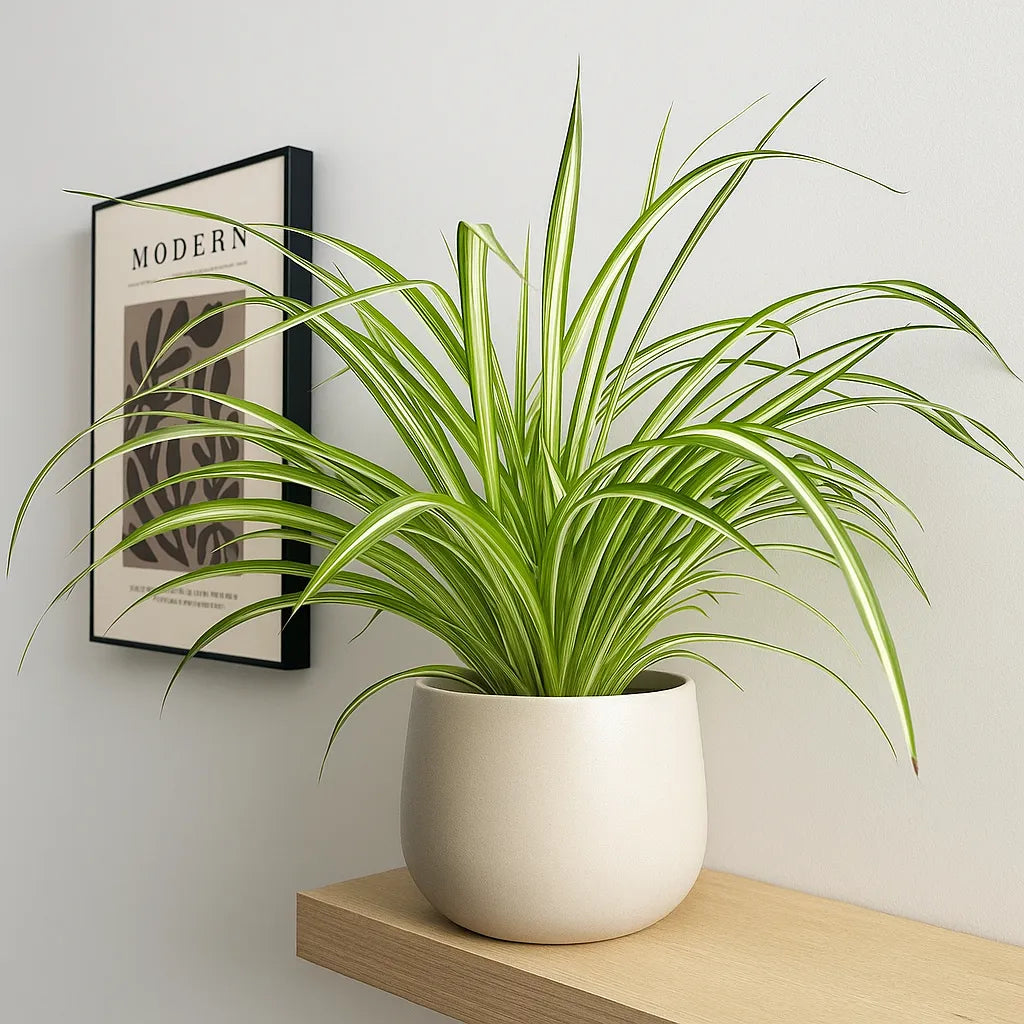
chlorophytum comosum lemon 20Chlorophytum comosum Vittatum, commonly known as the Variegated Spider Plant, is one of the most recognisable and best loved houseplants in the world. Native to South Africa and belonging to the Asparagaceae family, this variety is prized for its striking, striped leaves and its exceptional resilience, making it perfect for both beginners and experienced plant enthusiasts. The Vittatum cultivar features long, arching leaves with a creamy white central

Chlorophytum comosum ‘Vittatum’, commonly known as the Variegated Spider Plant, is one of the most recognisable and best-loved houseplants in the world. Native to South Africa and belonging to the Asparagaceae family, this variety is prized for its striking, striped leaves and its exceptional resilience, making it perfect for both beginners and experienced plant enthusiasts.

The ‘Vittatum’ cultivar features long, arching leaves with a creamy-white central stripe bordered by fresh green margins. The plant forms a graceful rosette that produces trailing stems adorned with tiny white flowers and baby plantlets (“spiderettes”), which can be easily propagated. Its flowing, fountain-like habit gives it an elegant and lively appearance, ideal for hanging baskets, shelves, or pedestal planters.

Beyond its beauty, the Spider Plant is also one of the best air-purifying plants, known for removing common indoor toxins and improving air quality.


Chlorophytum comosum ‘Vittatum’ – Care Guide

Light

Thrives in bright, indirect light but adapts well to medium or low-light conditions. Avoid direct sunlight, which may cause the white stripe to fade or the leaf tips to brown.

Watering

Keep the soil lightly moist during the growing season, watering when the top 2–3 cm feels dry. Avoid letting the plant sit in water. In winter, allow the soil to dry slightly more between waterings. Spider Plants prefer consistent moisture but will tolerate short dry periods.

Temperature and Humidity

  • Temperature: Prefers 18–26°C. Protect from draughts and cold below 10°C.

  • Humidity: Adapts well to average indoor humidity but benefits from occasional misting during dry months.

Soil and Potting

Use a free-draining, peat-free compost. A mix enriched with perlite or sand improves aeration and prevents soggy soil. Repot every 1–2 years in spring, as Chlorophytum grows quickly and may become root-bound.

Feeding

Feed every 2–4 weeks during spring and summer with a balanced liquid fertiliser. No feeding is necessary in winter.

Pruning and Maintenance

Remove any brown or damaged leaf tips using clean scissors. Trim off spent flower stems if desired, or leave them to produce new baby plants. Spiderettes can be easily propagated by placing them in water or directly into moist soil.

Growth and Maturity

A fast-growing, clump-forming plant that reaches around 30–45 cm tall and wide, with trailing stems extending much further. Over time, it produces multiple offshoots that can be divided and replanted.

Common Issues

  • Brown leaf tips: Caused by hard tap water, low humidity, or over-fertilisation. Use filtered or rainwater if possible.

  • Yellowing leaves: Overwatering or poor drainage.

  • Pests: Occasionally mealybugs or aphids; wipe leaves regularly to prevent infestations.

Background and Benefits

The Spider Plant has been a staple in households worldwide for over a century, loved for its adaptability and timeless beauty. The ‘Vittatum’ variety remains a favourite thanks to its crisp, white-striped foliage and cascading growth. It’s also a pet-safe, air-purifying plant, proven to absorb indoor toxins like formaldehyde and xylene — a perfect combination of form and function.


Quick Care Summary

  • Light: Bright, indirect; tolerates low light

  • Water: Lightly moist; let topsoil dry slightly

  • Temperature: 18–26°C; protect below 10°C

  • Humidity: Average indoor; mist occasionally

  • Soil: Free-draining, peat-free compost

  • Feed: Every 2–4 weeks in spring/summer

  • Growth: Fast-growing rosette, 30–45 cm; long, arching green leaves with white central stripe


🌿 Pet-Friendly Note:
Chlorophytum comosum ‘Vittatum’ is non-toxic to cats, dogs, and humans — making it an excellent choice for pet-friendly households.


🌸 Styling Tip:
Display Chlorophytum ‘Vittatum’ in a hanging planter or on a high shelf to showcase its flowing, variegated foliage and cascading baby plants — a timeless way to bring vitality and movement into any space.

Shipping Notes
  • Free Standard Shipping on $100+ Orders to the USA.
  • Except Preorder products are shipped in 48 hours.
  • Delivery to the USA:
  1. Standard Shipping : 3-10 business days
  • If time is of the essence, please consider selecting expedited delivery for faster service.
Exchange/Return Notes
  • We offer a 30-day return/exchange service after receiving.
  • Final sale items are not eligible for returns or exchanges.
  • To process your return/exchange, please contact us at [email protected]
  • Please click here for more details>>> Return & Exchange Policy
SKU: 50859967147

Discover Niche Categories That Outsell chlorophytum comosum lemon

Top-Converting Item to Boost Your Average Order

4.9 ★★★★★
Based on 18 reviews
Sort
Highest Rating
Newest First
Oldest First
Product Reviews
S
Verified Purchase
Scott Charles
Chelsea, US
★★★★★ 5
LOVED This Read! Blew Me Away
Format: Hardcover
What a fantastic read! Woah. All of the Americas have an extraordinary history. I was mesmerized from beginning to end. If you like knowing your history, you will love this book. Well researched and smartly written. Couldn't put it down. Books like this are why people love to read. If you think you know the Americas, you might be surprised to find that there's more, and be prepared for a bit of a shake up. This book was a real eye opener.
WAS THIS REVIEW HELPFUL?YesReportShare
Reviewed in the United States on November 18, 2025
J
Verified Purchase
James Ferguson
Charlottesville, US
★★★★★ 4
A Brave New World
Format: Hardcover
It wasn't quite what I expected, but Charles Mann leads the reader on a fascinating journey in the wake of Columbus, focusing mostly on the environmental impact of his "discovery" of the New World. Mann literally spans the globe, as the establishment of Spanish colonies in the Americas would have far reaching consequences. Most interesting to me was how silver came to be the currency of exchange, allow Spain to trade with China, when it established its trading outpost in the modern-day Philippines. Along with silver, came corn, rubber and potatoes which would radically alter the landscape of the world. Mann discusses how corn came to replace rice for many Chinese, and how rubber trees would be transplanted to Indochina, bringing with them unsuspected pests that would wreak havoc on ecosystems. In this sense, the book has similarities with Jared Diamond's but explores different terrain. One of the most interesting chapters was on the highly profitable mining of bird guano and how the British cornered the market in this new fertilizer. Mann describes how the shift to mono-cultures had a tremendous impact on agriculture. At first, these new crops seemed to solve much of the world's food shortages, but then as the Irish famine made all too painfully aware, putting all your "eggs in one basket" can lead to devastating consequences as an unforeseen blight wiped out much of Ireland's food supply. Mann also offers a long study on how slavery evolved and re-shaped the ethnic identity of many countries, particularly those in Central and South America. The miscegenation that took place, with particular focus on Brazil, reshaped cultural patterns and changed the political dynamics in these countries. He offers a number of intriguing case studies, and discussed the long term impact of this human cross-pollination. 1493 is a fascinating study and meditation on life after Columbus. We don't fully realize how rapidly the world changed after this fateful "discovery," and how continents became so interdependent, where before they had been relatively isolated from each other.
WAS THIS REVIEW HELPFUL?YesReportShare
Reviewed in the United States on April 30, 2012
R
Verified Purchase
Russell C.
Phoenix, US
★★★★★ 5
Great History book
Format: Paperback
This book was a gift for husband. He loves it. He is a slow reader, but he can’t put book down. New and interesting history facts and stories.
WAS THIS REVIEW HELPFUL?YesReportShare
Reviewed in the United States on February 6, 2026
J
Verified Purchase
John D. Cofield
Lake Worth, US
★★★★★ 5
Consequence After Consequence
Format: Hardcover
"In Fourteen Hundred Ninety Two, Columbus Sailed The Deep Blue Sea" is a ditty sung by generations of school children. Most of those students learned and believed that Columbus was the only man in Europe who believed the world was round and proved it by sailing three ships west to find the East. In 1493, Charles C. Mann dismisses these legends and goes on to demonstrate that Columbus (or as he refers to him, Colon) and the other Europeans who sailed across the Atlantic in the 1400s and 1500s did far more than just discover a New World, they helped create a planet wide system in which people, plants, animals, and diseases travelled further and were linked in more ways than had ever before been possible. In other words, 1493 was the beginning point of a new age of globalization. This is not a new theory. Alfred W. Crosby developed the term Columbian Exchange back in the 1970s to describe the changes that took place after 1492. Jared Diamond's Guns, Germs, and Steel and Collapse also detailed some of the consequences of the European "discovery" of the Americas. What makes Mann's new book so appealing is his ability to tell an engrossing story that ably explains how one consequence led to another, fundamentally changing society after society and helping to creat our modern world. This is global history at its best, jumping from Ming and Qing China's opulent but troubled societies to the fast growing but still relatively backwards European states to the myriad African and Native American cultures, all of them to be affected by the transfer of peoples, plants, diseases, and ideas. Mann has a keen eye for an appealing and informative anecdote which really details the consequences of seemingly small decisions, such as how the introduction of the sweet potato to China led to deforestation, or how the Little Ice Age was affected by the abandonment of the Native American practice of burning off underbrush in North American forests. Its books like 1493, as well as Mann's earlier and equally excellent 1491, which make studying history so fascinating. I taught Advanced Placement World History to high school students for many years before retiring, and I regularly amused them (at least I hope I did) with many references to Jared Diamond and Alfred Crosby's ideas. With 1493 Charles C. Mann deserves equal recognition by global historians.
WAS THIS REVIEW HELPFUL?YesReportShare
Reviewed in the United States on August 19, 2011
V
Verified Purchase
Victor Vögel
Lake Worth, US
★★★★★ 5
Mesmerizing; shows the butterfly effect in action
Format: Paperback
Charles Mann’s “1493” is about globalization and the Homogenocene epoch. Unlike the plenitude of other recent books about globalization, however, “1493” is about biological globalization rather than economic globalization. The book traces the results of the Columbian Exchange, with chapters devoted to tobacco, the earthworm, malaria, silver, potatoes and sweet potatoes, guano and rubber. The book is in four parts, and is written in an accessible, non-academic style. I found the first three parts of the book, which cover the impact of the Columbian Exchange on the Atlantic, the Pacific and Europe, respectively, to be captivating. These parts of the book demonstrated the fascinating interconnectedness of all things in a globalized society (in other words the “butterfly effect”) – for example, how transporting the sweet potato to Western China led to population migrations from Eastern to Western China, deforestation and overflowing of the Yellow River. The general result of such biological globalization is the creation of the Homogenocene epoch, a term which Mann uses to describe the biological homogenization that has replaced biological diversity since the time of Columbus. In the first three parts of the book, Mann demonstrates how history, biology and chemistry are all interrelated, and how today’s world continues to be influenced by the Columbian Exchange. I found the last part of the book to be less impressive than the first three parts. Part Four is called “Africa in the World,” but confusingly it is about South America, not Africa. Parts of it read more like travel writing than history. Still, the book deserves five stars for the first three thrilling parts, which successfully trace the mesmerizing history of various everyday biological substances.
WAS THIS REVIEW HELPFUL?YesReportShare
Reviewed in the United States on December 31, 2017

recommand products