SKU: 5096114742
the money tree 1992

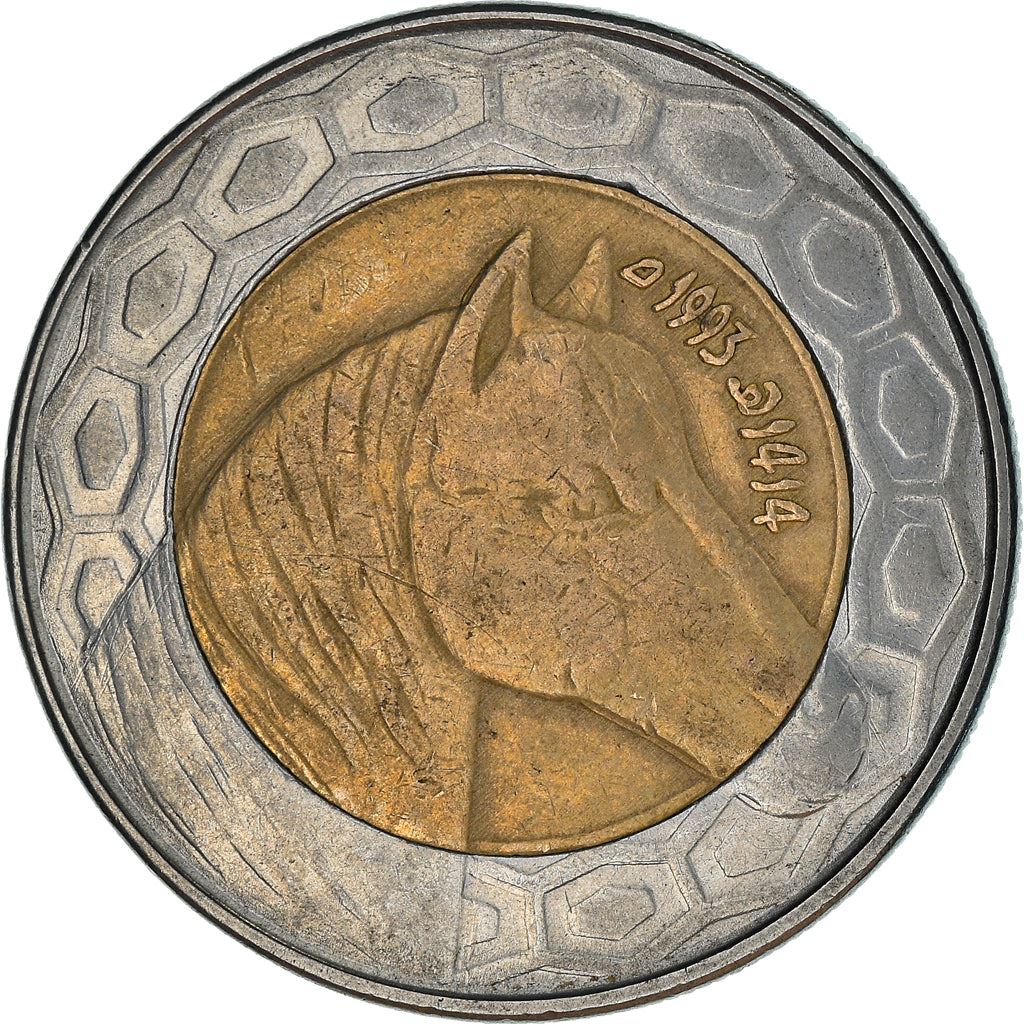
the money tree 1992 Algeria 100 Dinars Coin | Horse | Palm Tree | Horse | KM132 | 1992

Sale price$26.96 Regular price$29.96
Save 10%

Pay in installments of $7.49 with ShopPay, AfterPay and Klarna

Shipping Estimate
USA
  • USA
  • CAN

Ships within 48 hours · Estimated delivery Jul 28 - Aug 2

Promo Codes Available:

For Your Every Summer RSVP, with Code: SUMMER15

Description

the money tree 1992 Algeria 100 Dinars Coin | Horse | Palm Tree | Horse | KM132 | 1992100 Dinars coin from Algeria (People's Democratic Republic of Algeria, ). The coin was circulated in 1992 2018 and will be picked randomly. Various grades from Good to Very fine. A photo is for advertising purposes only. The coin may have scratches, dirt, or damage from oxidation. Country: Algeria Continents: Africa Groupings: North Africa Denomination: 100 Dinars Value: 100 Dinars 100Dzd = Sek 7. 96 Type: Standard circulation coin Year: 1992 2018

100 Dinars coin from Algeria (People's Democratic Republic of Algeria, الجمهورية الجزائرية الديمقراطية الشعبية). The coin was circulated in 1992 - 2018 and will be picked randomly. Various grades from Good to Very fine. A photo is for advertising purposes only. The coin may have scratches, dirt, or damage from oxidation. 

Country: Algeria

Continents: Africa

Groupings: North Africa

Denomination: 100 Dinars

Value: 100 Dinars 100Dzd = Sek 7.96

Type: Standard circulation coin

Year: 1992 - 2018

Numismatic period: People's Democratic Republic 1964 - 2023

Number of coins: 1

Composition: Bi-Metallic: Copper-Aluminium-Nickel Center, Copper-Nickel Ring

Composition details: Aluminium-bronze center in stainless steel ring

Diameter: 29.5 mm.

Thickness: 2.3 mm.

Weight: 11 g.

Calendar: Islamic (Hijri)

Shape: Round

Technique: Milled

Orientation: Coin alignment ↑↓

Mint: Algiers

Obverse: The Face Value Is Written With A Palm Tree For The Number 1, The Obverse Of The Coin For The First 0 And Its Symmetry For The Second 0. It Is Surrounded With The Arabic Inscription "Bank Of Algeria" (On Top) And "Dinars" (Underneath) And Two Stars. The Palm Tree Is Inscribed Inside A Pattern Shaped Like A Door From The Southern Algeria.

Obverse lettering: بنك الجزائر 100 دينار

Reverse: A Head Of An Arabian Horse Looking Right Is Accompanied With The Year In The Islamic And The Gregorian Calendars And Surrounded With An Adornment

Reverse lettering: 1994 1415

Edge: Reeded (185 reeds)

ℹ Themes: Tree, Horse Or Equine, Animals

Shipping Notes
  • Free Standard Shipping on $100+ Orders to the USA.
  • Except Preorder products are shipped in 48 hours.
  • Delivery to the USA:
  1. Standard Shipping : 3-10 business days
  • If time is of the essence, please consider selecting expedited delivery for faster service.
Exchange/Return Notes
  • We offer a 30-day return/exchange service after receiving.
  • Final sale items are not eligible for returns or exchanges.
  • To process your return/exchange, please contact us at [email protected]
  • Please click here for more details>>> Return & Exchange Policy
SKU: 5096114742

Discover Niche Categories That Outsell the money tree 1992

Top-Converting Item to Boost Your Average Order

4.0 ★★★★★
Based on 26 reviews
Sort
Highest Rating
Newest First
Oldest First
Product Reviews
F
Verified Purchase
Fabricio
Pawtucket, US
★★★★★ 5
A must for Spanish Speaking Officers.
Format: Paperback
I sought out this book because I did not feel comfortable speaking Spanish in a law enforcement context. This booked greatly improved my Spanish and allowed me to bolster my proficiency. If you are a Spanish Speaking officer, please get this book.
WAS THIS REVIEW HELPFUL?YesReportShare
Reviewed in the United States on May 3, 2023
A
Verified Purchase
Amazon Customer
Birmingham, US
★★★★★ 5
Son likes it
Format: Paperback
Son says it's helpful.
WAS THIS REVIEW HELPFUL?YesReportShare
Reviewed in the United States on February 2, 2025
J
Verified Purchase
Jan
Charlottesville, US
★★★★★ 5
Very Helpful
This book applies to others also, not just law enforcement. There is a lot of information in the book that will help you with all your Spanish. Found it to be accurate with dealing with locals as many of the words are a little different than what you learn in Spanish 101(Spain Spanish). For law enforcement officials wanting to learn to communicate with latinos in america, this book will help you learn what you want to say. There are three CD's with the book. I would strongly suggest listening to the CD's over and over again.....it really will help you.
WAS THIS REVIEW HELPFUL?YesReportShare
Reviewed in the United States on August 18, 2012
A
Verified Purchase
Amazon Customer
Carnegie, US
★★★★★ 5
Excellent
It's an excellent textbook from the Barron's series of which I have this author's other books. I love the set up. I'm constantly trying to improve my Spanish in different categories....these books are amazing.
WAS THIS REVIEW HELPFUL?YesReportShare
Reviewed in the United States on May 3, 2024
K
Verified Purchase
Kyle Henderson
West Palm Beach, US
★★★★★ 5
A must-read for anyone interested in communication studies, rhetoric, American public debates
Format: Paperback
In this seminal book, Fisher expounds his "narrative paradigm," a sweeping theory of human communication and more. Professor Emeritus at USC's Annenberg School of Communication, Fisher's discipline was rhetoric. But the book's subtitle -- "Toward a Philosophy of Reason, Value, and Action" -- isn't a stretch. Fisher's theory is a grand project extending its purview way beyond the communication department's door. At root is Fisher's rejection of what he calls the "rational world paradigm," which falsely separates logos from mythos, reason from imagination, fact from value. Doesn't work that way, Fisher says. No such thing as a value-free belief, assertion, or action. Instead, we evaluate according to a "logic of good reasons" -- reasons we value as good -- rooted in the narratives of our experience. An under-appreciated aspect of Fisher's work is the application of his theory to American politics. America's most enduring narrative is The American Dream. But that dream comprises two sub-narrative strands: the "materialistic myth" and the "moralistic myth." These two strands broadly represent conservative and progressive impulses respectively, but those threadbare categories don't do Fisher's explication justice. The two myths find their roots in the narratives of the earliest Americans, and have been battling it out ever since. It's a credible understanding of the history of American public moral debates.
WAS THIS REVIEW HELPFUL?YesReportShare
Reviewed in the United States on April 28, 2010

recommand products