SKU: 51187976614
bulk flower seeds for bees

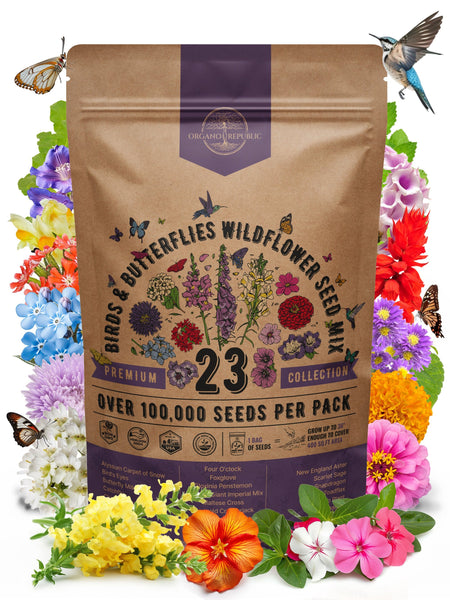
bulk flower seeds for bees 23 Hummingbird Butterfly Wildflower Seeds Mix for Planting Indoor & Outdoors. 100,000+ Non-GMO, Heirloom Wildflower Garden Seeds in Bulk 4oz Packet for Growing Wild Flowers to Attract Bees, Butterflies & Birds… -

Sale price$25.73 Regular price$28.59
Save 10%

Pay in installments of $7.15 with ShopPay, AfterPay and Klarna

Shipping Estimate
USA
  • USA
  • CAN

Ships within 48 hours · Estimated delivery Sep 15 - Sep 20

Promo Codes Available:

For Your Every Summer RSVP, with Code: SUMMER15

Description

bulk flower seeds for bees 23 Hummingbird Butterfly Wildflower Seeds Mix for Planting Indoor & Outdoors. 100,000+ Non-GMO, Heirloom Wildflower Garden Seeds in Bulk 4oz Packet for Growing Wild Flowers to Attract Bees, Butterflies & Birds… -Attract Pollinators with Our Premium Hummingbird & Butterfly Wildflower Seeds Mix Wildflower Seeds Elevate your garden's beauty and ecological value with our Premium 23 Hummingbird & Butterfly Wildflower Seeds Mix. Specially crafted for planting both indoors and outdoors across North America, this blend includes over 100,000 wildflower seeds from 23 vibrant varieties. Designed to attract essential pollinators like hummingbirds, butterflies, bees, and

Attract Pollinators with Our Premium Hummingbird & Butterfly Wildflower Seeds Mix

Wildflower Seeds

Elevate your garden's beauty and ecological value with our Premium 23 Hummingbird & Butterfly Wildflower Seeds Mix. Specially crafted for planting both indoors and outdoors across North America, this blend includes over 100,000 wildflower seeds from 23 vibrant varieties. Designed to attract essential pollinators like hummingbirds, butterflies, bees, and birds, this mix is the perfect way to ensure the health and vitality of your garden plants.

Features of Our Hummingbird & Butterfly Wildflower Seeds Mix

  • Diverse and Vibrant Selection: This wildflower mix features 23 carefully selected varieties that not only add a burst of color to your garden but also support pollinators that are crucial to plant health. Whether you're looking to enhance a garden bed, meadow, or flower border, these wildflowers will create a stunning display that attracts hummingbirds, butterflies, and more.
  • Enhanced Growing Experience: Our wildflower seeds are packaged in a resealable bag to maintain freshness and are accompanied by essential gardening tools like a seed dibber tool, weeding fork, and widger tool. The kit also includes QR codes that link to our comprehensive online growing guides, ensuring you have all the information you need for a successful gardening experience.
  • Garden Success Guaranteed: Whether you’re planting wildflowers in a window garden or creating an outdoor sanctuary, our seeds are designed for success. With a high germination rate, these heirloom seeds guarantee a lush, colorful garden that will thrive and support local pollinators.

Benefits of Planting Wildflower Seeds

Our wildflower seeds offer an easy and rewarding way to create a garden filled with natural beauty and ecological benefits. Each variety is chosen for its ability to thrive in diverse climates and soil types, ensuring a vibrant garden that supports bees, butterflies, hummingbirds, and other pollinators. Sourced from trusted U.S. suppliers, our seeds are stored in resealable bags to keep them fresh for up to three years.

Complete Wildflower Gardening Kit

Each wildflower gardening kit includes:

  • 23 unique wildflower seed varieties specifically selected to attract hummingbirds and butterflies
  • Mini gardening tools: seed dibber tool, weeding fork, and widger tool
  • Resealable bag for seed freshness
  • QR codes for accessing detailed gardening guides and growing instructions

The Perfect Gift for Garden and Nature Lovers

Our Hummingbird & Butterfly Wildflower Seeds Mix is an ideal gift for gardeners of all levels, as well as nature enthusiasts. Perfect for housewarmings, birthdays, or any special occasion, this mix brings the joy of a blooming garden that supports essential pollinators and adds vibrant beauty to any space.

Quality You Can Trust

Proudly made in the USA by a small family-owned business, our wildflower seeds undergo rigorous testing to ensure the highest germination rates. Each packet is sealed for freshness, guaranteeing that your garden will bloom with vibrant, healthy flowers season after season.

Create a pollinator-friendly paradise with our Premium Hummingbird & Butterfly Wildflower Seeds Mix and enjoy the beauty and benefits of a garden filled with colorful, nectar-rich blooms.

Shipping Notes
  • Free Standard Shipping on $100+ Orders to the USA.
  • Except Preorder products are shipped in 48 hours.
  • Delivery to the USA:
  1. Standard Shipping : 3-10 business days
  • If time is of the essence, please consider selecting expedited delivery for faster service.
Exchange/Return Notes
  • We offer a 30-day return/exchange service after receiving.
  • Final sale items are not eligible for returns or exchanges.
  • To process your return/exchange, please contact us at [email protected]
  • Please click here for more details>>> Return & Exchange Policy
SKU: 51187976614

Discover Niche Categories That Outsell bulk flower seeds for bees

Top-Converting Item to Boost Your Average Order

4.5 ★★★★★
Based on 10 reviews
Sort
Highest Rating
Newest First
Oldest First
Product Reviews
W
Verified Purchase
WellBCare
Grantham, US
★★★★★ 2
Be clear that it's a blank journal you create, with brief quotes and thumbnail art
Format: Paperback
If one is looking for a personal journal of empty lined pages ~ and a brief Lilias Trotter quote with a thumbnail-size photo of her art on each page then this is for you. I understood it was a book of her journalling with more viewable-size sketches.
WAS THIS REVIEW HELPFUL?YesReportShare
Reviewed in the United States on May 13, 2022
E
Verified Purchase
Eric Balkan
Chelsea, US
★★★★★ 5
When and where economics went wrong
Format: Paperback
This is one of those books that can provide an epiphany to the reader -- but not very many American readers have even heard of it, unfortunately. That could be due to it's being a book primarily about English economic history, with assumptions that the reader is familiar to some extent with things like the Poor Laws and Tory socialism. But I wasn't, and was still able to glean some great insights from the work. That could be because Polanyi is not afraid of repetition. :-) A key insight, and the one that could be summed up as the theme of the book, is Polanyi's realization that prior to about 1830, the market and the economy were considered part of society. That is, economic activity was something that people did along with everything else they did, like engage in social/familial relationships, religious rituals, etc. But with the 1830s came a paradigm shift: the advent of rational capitalism. Now, the market was considered an entity by itself, outside of society. This market entity was viewed as governed by universal laws. Like laws of physics, these market laws were independent of culture, independent of social group, independent of time period, and, in fact, independent of human behavior. While any observer of human nature would say that people often make decisions for emotional reasons -- and modern neurological research shows that virtually every decision we make is a combination of the rational and the emotional -- these market laws assumed only rational behavior on the part of economic actors. Though Polanyi doesn't mention it, it's now easy to see how Alfred Marshall could get carried away with creating a mathematical foundation for microeconomics and how Leon Walras could, reportedly, say that if something couldn't be studied mathematically, it wasn't worth studying. There's no current way to model emotions with math, and so the Ricardian prototype of an emotion-less economics continues into the modern economics of today. These universal market laws frees the market from any social constraints. A number of modern neo-classical economists assert that this makes economics purely amoral, i.e., without regard for any ethics. Therefore any attempts by the public, by politicians, or by workers to add ethics to the market is an interference with pure market workings, which, according to their interpretation of Adam Smith's "invisible hand", will produce optimal results if just left alone. But Smith never said that, and in fact rational capitalism, in elevating greed and selfishness to the status of goals -- see the Ayn Rand work "The Virtue Of Selfishness" -- is, IMO, not amoral at all, but rather is a morality of its own. Anyway, back to Polanyi's insights. Another key one is the concept of a "double movement" in 19th century England. Each move to create a purer market created an ad-hoc counter move. E.g., Ricardian free trade was faced with opposition from workers losing their jobs and local firms losing business Americans can easily think of another example: where the employment of children (eventually) led to laws restricting that employment, simply because human beings have too much of a sympathetic nature to sit still for children losing limbs in the dangerous factories and mines of the time. Polanyi notes that capitalists often blame these anti-capitalist laws on planned activity by socialist anti-market groups, but he says they're actually the result of the recognition by the general public that they don't want to live under a pure market system. Yet another good insight is Polanyi's recognition that market laws treat labor, land, and money as commodities. We can see that today, where neo-classical economists assert that the law of supply and demand should apply to workers as it applies to anything else in the economy. That is, if there's a surplus of workers in one area and a shortage in another, supply and demand dictates the flow of workers from the one area to the other. But a laid-off textile worker in South Carolina is not going to move to China for a job. That's my own example, but Polanyi offers his own from modern English history. The book isn't perfect. Polanyi does have a tendency to generalize, a common failing among authors, IMO. E.g., in discussing the rise of fascism in the 1930s, he's on very shaky ground when he starts talking about the US or about Russian policy intentions during that period. I gave The Great Transformation 5 stars because, even with its faults, the reader will be thinking about Polanyi's insights for some time to come. I am.
WAS THIS REVIEW HELPFUL?YesReportShare
Reviewed in the United States on May 18, 2009
K
Verified Purchase
Kindle Customer
Whiting, US
★★★★★ 5
Not light reading but worth it
Format: Kindle
Much of this book was heavy reading for me, mainly due my not being familiar with the background development and history of various economic theory and associated laws over 500 or so years of British history. I did stick it out and am glad I did. There are many insights as to how we have arrived at today and the book is still relevant even though it was written in 1942. I found the last few chapters and the comments in Sources to offer the most explanations to fit modern times especially with regard to the rise of fascism. Thick but worth it.
WAS THIS REVIEW HELPFUL?YesReportShare
Reviewed in the United States on May 6, 2025
B
Verified Purchase
Blake West
San Leandro, US
★★★★★ 4
Interesting anthropology and critique, but dense and obtuse writing
Format: Kindle
The good part is that at the end of the day, I learned a lot here, and Polanyi raised a lot of very interesting and under-discussed historical points to create his argument. It felt very similar to David Graeber (or I guess Graeber is similar to Polanyi) in that way. The bad part is that, whereas Graeber writes with exceptional clarity and vividness, Polanyi is obtuse and dense. And I've read other books from this era, I don't think it's the time. I think it's Polanyi's writing. Beyond that, his work serves more as analysis than prescription. It's a bit unclear exactly what he's advocating for. Which maybe is OK, though I prefer when non fiction writers offer solutions rather than just pointing out problems. All in all, if you can settle in with his writing, there are definite gems in there.
WAS THIS REVIEW HELPFUL?YesReportShare
Reviewed in the United States on June 5, 2026
K
Verified Purchase
Kitty Bryant
Omaha, US
★★★★★ 5
Inspiring analysis of economic history
Format: Paperback
Polanyi presents economic history through an analysis of the "utopian" catastrophy of the self-regulating market economy. Polanyi argues that the free market economy treats the most essential elements of human society - labor, nature, and money - as if they should be exploited like commodities. When liberalism (free marketeerism) rules, then the economy dictates what is possible in human society, and these rules are intolerable because they create conditions under which humans are impoverished and disempowered. In his final chapter he lays out the battle ground between liberalism and its alternatives, which when he was writing (1945) were socialism and fascism. Fascism refuses the dictates of economic liberalism but substitutes in its place the dictates of a state that denies individual freedom. Socialism, alternatively, holds the only promise of true freedom for the individual where economic and political rules are developed and enforced democratically for the protection of society. While this is not an easy read because it demands a background in history, he is a fluent and persuasive writer.
WAS THIS REVIEW HELPFUL?YesReportShare
Reviewed in the United States on February 2, 2023

recommand products