SKU: 53700855202
spider web plant

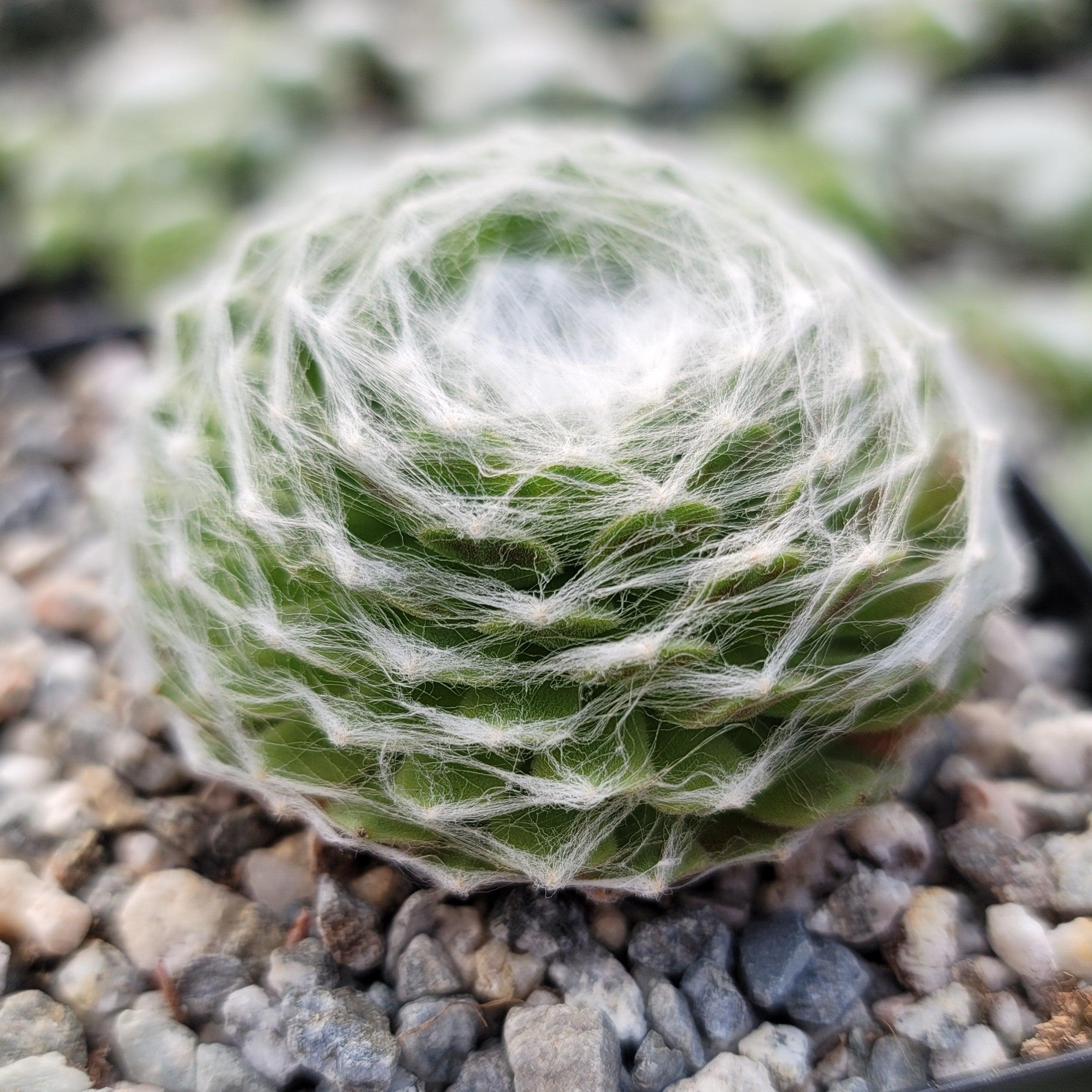
spider web plant Cobweb Hens and Chicks

Sale price$19.39 Regular price$21.54
Save 10%

Pay in installments of $5.38 with ShopPay, AfterPay and Klarna

Shipping Estimate
USA
  • USA
  • CAN

Ships within 48 hours · Estimated delivery Sep 9 - Sep 14

Promo Codes Available:

For Your Every Summer RSVP, with Code: SUMMER15

Description

spider web plant Cobweb Hens and ChicksIntroducing the Cobweb Hens and Chicks, known as Sempervivum arachnoideum, which is a vibrant mat forming succulent plant, that belongs to the Sempervivum genus. The Sepervivum arachnoideum has several other common names such as Cobweb Houseleek, Cobweb sedum, or Spiderweb Hens and Chicks because of its fine, web like hairs that cover its leaves. The webs on Sempervivum arachnoideum, are actually a natural characteristic of the plant. These webs, made

Introducing the Cobweb Hens and Chicks, known as Sempervivum arachnoideum, which is a vibrant mat-forming succulent plant, that belongs to the Sempervivum genus. The Sepervivum arachnoideum has several other common names such as Cobweb Houseleek, Cobweb sedum, or Spiderweb Hens and Chicks because of its fine, web-like hairs that cover its leaves. 

The webs on Sempervivum arachnoideum, are actually a natural characteristic of the plant. These webs, made up of silvery-white hairs, serve a few purposes. They help protect the plant from excessive sunlight by providing some shade. The webs can help trap moisture around the leaves, acting as a natural insulation and reducing water loss. Additionally, the webs add a unique and visually appealing feature to the plant, making it stand out among other succulents. 

The Hens and Chicks plants form tight evergreen rosettes of fleshy, pointed leaves that are covered in silvery-white hairs, resembling a spiderweb. The leaves have a green or reddish coloration, depending on the variety. With a fast growth rate, it can grow up to 3 inches tall and 12 inches wide, which creates a beautiful, textured carpet-like effect.

Sempervivum arachnoideum crested is a unique variant of Sempervivum arachnoideum distinguished by its distinctive crested fan-shaped growth pattern.  

The Sempervivum arachnoideum flower blooms in late summer and produces tall flower stalks that rise from the center of the rosettes. The flowers are star-shaped and can vary in color, ranging from pink to red or even yellow. The monocarpic plant will produce numerous chicks before dying, with offsets or "chicks" around the mother plant's base after flowering. 

The Cobweb Hens and Chicks can be propagated through offsets or leaf cuttings. The offsets, which are the small rosettes that grow around the mother plant, can be carefully separated and replanted to establish new plants. Additionally, individual leaves can be removed and rooted to grow new plants. This succulent is relatively easy to propagate, making it a popular choice for plant enthusiasts. 

Remember, the Cobweb Hens and Chicks Sempervivum arachnoideum are generally considered non-toxic to both humans and pets. Sempervivums, like many cacti and succulents, require little maintenance once established and will survive near-total neglect.  

Watering Needs 

Like other succulents, the Sempervivum arachnoideum has adapted to survive in arid conditions, which means it prefers drier soil. It's important to allow the soil to dry out completely between regular watering to prevent overwatering, which can lead to root rot and other issues. Aim for a watering schedule of once every 1-2 weeks in the summer, during the growing season, and even less frequently during the winter months when it goes into a dormant phase. 

When watering your Cobweb Hens and Chicks Sempervivum arachnoideum, it's important to water the soil directly rather than spraying or misting the leaves. This helps prevent excess moisture from getting trapped in the cobweb-like threads and causing rot. Water the soil thoroughly until it is evenly moist, but avoid letting the plant sit in standing water, as this can also lead to root rot. 

Remember, it's always better to underwater rather than overwater your Hens and Chicks plant. These Sempervivum arachnoideum succulents are quite resilient and can tolerate short periods of drought. Observing the leaves can also give you an indication of when to water. If the leaves start to appear slightly wrinkled or feel soft, it's a sign that your Hens and Chicks plant is thirsty and could use a drink. 

Light Requirements 

When it comes to growing Sempervivum arachnoideum indoors, they thrive in bright, indirect light. Place them near a south or west-facing window where they will get plenty of sunlight throughout the day. If you don't have access to a lot of natural light, you can also use artificial grow lights to provide the necessary light intensity for the plant. 

If you decide to grow your Sempervivum arachnoideum Cobweb Hens and Chicks outdoors, they prefer a spot with full sun to partial sun. These plants can handle direct sunlight, but they may appreciate some protection from intense afternoon sun, especially in hotter climates. A location that receives 4-6 hours of sunlight per day is generally ideal for their growth and color development. 

It's critical to remember that during a heatwave or periods of extreme heat, your Sempervivum arachnoideum could still sustain sun damage or get sunburned. You can protect the plant in this situation by moving it indoors or to a shaded area. 

Optimal Soil & Fertilizer Needs 

The Cobweb Hens and Chicks prefer well-draining soil that allows excess water to escape easily. A good mix for these succulent plants is a combination of regular potting soil and coarse sand or perlite. This mixture helps prevent the roots from sitting in too much water alone, which can lead to root rot. Planet Desert specializes in succulents and has specialized succulent potting soil that includes an organic substrate with mycorrhizae to help with the growth of a healthy root system to help your succulents thrive. As an okay alternative, you can create your own potting mix by combining equal portions of perlite, coarse sand, and good natural potting soil. 

The Sempervivum arachnoideum are generally low-maintenance plants and don't require heavy fertilization. In fact, they can do well without any additional fertilizers. However, if you want to give them a little boost, you can use a balanced (5-10-5), water-soluble NPK fertilizer diluted to half-strength. Apply the fertilizer sparingly, only once a year during the growing season, which is typically spring. Avoid fertilizing during the winter months when it is in a dormant phase. 

Remember that Sempervivum arachnoideum is native to rocky, mountainous regions, so replicating its natural habitat is key. Make sure to select a fast-draining soil with adequate drainage. As for fertilization, it's better to under-fertilize than over-fertilize, as excessive nutrients can cause the plants to become leggy or lose their vibrant colors. Always follow the instructions and err on the side of caution. 

Hardiness Zone & More 

When planted indoors, the Sempervivum arachnoideum prefers temperatures between 50°F and 65°F. They can tolerate slightly lower temperatures during their dormant period in winter. It's important to place them in a well-lit area, preferably near a sunny window where they can receive at least 4 to 6 hours of indirect sunlight per day. 

If you are living in USDA zones 5-8, you can grow your Cobweb Hens and Chicks outdoors in the garden, year-round. They are generally frost-tolerant and can survive temperatures as low as 20°F. However, it's important to ensure good drainage in the soil to prevent waterlogging during heavy rain or snow. 

As for humidity, they are adaptable and can tolerate a variety of humidity levels, from dry to moderately humid environments. It can tolerate average indoor humidity, but it's important to avoid excessively dry conditions. You can increase the humidity around the plant by placing a tray of water near it or by using a humidifier. 

So, no matter where you live, as long as you provide the right temperature, humidity, and Sempervivum care, your Cobweb hens and Chicks will be happy and healthy! 

Final Thoughts 

Overall, the Sempervivum arachnoideum (Cobweb hens and chicks) are unique, silvery-white succulent plants with a unique appearance. They have a fast-growing habit and tight clusters of rosettes, creating a visually appealing carpet-like effect. They produce star-shaped flowers in various colors during the summer and are easy to propagate through offsets or leaf cuttings. They are hardy in USDA hardiness zones 5 to 8, preferring temperatures between 50°F and 65°F and well-lit areas with indirect sunlight. They are non-toxic, making them safe for households with pets or children. Whether you're a succulent enthusiast or just starting your plant collection, Sempervivum arachnoideum Cobweb Hens and Chicks add beauty and intrigue to any space. 

Shipping Notes
  • Free Standard Shipping on $100+ Orders to the USA.
  • Except Preorder products are shipped in 48 hours.
  • Delivery to the USA:
  1. Standard Shipping : 3-10 business days
  • If time is of the essence, please consider selecting expedited delivery for faster service.
Exchange/Return Notes
  • We offer a 30-day return/exchange service after receiving.
  • Final sale items are not eligible for returns or exchanges.
  • To process your return/exchange, please contact us at [email protected]
  • Please click here for more details>>> Return & Exchange Policy
SKU: 53700855202

Discover Niche Categories That Outsell spider web plant

Top-Converting Item to Boost Your Average Order

4.6 ★★★★★
Based on 18 reviews
Sort
Highest Rating
Newest First
Oldest First
Product Reviews
A
Verified Purchase
Amazon Customer
Lowell, US
★★★★★ 5
Excellent LXX
Format: Hardcover
The NETS is the single best translation of the Septuagint on the market (at least at the moment). The translation follows an ultra-literal method of translation they call "interlinear". The reason for this is that the LXX follows the same pattern and is very jarring. So, where the Hebrew and LXX agree, they translate the Hebrew text and translate it as literally as possible following the LXX at the same time. Where it disagrees, they follow the LXX. It has as a "boiler-plate" the NRSV, but it eschews many NRSV translation principles like gender-inclusive language. All gender-inclusive language except when the LXX's language is itself gender-inclusive (and this happens). The method of translation further removes it from its English parent. In the end, the only way you can know that it started as an NRSV would be to read the introduction. It really only has a few drawbacks. First, because the Bible is written for scholarly study, it is not useful for liturgical use or for private devotional use. Its language would also be too hard for the average reader because of its audience. This, however, is its stated goal. It may be a draw-back, but that's a side-effect of what it set out to do. I do not like the way they translated "pnevma theou" as "divine wind" in Genesis. It's justifiable to a point (it means "breath" and "wind" as much as it does "spirit), but everywhere else I checked they translated translated "pnevma" as "spirit". It should be consistent. The reason for this is plainly obvious: it was produced by an inter-religious committee of Christians and Jews. Since Jews are not Trinitarians, and that would be a valid understanding of the Hebrew and to a degree of the Greek, they would naturally not want anything like this. Christians, almost from the beginning, have made the connection between "Spirit of God" in Genesis and "Holy Spirit". The connection is further exasperated in English, because "spirit" for us does not have the same range of meaning as it does in Greek or Hebrew. So, the only fault I can give them is that it is an inconsistent translation, not that it's an invalid one. The prefaces also almost invariably favor the theory that the LXX is a translation with liberties over that it has a different parent text. Both are truly present, but we generally cannot tell when the LXX reading cannot be derived from repointing or re-dividing the Hebrew words (at that time, they had not yet pointed the text or put spaces in it, and so there were more ways to interpret the consonants than in its current form). Again, however, they do not say anything that is invalid regarding the relation of the LXX and its parent text. I simply divide the text differently than they do and so do not always like the introductions' emphasis. Going back to its strengths, its production standards were exceptional. The binding is excellent, the font is excellent, and it has generous margins. It even does this by being as cheap as the "cheap" Bibles. Short of going back to rag paper, this is about as good as I would normally expect. Overall, if you have good reading skills, I would reccomend this translation hands-down over any other English translation.
WAS THIS REVIEW HELPFUL?YesReportShare
Reviewed in the United States on December 22, 2008
K
Verified Purchase
Kindle Customer
Battle Creek, US
★★★★★ 5
Second best.
Format: Hardcover
It's not for daily reading or devotion, or like memorisation. For that, I switched to the Lexham Septuagint ( more smoother). Still beautiful, accurate to represent the Greek text. And no, it's not merely a NRSV modified as some claim. You feel it's a Greek based translation. I keep it for reference, intro on the books, and maybe for some reading. It's based on Ralhf Septuagint, but nothing too different to the Lexham (Sweete edition). Font too small, but great cover. Not my go to Septuagint in English. The Lexham has taken that place.
WAS THIS REVIEW HELPFUL?YesReportShare
Reviewed in the United States on May 9, 2026
E
Verified Purchase
Eduardo
Houston, US
★★★★★ 5
Importance of the Septuagint
Format: Hardcover
I write as a Christian layperson. The Septuagint translation of the Hebrew scriptures (the Old Testament) into Greek was produced by Jewish scholars in Alexandria in the late third and second centuries before the Common Era. It had incalculable influence on the development of Christianity. Before the important Christian writings were gathered together in the second century of the Common Era to form the New Testament, the Septuagint was THE Bible of the new Church. It has been said that quotations from the Septuagint appear in every book of the New Testanent except the letters of John. As Christianity spread through the Roman Empire, few of its adherents could read Hebrew or Aramaic. Many could read Greek, if they could read at all. Pietersma and Wright have put together the first good English translation of the Septuagint since the nineteenth century. It is a literal translation, very close to the original Greek, and therefore often somewhat awkward in English, and this is good. Readers with even a modicom of biblical Greek, say a New Testament Greek course from college days, can use this hand-in-hand with the Greek Septuagint text (available from the American Bible Society), and do quite well. One experiences a very ancient text of the Old Testament even if one has little or no Hebrew. In the past few weeks I have thus worked through the Greek text of the first chapter of Genesis, several psalms, and selections from Second Isaiah, and this has been revivifying and enlightening. I am in debt to Pietersma and Wright. Even with no command of ancient languages, one can taste the flavor of the Septuagint text with this book. Oxford University Press, with its five hundred-plus years of experience in printing bibles, has laid out the text in 1,027 double-column pages with one minor fault--the margins are too narrow to write notes. This inexpensive and well produced translation should be on the bookshelf of every serious bible reader no matter what the level of scholarship.
WAS THIS REVIEW HELPFUL?YesReportShare
Reviewed in the United States on October 7, 2011
P
Verified Purchase
Patrick Ramsdell
Massapequa, US
★★★★★ 4
Septuagint LXX Codex Alexandrinus finally in English!
Format: Hardcover
This is the overall accurate and most complete collection of books of the original covenant scriptures, (the Old Testament.) For the average English reader who doesnt know or care much to learn the spiritual gems of the bible through the languages of modern Hebrew and Ancient pictoral Hebrew, this will be your best version of the O. T. to have by far! Its all in English, translated out of the LXX, Codex Alexandrinus, which is the most ancient and most accurate septuagint text available so far, despite what modern scholars and pastors are wrongly telling you. Why the hell does every church have colies of the NIV Nearly Inspired version, for everyone to use, when they could buy this along with the Greek- English Interlinear N.T with NKJV along the side as well!?? Many scholars will say that the LXX V or Codex Vaticanus is dated earlier and is therfore more accurate but that is not completely true. It is still another great version to use also, as found in Brentons English version and the amazing Apostolic Bible Polyglot but it is still a translation made later in time from out of the Masoretic Hebrew Text. But this NETS version of the septuagint is from the original source Greek O.T. which was made originally around 250 B.C and was made out of Ezras authentic and most accurate Hebrew copy of the Tanakh or O.T., given to him directly by God again, when he was in Babylon. (See 4 Esdras 14 in the Good News Bible with deuterocanonicals/Apochrypha! $8 FROM AMAZON, of which I also did a brief review of a while ago!)You will get the most out of this version of the O.T set of scriptures. But don't forget to also get the other missing scriptures and restore many other lost and forgotten books, and verses of scripture like 4th Esdras, 1st and 2nd Adam and Eve, Jasher and 1st and 2nd Enoch, and the testament of the twelve patriarchs! Plus you will need a separate Set of the Renewed Covent scriptures or (the N.T.) because this bound package of scriptures does still not contain the whole counsel of God. There is no New testament in here in case you were wondering. But this version is still the closest to having the most of Gods words, than any other English O.T version in one bound package, that I have found and this is more accurate in more places than not. But there are a few errors still from the Greek, which get carried over into English, like Genesis 4:26 of which the Aramaic versions, and Hebrew Masoretic text and Jasher have, when the letters are respaced correctly. This verse should tell us that Enosh profaned the name of God, not worshiped or called upon or hoped to call upon God. Some of the Greek text's flaws in which the Hebrew M.T. is superior are: Zechariah 5:1- 2, 12:10 and Genesis 1:1 (of which the Aleph and Tav is present and is unjustly left out and equals The Messiah/God, as in Revelation 1:8!) And psalm 138:2 to name a few. But over all without other deeper study, the Greek O.T. text has more to offer as a whole than the Hebrew version left preserved for us. And there is no finished English translation and bound book yet, of the Aramaic Targumim O.T. TIthat will be the next masterpiece, when someone gets it done. It is still being worked on. See Andrew Gabriel Roth's Aramaic Eastern Peshitta N.T. as well as David Bausher's western peshitta N. T. Interlinear pr plain English. Hopefully one of these guys or both will do the correct smd more co ete Aramaic Targumim for the O. T. and not he later made syriac translation but we will ha e ro wait and see.? Also, some verses in which the LXX is superior over the late made Hebrew M.T. are found in verses like Genesis 11:13- 14, which are missing completely from the Hebrew!!! See Luke 3:36 to verify Kainan or Caianan's existence in the genealogical bible lineage of the Patriarchs! Cainan's existence also makrs creation 565 years earlier then 4004 bc that bishop Ussher wrongly dated from the Hebrew Masoretic Text. And see Ezekiel 21:3- which shows God only killing the unrighteous in the two LXX versions and never the righteous with the wicked, like Abraham pleaded with God in Genesis 18:23. Sadly the late Masoretic Hebrew Text erroneously has God killing both the righteous with the unrighteous! Also see DANIEL 12:4 in this LXX, which has a superior English translation, even though the same better meaning is hidden in the Hebrew. This verse should say the knowledge of evil and cunning to harm us, will increase, not the knowledge of the gospel or technology increasing, like many commentators have said.. Also DANIEL 12:4 should be translated as saying that many people will run away in apostasy and violent madness, not just running to and fro!?? Any serious students can contact me at AnswersInGenesis at live dot com. Every disciplined learned who wishes to mature, needs a copy of this and should read this as their main version of the Tanakh or O.T. I will also be happy to further translate and teach this along with the Hebrew Masoretic Text and both Aramaic Targumim to serious literal minded people, as I am already doing chronologically, through the whole bible, in my own bible study in Tucson on Shabbat (friday) evenings. Enjoy!😊
WAS THIS REVIEW HELPFUL?YesReportShare
Reviewed in the United States on September 7, 2016
E
Verified Purchase
eliot
Dallas, US
★★★★★ 5
A very well made book
Format: Hardcover
Just anecdotally, I've found that often when the NETS diverges from the Masoretic text it aligns with the Douay translation of the Vulgate. For example, LXX Psalm 42,4 in the NETS renders it: "to God who makes glad my youth" Douay has: "to God who giveth joy to my youth" Whereas JPS Tanakh has: "unto God, my exceeding joy." The Douay has the Latin book names so none of the frankly weird faux Greek spellings. And the Douay is more poetic. Brenton is more poetic for that matter. The point is if you're looking at buying the NETS just know that Brenton and Douay did it hundreds of years ago only better (IMHO) and those books are public domain. Do buy this book if you 1. can't be bothered to learn Greek and 2. prefer a mutilated NRSV over a little legwork learning how the LXX differs from the Masoretic text. On the other hand, it's sewn bound, compact, sleek and convenient. It opens flat and has a pleasing font. It's nice to consult when Liddell & Scott fail.
WAS THIS REVIEW HELPFUL?YesReportShare
Reviewed in the United States on November 26, 2024

recommand products