SKU: 54277882074
anthurium peltigerum chocolate

anthurium peltigerum chocolate Anthurium peltigerum

Sale price$20.59 Regular price$22.88
Save 10%

Pay in installments of $5.72 with ShopPay, AfterPay and Klarna

Shipping Estimate
USA
  • USA
  • CAN

Ships within 48 hours · Estimated delivery Jul 26 - Jul 31

Promo Codes Available:

For Your Every Summer RSVP, with Code: SUMMER15

Description

anthurium peltigerum chocolate Anthurium peltigerumAnthurium peltigerum Anthurium peltigerum is an unusual foliage Anthurium with peltate leaves, meaning the petiole attaches underneath the blade, inside the leaf outline. This gives the leaves a shield like outline and a distinctive vein pattern, with strong basal veins running outward through the blade. The plant grows as an epiphytic Anthurium and can develop broad, rounded leaves as it sizes up. Mature blades are green, firm and strongly patterned

Anthurium peltigerum

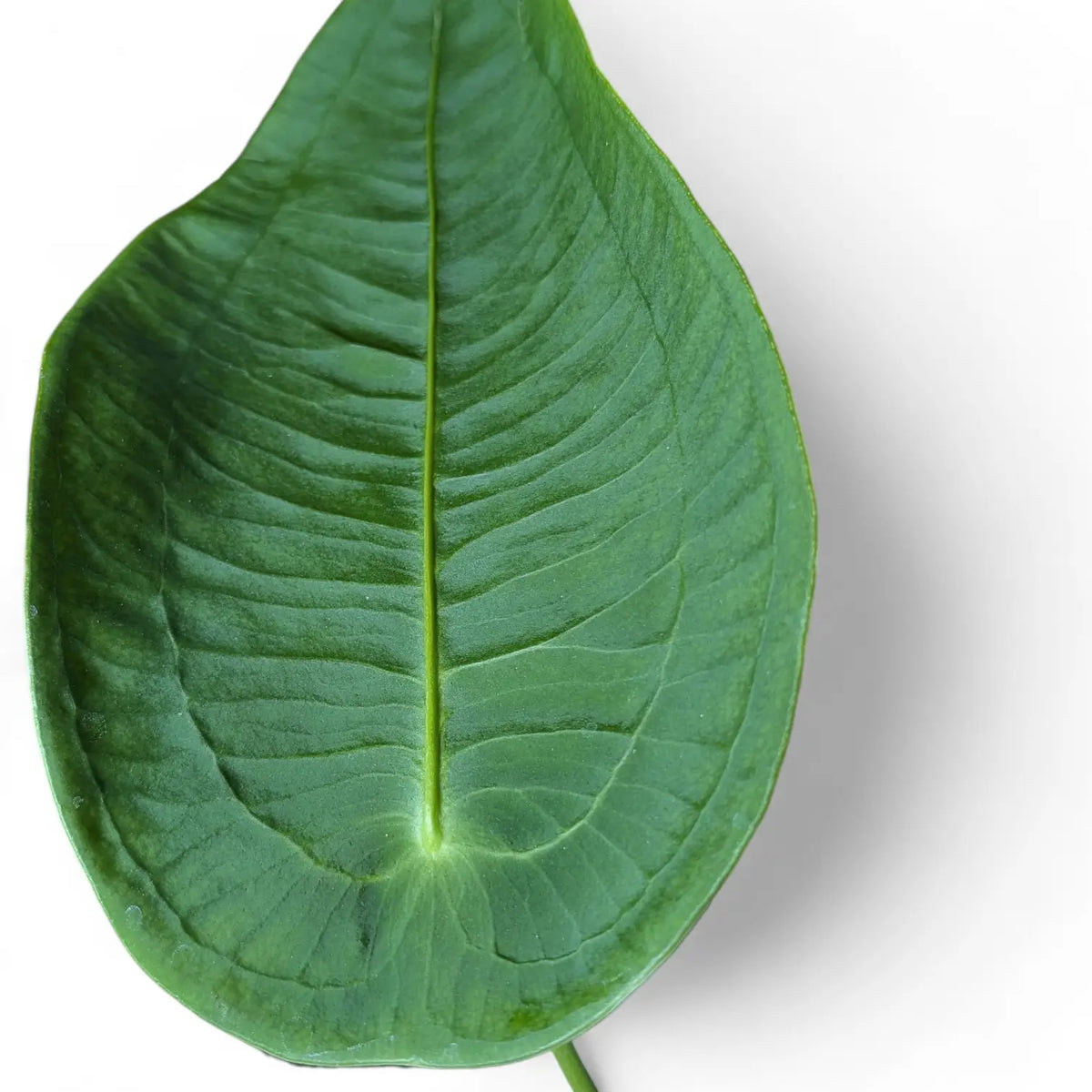
Anthurium peltigerum is an unusual foliage Anthurium with peltate leaves, meaning the petiole attaches underneath the blade, inside the leaf outline. This gives the leaves a shield-like outline and a distinctive vein pattern, with strong basal veins running outward through the blade.

The plant grows as an epiphytic Anthurium and can develop broad, rounded leaves as it sizes up. Mature blades are green, firm and strongly patterned by radiating veins and parallel tertiary venation, with a shield-like form that shows clearly from above.

Fast-scan traits on Anthurium peltigerum

  • Growth habit: Epiphytic Anthurium with a strong root system and broad leaves.
  • Leaf attachment: Peltate blades with the petiole attached beneath the leaf surface.
  • Venation: Basal veins travel toward the apex, with many parallel tertiary veins between them.
  • Blade character: Firm green foliage with a shield-like profile.
  • Origin: Native from southwestern Colombia to Ecuador, with Andean Colombian records.

Peltate leaf form and Andean habitat

Anthurium peltigerum is native from southwestern Colombia to Ecuador and is recorded as an epiphytic herb in wet tropical conditions. Colombian records place it in Andean regions at roughly 950–2100 m elevation, where moisture, airflow and an open root zone occur together.

The peltate blade gives the species its distinctive shape. Because the petiole joins the leaf from beneath, the veins radiate differently from cordate Anthuriums. As the plant matures, each leaf shows more shield-like geometry, especially with consistent moisture and enough light for firm petioles.

Care for Anthurium peltigerum

  • Light: Grow in bright filtered light. Strong, indirect light allows larger leaves to develop and a sturdier petiole-to-blade connection.
  • Watering: Keep the mix lightly moist, then water again once the upper layer has begun to dry. The epiphytic roots need oxygen between waterings.
  • Substrate: Use a coarse Anthurium mix with bark, coco chips, perlite, pumice and a little sphagnum or fine organic material for moisture retention.
  • Root space: A deep, airy pot or basket-style setup gives the thick roots room and reduces compaction around the base.
  • Humidity: Aim for 60–80% relative humidity with airflow. The broad blades benefit from stable humidity while expanding.
  • Temperature: Keep warm, ideally 20–28 °C. Cooler nights should stay mild and the substrate should drain quickly.
  • Feeding: Feed lightly during active growth. Large leaves need steady nutrition, but high salt levels can damage roots and margins.
  • Repotting: Repot when roots are tight or the mix has degraded. Refresh the substrate before it turns dense around the epiphytic roots.
  • Handling: Hold the blade and petiole when moving the plant. Peltate leaves can be stressed where the petiole meets the blade.
  • Propagation: Divide only established plants with multiple growth points. Keep divisions warm and evenly moist while roots re-establish.

Common issues on Anthurium peltigerum

  • Weak petioles: Check exposure level and root health. Large peltate blades need enough energy and a strong root system to hold well.
  • Yellowing after watering: Inspect the substrate for compaction. Epiphytic roots decline quickly when air spaces collapse.
  • Dry or torn new leaves: Stabilise humidity and reduce physical contact while the blade is expanding.
  • Brown spotting: Improve airflow and keep foliage drier overnight. Warm, wet leaf surfaces can encourage bacterial or fungal problems.
  • Stalled growth: Review warmth, light and root space before increasing fertiliser. This species often sizes up gradually.

Anthurium peltigerum growing notes

Anthurium peltigerum often shows its peltate attachment before it reaches mature blade size. With age, the spacing between leaves, petiole length and vein pattern become more pronounced.

Anthurium peltigerum safety notes

Anthurium peltigerum should be kept away from children and animals that may chew foliage or stems. Anthuriums contain insoluble calcium oxalate crystals that can irritate the mouth, lips, tongue, throat, skin and eyes. Use clean tools and wash hands after cutting or dividing the plant.

Anthurium peltigerum name background

The accepted botanical name is Anthurium peltigerum Sodiro, in the family Araceae. The genus name Anthurium is formed from Greek words for “flower” and “tail”, referring to the spadix. The species epithet peltigerum refers to the peltate, shield-bearing leaf form that gives this species its distinctive outline.

Anthurium peltigerum develops shield-like peltate leaves with radiating veins, firm green blades and epiphytic root growth.

Shipping Notes
  • Free Standard Shipping on $100+ Orders to the USA.
  • Except Preorder products are shipped in 48 hours.
  • Delivery to the USA:
  1. Standard Shipping : 3-10 business days
  • If time is of the essence, please consider selecting expedited delivery for faster service.
Exchange/Return Notes
  • We offer a 30-day return/exchange service after receiving.
  • Final sale items are not eligible for returns or exchanges.
  • To process your return/exchange, please contact us at [email protected]
  • Please click here for more details>>> Return & Exchange Policy
SKU: 54277882074

Discover Niche Categories That Outsell anthurium peltigerum chocolate

Top-Converting Item to Boost Your Average Order

4.0 ★★★★★
Based on 16 reviews
Sort
Highest Rating
Newest First
Oldest First
Product Reviews
J
Jill
Lowell, US
★★★★★ 5
Ancient Greece: the progenitor for modern day civilization
Format: Kindle
This enthralling text explores Ancient Greece from its Bronze age origins to its capitulation under the Roman Empire. Furthermore, it emphasizes the long-reaching impact this heterogeneous collection of city-states had on political, scientific, mathematical, philosophical, architectural, and military development. All of this was accomplished in spite of constantly shifting intra-regional conflict between Athens, Thrace and Sparta. Outside enemies like the Persian empire only complicated relations further. This sibling rivalry-of-sorts evolved when Alexander the Great's Macedonian empire conquered the Greek world and supplanted itself in the greco-persian conflict. While Macedonia's did embroil the internecine conflicts in the area they hellenized the regions they conquered, including: Persia,Egypt, and parts of India. However, when Alexander the Great died it left a power vacuum exploited by his men, the Romans, and the Ancient Greeks. This ultimately resulted in the Roman Empire. Ancient Greece set the stage for roman empire and while they were an autonomous union of city-states for much of their existence two things united them: their language and religion. These two cultural touchstones united these city-states as brothers, albeit with a love-hate relationship at times. This text explores the archaic,classic, and hellenic periods of Greek history in a fascinating and concise manner. It is a must-read.
WAS THIS REVIEW HELPFUL?YesReportShare
Reviewed in the United States on October 30, 2021
D
Dr. Lester Wills
Lexington, US
★★★★★ 5
Enlightening
Format: Paperback
I discovered a number of interesting things reading this book. I learned for example, that Sparta was indeed a warrior city, with men training to be soldiers from an early age and living in barracks, even when they were married. This and the death rate from fighting led to a low birth rate and their eventual demise. I also discovered that athletes in the original Olympics did indeed compete naked and that making a false start to a race was not a good idea, as people who did that were executed! I also learned that there were Greeks who believed the Earth was round and that it circled the sun, hundreds of years before Copernicus. I also discovered that the various Greek factions, (e.g. Athens, Sparta, Macedonia etc.) seemed to be constantly fighting one another). I knew that Alexander the Great built a massive empire but did not realize the extent of that empire until I read this tome. I also discovered that Aristotle was a student of Plato, who in turn was a student of Socrates Overall, it was a very enlightening read where I gathered all sorts of interesting facts
WAS THIS REVIEW HELPFUL?YesReportShare
Reviewed in the United States on November 27, 2021
O
Verified Purchase
Ordell E. Mindrum
Houston, US
★★★★★ 1
No stars
Format: Hardcover
No author or publisher provided in the book. Reads, appears, and presents it self like an AI generated high High School project. Most importantly I returned it.
WAS THIS REVIEW HELPFUL?YesReportShare
Reviewed in the United States on August 19, 2024
J
Verified Purchase
John Maina
Boise, US
★★★★★ 5
Bear Witness
Format: Kindle
This is an excellent read for anyone ignorant of the history of Slavery in the United States. It is this account that jolted the abolitionist movement that would later lead to the emancipation proclamation. It is a quick and powerful read of our shameful pass. But it is necessary for us to learn our pass to move forward.
WAS THIS REVIEW HELPFUL?YesReportShare
Reviewed in the United States on May 23, 2026
J
Verified Purchase
JC Davenport
Omaha, US
★★★★★ 5
Skip the introductions and go right to the narrative
Let's face it. Most of the history I read is written by white people. Some things need to be read in the "first person" and this is one of them. Not only is it a landmark book (not just for it's time but for all time), it is still easy to read, believable, compassionate to all (including slave owners) and completely gripping. It is not too brutally descriptive to be disturbing to any older kids or teens I know, and it is a patient, instructive and compelling story that I believe could still be a powerful, memorable and life changing read for anyone. Personal Note: I went to Maryland public schools in the 70's and early 80's. This was not on my required reading list. I wish it had been, but then maybe I would have hated it. The story of Frederick Douglas is to me overwhelming. The indictment of Southern Christianity is also particularly grievous. I do feel like I'm beginning to get a sense of the longtime North - South cultural divide as a matter of regional . . . religious . . . and economic ... pride. Misc Notes: 1. Brer Rabbit - in the intro to my book - Robert O'Meally mentions Brer Rabbit and Disney's now banned (and well censored) in the USA "Song Of The South" movie (think "Zip-A-De-Do-Da") - I don't have any wisdom on this but Brer Rabbit is a vaguely forbidden character in our country, as is Bugs Bunny, who the writer indentifies as a modern day Brer Rabbit. I always liked Bugs Bunny, but you don't see these cartoons around. I have an older African American friend who asked me if I could find a copy of "Song of the South" which he had fond memories of watching in the movie theater as a kid. Well I couldn't . . . 2. In my appendix, there is mention of pro slavery arguements of the 1840's. One is to the effect of "Slavery itself doesn't hurt slaves . . . its the abuse of slavery by slaveholders that hurts slaves." Hmmm, that sounds familiar . . .
WAS THIS REVIEW HELPFUL?YesReportShare
Reviewed in the United States on November 6, 2013

recommand products