Pay in installments of $6.35 with
 ,
,
 and
and

Shipping Estimate
USA
- USA
- CAN
- USA
- CAN
Ships within 48 hours · Estimated delivery Sep 6 - Sep 11
 Promo Codes Available:
For Your Every Summer RSVP, with Code: SUMMER15
Description
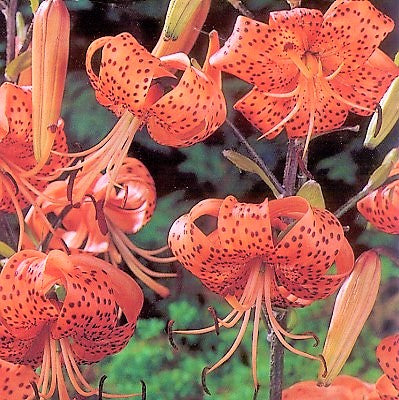
tiger lily capital llc Tiger Lily Species Lily – The Lily Pad Bulb FarmLilium Tigrinum (lancifolium) is an heirloom favorite, quite properly known as the "Tiger Lily" of "Grandma's garden" fame. It has large unscented pendant orange flowers with black spots and recurved tips. It is a notoriously vigorous grower and naturalizes easily, producing a big crop of stem "bulblets" every year and aerial bulbils (resembling black beads thickly arranged along the stem). Once they develop rootlets, these bulbils can be easily
Lilium Tigrinum (lancifolium) is an heirloom favorite, quite properly known as the "Tiger Lily" of "Grandma's garden" fame. It has large unscented pendant orange flowers with black spots and recurved tips. It is a notoriously vigorous grower and naturalizes easily, producing a big crop of stem "bulblets" every year and aerial bulbils (resembling black beads thickly arranged along the stem).
Once they develop rootlets, these bulbils can be easily raised to blooming size, in fact will plant themselves if allowed to drop to the ground. If you seek a rapidly-propagating lily, this one's FOR YOU! In the Orient this species is raised for its edible bulbs (delicious in veggie stir-fry dishes. Very enduring and virus-resistant. We barely keep up with the revival of demand for this hard-to-get species. 16-18 cm bulb size. Choose between 1 bulb or a 3-pack.
Once they develop rootlets, these bulbils can be easily raised to blooming size, in fact will plant themselves if allowed to drop to the ground. If you seek a rapidly-propagating lily, this one's FOR YOU! In the Orient this species is raised for its edible bulbs (delicious in veggie stir-fry dishes. Very enduring and virus-resistant. We barely keep up with the revival of demand for this hard-to-get species. 16-18 cm bulb size. Choose between 1 bulb or a 3-pack.
Botanical name: Lilium lancifolium 'Splendens'
Form: Perennial
Hardiness Zone: 3-9
Flower Color: Orange/black spots
Foliage Type: Linear, green leaves arranged in whorls or spirals up the stems
Bloom time: July-August
Height: 3-4 ft
Spread: 12 inches
Light requirements: Full or partial sun
Plant depth: 6 inches of soil over top of bulb
See "Growing Tips" for more detailed instructions
Form: Perennial
Hardiness Zone: 3-9
Flower Color: Orange/black spots
Foliage Type: Linear, green leaves arranged in whorls or spirals up the stems
Bloom time: July-August
Height: 3-4 ft
Spread: 12 inches
Light requirements: Full or partial sun
Plant depth: 6 inches of soil over top of bulb
See "Growing Tips" for more detailed instructions
Tips and Growing Instructions
Visit our How-To Cultivation Library for more growing tips.
Species lilies, also known as Tiger Lilies, are wild lilies, native to North America, Europe, and Asia. Delicate and full of charm, there are 80 - 100 accredited Species. Most species lilies do not require specialized care and will naturalize themselves very well. They are very adaptable to most soil conditions and environmental conditions, and they do quite well in warm, moist climates with fertile soil. Tiger Lily bulbs for the most part are smaller than hybrid varieties, but will produce good quality stems and a lot of blooms. Their delicate, beautiful flowers are quite showy and most will bloom for long periods compared to other lilies.
Lilies are incredibly easy to grow and few garden pests trouble them. The most natural location for lilies is on sloping ground with excellent drainage. Lilies prefer to have their blooms in the sun and their roots in the shade. Try planting them among annuals or perennials that will keep their roots cool.
The general rule of thumb for planting spring bulbs is to plant two to three times as deep as the bulb is tall. This means that some of our larger Bulb-Zilla lily bulbs will need to be planted 6-8 inches deeps. Plant with the roots downward and the scales upward. After planting, water well two or three times. Lilies are most effective when planted in groups of three or more. Space them about a foot apart – they will spread and fill this space in no time!
Always allow the leaves on the stalk to turn yellow and fall off as part of the lily’s natural growth process. This ensures that the bulbous underground part of the plant has gotten enough nourishment and will mean greater growth next year. Each year watch their beauty increase as they multiply!
Visit our How-To Cultivation Library for more growing tips.
Species lilies, also known as Tiger Lilies, are wild lilies, native to North America, Europe, and Asia. Delicate and full of charm, there are 80 - 100 accredited Species. Most species lilies do not require specialized care and will naturalize themselves very well. They are very adaptable to most soil conditions and environmental conditions, and they do quite well in warm, moist climates with fertile soil. Tiger Lily bulbs for the most part are smaller than hybrid varieties, but will produce good quality stems and a lot of blooms. Their delicate, beautiful flowers are quite showy and most will bloom for long periods compared to other lilies.
Lilies are incredibly easy to grow and few garden pests trouble them. The most natural location for lilies is on sloping ground with excellent drainage. Lilies prefer to have their blooms in the sun and their roots in the shade. Try planting them among annuals or perennials that will keep their roots cool.
The general rule of thumb for planting spring bulbs is to plant two to three times as deep as the bulb is tall. This means that some of our larger Bulb-Zilla lily bulbs will need to be planted 6-8 inches deeps. Plant with the roots downward and the scales upward. After planting, water well two or three times. Lilies are most effective when planted in groups of three or more. Space them about a foot apart – they will spread and fill this space in no time!
Always allow the leaves on the stalk to turn yellow and fall off as part of the lily’s natural growth process. This ensures that the bulbous underground part of the plant has gotten enough nourishment and will mean greater growth next year. Each year watch their beauty increase as they multiply!
Shipping
Sorry, we do not ship outside the U.S. or to Hawaii due to agricultural restrictions.
We guarantee safe arrival of healthy bulbs, that varieties will be true-to-name, and will grow if planted as instructed, subject to the limitations described in our Shipping and Returns Policy.
We begin shipping our bulbs in mid-February through Spring. Despite what you may have heard, Spring planting of bulbs is not a bad thing, and in fact, there are many advantages to planting in Spring. Visit our Spring Planting page to learn more. Upon arriving, your bulbs and most of your perennials may show signs of growth such as green leaves and sprouts - this is okay and transportation during this time should not harm the plants.
All bulbs and perennials should be planted in your garden as soon as possible to ensure the best success. If you must delay planting, open the bags to permit air circulation and place them out of direct sunlight in a cool, well-ventilated room. Do not place the bulbs where they can freeze. If you have the space, storing the bulbs in the refrigerator is another excellent way to “hold them” prior to planting. If you choose this method of storing your bulbs, be sure not to store fruit with them, as this is detrimental to bulbs.
Plant outdoors when the ground is no longer frozen and the conditions have improved for your zone.
If you have any questions or concerns our customer service team would be glad to help you at any time. Please use our contact form, email us at [email protected], or call us at 541-671-3196.
Shipping Notes
- Free Standard Shipping on $100+ Orders to the USA.
- Except Preorder products are shipped in 48 hours.
- Delivery to the USA:
- Standard Shipping : 3-10 business days
- If time is of the essence, please consider selecting expedited delivery for faster service.
Exchange/Return Notes
- We offer a 30-day return/exchange service after receiving.
- Final sale items are not eligible for returns or exchanges.
- To process your return/exchange, please contact us at [email protected]
- Please click here for more details>>> Return & Exchange Policy
4.5 ★★★★★
Based on 19 reviews
Sort
Product Reviews
★★★★★ 5
Sensitively written and beautifully illustrated
Format: Hardcover
Why Do We Cry? is an sweetly illustrated and sensitively written book for young readers. Originally published in Spanish in 2018, this English translation released 7th April 2020 from Kids Can Press is 34 pages and available in hardcover and ebook formats.
The book takes the form of a dialogue between a mother and son about why people cry and why it's good to examine and experience negative emotions so we can process them and what function tears (and crying) actually serve physiologically and emotionally. The text by Fran Pintadera (weblink in Spanish) is supported and enhanced beautifully by the nuanced illustrations by Ana Sender.
This would make a superlative reading circle, library group, or classroom read for youngsters. There's a short discussion resource at the back of the book which includes some science based information on tears and the physiological functions they perform.
Learning to process strong emotion in a positive and constructive manner is -vital- for development. I appreciated that the dialogue was sensitively handled and that the author chose to make the child male was a nice touch. I think that this could be a very valuable book *especially* given our current pandemic world situation.
Five stars. Beautiful little book with universal relevance.
Disclosure: I received an ARC at no cost from the author/publisher for review purposes.
WAS THIS REVIEW HELPFUL?YesReportShare
Reviewed in the United States on April 19, 2020
★★★★★ 5
A thoughtful book to normalize tears
Format: Hardcover
I'm a child life specialist I have heard many parents and providers tell kids (and teens) to "stop crying" or "there's nothing to cry about" or some other variation of that hurtful phrase. I now work with children who have a parent with a serious illness and those experiencing grief. Why Do We Cry? is an amazing resource that is relevant to the majority of situations experienced by kids in my practice. It is beautifully illustrated with images that reflect the emotion in the written content. This book embraces the many reasons people cry without overstepping a boundary by trying to explain or justify the feelings. I love the subtlety of normalizing a variety of feelings and the gentle truth that sometimes we cry without knowing why. I highly recommend this book!
WAS THIS REVIEW HELPFUL?YesReportShare
Reviewed in the United States on December 10, 2022
★★★★★ 5
5 Stars!
Format: Hardcover
Mario asks his mother, “Why do we cry?” and she goes on to tell him all the different reasons that we do cry. Some of the reasons are a bit metaphorical, and might be harder for younger children to understand, but the illustrations help in those cases. (The book is aimed for 3-7 year olds, but I think the story is more fitting for ages 5 and up). The illustrations correspond well with the words on the page.
The story lets children know that it is ultimately ok to cry. I feel that the book showcasing a boy asking about crying is wonderful as some boys are told NOT to cry.
A few added pluses:
There is also a lesson that scientifically explains about tears so children can understand some of the varying reasons that tears exist. There is also a small interactive section with activities dealing with tears that will help children express their imagination.
Many thanks to Kids Can Press for granting me an e-arc to read that I chose to review. A+ on this children’s picture book!
WAS THIS REVIEW HELPFUL?YesReportShare
Reviewed in the United States on April 7, 2020
★★★★★ 4
Learn why we cry in this great kids book!
Format: Hardcover, Format: Hardcover
I received a digital copy of this book from the publisher. All thoughts and opinions are my own.
"Some days we cry because we call out for a hug but all we get back is an echo."
Why Do We Cry? begins with a boy asking his mother why we cry. There are many answers to such a question and the mother helps the boy explore the many reasons why we may shed tears.
As the mother explains the reasons why we cry, the illustrations become a bit surreal, to show the emotions and feelings associated with crying, from sadness to anger to grief. The mother compares and contrasts, all the while weaving a poetic story about her own life or memories and emotions.
This book reminds us that it is okay to cry, that crying can be a release, a way to heal, or let go. It helps us understand the difference between emotions and how they affect us.
There's an educational spread at the end of the book that teaches us the different types of tears, one of which--emotional tears-- is featured in this book, what they are made of, and even how much they weigh!
WAS THIS REVIEW HELPFUL?YesReportShare
Reviewed in the United States on June 12, 2020
★★★★★ 5
A Beautiful & Informative Exploration of Tears and Feelings
Format: Hardcover
A nonjudgemental and supportive exploration of the reasons we cry accompanied by imaginative and thoughtful art. Beautiful and informative, the final two pages include scientific information on tears to complement the emotional context of the main part of the story. Suitable for ages 3 to 7.
WAS THIS REVIEW HELPFUL?YesReportShare
Reviewed in the United States on August 25, 2020