SKU: 55576477663
carnivorous plants indoors

carnivorous plants indoors 6 Plant Deluxe Beginner’s Bog Kit

Sale price$23.56 Regular price$26.18
Save 10%

Pay in installments of $6.54 with ShopPay, AfterPay and Klarna

Shipping Estimate
USA
  • USA
  • CAN

Ships within 48 hours · Estimated delivery Sep 8 - Sep 13

Promo Codes Available:

For Your Every Summer RSVP, with Code: SUMMER15

Description

carnivorous plants indoors 6 Plant Deluxe Beginner’s Bog KitThis is a great kit to make your very own container planting of a few different kinds of temperate carnivorous plants. These plants will enjoy being grown outdoors, in many areas and will catch tons of flies, yellow jackets, and gnats. Our kit is great if you are new to carnivorous plants, want a showpiece for your garden, or just want to get planty! And, we will ship this kit for free! If you order this kit in the summer, its best to place it in full

This is a great kit to make your very own container planting of a few different kinds of temperate carnivorous plants. These plants will enjoy being grown outdoors, in many areas and will catch tons of flies, yellow jackets, and gnats. Our kit is great if you are new to carnivorous plants, want a showpiece for your garden, or just want to get planty! And, we will ship this kit for free!

If you order this kit in the summer, it’s best to place it in full morning sun outside, where it will be protected from the afternoon sun a bit, just to reduce the shock to the plants. By the next year, they’ll be fully acclimated and will not need as much protection.

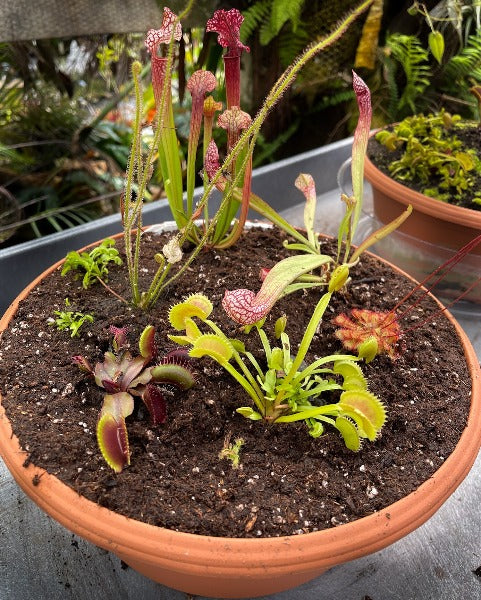
We send you a 12 x 5 inch terracotta plastic pot, XX-large water saucer, two bags of peat and perlite mix (premixed), a little long-fibered moss to the cover holes on the bottom of the pot, and a selection of temperate plants. The plants we send vary by month depending on what we have available but in general, you will receive a mix of:

Venus flytraps (Dionaea), American Pitcher Plants (Sarracenia), and temperate sundews (Drosera)

We send an assortment of plants depending on the season and what looks the best! We send you plants either potted or in plugs based on availability. We cannot customize these collections.

Daniela will walk you through building your own bog and care instructions in this video:


Care Instructions:

Growth Habit: Venus flytraps are low-growing bog plants native to North and South Carolina. These plants grow their traps, modified leaves, from a rhizome that spreads over time. The traps will die back frequently all year, have high leaf turnover, and many new traps will grow throughout the spring and summer. In spring, the traps grow, often low to the ground and small. In summer, they grow their best traps, taller and more prominent. As Fall comes on, the traps start to die back, growing lower to the ground and smaller, and by winter, the plant will be dormant, with many or all of the traps gone, but the rhizome remains healthy and intact throughout winter dormancy even if you cannot see any traps growing.

Sarracenia will grow tall modified leaves, pitchers, that vary greatly in size and shape by the hybrid or species of Sarracenia. Each plant grows many pitchers from the rhizome in the soil over the spring, summer and fall. These are temperate plants like Venus flytraps, growing actively in the warm sunny months of the year and dying back to the rhizome in winter. 

Drosera are found all over the world in many different forms, they have sticky leaves that catch small flying bugs. They have high leaf turnover, dying back frequently but growing lots of new leaves. Many of the temperate Drosera sent in this kit will die back to a hibernaculum in the soil in winter.

Sun: Full sun. These plants require lots of direct sun to grow and produce leaves. In many areas, they can be grown outdoors in full sun. If you live in a very hot AND very dry place like Arizona or Sacramento, for example, you will want to grow your plants in full morning sun with protection from the afternoon sun or under 30% shade cloth. It is common for several leaves to "burn" and die back when you first place your plant into the sun; your plant is acclimating to your conditions, and in most cases, new leaves will soon grow and fully acclimated. Thead can be grown indoors and on extremely sunny windowsills that receive all-day sun, but they will require a grow light in most circumstances due to the amount of light the plant needs. Grow lights should be 6-12” from the light depending on the light and a 10-12 hour day. These plants generally are not a good candidate for a terrarium as they need intense light and good airflow. Grow outdoors if possible for best results.

Water: Always keep them in a saucer with a few inches of distilled, rainwater, or reverse osmosis water. Never let them dry out, especially in the hot summer months. These are bog plants that prefer water-logged conditions unless you live somewhere both very hot AND extremely humid, like Alabama. In that case, let the water tray dry out for a day or two between refills. Always use distilled, reverse osmosis, or rainwater only. These plants are especially sensitive to their water quality, and giving them mineral and salt-free water is very important. In winter, when the plants are dormant, you can let them dry out a bit between rain storms, but do not let the soil get so dry that it pulls away from the edges of the pots. Be sure to supplement water as needed in between rains in winter.

Temperature and Dormancy: These are warm-temperate plants, meaning they need warm summers and chilly winters. They should be grown outdoors year-round in areas with mild winters. They thrive in temperatures ranging from 20 degrees - 90F degrees and can take a brief freeze or high-temperature spike up to 105F degrees for a short period. If nighttime temps drop below 20 but rise again during the day above 40, your plant will be fine outside.

If you live in an area with very cold winters, where nighttime temperatures drop below 20 degrees for sustained periods, you have three options for providing them with winter dormancy: the garage method, mulching in, or the fridge method. Dormancy is triggered by a combination of exposure to shorter photo-periods and cooler temperatures in the 40-60's F. While you can skip a dormancy period once or twice, in the long term, your plant will begin to do poorly and will eventually die if you skip this crucial period.

The garage method: Bring your plant indoors to a sunny windowsill in an unheated room or garage, where the nighttime temperatures will dip down to 50-60F. Keep it well watered during this period, do not let it dry out, and put it outside again when the outside nighttime temperatures increase consistently above 20F.

The mulch method: Mulch them very, very well outdoors. Pack at least four inches of mulch on top of the plants and all around the sides to prevent winds from chilling them and freezing the roots. You can also dig the pots into the ground and then mulch heavily on top.

The fridge method: remove the plants from pots, gently clean the roots of soil, wrap the roots in a bit of damp long-fibered New Zealand sphagnum moss, place the plants in a resealable bag, and put the bag into the refrigerator. Leave them in the fridge from October to February, periodically checking on them to ensure they are still moist and not growing mold or fungus. Pot them back up in February. You can vary the timing to align with your outside nighttime temperatures so that your plants can come out of dormancy when it is safe to place them back outside. You can leave them in the fridge for an extended period if you have very long winters.

Soil and Repotting: We prefer a mix of four-part fertilizer-free peat moss to one-part perlite. You can add our pre-made mix to your order here. Repot, dividing out plants and refreshing the peat and perlite, every 3 years in January or winter. 

Feeding and Fertilizer: These plants will catch plenty of food when grown outdoors. When grown indoors, they will significantly benefit from fertilizing, a foliar fertilizer, and feeding the traps. Plants grown outdoors will appreciate a foliar feed as well. Apply MaxSea fertilizer once per month to the foliage only. Dilute 1/4 teaspoon of MaxSea into one gallon of water and then apply to the leaves with a mister bottle. If you would like to feed the traps of your flytrap, it is recommended that you use live prey, as the traps usually require continued movement from their food to stimulate the complete absorption process. They will often open too soon if fed inert foods and do not absorb nutrients. We recommend live mealworms, which are available from any pet store. After digestion, Venus flytraps open back up, leaving the exoskeleton of their prey. They have liquified and absorbed the contents of the insect, but the exoskeleton remains. This does not need to be removed. Traps often die back after a big meal; new ones will grow, and the plant benefits greatly from the nutrients!

More Information: For further information on dormancy, repotting, dividing, and more, check out our website, or our YouTube channel.

Shipping Notes
  • Free Standard Shipping on $100+ Orders to the USA.
  • Except Preorder products are shipped in 48 hours.
  • Delivery to the USA:
  1. Standard Shipping : 3-10 business days
  • If time is of the essence, please consider selecting expedited delivery for faster service.
Exchange/Return Notes
  • We offer a 30-day return/exchange service after receiving.
  • Final sale items are not eligible for returns or exchanges.
  • To process your return/exchange, please contact us at [email protected]
  • Please click here for more details>>> Return & Exchange Policy
SKU: 55576477663

Discover Niche Categories That Outsell carnivorous plants indoors

Top-Converting Item to Boost Your Average Order

4.3 ★★★★★
Based on 10 reviews
Sort
Highest Rating
Newest First
Oldest First
Product Reviews
A
Verified Purchase
Arturo Brillembourg
West Palm Beach, US
★★★★★ 5
Understand the past to shape our future
Format: Kindle
I’m grateful Ray Dalio has shared his world view and his access to leading thinkers and valuable sources of data, to make me more aware and better prepared for what’s coming. I am also friends with Ray, and I trust him. This book offers at least two major contributions. First, the synthesis and integration of economic, social, and geopolitical history that presents a holistic view of how countries rise and fall. Leveraging his relationships with leading thinkers and historians, Ray gives us a way to understand the major forces, cycles, and paradigm shifts that can dramatically change the world around us. You would have to read dozens of well-chosen books to gain such an understanding, and you still may not have a comprehensive theory. Second, the quantification of each major nation’s economic, cultural, and geopolitical health. With the support of Bridgewater’s multi-hundred-million-dollar research budget and team, Ray presents the key determinants of a country’s strengths and weaknesses through time, and relative to other countries. Seeing the most important long-term trends in charts provide useful perspectives that are unavailable elsewhere. Here are some of my biggest take-aways. Disorderly conflict is the pre-cursor to destructive conflict that is likely to be devastating for all of us. Both the winners and the losers of destructive actions are worse off relative to compromise, mutual understanding, and respect. As an American, I should not take for granted that I live in the most powerful country that has seen one of the longest periods of peace, economic growth, and innovation in global history. It’s not the norm, and if we aren’t careful, things could get a lot worse. Invest in innovation. Both as an investor and as a citizen, innovation has been a powerful force for improving lives and driving economic growth. We are likely in for a period of high inflation. The easiest way for the government to deal with high levels of debt is by printing money, using stimulus to spur economic growth, and keeping interest rates lower than nominal GDP growth. That is, to inflate their way out of debt. As an investor, he suggests avoiding long term holdings of cash and bonds. Instead, he recommends diversifying with assets that can do well in an inflationary environment, like highly dependable cash generating stocks, some gold (possibly a little cryptocurrency), and other scarce inflation-protected assets. This book is a major contribution. I strongly recommend reading or listening to it. If you don’t have the time, at least read the first few pages of the introduction, the first chapter “The Big Cycle in a Tiny Nutshell”, chapter 8 "The Last 500 Years in a Tiny Nutshell", and the final chapter called “The Future”. I hope you found this helpful.
WAS THIS REVIEW HELPFUL?YesReportShare
Reviewed in the United States on December 5, 2021
M
Verified Purchase
Mike Dillemuth
Draper, US
★★★★★ 5
A Captivating Look at Empires and America’s Future
Format: Kindle
This is an extraordinary book. Although it’s written by an economist, it is anything but boring. The author does an outstanding job of examining multiple empires across hundreds of years. He analyzes the rise and fall of each empire by segmenting their respective histories into different cycles. He then identifies the various cycles that each empire goes through, from its initial rise to its eventually fall. Each cycle is sub divided into key indicators such as military strength, budget deficits, wealth gaps, education, etc. In the end, the author looks at the United States using this same cyclical methodology. Mr. Dalio’s arguments and analysis are sound and make good sense. His interpretation and description of various historical events, especially those pertaining to the British and Dutch empires, are right on target. Throughout the book, he is consistent in the application of his analytic model. This is noteworthy as I felt his analysis of China to be slightly flawed. The author appears to have omitted certain elements of modern-day China; most notably is the pending population time bomb caused by their previous one child policy. China’s population is now shrinking. In addition, and unlike America, the Chinese seem culturally incapable of using immigration to solve their problem. This opposing view of China, however, does not detract from the author’s overall analysis. He is consistent in his analysis and cites other data which support counter arguments. Bottom line, this book was far more interesting than I anticipated. Even though the author’s analysis is complex, the book is well written and easy to understand. The narrative is both captivating and entertaining. Overall, this is just a great book.
WAS THIS REVIEW HELPFUL?YesReportShare
Reviewed in the United States on December 17, 2023
L
Verified Purchase
LenZen
Houston, US
★★★★★ 4
Is the United States Getting Close to Multiple Simultaneous Crises?
Format: Hardcover
In this book, Dalio presents his model of the rise and fall of "empires". The closer it gets to the present day the more interesting the book is. The last three chapters of the book which deal with the rise of China, the current tensions between China and the US, the United States's alleged decline and Dalio's conjectures regarding the future are five stars. The build up to the final three chapters is decent, although only occasionally riveting: The book is only three stars before the strong close. It is hard to evaluate the merits of Dalio's historical model given that he is only presenting it at moderate depths so as to introduce it all in one volume. The model says that empires rise and fall, no surprise, and talks about the interplay of economic, internal, and external factors that take an empire through the cycle. Dalio also mentions that inside the Big Cycle there are other cycles, and inside those cycles other cycles. He does not, however, go into much detail regarding the sub-cycles. This sounds reminiscent of Robert Prechter's Elliot Waves or perhaps, even, pre-Copernican astrology. Is this a model so loose, like Elliot Waves, that it can be found to fit anything that could happen? Is it falsifiable? Along the way was the validity tested by approaching an empire that there was little prior knowledge of to make "forward predictions" regarding what would happen? Has Dalio merely cherry picked the three examples which best seem to demonstrate the soundness of the model while omitting more problematic cases? There is not enough in this book to do a rigorous analysis. The United States Civil War is a good example of something I had trouble thinking about in terms of the model. According to the model the final stage in an empire's breakdown is civil war or revolution. In the case of the United States, however, the Civil War occurred while the United States was still ascendant: in stage 2 out of 6 with stage 3 being the peak. Certainly there was no debt crisis which caused the Civil War and the United States had little going on in terms of external conflict at the time. So perhaps that could have been taken as a "prediction" that the United States would almost certainly have survived the Civil War in tact? The truth, however, is that the South came very close to winning the Civil War, in the sense of being recognized as independent, according to McPherson's Battle Cry of Freedom. Another thing that I am not sure how to evaluate using the model is the United States after the Civil War and after the Revolution. Although these were periods of rebuilding they do not seem to fit well into Dalio's model. After victory in these conflicts Americans were very magnanimous (as it was later after World War II). Far from being purged those who were on the wrong side of history ended up facing rather little in the way of consequences. So how does this fit into the model? Obviously, there will be some "rebuilding" after a Revolution or Civil War so is the model just saying there will be something which could not not happen? Indeed although the United States was vibrant after the Revolution, the period after the Civil War as described in Richard White's The Republic for Which it Standards seems in decline compared to the Antebellum period. According to Dalio's model, however, the United States was stage 2 rising into stage 3 during this period. Regardless of the merits of the model, which would probably require many in depth books to evaluate fully, there is definitely some good high level overviews of Chinese, European, and American history. There are many interesting charts and statistics thrown in. As mentioned, the close of the book is far and away the best part of it. Dalio describes the cultural differences between Americans and Chinese people and their different outlooks toward governing. Dalio does not seem to be pushing any political agenda, at least not too hard, but rather what he has carefully measured to be objectively true. Although clearly an admirer of much about China, he is also willing to criticize some aspects of China. At the same time, his criticism omits its surveillance state. Looking forward Dalio presents some very interesting charts and statistics regarding America's growing internal conflicts. He even has a graph to show how bad it is now compared to early points in history. Dalio is willing to stick his neck out and quantify what his model is predicting as the probability of civil war in the United States and the probability of military war with China in the next decade. Although very thought provoking overall, one particularly persistent problem throughout the book is that many of the charts are very hard to read. There are graphs with eight different lines with some of the colors very hard to distinguish between. The book also almost never references its sources. Indeed, given how much history Dalio has obviously studied, a bibliography, or at least a list of recommendations, would be very nice. Dalio is very repetitive regarding the inevitable death of fiat currencies through money printing. At the same time he also does provide concrete advise of how to prepare. He gives some definite timelines and the dates are very close. To qualify this, somewhat, however, his company Bridgewater Associates has basically had a "lost decade" using his models to generate any kinds of returns since his departure around 2012. Nevertheless it is interesting to think about whether or the US is on the verge of multiple simultaneous crises.
WAS THIS REVIEW HELPFUL?YesReportShare
Reviewed in the United States on February 1, 2022
D
Verified Purchase
Desmond Yuen
Battle Creek, US
★★★★★ 5
The past is the future? Focus on the big picture
Format: Hardcover
This book isn’t just about economics; it also takes a captivating look at history. Written in a style similar to his previous book, "Big Debt Crises," Ray presents history in cycles. To make things easier to grasp, he added some helpful features: passages are bolded for a quick read, and a red dot marks principles that are considered timeless and universal truths. I really appreciate the QUICK-READ option. It’s so easy to overlook key points in a long book, but the bolded sections help me focus. For example, one universal truth is, "Throughout time, the formula for success has been a system in which well-educated people operating civilly with each other, come up with innovations, receive funding through capital markets, and own the means by which their innovation..." The book is divided into three parts: How the world works, How it has worked over the last 500 years, and the Future. The first part explores the rise and fall of empires. The second offers an in-depth look at the Dutch Empire, the British Empire, the United States, and China. The last part looks ahead at what’s to come. The appendix even includes a computer-generated power score for 11 world-leading countries. I haven’t finished the entire book yet, but after reading some chapters, I can say Ray did a fantastic job condensing 500 years of history into an accessible, engaging format. The graphs also help clarify his points. It answered many questions I had, like how pandemics have impacted the world. Instead of flipping through multiple books to find answers, I can find everything I need here. What I also really appreciate is Ray’s honesty. He doesn’t shy away from tough issues. If he's not an expert on something, he clearly states where he learned it from. He’s straightforward, sincere, and speaks his mind. Even if you do not believe that history will repeat itself, you will still enjoy reading this book.
WAS THIS REVIEW HELPFUL?YesReportShare
Reviewed in the United States on December 1, 2021
K
Verified Purchase
Kindle Customer
Battle Creek, US
★★★★★ 5
Phenomenal book, one major criticism
Format: Kindle
Great book. Dalio does a remarkable job seeing the bigger picture and providing confidence through historical events/ever repeating cycles that you can predict at a high level what is coming next for a given country or the world and plan accordingly. The corkscrew of evolution analogy is a perfect one, where the human race has up and down cycles but always trends up longer term thanks to technological innovation. My one criticism is he speaks out of both sides of his mouth in one instance, presumably because he doesn’t want to upset any high ranking politicians or leaders he may be friends with, which I found to be disappointing. On the one hand, he notes at the start of the book that no two democracies have waged war with each other, wars have only been fought between dictators/police states and democracies or just dictators/police states. Then later on when discussing China, he all but excuses and rationalizes their increasingly authoritarian state, as seen by Xi crowning himself leader until death and abolishing the precedent of 2 5 year term limits as of 2018. He blesses the Chinese approach of a few rulers knowing what’s best for all, as if those rulers are acting in the broader interest of Chinese people, and that’s an acceptable alternative to democratic rule. He cites the recent video game ban as having merit or at least being understandable, suggesting that he thinks the ends can justify the means. All the while there’s no mention of the atrocities of Mao under this authoritarian type of rule, no mention of the Muslim genocide going on now, the suppression of free speech and jailings and beating and murders of those that oppose the current regime, no mention of internet censorship, etc. To bring the criticism full circle, he doesn’t link his first point on wars and authoritarians always being involved in them, with the fact that China is an authoritarian state and therefore it’s rise threatens the free world and human progress. Ironically, he does correctly acknowledge China’s opening up to market and establishment of capitalist principles for rocketing them toward the US in terms of power, while refuses to critique the political system despite its history of failings, violence and pain. Russia invading Ukraine couldn’t drive this point (ie the civil or political system being as important as the economic system to the long term success of a country and world peace) home any harder.
WAS THIS REVIEW HELPFUL?YesReportShare
Reviewed in the United States on March 12, 2022

recommand products